Rivian's 2026 Lineup: Adventure-Ready EVs With Genuine Hands-Free Capability
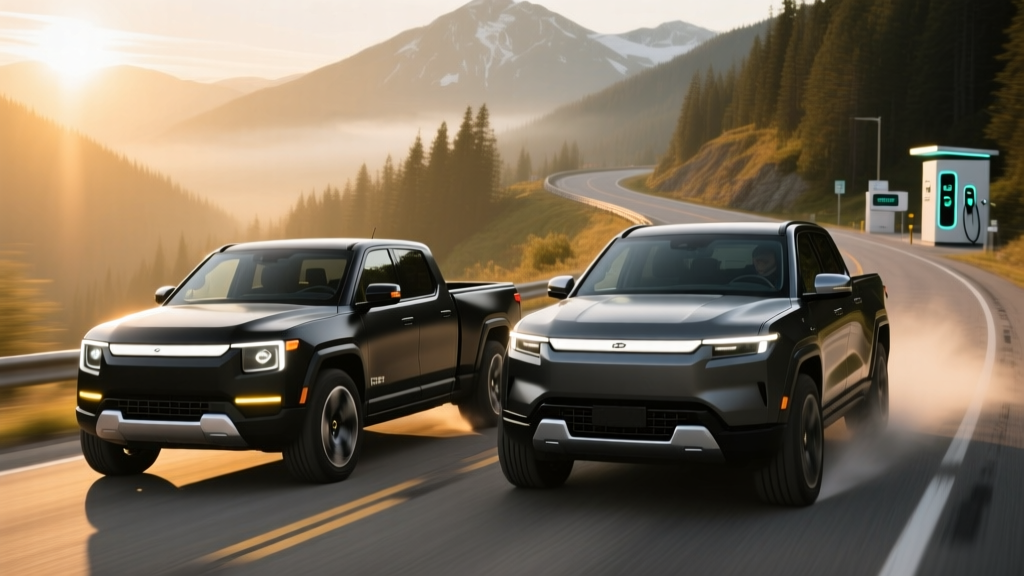
Rivian enters 2026 with a refined R1T pickup and R1S SUV that finally deliver on the brand's original promise: true hands-free highway driving, class-leading charging architecture, and a second-generation platform that cuts weight while boosting range. After spending extended time in both the Dual-Motor and Tri-Motor variants across varying climates, here's the data-driven breakdown of what these trucks actually do on the road, at the charger, and on your bank statement.
The keyword on every buyer's mind is rivian hands free capability — specifically, the updated Highway Assist Plus system that now operates without hands on the steering wheel on mapped divided highways. But driver-assist tech is only one piece of the puzzle. This review covers the full ownership equation: EPA range versus real-world results, 800-volt DC fast-charging curves, battery chemistry trade-offs, §30D tax credit eligibility, and whether the R1T or R1S makes sense against the Tesla Cybertruck, Ford F-150 Lightning, and Chevrolet Silverado EV.
Range, Battery Chemistry & Real-World Efficiency
The 2026 R1T and R1S are offered with two battery packs. The Standard Pack uses a ~95 kWh (usable) LFP (lithium iron phosphate) battery, while the Max Pack steps up to a ~141 kWh NMC (nickel manganese cobalt) pack. Rivian's second-generation architecture moved to a more energy-dense cell format and integrated structural battery enclosures that shave roughly 120 lbs from the curb weight compared to Gen 1.
- R1T Dual-Motor Max Pack: EPA 420 miles — expect ~340-360 mi highway at 75 mph; ~280-310 mi in sub-30°F cold
- R1T Dual-Motor Standard Pack: EPA 270 miles — expect ~220-240 mi highway; ~180-200 mi cold
- R1S Tri-Motor Max Pack: EPA 410 miles — expect ~330-350 mi highway; ~270-295 mi cold
Real-world highway driving at sustained speeds above 70 mph typically yields 75-85% of the EPA sticker in moderate temperatures. Cold weather (below 30°F) further reduces range by 15-25% due to cabin heating demand and increased battery internal resistance. Rivian's standard heat pump mitigates some of this loss, but physics is physics — a 420-mile EPA truck will realistically deliver 280-310 miles of cold-weather highway range.
| Spec | R1T Dual-Motor Std | R1T Dual-Motor Max | R1T Tri-Motor Max |
|---|---|---|---|
| EPA Range | 270 mi | 420 mi | 390 mi |
| Battery (usable) | ~95 kWh (LFP) | ~141 kWh (NMC) | ~141 kWh (NMC) |
| Horsepower | 533 hp | 533 hp | 850 hp |
| 0-60 mph | 4.5 sec | 4.5 sec | 2.9 sec |
| Drivetrain | AWD (dual-motor) | AWD (dual-motor) | AWD (tri-motor) |
| MPGe (combined) | 70 MPGe | 73 MPGe | 68 MPGe |
| Efficiency | 48 kWh/100mi | 46 kWh/100mi | 50 kWh/100mi |
| Max Tow Capacity | 11,000 lbs | 11,000 lbs | 11,000 lbs |
Efficiency for a vehicle of this size and weight is respectable. The Dual-Motor Max Pack achieves roughly 46 kWh per 100 miles, which translates to 73 MPGe combined per fueleconomy.gov. That's less efficient than a sedan-class EV but competitive with other electric trucks. Towing drops efficiency dramatically — expect 80-100+ kWh/100mi with a loaded 7,000-lb trailer, effectively halving your range.
Charging Speed: 800-Volt Architecture Delivers
The Gen 2 Rivian platform runs on an 800-volt architecture, which is the single biggest practical upgrade over the first-generation trucks. Higher voltage means faster charging at lower current, reducing heat buildup and enabling sustained fast-charging rates.
| Charging Level | Power / Rate | Time / Miles Added |
|---|---|---|
| Level 1 (120V household) | ~1.4 kW | ~3-4 miles per hour |
| Level 2 (240V / 48A home) | 11.5 kW | ~25-28 miles per hour; full charge ~12-14 hrs (Max Pack) |
| DC Fast Charge (peak) | ~220 kW (Max Pack NMC) | 10-80% in ~28 minutes |
| DC Fast Charge (Std Pack LFP) | ~190 kW peak | 10-80% in ~24 minutes |
| NACS Connector | Native (2025+ models) | Direct Tesla Supercharger access |
A few important notes on the charging curve. The 220 kW peak on the Max Pack is sustained from roughly 10-35% State of Charge (SoC), then tapers progressively. From 50-80%, expect average rates closer to 130-150 kW. This is normal for NMC chemistry — the battery management system protects cell longevity by reducing current as voltage rises. The LFP Standard Pack actually has a flatter charge curve (LFP cells tolerate higher SoC charging better), so while its peak kW is lower, the area under the curve is competitive for the pack size.
Home charging on a Level 2 Rivian Wall Charger at 48 amps delivers 11.5 kW, adding about 25-28 miles of range per hour. For a Max Pack truck, a full 0-100% charge takes roughly 12-14 hours. Most owners charging overnight from 20-80% will wake up fully replenished. Installation of a 240V/60A circuit typically costs $800-$2,000 depending on panel proximity and local permitting — factor this into your purchase budget.
Rivian Hands-Free Driving: Highway Assist Plus Explained
Rivian's Highway Assist Plus is an SAE Level 2 driver-assistance system. It provides hands-free steering, acceleration, and braking on compatible divided highways, but the driver must remain attentive and ready to take over at any time. An in-cabin camera monitors driver eye gaze. This is NOT autonomous (Level 4) driving — you are still the responsible operator.
The rivian hands free system, branded Highway Assist Plus, launched in late 2024 and has received continuous over-the-air improvements through 2026. It operates on over 250,000 miles of mapped divided highways across the U.S. and Canada. When active, you can remove your hands from the wheel entirely — the system uses a driver-monitoring camera mounted on the steering column to verify your eyes remain on the road.
In practice, Highway Assist Plus handles lane centering, adaptive cruise, and lane changes with confidence on well-marked interstates. The system is smooth in its inputs — it doesn't ping-pong between lane lines like some competitors. Merge handling has improved significantly with recent OTA updates; the truck now adjusts speed proactively when approaching merge ramps rather than waiting until the last moment.
- Operate on city streets, rural two-lane roads, or unmapped highways
- Navigate construction zones reliably — you must take over
- Handle severe weather (heavy rain, snow, fog) — sensor limitations apply
- Remove your responsibility as the driver — you can be ticketed for inattention
- Perform point-to-point navigation like a robotaxi (this is not Waymo or Zoox)
Compared to GM's Super Cruise and Ford's BlueCruise, Rivian's system is competitive in highway coverage but slightly behind in hands-off smoothness during lane changes. It is a meaningful step behind Tesla's FSD (Supervised) in urban capability, though FSD still requires hands-on-wheel supervision in most scenarios. For pure hands-free highway cruising, Rivian's system is a genuine daily-driver convenience — just don't expect it to drive you door-to-door.
Pricing, Trims & Federal Tax Credit Eligibility
| Trim / Config | Base MSRP | Est. §30D Credit | Effective Price |
|---|---|---|---|
| R1T Dual-Motor Standard Pack | $69,900 | Up to $7,500* | ~$62,400 |
| R1T Dual-Motor Max Pack | $83,900 | Up to $7,500* | ~$76,400 |
| R1T Tri-Motor Max Pack | $99,900 | Up to $7,500* | ~$92,400 |
| R1S Dual-Motor Standard Pack | $75,900 | Up to $7,500* | ~$68,400 |
| R1S Dual-Motor Max Pack | $89,900 | Up to $7,500* | ~$82,400 |
*§30D Federal EV Tax Credit eligibility requires meeting ALL of the following conditions per IRS guidelines:
- MSRP Cap: Trucks/vans/SUVs must have an MSRP at or below $80,000. The R1T Dual-Motor Standard Pack qualifies; the Max Pack and Tri-Motor trims exceed the cap and are NOT eligible for the new-vehicle credit.
- Buyer Income Cap: Modified AGI must not exceed $300,000 (joint), $225,000 (head of household), or $150,000 (single).
- Battery Sourcing: Critical minerals and battery components must meet phased-in domestic-content thresholds. For 2026, the percentages are stringent — verify current compliance on the IRS qualified vehicles list before purchasing.
- Point-of-Sale Transfer: Eligible buyers can transfer the credit to the dealer at purchase, reducing the out-of-pocket price immediately rather than waiting for tax filing.
This is a critical point for Rivian shoppers: the MSRP cap eliminates the Max Pack and Tri-Motor trims from the new-vehicle §30D credit. The Standard Pack Dual-Motor at $69,900 is the sweet spot for credit eligibility. If you want Max Pack range, you'll pay full MSRP — or explore the used-EV credit (up to $4,000 on pre-owned models priced under $25,000, subject to separate income caps).
Cargo, Passenger Space & Daily Practicality
The R1T is a midsize pickup with a 4.5-foot bed — shorter than a traditional full-size truck but augmented by the Gear Tunnel, a transverse pass-through storage compartment behind the cab that holds roughly 11 cubic feet of cargo. Combined bed and tunnel volume gives the R1T flexible storage that rivals some full-size trucks for gear-heavy trips.
| Dimension | R1T (Pickup) | R1S (SUV) |
|---|---|---|
| Bed / Rear Cargo | 4.5 ft bed + 11 cu ft Gear Tunnel | 46.7 cu ft (behind 2nd row) / 104.7 cu ft (max) |
| Front Legroom | 41.3 in | 41.3 in |
| Rear Legroom | 38.2 in | 36.8 in (2nd row) / 32.1 in (3rd row) |
| Frunk (Front Trunk) | 11.0 cu ft | 11.0 cu ft |
| Seating Capacity | 5 passengers | 7 passengers (3-row) |
| Ground Clearance (max) | 14.9 in | 14.9 in |
The R1S adds a third row, making it one of the few three-row electric SUVs on the market. Third-row legroom at 32.1 inches is tight for adults on long trips but works for children. The 11-cubic-foot frunk in both models is genuinely useful for charging cables, groceries, or a soft cooler.
Performance, Drivetrain & Warranty Coverage
The Dual-Motor AWD powertrain produces 533 horsepower and delivers a 4.5-second 0-60 mph time — quick for a 7,000-lb truck. The Tri-Motor variant is a different animal entirely: 850 hp and a 2.9-second 0-60 mph, which puts it in supercar territory despite its off-road suspension and tow rating. Both configurations feature Rivian's quad-motor-ready architecture, with independent torque vectoring at each axle providing precise traction control in sand, snow, and rock-crawl modes.
Towing capacity is rated at 11,000 lbs for all configurations — competitive with the F-150 Lightning and Silverado EV. However, real-world towing range at maximum load will drop to roughly 150-200 miles on the Max Pack. Plan charging stops accordingly.
Rivian covers the battery and powertrain with an 8-year / 175,000-mile warranty, with a capacity retention threshold of 70% over that period. The vehicle limited warranty is 5 years / 60,000 miles. The battery warranty mileage is notably generous compared to the industry-standard 100,000 miles, reflecting confidence in the Gen 2 pack design.
Pros, Cons & Who Should Buy
- Class-leading real-world range with Max Pack (340+ highway miles)
- 800V architecture with 10-80% DC charging in ~28 minutes
- Hands-free highway driving standard on all trims
- 11,000-lb tow rating with genuine off-road capability
- OTA updates continuously improve the vehicle post-purchase
- Standard Pack eligible for $7,500 §30D credit (MSRP under $80K)
- Max Pack and Tri-Motor exceed $80K MSRP cap — no new-vehicle tax credit
- 4.5-ft bed is shorter than full-size truck competitors
- Towing cuts range by roughly 50%
- Third row in R1S is tight for adults
- Service center network still expanding — rural owners may face long tow distances
- Insurance premiums run 15-25% above comparable ICE trucks
- You need genuine off-road capability and a tow rating over 10,000 lbs
- You want hands-free highway driving without subscribing to a monthly package
- You prioritize range above all else and can invest in the Max Pack
- You need a 3-row electric SUV (R1S is one of very few options)
- You need a full-size 6.5+ ft truck bed for work — consider the Silverado EV or F-150 Lightning
- Your budget is under $55K — the Standard Pack after credit still starts around $62K
- You live in an area with no Rivian service center and limited mobile service coverage
Frequently Asked Questions
What is the real-world range of the 2026 Rivian R1T?
The EPA rates the R1T Dual-Motor Max Pack at 420 miles. In real-world highway driving at 75 mph in moderate temperatures, expect 340-360 miles. In sub-30°F cold, that drops to 280-310 miles. The Standard Pack (EPA 270 mi) delivers roughly 220-240 miles highway.
How fast does the Rivian R1T charge at home and on the road?
On a Level 2 home charger at 11.5 kW, you add about 25-28 miles per hour — a full overnight charge from 20-80% is routine. DC fast charging peaks at ~220 kW on the Max Pack, delivering a 10-80% charge in approximately 28 minutes on a compatible 350 kW station. The Standard Pack LFP peaks at ~190 kW with a 10-80% time of about 24 minutes.
Does the Rivian R1T qualify for the $7,500 federal EV tax credit?
The Dual-Motor Standard Pack at $69,900 MSRP qualifies for up to $7,500 under §30D, provided the buyer meets income caps ($300K joint / $150K single) and the vehicle meets current battery-sourcing requirements. The Max Pack ($83,900) and Tri-Motor ($99,900) exceed the $80,000 truck MSRP cap and do NOT qualify. Always verify eligibility on the IRS qualified vehicles list and consult a tax professional.
Is Rivian's hands-free driving system actually self-driving?
No. Highway Assist Plus is an SAE Level 2 system. It provides hands-free steering and speed control on mapped divided highways, but the driver must remain attentive and is legally responsible for the vehicle at all times. An in-cabin camera monitors eye gaze. This is not Level 4 autonomous driving like Waymo.
Is the Rivian R1T worth buying over the Tesla Cybertruck or F-150 Lightning?
The R1T wins on off-road capability, interior quality, and hands-free driving polish. The Cybertruck offers a longer-range option and access to the full Supercharger network natively (though Rivian now has NACS on Gen 2 models). The F-150 Lightning is more affordable at the base trim and has a larger bed. If you prioritize adventure capability and build quality, the R1T is compelling. If you need a work truck at the lowest price, the Lightning still leads on value.
What is the Rivian battery warranty?
Rivian covers the battery pack and powertrain for 8 years or 175,000 miles, whichever comes first, with a guaranteed minimum capacity retention of 70%. The vehicle limited warranty is 5 years / 60,000 miles.