Rivian's Halloween Update: More Than Just Spooky Easter Eggs
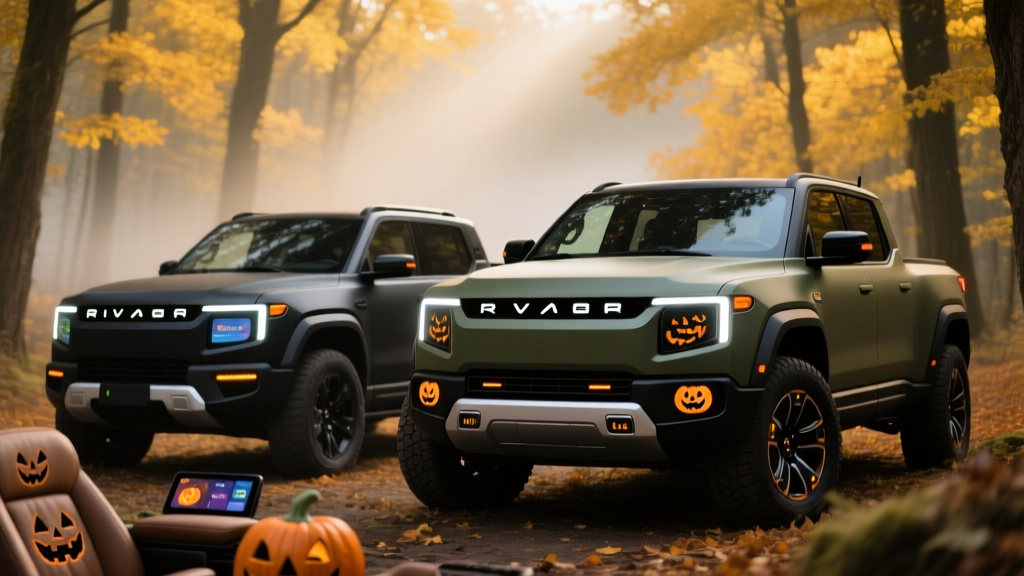
Rivian has built a tradition around its seasonal over-the-air software drops, and the Rivian Halloween update for 2026 continues that legacy. While the automaker is known for hiding playful Easter eggs — think pumpkin-themed instrument cluster graphics, ghostly ambient lighting sequences, and themed drive modes — the latest OTA release for the second-generation R1T pickup and R1S SUV also bundles meaningful performance and efficiency refinements that affect real-world ownership.
This profile covers the 2026 R1 platform (Dual-Motor and Tri-Motor variants) with the latest software build applied, examining how the Halloween update fits into the broader ownership picture: range, charging speed, pricing, tax credit eligibility, and whether Rivian's adventure EVs still hold up against a crowded field of electric trucks and three-row SUVs.
2026 Rivian R1T & R1S: Core Specs at a Glance
| Spec | R1T Dual-Motor (Standard) | R1T Tri-Motor | R1S Dual-Motor | R1S Tri-Motor |
|---|---|---|---|---|
| EPA Range | 342 mi | 420 mi (Max Pack) | 330 mi | 410 mi (Max Pack) |
| Battery (usable) | 106 kWh (NMC) | 141 kWh (NMC) | 106 kWh (NMC) | 141 kWh (NMC) |
| Horsepower | 533 hp | 850 hp | 533 hp | 850 hp |
| 0–60 mph | 4.5 sec | 2.9 sec | 4.6 sec | 3.0 sec |
| Drivetrain | AWD (dual-motor) | AWD (tri-motor) | AWD (dual-motor) | AWD (tri-motor) |
| Peak DC Fast Charge | 220 kW | 300+ kW | 220 kW | 300+ kW |
| 10–80% DC Time | ~30 min | ~22 min | ~30 min | ~22 min |
| Level 2 Home Rate | 11.5 kW (~30 mi/hr) | 11.5 kW (~30 mi/hr) | 11.5 kW (~30 mi/hr) | 11.5 kW (~30 mi/hr) |
| MPGe (combined) | 73 MPGe | 69 MPGe | 74 MPGe | 70 MPGe |
| Towing Capacity | 11,000 lb | 11,000 lb | 7,700 lb | 7,700 lb |
| Base MSRP | $69,900 | $99,900 | $75,900 | $104,900 |
Source: fueleconomy.gov, Rivian official specifications (2026 model year).
Range Reality: EPA Sticker vs. Real-World Miles
Rivian's second-generation battery architecture, introduced for the 2025 model year and carried into 2026, uses Samsung SDI NMC (nickel-manganese-cobalt) cells in both the Standard (106 kWh usable) and Max (141 kWh usable) packs. Rivian has not offered an LFP (lithium iron phosphate) option, prioritizing energy density for its adventure-oriented use case. The larger pack's added weight (~1,300 lb more) is reflected in slightly lower MPGe, but the range buffer is substantial for backcountry or corridor driving where chargers are sparse.
The Halloween update's software refinements include a revised thermal management preconditioning algorithm. When navigation is set to a DC fast charger, the vehicle now begins heating the battery pack approximately 10 minutes earlier than previous builds, improving cold-weather charge acceptance. Owners in northern climates should notice marginally faster 10–80% times in sub-40°F conditions — a meaningful improvement even if it doesn't change the EPA sticker.
Charging Speed: DC Fast, Level 2, and the Curve
Rivian's 900-volt electrical architecture (on Tri-Motor models) enables some of the fastest DC charging in the electric truck segment. Here's how the numbers break down in practice:
| Charging Level | Power | R1T Dual-Motor | R1T Tri-Motor (Max Pack) |
|---|---|---|---|
| Level 1 (120V household) | 1.4 kW | ~4 mi/hr | ~4 mi/hr |
| Level 2 (240V, 48A) | 11.5 kW | ~30 mi/hr | ~30 mi/hr |
| DC Fast (peak) | 220 kW / 300+ kW | 10–80% in ~30 min | 10–80% in ~22 min |
Charging curve reality: The Tri-Motor's 300+ kW peak is not sustained across the entire session. Peak rate holds from roughly 10–35% State of Charge, then tapers to ~200 kW through 60%, and drops further to ~120 kW above 80%. This is normal for NMC chemistry at high C-rates, but it means a 10–90% session takes closer to 35–40 minutes, not the 22-minute headline figure. Plan road-trip stops around the 10–80% window for maximum efficiency.
At home, an 11.5 kW Level 2 wall connector (hardwired on a 60A circuit) replenishes the Standard pack from empty in about 10.5 hours and the Max pack in roughly 14 hours. Most owners charging overnight from a 30–50% daily deficit will wake to a full battery regardless of pack size. Rivian includes a portable charge cord with a NACS plug; the R1 platform adopted the Tesla North American Charging Standard connector starting with the 2025 refresh, granting access to Tesla Supercharger stalls via built-in compatibility (no adapter needed for V3/V4 stalls).
Performance and Driving Dynamics
The Tri-Motor R1T's 2.9-second 0–60 mph time places it in supercar territory — a remarkable figure for a 7,000-lb pickup. The dual-motor variants at 4.5 seconds are hardly slow, delivering confident highway merging and passing. All 2026 R1 models use a torque-vectoring AWD system with individual motor control, enabling precise traction management on loose surfaces.
The Halloween update introduces a new "Camp Guard" enhancement: when the vehicle is parked in camp mode, exterior cameras now trigger a subtle perimeter-alert animation on the driver display if motion is detected nearby — useful for backcountry camping. Rivian also refined the air suspension tuning in this build, slightly softening the default ride in Comfort mode at low speeds without sacrificing body control on twisty roads.
Off-road, the R1T retains 14.9 inches of ground clearance in Max mode, 34.4-degree approach angle, and 45-degree departure angle. The quad-motor variant was discontinued after 2025, with the Tri-Motor absorbing its performance role at a lower price point and reduced complexity.
Pricing, Trims, and Federal Tax Credit Eligibility
| Trim / Configuration | MSRP | Est. After §30D Credit |
|---|---|---|
| R1T Dual-Motor Standard Pack | $69,900 | $62,400* |
| R1T Dual-Motor Max Pack | $83,900 | $76,400* |
| R1T Tri-Motor Max Pack | $99,900 | $92,400* |
| R1S Dual-Motor Standard Pack | $75,900 | $68,400* |
| R1S Tri-Motor Max Pack | $104,900 | $97,400* |
*Estimated price assumes full $7,500 federal tax credit. Actual eligibility depends on buyer income, MSRP caps, and battery-sourcing requirements under IRS §30D. See IRS Clean Vehicle Credit for current rules.
Tax credit caveats for 2026: The §30D credit imposes an MSRP cap of $80,000 for trucks (R1T qualifies) and $80,000 for SUVs/vans (R1S qualifies as an SUV per DOE classification). Buyer adjusted gross income must not exceed $300,000 (married filing jointly), $225,000 (head of household), or $150,000 (single). Additionally, battery critical-mineral and component sourcing requirements phase in more strictly each year. As of early 2026, the R1T Dual-Motor Standard and Max Pack configurations qualify for the full $7,500 when purchased new, but the Tri-Motor Max Pack exceeds the $80,000 truck MSRP cap and is ineligible for the federal credit. The point-of-sale transfer option allows eligible buyers to apply the credit as an immediate price reduction at the dealer (or directly from Rivian) rather than waiting for a tax refund.
Interior, Cargo, and Technology
The R1T offers a 54-inch bed with a powered tonneau cover, a front trunk (frunk) with 11 cu ft of lockable storage, and the signature Gear Tunnel — an 11.6 cu ft pass-through compartment behind the cab exclusive to the R1T. The R1S provides 104.7 cu ft of maximum cargo volume with both rear rows folded, plus seating for up to seven.
Legroom is generous: 41.3 inches front, 38.2 inches second row (R1T). The R1S third row accommodates adults on short trips (33.1 inches legroom) but is best suited for children on longer journeys.
The 15.6-inch center touchscreen runs Rivian's proprietary infotainment stack — no Apple CarPlay or Android Auto, a persistent drawback for some buyers. However, native navigation, Spotify, and a built-in Wi-Fi hotspot are well-integrated. The 2026 model year adds an improved Driver+ hands-on-wheel assist system (SAE Level 2), with smoother lane-centering on divided highways. This is not a self-driving system — the driver must maintain steering contact and visual attention at all times.
The Halloween update adds a "Phantom" ambient lighting theme (deep purple and orange gradients), a seasonal startup animation, and a new "Trick or Treat" horn sound available only during October. While cosmetic, these touches reflect Rivian's software-defined approach — owners receive regular feature additions without visiting a service center.
Warranty and Ownership Costs
Rivian covers the R1 platform with a 5-year/60,000-mile bumper-to-bumper warranty and an 8-year/175,000-mile battery and drive-unit warranty. The battery warranty guarantees at least 70% capacity retention over the coverage period. Rivian's mobile service fleet and growing network of service centers handle most repairs, though wait times for body work remain a concern in some metro areas.
Insurance premiums for the R1T average 15–25% above comparable gas pickups (Ford F-150 Lariat, Ram 1500) due to repair cost data and parts availability. Expect annual premiums of $2,200–$3,000 depending on state, driving record, and coverage level.
Who the Rivian R1 Platform Suits Best
Choose the R1T if: you need a daily-drivable pickup with genuine off-road capability, 11,000-lb towing, and the flexibility of the Gear Tunnel for gear-heavy lifestyles (skiing, camping, biking). The Dual-Motor Standard Pack offers the best value; the Tri-Motor is for those who want supercar acceleration and 420-mile range for remote adventures.
Choose the R1S if: you need three rows and family-hauling practicality with EV efficiency. The R1S competes directly with the Kia EV9 and Tesla Model X but offers superior ground clearance and wading depth for active families.
Look elsewhere if: you require Apple CarPlay, want the lowest possible insurance cost, or need a sub-$55,000 entry price. The Ford F-150 Lightning (discontinued after 2025) and Chevrolet Silverado EV offer different trade-offs in the electric truck space.
Pros and Cons
- Class-leading off-road capability (14.9" clearance, air suspension)
- Tri-Motor acceleration (2.9 sec 0–60) and 420-mi Max Pack range
- NACS native — full Supercharger network access
- Regular OTA updates (Halloween update adds features yearly)
- Gear Tunnel and frunk add versatile storage
- No Apple CarPlay or Android Auto
- Tri-Motor trims exceed §30D MSRP cap — no federal credit
- Insurance premiums above segment average
- Real-world highway range drops 15–20% vs. EPA
- Service center availability still limited in rural areas
Frequently Asked Questions
What does the Rivian Halloween update actually add?
The 2026 Halloween OTA update includes seasonal cosmetic features (Phantom ambient lighting, themed startup animation, Trick or Treat horn), an improved battery preconditioning algorithm for cold-weather DC charging, refined air suspension tuning in Comfort mode, and enhanced Camp Guard perimeter alerts. It does not change EPA range or peak horsepower.
Does the 2026 Rivian R1T qualify for the $7,500 federal tax credit?
The Dual-Motor Standard and Max Pack R1T configurations (MSRP under $80,000) qualify for the full $7,500 credit, provided the buyer meets IRS §30D income limits ($150K single / $300K joint) and the battery satisfies critical-mineral and component-sourcing requirements. The Tri-Motor Max Pack at $99,900 exceeds the truck MSRP cap and is ineligible. Verify current rules at irs.gov.
How fast does the R1T charge on a road trip?
The Dual-Motor peaks at 220 kW (10–80% in ~30 minutes). The Tri-Motor on a 350 kW-capable charger peaks above 300 kW, reaching 10–80% in approximately 22 minutes. Real-world sessions average 25–35 minutes accounting for taper above 80% SoC and station availability. NACS compatibility gives access to Tesla Superchargers nationwide.
Is the Rivian R1T worth buying over the Ford F-150 Lightning or Chevy Silverado EV?
The R1T excels in off-road capability, acceleration, and software iteration. The Silverado EV (2026 refresh) offers a longer Max Range option (450+ mi EPA) at a lower base price, while the F-150 Lightning was discontinued after 2025. If you prioritize daily comfort, towing, and genuine trail-riding ability, the R1T remains the segment benchmark. If budget and fleet availability matter more, the Silverado EV is a strong alternative.
What is the real-world range of the Rivian R1T in winter?
Expect 240–270 miles from the Dual-Motor Standard Pack (EPA 342 mi) in temperatures below 32°F with cabin heating active. The Max Pack's larger battery provides a bigger buffer, delivering roughly 300 miles in deep cold. Preconditioning while plugged in and using seat heaters over cabin air can recover 15–25 miles of range.