What Is Rivian Halloween Mode — and Why Does It Matter?
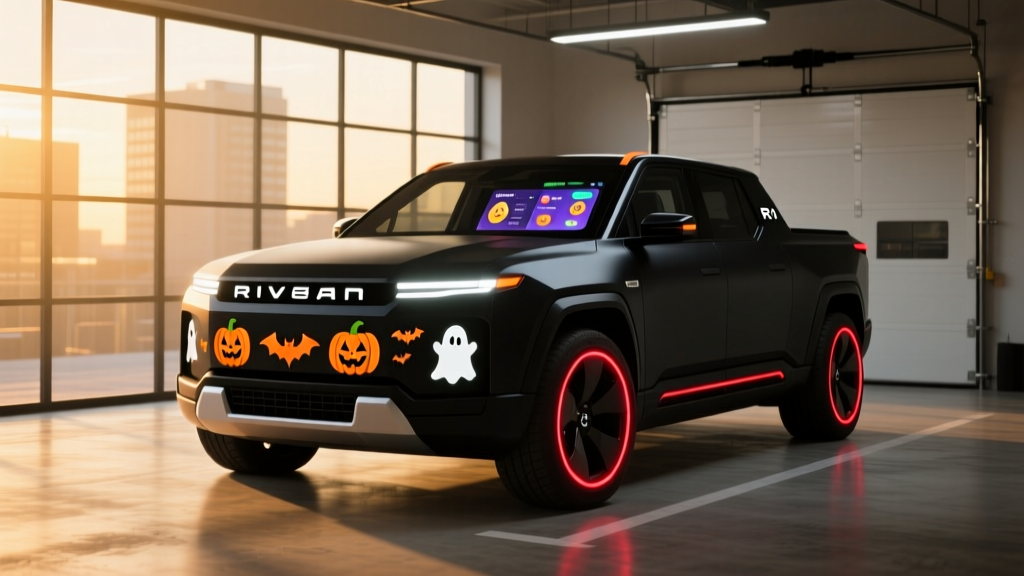
Every October, Rivian owners look forward to one software update detail above all others: Rivian Halloween Mode. It's a seasonal easter egg package that transforms the R1S SUV and R1T truck's lighting, sounds, and infotainment into a themed experience. But beyond the spooky fun, it's also a window into how Rivian uses over-the-air (OTA) updates to keep its vehicles feeling fresh years after purchase — something that directly affects long-term ownership satisfaction and resale value.
In this guide, we'll walk through exactly what Halloween Mode does on 2026-model R1S and R1T vehicles, then pivot to the hard numbers every buyer actually needs: real-world range, charging speeds, pricing after federal tax credits, and whether a Rivian still makes sense versus the growing field of three-row electric SUVs and electric trucks.
Rivian Halloween Mode: The Full Feature Breakdown
Halloween Mode is activated through the vehicle's infotainment settings (typically under Controls → Seasonal Modes) and runs from late September through early November. Here's what it changes on 2026 R1S and R1T models:
- Exterior lighting choreography: The signature Rivian stadium headlights and taillights animate in orange and purple sequences when you approach, unlock, or lock the vehicle. The lightbar across the front grille pulses in a slow "breathing" pattern.
- Custom horn sounds: The standard horn is replaced (temporarily) with options like a wolf howl, a creaky door, or a cartoonish ghost wail. You can toggle back to the standard horn at any time from the steering wheel menu.
- Infotainment theme: The main cluster and center screen swap to a dark-orange UI with subtle animated elements — bats crossing the navigation map, a full moon behind the media player, and cobweb borders on menu cards.
- Approach/exit sounds: Instead of the standard chime, the vehicle plays a short theremin-style melody when you walk up with your phone-as-key or open the door.
- Camp Mode integration: If you enable Camp Mode while Halloween Mode is active, the exterior speakers can play ambient spooky soundscapes (wind, distant thunder, owl calls) — popular for fall campsite setups and trunk-or-treat events.
- Frunk and gear tunnel lighting: On the R1T, the gear tunnel and frunk lights shift to a dim orange, which owners use for Halloween-themed tailgate displays and candy distribution setups.
None of these features affect driving dynamics, range, or safety systems. They're purely cosmetic and can be disabled individually or as a package. Rivian has shipped a seasonal mode every year since 2022, and the 2026 iteration is the most polished yet — a signal that the company continues investing in software delight even as it scales production of its second-generation R1 platform.
2026 Rivian R1S and R1T: Range, Battery, and Real-World Efficiency
Seasonal easter eggs are fun, but the purchase decision lives and dies on range and efficiency. The 2026 R1S (three-row SUV) and R1T (crew-cab truck) share the same Gen 2 battery architecture, offered in two pack sizes with distinct chemistries.
| Spec | Standard Pack (LFP) | Large Pack (NMC) | Max Pack (NMC) |
|---|---|---|---|
| Usable Battery Capacity | ~95 kWh | ~119 kWh | ~141 kWh |
| Chemistry | LFP (Lithium Iron Phosphate) | NMC (Nickel Manganese Cobalt) | NMC |
| EPA Range (R1S Dual-Motor) | 270 mi | 352 mi | 410 mi |
| EPA Range (R1T Dual-Motor) | 272 mi | 352 mi | 420 mi |
| Efficiency (R1S Large, Dual-Motor) | ~2.0 kWh/mi (50 MPGe combined) | ||
| Drivetrain | Dual-Motor AWD (standard); Quad-Motor AWD (available, Large/Max only) | ||
| 0–60 mph (Dual-Motor) | ~4.5 sec | ||
| 0–60 mph (Quad-Motor) | ~2.5 sec (1,025 hp) | ||
EPA estimates assume a mix of city and highway driving at moderate temperatures. In our experience and owner-reported data, expect the following adjustments:
- Highway cruising (70–75 mph): Subtract 10–15%. A 352-mile Large Pack R1S realistically delivers ~295–315 miles at sustained interstate speeds.
- Cold weather (below 32°F): Subtract 15–25% depending on cabin heat use. The R1's heat pump helps, but a 410-mile Max Pack can drop to ~320–340 miles in single-digit temperatures.
- Towing (R1T): Expect a 35–50% range reduction when towing near the 11,000-lb max capacity. A 5,000-lb camper trailer typically cuts range by ~30%.
- City/regenerative driving: You may exceed EPA by 5–10% in stop-and-go traffic thanks to strong regen braking.
The LFP Standard Pack is worth special attention. LFP chemistry trades energy density for longevity — it tolerates daily 100% charging without the degradation concerns of NMC, and it's generally cheaper to replace out of warranty. If your commute is under 200 miles round-trip and you charge at home nightly, the Standard Pack saves thousands upfront and may outlast the vehicle itself. See fueleconomy.gov's EV technology guide for more on LFP vs. NMC trade-offs.
Charging Speed: DC Fast, Level 2, and the Rivian Network
Rivian's Gen 2 platform supports robust charging across all three levels. Here's what 2026 owners can expect:
| Charging Level | Power / Rate | Speed (Miles Added) | Notes |
|---|---|---|---|
| Level 1 (120V household) | ~1.4 kW | ~3–4 mi/hr | Emergency/trickle only; ~7 days for full charge |
| Level 2 (240V home, 48A) | 11.5 kW | ~25–30 mi/hr | Full overnight charge in 10–14 hours |
| Level 2 (240V home, 60A) | ~14.4 kW | ~32–37 mi/hr | Requires 80A circuit; Gen 2 onboard charger supports this |
| DC Fast Charge (CCS/NACS) | Peak 220 kW | ~140 mi in 20 min | 10–80% in ~30 min (Large Pack); tapers above 80% |
A critical nuance: the 220 kW peak only sustains roughly from 10–40% State of Charge. Between 40–60%, you'll see ~150–170 kW, and above 80%, the curve drops sharply to protect the battery — often below 50 kW. This means a 10–90% session takes considerably longer than a 10–80% session. Plan road-trip stops to charge to 80% and drive on; the last 10% isn't worth the wait.
Rivian owners also get access to the Rivian Adventure Network — the company's proprietary DC fast-charging stations near national parks and outdoor destinations, typically rated at 200+ kW. As of late 2025, Rivian also opened its vehicles to the Tesla Supercharger network via NACS adapter (included with new vehicles), dramatically expanding public charging access for road trips. For the latest public charging compatibility, see the Rivian charging page.
Pricing, Trims, and Federal Tax Credit Eligibility
The 2026 Rivian lineup is structured around pack size and motor count rather than traditional "trim levels." Here's the current MSRP landscape:
| Configuration | Base MSRP | Federal Credit (§30D) | Effective Price |
|---|---|---|---|
| R1S Dual-Motor Standard | $75,900 | Up to $7,500* | ~$68,400 |
| R1S Dual-Motor Large | $83,900 | Up to $7,500* | ~$76,400 |
| R1T Dual-Motor Standard | $69,900 | Up to $7,500* | ~$62,400 |
| R1T Dual-Motor Large | $77,900 | Up to $7,500* | ~$70,400 |
| R1T Quad-Motor Max | $99,900 | $0 (over MSRP cap) | $99,900 |
*Federal tax credit eligibility under IRS §30D is subject to multiple requirements. Consult a tax professional before relying on credit estimates.
- MSRP cap: SUVs (R1S) must be ≤ $80,000 MSRP; trucks (R1T) must be ≤ $80,000 MSRP. This eliminates Quad-Motor Max configurations from eligibility.
- Buyer income cap: Adjusted gross income must not exceed $150,000 (single), $225,000 (head of household), or $300,000 (married filing jointly).
- Battery sourcing: A percentage of critical minerals and battery components must be sourced from the U.S. or free-trade-agreement partners. Rivian has worked to qualify its supply chain, but specific pack configurations may vary — verify on IRS.gov's clean vehicle credit page before purchasing.
- Point-of-sale transfer: As of 2024, buyers can transfer the credit to the dealer at purchase, reducing the out-of-pocket price directly rather than waiting for a tax refund. Rivian supports this at delivery.
As-tested pricing climbs quickly with options. A Dual-Motor Large R1S with the Adventure package, premium interior, and 21-inch wheels typically lands around $89,000–$92,000 before credit. The R1T with the camp kitchen and gear tunnel accessories can push past $90,000. Always configure on Rivian's site to see exact pricing for your build.
Cargo, Passenger Space, and Daily Practicality
The R1S and R1T are among the most space-efficient vehicles in their respective classes, thanks to skateboard-platform packaging that eliminates the transmission tunnel and engine bay intrusion.
R1S (three-row SUV):
- Cargo behind 3rd row: ~11 cu ft
- Cargo behind 2nd row (3rd row folded): ~47 cu ft
- Max cargo (all rear seats folded): ~105 cu ft
- Frunk (front trunk): ~11 cu ft — fits a carry-on roller bag
- 3rd-row legroom: ~30 inches — best for children or short trips
- 2nd-row legroom: ~37 inches
R1T (crew-cab truck):
- Bed length: 4.5 ft (standard); extends to ~6 ft with tailgate down and mid-gate open
- Gear tunnel (cross-vehicle storage behind cab): ~11 cu ft — a signature Rivian feature, lockable and weather-sealed
- Frunk: ~11 cu ft with a drain plug (doubles as a cooler)
- Max towing: 11,000 lbs
- Max payload: ~1,760 lbs
The gear tunnel on the R1T is genuinely one of the most useful storage innovations in the truck segment. It spans the full width of the vehicle behind the rear seats and is accessible from either side — perfect for muddy boots, camping gear, or groceries you don't want rolling around the bed.
Technology, Driver Assistance, and Standout Features
Rivian's software stack is one of its strongest competitive advantages, and the 2026 model year continues to refine it.
Infotainment: A 15.6-inch center touchscreen runs Rivian's proprietary OS — no Android Automotive or Apple CarPlay/Android Auto. This is a polarizing choice. The native system is fast, well-designed, and integrates deeply with vehicle functions (camp mode, pet mode, gear tunnel locks). But if you rely on Waze, Spotify's full interface, or specific third-party apps, the lack of phone projection is a genuine limitation.
Driver assistance (Rivian Driver+): This is a SAE Level 2 system — meaning it combines adaptive cruise control and lane-centering on divided highways, but the driver must remain fully engaged with hands on the wheel and eyes on the road. It is not autonomous driving. The system is competent for long highway stints but doesn't match the hands-free capabilities of GM's Super Cruise or Ford's BlueCruise on mapped roads. Rivian has signaled future hands-free capability via OTA, but as of the 2026 model year, Driver+ requires active supervision.
Rivian Driver+ is a Level 2 driver-assistance system. It does NOT make the vehicle self-driving. You must keep your hands on the steering wheel and monitor traffic at all times. Failure to respond to system alerts will result in progressive warnings and eventual system disengagement. No production Rivian currently supports Level 3 or higher automation.
Standout features beyond Halloween Mode:
- Camp Mode: Keeps climate control running, disables exterior chimes, and levels the suspension for sleeping. Combined with the available camp kitchen (R1T), it's a legitimate overlanding platform.
- Pet Mode: Maintains cabin temperature and displays a message on the exterior screen reassuring passersby that your pet is safe.
- Shore power / V2L: The R1T and R1S can output up to 7.2 kW of 240V power — enough to run a campsite, power tools at a job site, or provide emergency backup to a home circuit (with proper transfer switch installation by a licensed electrician).
- OTA updates: Rivian ships major software updates every few months, adding features like new drive modes, efficiency improvements, and seasonal easter eggs (Halloween Mode, Holiday Mode, etc.) without a dealership visit.
Notable drawbacks:
- No Apple CarPlay or Android Auto — a dealbreaker for some buyers
- Service center availability is still expanding; rural owners may face long tow distances for warranty work
- Insurance premiums run 15–25% higher than comparable ICE vehicles (common across the EV segment)
- Third-row space in the R1S is tight for adults on longer trips
Warranty Coverage and Long-Term Ownership
Rivian's warranty package is competitive with the EV segment standard:
- Basic vehicle warranty: 5 years / 60,000 miles
- Battery and drive unit warranty: 8 years / 100,000 miles (retains at least 70% of original capacity during the warranty period)
- Corrosion warranty: 12 years (unlimited mileage)
- Roadside assistance: 5 years / 60,000 miles, including flat-bed towing to the nearest service center
The 70% capacity retention threshold is industry-standard (Tesla, Ford, and Hyundai use similar benchmarks). Real-world degradation data on Rivian's Gen 2 packs is still maturing, but early Gen 1 owner reports suggest ~5–8% degradation over the first 60,000 miles — well within warranty tolerance. LFP packs (Standard) are expected to degrade even less over equivalent mileage, making them an attractive choice for high-mileage commuters who plan to keep the vehicle past the warranty period.
Who Should Buy a Rivian — and Who Should Look Elsewhere?
- You need a three-row electric SUV with genuine off-road capability and don't want to default to the Tesla Model X
- You value software-driven features, seasonal updates, and a strong owner community
- Your daily driving is under 250 miles and you can charge at home
- You want an electric truck that's genuinely capable for towing (11,000 lbs) and off-road use, not just a commuter with a bed
- The gear tunnel and camp kitchen ecosystem appeal to your outdoor lifestyle
- You're replacing a mid-size truck (Tacoma, Ranger, Colorado) rather than a full-size heavy-duty
- You absolutely need Apple CarPlay/Android Auto (consider Hyundai Ioniq 5, Kia EV9, or Ford F-150 Lightning)
- You need a true full-size truck for daily heavy towing (consider the F-150 Lightning Extended Range or Chevy Silverado EV)
- Budget is under $60,000 after incentives — Rivian doesn't currently compete in the entry-level EV segment
Pros and Cons at a Glance
- Class-leading software experience with regular OTA updates and seasonal modes
- Standard Pack LFP option offers excellent long-term battery longevity
- Genuine off-road capability (up to 14.9 inches ground clearance, wading to 36 inches)
- R1T gear tunnel is a genuinely innovative storage solution
- V2L shore power (7.2 kW) for camping and emergency home backup
- Tesla Supercharger access via NACS adapter
- Strong build quality improvements in Gen 2 platform
- No Apple CarPlay or Android Auto
- Premium pricing — well-equipped builds exceed $90,000
- Driver+ is competent but not hands-free (unlike Super Cruise/BlueCruise)
- Service center network still growing; rural coverage gaps
- Third row in R1S is cramped for adults
- Towing significantly reduces range (30–50% depending on load)
- Higher insurance costs than ICE equivalents
Frequently Asked Questions
What is the real-world range of a 2026 Rivian R1S or R1T?
EPA estimates range from 270 miles (Standard Pack) to 420 miles (R1T Max Pack). In real-world highway driving at 70–75 mph, expect 10–15% less than the EPA sticker. In cold weather below freezing, expect 15–25% less. For most Large Pack owners, realistic daily range is 300–320 miles in fair weather and 260–280 miles in winter.
How fast does the Rivian charge at home and on the road?
On a 48-amp Level 2 home charger, you'll add ~25–30 miles per hour (full charge overnight). On DC fast charging, the Gen 2 platform peaks at 220 kW, achieving a 10–80% charge in roughly 30 minutes for the Large Pack. Expect 10–90% to take closer to 45 minutes due to charge-curve tapering above 80%.
How much does a Rivian cost after the federal tax credit?
Dual-Motor Standard and Large configurations under the $80,000 MSRP cap can qualify for up to $7,500 under IRS §30D, subject to buyer income limits and battery-sourcing requirements. This brings the R1T Standard to roughly $62,400 and the R1S Standard to ~$68,400. Quad-Motor Max configurations exceed the MSRP cap and do not qualify. Always verify current eligibility at IRS.gov before purchasing.
Is Rivian worth buying versus the Kia EV9, Tesla Model X, or Ford F-150 Lightning?
It depends on your priorities. The R1S offers more off-road capability and a richer software experience than the EV9, but the EV9 starts ~$20,000 lower and includes CarPlay. The Model X has more range and Supercharger-native access but costs significantly more and has a polarizing interior. The F-150 Lightning is a full-size truck with more bed length and towing capacity for less money, but it lacks the R1T's gear tunnel, off-road sophistication, and LFP battery option. Rivian wins on lifestyle integration and software; competitors win on price or specific utility needs.
Does Rivian's Halloween Mode drain the battery?
Negligibly. The lighting animations, themed sounds, and UI changes draw minimal power — roughly equivalent to leaving the interior dome lights on briefly. You won't see measurable range loss from running Halloween Mode, even if you leave approach lighting active for extended periods. It's a purely cosmetic feature with no impact on the traction battery's usable capacity.
Can I get Halloween Mode on older Rivian models?
Yes. Rivian has shipped seasonal modes to all R1S and R1T vehicles going back to the 2022 launch via OTA updates. The specific features evolve each year, but Gen 1 vehicles (2022–2024) receive the seasonal package alongside Gen 2 models. If your vehicle hasn't received it, check for pending software updates in Settings → Software.