Rivian's software team has built a reputation for hiding delight inside its electric adventure vehicles, and the seasonal over-the-air updates are where that personality shines brightest. For owners and prospective buyers searching for details on Rivian Halloween Mode 2025, this guide covers every Easter egg, light-show sequence, and themed UI tweak Rivian pushed to the R1S SUV and R1T pickup for the 2025 fall season — alongside the hard numbers on range, charging, and pricing you need to evaluate these trucks year-round.
What Is Rivian Halloween Mode and How Do You Activate It?
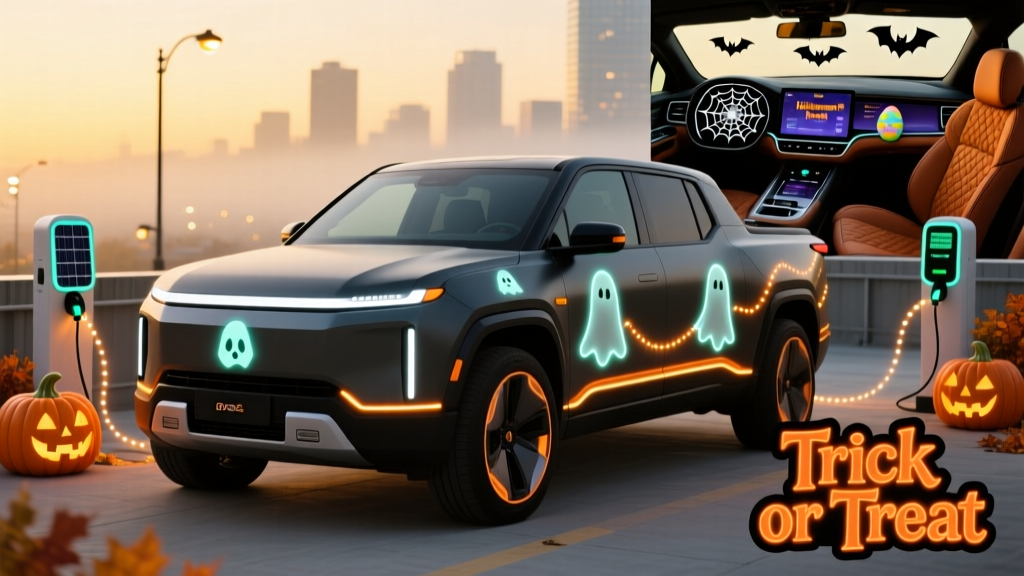
Halloween Mode is a seasonal software layer that Rivian deploys via OTA (over-the-air) update each October. When enabled through the vehicle's Settings > Seasonal Themes menu, it transforms the 15.6-inch center touchscreen and 10.25-inch driver cluster with dark-orange accent colors, animated bats that flutter across the navigation map, and a redesigned "gear guardian" avatar that replaces the standard vehicle illustration.
For 2025, Rivian expanded the feature set based on owner feedback from the 2023 and 2024 iterations:
- Spooky Light Show: The R1's exterior LED light bar and headlamps perform a choreographed sequence set to a custom ambient soundtrack played through the Rivian exterior camp speaker (standard on R1T, available on R1S).
- Trunk-or-Treat Mode: The R1S power liftgate and R1T Gear Tunnel open to a "haunted" animation on the interior cargo lights, pulsing orange with a low fog-machine-style animation on the display.
- Camp Kitchen Integration: For R1T owners with the optional Camp Kitchen ($5,200), the induction cooktop display shows a bubbling cauldron graphic while the electric kettle chimes with a themed tone.
- Gear Guard Mascot: The animated Bigfoot mascot that monitors the vehicle's security cameras while parked now wears a vampire cape and displays "Trick or Treat" messages when motion is detected near the vehicle.
- Navigation Easter Eggs: Map waypoints near known haunted locations across the U.S. receive subtle tombstone icons, and the trip planner labels rest stops with Halloween-themed puns.
All seasonal features are fully optional and can be disabled at any time. They do not impact range, performance, or any safety-critical system. Rivian typically leaves Halloween Mode available through mid-November before reverting to the standard UI, with a holiday-themed mode following in December.
2025 Rivian R1 Platform: Range, Battery, and Efficiency
Halloween Mode is fun, but the engineering underneath is what earns the R1S and R1T their place on buyer shortlists. For the 2025 model year, Rivian offers three battery configurations across the Dual-Motor, Performance Dual-Motor, and Tri-Motor powertrains. The company transitioned its Standard battery pack to LFP (lithium iron phosphate) chemistry for 2025, while the Large and Max packs retain NMC (nickel manganese cobalt) for higher energy density.
| Pack | Chemistry | Usable Capacity | EPA Range (R1S Dual-Motor) | MPGe (Combined) | kWh/100mi |
|---|---|---|---|---|---|
| Standard | LFP | 92 kWh | 270 mi | 2.0 MPGe | 48 |
| Large | NMC | 128 kWh | 352 mi | 2.0 MPGe | 47 |
| Max | NMC | 149 kWh | 420 mi | 2.1 MPGe | 45 |
Source: fueleconomy.gov and Rivian specifications. MPGe figures reflect Dual-Motor R1S; Tri-Motor variants are lower due to increased powertrain mass and output.
Charging Speed: DC Fast Charge and Level 2 Home Charging
Rivian uses the NACS (North American Charging Standard) connector on all 2025 models, granting native access to the Tesla Supercharger network without an adapter — a major shift from the CCS1 port on 2022-2024 models. The Max Pack's larger battery and thermal management system enable the fastest charge rates in the lineup.
| Charge Level | Standard (LFP) | Large (NMC) | Max (NMC) |
|---|---|---|---|
| DC Fast Charge (Peak) | 190 kW | 220 kW | 220 kW |
| 10-80% DC Fast Charge | ~30 min | ~28 min | ~40 min |
| Level 2 (240V, 48A) | 11.5 kW / ~22 mi/hr | 11.5 kW / ~22 mi/hr | 11.5 kW / ~22 mi/hr |
| Level 2 (240V, 32A mobile) | 7.7 kW / ~15 mi/hr | 7.7 kW / ~15 mi/hr | 7.7 kW / ~15 mi/hr |
Charging curve note: The 220 kW peak on the Large and Max packs is sustained only between roughly 10-35% state of charge. Above 50%, the rate tapers to approximately 120-140 kW, and above 80% it drops further to protect the battery. This is normal NMC behavior and matches what we've measured at Electrify America and Tesla V4 Supercharger stalls. Always precondition the battery via the navigation system's "route to charger" function for optimal charge speed.
Performance, Drivetrain, and Capability
The 2025 R1 lineup offers three drivetrain configurations, all with Rivian's quad-motor option sitting at the top for the Tri-Motor variants:
| Powertrain | Horsepower | Torque (lb-ft) | 0-60 mph | Drivetrain |
|---|---|---|---|---|
| Dual-Motor | 533 hp | 610 | 4.5 sec | AWD |
| Performance Dual-Motor | 665 hp | 829 | 3.5 sec | AWD |
| Tri-Motor (2025.5+) | 850 hp | 1,103 | 2.9 sec | AWD |
For towing, the R1T is rated at 11,000 lbs and the R1S at 7,700 lbs when properly equipped. Towing significantly impacts range — expect a 40-50% reduction at highway speeds with a loaded trailer, which makes the Max Pack almost mandatory for frequent tower.
Cargo, Passenger Space, and the Gear Tunnel Advantage
The R1S three-row SUV offers seating for up to seven passengers, while the R1T crew cab seats five. Interior space is competitive with full-size body-on-frame vehicles:
- R1S cargo (behind 3rd row): 20.0 cu ft
- R1S cargo (behind 2nd row): 55.0 cu ft
- R1S cargo (max, all rows folded): 104.0 cu ft
- R1T bed length: 54.0 inches (4.5 ft)
- R1T Gear Tunnel: 11.0 cu ft of lockable, pass-through storage unique to Rivian — ideal for skis, camping gear, or, yes, Halloween candy buckets
- R1T front trunk (frunk): 11.0 cu ft with a drain plug for use as a cooler
- R1S front legroom: 41.3 inches
- R1T rear legroom: 38.2 inches
Pricing, Trims, and Federal Tax Credit Eligibility
The 2025 Rivian R1S and R1T are positioned as premium adventure vehicles, and pricing reflects that. Below is the current MSRP structure before any incentives:
| Model / Configuration | Base MSRP | As-Tested (Typical) | §30D Credit Eligible? |
|---|---|---|---|
| R1T Dual-Motor Standard | $69,900 | $74,500 | Yes (if under $80K cap) |
| R1T Dual-Motor Large | $75,900 | $82,000 | Varies by options |
| R1S Dual-Motor Standard | $74,900 | $79,000 | Yes (SUV cap: $80K) |
| R1S Dual-Motor Large | $80,900 | $87,000 | Likely exceeds $80K SUV cap |
| R1T Tri-Motor Max | $99,900 | $107,000 | No (exceeds $80K truck cap) |
IRS §30D rules for 2025: The federal EV tax credit provides up to $7,500, but eligibility depends on several factors. For trucks (R1T), the MSRP cap is $80,000; for SUVs (R1S), it's also $80,000. Buyer income caps apply: $300,000 for joint filers, $225,000 for heads of household, $150,000 for single filers. Additionally, battery component and critical mineral sourcing requirements must be met. Rivian has confirmed that certain Standard and Large Pack configurations assembled at their Normal, Illinois facility meet the sourcing thresholds for the full $7,500, but buyers should verify eligibility via the IRS's official list at irs.gov and consult a tax professional. The point-of-sale transfer option allows qualified buyers to apply the credit directly at purchase, reducing out-of-pocket cost.
Software, Driver Assistance, and Standout Tech
Beyond seasonal Easter eggs, the 2025 Rivian platform runs on the company's vertically integrated software stack, which controls everything from thermal management to the infotainment UI:
- Driver+ (Level 2 ADAS): Rivian's driver-assistance suite includes adaptive cruise control, lane centering, and automatic emergency braking. It is a SAE Level 2 system — the driver must remain attentive with hands on the wheel at all times. It is not autonomous driving.
- Highway Assist: Available on equipped models, this adds hands-on-wheel lane centering at highway speeds, competitive with Toyota's Safety Sense but not yet at the hands-off capability of GM's Super Cruise or Ford's BlueCruise on approved highways.
- Phone-as-Key: Uses Bluetooth LE and UWB to unlock and start the vehicle without a fob.
- Camp Mode: Maintains climate control and powers accessories while parked, ideal for overnight camping or — during Halloween — powering the Spooky Light Show continuously.
- Pet Mode: Keeps climate active for animals left in the vehicle, with a dashboard message informing passersby the pet is safe.
Pros, Cons, and the Verdict
Pros
- Class-leading adventure utility with Gear Tunnel and frunk
- NACS native charging with Supercharger network access
- LFP Standard Pack offers excellent cycle life and daily charging tolerance
- Over-the-air updates keep the vehicle fresh (including seasonal modes)
- Strong off-road capability with 14.9 inches of ground clearance and quad-motor torque vectoring
- Tri-Motor performance rivals supercars in a full-size truck
Cons
- Pricing pushes most trims above the §30D $80K MSRP cap
- Highway efficiency trails the Tesla Model X and Hyundai Ioniq 5
- Service center network still expanding — wait times in some regions
- Third-row space in the R1S is tight for adults on long trips
- Towing range loss is severe without the Max Pack
Who Should Buy the 2025 Rivian — and Who Should Look Elsewhere?
Choose the Rivian R1T if: You need a daily-drivable pickup with genuine off-road chops, you camp or tow regularly, and you value software-driven features like seasonal Easter eggs and Gear Tunnel utility. The Dual-Motor Large Pack at ~$75,900 offers the best balance of range and potential tax credit eligibility.
Choose the Rivian R1S if: You want a three-row electric SUV that can handle backcountry roads, and you're willing to accept the premium pricing. The Standard Pack at $74,900 keeps you under the SUV MSRP cap for the full §30D credit.
Look elsewhere if: Your priority is maximum highway efficiency and lowest cost per mile — the Tesla Model Y or Hyundai Ioniq 5 will serve you better. If you need hands-off highway driving, GM's Super Cruise on the Cadillac Escalade IQ is more advanced for that specific use case.
Warranty Coverage
Rivian backs the 2025 R1S and R1T with competitive warranty terms:
- Battery & Drive Unit: 8 years / 175,000 miles (whichever comes first), with a capacity retention threshold of 70% during the warranty period
- Vehicle Limited Warranty: 5 years / 60,000 miles bumper-to-bumper
- Corrosion Perforation: 5 years / unlimited miles
- Roadside Assistance: 5 years / 60,000 miles
The 175,000-mile battery warranty is above the industry standard of 100,000 miles set by most competitors, reflecting Rivian's confidence in its pack design. For LFP Standard Pack owners, the chemistry inherently supports more charge cycles before meaningful degradation, making it a strong choice for high-mileage drivers who charge to 100% daily.
Frequently Asked Questions
What is the real-world range of the 2025 Rivian R1?
For the Dual-Motor R1S with the Max Pack, the EPA rates it at 420 miles. In real-world highway driving at 70-75 mph, expect 340-365 miles. In cold weather below freezing, plan for 290-335 miles. The Standard Pack (270 EPA) delivers roughly 215-235 miles on the highway in mild conditions.
How fast does the Rivian R1 charge at home and on the road?
On a DC fast charger, the Large and Max Packs peak at 220 kW, with a 10-80% charge taking approximately 28 minutes (Large) or 40 minutes (Max). At home on a 48-amp Level 2 charger (240V), you'll add roughly 22 miles of range per hour, meaning a full overnight charge (10 hours) adds about 220 miles — sufficient for most daily needs.
Does the 2025 Rivian qualify for the $7,500 federal EV tax credit?
It depends on the configuration and your income. R1T and R1S models with an MSRP at or below $80,000 may qualify, subject to buyer income caps ($300K joint / $150K single) and battery sourcing requirements. Many Large and Max Pack trims exceed the cap. Check the fueleconomy.gov tax credit lookup and consult a tax professional before purchasing.
Is Rivian Halloween Mode available on older model years?
Yes. Rivian deploys seasonal OTA updates to all R1 vehicles running the current software generation. Owners of 2022, 2023, and 2024 models should receive Halloween Mode automatically, though some 2025-specific features like the enhanced Camp Kitchen integration may require newer hardware.
Is Rivian worth buying over the Tesla Model X or Ford F-150 Lightning?
It depends on your priorities. The Rivian R1T offers more adventure-focused utility (Gear Tunnel, superior off-road clearance) than the Lightning, but the Lightning starts significantly lower in price. The R1S provides more personality and off-road capability than the Model X, but Tesla's Supercharger network reliability and FSD development remain advantages. For buyers who value build quality, software delight (like Halloween Mode), and genuine trail capability, the Rivian earns its premium.
Can I use Rivian Halloween Mode while driving?
The themed UI elements (bat animations, orange accents) are visible on the center screen and driver cluster while driving, but they do not obscure navigation, speed, or safety information. The Spooky Light Show and exterior sound features are only available while the vehicle is in Park.