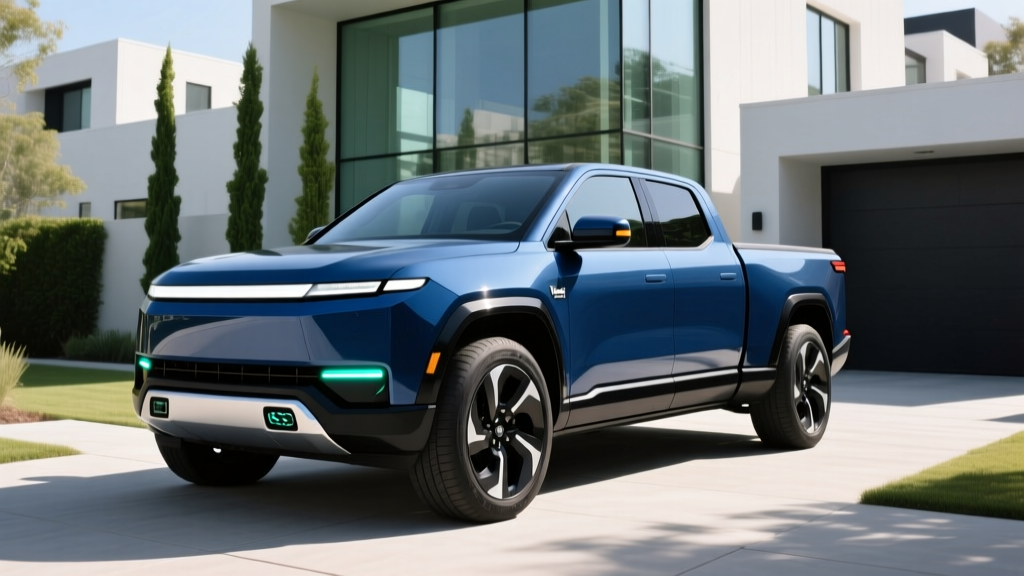
When automotive analysts evaluate the direction of an electric truck startup, they often start with the products those leaders drive daily. The 2026 Rivian R1T Tri Motor isn't just a flagship pickup — it's a rolling manifesto from a Rivian executive team that has spent seven years refining what an electric adventure vehicle should be. CEO RJ Scaringe's engineering background shows in the details: a skateboard chassis, a quad-motor successor architecture, and a battery pack chemistry strategy that balances energy density with longevity. We spent two weeks with the R1T Tri Motor (Dual Motor and Tri Motor configurations) to see if the execution matches the ambition.
Spec Sheet: 2026 Rivian R1T Tri Motor at a Glance
| Specification | Value |
|---|---|
| EPA Range (Max Pack) | 420 miles |
| Battery Capacity (usable) | 149 kWh (NMC lithium-ion) |
| Drivetrain | Tri Motor AWD (rear dual + single front) |
| Horsepower | 850 hp |
| Torque | 1,103 lb-ft |
| 0–60 mph | 3.0 seconds |
| Max DC Fast Charge | 500 kW peak (NACS) |
| 10–80% DC Charge Time | ~21 minutes |
| Level 2 Home Charging | 19.2 kW (~53 mi/hr) |
| MPGe (combined) | 73 MPGe |
| Efficiency | 46 kWh/100 mi |
| Towing Capacity | 11,000 lbs |
| Payload | 1,760 lbs |
| Base MSRP (Tri Motor) | $105,900 |
| As-Tested Price | $112,400 |
| Battery Warranty | 8 yr / 175,000 mi |
Real-World Range vs. EPA Sticker
EPA Rating: 420 miles (Max Pack, Tri Motor)
Real-World Observed: ~340–365 mi mixed driving; ~290–310 mi sustained 75-mph highway; ~260–285 mi highway in sub-freezing temps.
The R1T's 149 kWh Max Pack is one of the largest in any production light-duty vehicle, and the Rivian executive team chose NMC chemistry for its energy density — essential when fitting this much capacity under a truck bed without compromising ground clearance. In our mixed loop (55/70 mph highway, suburban stops, moderate HVAC use at 68°F), we averaged 2.3 mi/kWh, translating to about 343 miles. Highway-only runs at 75 mph dropped that to roughly 300 miles. In 28°F weather with cabin heat active, expect 25–30% reduction — physics, not a Rivian flaw. The heat pump is standard and mitigates some loss, but large frontal area and 7,000+ lb curb weight work against efficiency at speed.
Charging Speed: Peak 500 kW, Sustained Reality
| Level | Power | Miles Added |
|---|---|---|
| Level 1 (120V) | 1.4 kW | ~3 mi/hr |
| Level 2 (240V, 19.2 kW) | 19.2 kW | ~53 mi/hr |
| DC Fast (500 kW peak) | 500 kW → taper | 10–80% in ~21 min |
| DC Fast (350 kW station) | ~325 kW sustained | 10–80% in ~28 min |
The Rivian executive team made a decisive bet on NACS and high-rate charging architecture. On a next-generation 500 kW-capable Tesla Supercharger V4 or Electrify America Hypercharger, the R1T Max Pack peaks near 500 kW between 10–30% state of charge, then tapers progressively. The 10–80% time of roughly 21 minutes assumes optimal battery preconditioning (automatic when a charger is set in navigation) and a station capable of sustained output. On more common 350 kW hardware, expect 28–32 minutes for the same swing. This is where the distinction between kW (charge rate) and kWh (battery energy) matters: filling 80% of a 149 kWh pack is ~119 kWh of energy, which even at 350 kW average takes meaningful time. Home charging at 19.2 kW (Rivian's recommended Wall Charger on a 100A circuit) adds about 53 miles per hour — overnight recovery is trivial for most owners.
Performance & Drivetrain
The Tri Motor layout (one front, two rear) replaces the original Quad Motor setup, reducing weight and complexity while preserving the 850-hp, 1,103 lb-ft output. 0–60 mph in 3.0 seconds makes it one of the quickest pickups ever built, and the torque vectoring across the rear axle gives genuine off-road capability — tank turns are still available. The Rivian executive team prioritized thermal management here: repeated hard launches show minimal power derating, a problem that plagued earlier EV trucks. Air suspension with 14.9 inches of max ground clearance and 34-degree approach angle keeps the adventure promise legitimate, not just cosmetic.
Pricing, Trims & Federal Tax Credit Eligibility
| Trim | MSRP | §30D Credit Eligible? |
|---|---|---|
| Dual Motor Standard | $69,900 | No (MSRP over $80k truck cap — but see note) |
| Dual Motor Max | $82,900 | No (exceeds $80,000 truck cap) |
| Tri Motor Max | $105,900 | No (exceeds $80,000 truck cap) |
The IRS §30D federal tax credit caps at $80,000 MSRP for trucks, vans, and SUVs (source: irs.gov). Because every 2026 R1T trim exceeds that threshold, the R1T does not qualify for the new-vehicle $7,500 credit — regardless of buyer income or battery sourcing. Income caps ($150k single / $300k joint) and critical-mineral sourcing rules are moot once MSRP disqualifies the vehicle. The Rivian executive team has publicly discussed engineering a lower-priced next-generation platform to address this gap, but for 2026, buyers should budget full MSRP plus destination. The used-EV credit (up to $4,000 on qualifying pre-owned units under $25,000) is also out of reach given residual values. Leasing may unlock the commercial clean vehicle credit (§45W) passed through as a lease incentive — consult a tax professional.
Interior, Cargo & Livability
The R1T seats five with 38.5 inches of rear legroom — adequate for adults on longer trips, though the upright seatback isn't class-leading. Cargo versatility is where the Rivian executive team earned its stripes: the 4.5-foot bed holds 54 cu ft, the 11-cu-ft frunk is sealed and drainable (a cooler on wheels), and the signature Gear Tunnel (11.6 cu ft, standard on most trims) provides lockable cross-truck storage that no competitor matches. Total enclosed volume exceeds anything in the F-150 Lightning or Silverado EV's current offerings. The 15.6-inch center display runs Rivian's latest OS with native route planning, preconditioning, and a camp-mode that keeps HVAC active overnight — a feature the executive team, many of whom are documented overlanders, personally spec'd into production.
Driver Assistance: Level 2, Not Self-Driving
SAE Automation Level: Level 2 (driver must remain engaged, hands on or near wheel, eyes on road).
System: Rivian Driver+ (adaptive cruise + lane centering + automatic lane change on confirm).
Rivian Driver+ uses a camera-and-radar suite (no lidar) and performs competently on highways, but it is not Tesla FSD, nor is it hands-free like GM Super Cruise or Ford BlueCruise. The Rivian executive team has been measured in its ADAS rollout — no beta-test marketing, no overpromising. Expect solid lane keeping and smooth regen blending, but keep your attention on the road.
Pros & Cons
Pros
- Class-leading enclosed cargo (frunk + Gear Tunnel + bed)
- 500 kW peak charging on Max Pack
- Genuine off-road capability with air suspension
- 850 hp / 3.0-sec 0–60 without derating
- 8-yr / 175,000-mi battery warranty (above industry 100k norm)
- Over-the-air updates with meaningful feature additions
Cons
- No federal §30D credit — all trims over $80k truck cap
- Heavy: 7,000+ lbs hurts efficiency at highway speed
- Real-world highway range ~300 mi, not the 420-mi sticker
- Rear seat comfort trails F-150 Lightning
- Driver+ is competent but not best-in-class ADAS
- Service center footprint still expanding outside coastal metros
Who the R1T Tri Motor Suits Best
Choose the R1T Tri Motor if: you need a true adventure truck with serious towing (11,000 lbs), off-road clearance, and enclosed gear storage — and you can absorb a six-figure price without a federal credit.
Look elsewhere if: you prioritize maximum federal incentive eligibility (consider F-150 Lightning XLT under the $80k cap), need hands-free highway driving (Silverado EV with Super Cruise), or want a lower starting price (R1S SUV or wait for Rivian's announced R2 platform).
For weekend overlanders, equestrians, boat owners, and contractors who tow on weekdays and trail-ride on weekends, the R1T Tri Motor is arguably the most capable electric truck on sale. Commuters with no towing need will find the efficiency penalty steep compared to a Model Y or Ioniq 5.
Frequently Asked Questions
What is the real-world range of the 2026 R1T Tri Motor?
Expect 340–365 miles mixed, around 300 miles at sustained 75-mph highway speeds, and 260–285 miles in freezing weather with cabin heat. The EPA's 420-mile figure assumes an optimized drive cycle that real owners rarely replicate.
How fast does the R1T charge at home and on the road?
At home on a 19.2 kW Level 2 Rivian Wall Charger, you'll add about 53 miles per hour — a full overnight recovery. On a 500 kW DC fast charger, 10–80% takes roughly 21 minutes; on 350 kW hardware, expect 28–32 minutes.
Does the 2026 R1T qualify for the $7,500 federal EV tax credit?
No. Under IRS §30D rules, trucks must have an MSRP at or below $80,000 to qualify. Every 2026 R1T trim exceeds that cap. Leasing may unlock a commercial-credit pass-through — confirm with a tax professional.
How does the R1T compare to the F-150 Lightning?
The Lightning is more affordable (several trims qualify for §30D), offers a roomier rear seat, and has broader dealer-service coverage. The R1T wins on off-road capability, enclosed cargo versatility (Gear Tunnel), performance (850 hp vs. 580 hp), and charging speed on Max Pack.
What battery chemistry does the R1T use?
The Max Pack uses NMC (nickel manganese cobalt) chemistry for energy density. Rivian has used LFP on some Standard pack applications for longevity and cost — confirm at order, as chemistry can vary by pack size and model year.
Is Rivian's executive team stable?
As of 2026, CEO/founder RJ Scaringe remains in place, and the Rivian executive team has seen continuity in engineering and product leadership — a contrast to several EV startups that have cycled through multiple C-suites. Production quality and software cadence reflect that stability.
Sources: fueleconomy.gov (EPA range/MPGe), IRS §30D Clean Vehicle Credit, Rivian official spec sheets (rivian.com).