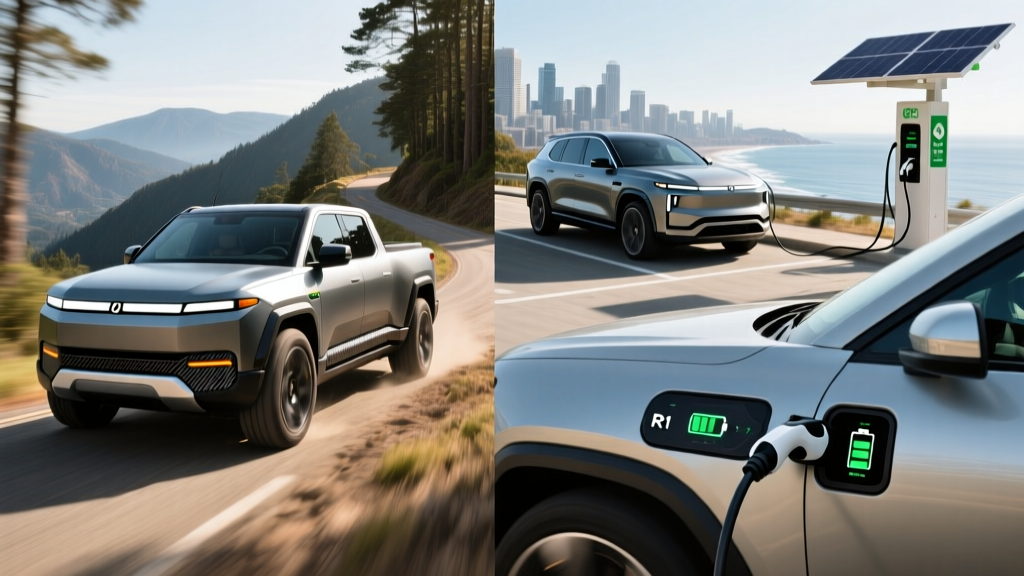
Rivian has evolved from an ambitious startup into one of the most compelling American EV automakers. For 2026, the lineup spans the rugged R1T pickup, the three-row R1S SUV, and the highly anticipated midsize R2 crossover. But beyond the adventure marketing, how do these vehicles actually perform as daily drivers, road-trip companions, and long-term ownership propositions?
This guide breaks down every current Rivian EV with the exact numbers buyers need: EPA range versus real-world expectations, DC fast-charging curves, battery chemistry trade-offs, and the nuances of federal tax credit eligibility under IRS §30D rules. Whether you're cross-shopping the R1T against the Ford F-150 Lightning or sizing up the R2 against the Tesla Model Y, this is your data-driven starting point.
Rivian's 2026 Lineup at a Glance
Rivian currently sells the second-generation R1T and R1S (refreshed for the 2025 model year and carried into 2026) and has begun deliveries of the smaller, more affordable R2. All three share the company's latest electrical architecture, updated drive units, and NACS (North American Charging Standard) native ports, which grant access to Tesla's Supercharger network without an adapter.
| Spec | R1T (Dual-Motor) | R1S (Dual-Motor) | R2 (Dual-Motor AWD) |
|---|---|---|---|
| EPA Range (Max Pack) | 420 mi | 410 mi | 340 mi (est.) |
| Battery Usable (Max Pack) | ~141 kWh (NMC) | ~141 kWh (NMC) | ~95 kWh (NMC, est.) |
| Standard Pack Range | 270 mi | 260 mi | ~290 mi (est.) |
| Peak DC Fast Charge | 220 kW | 220 kW | ~200 kW (est.) |
| 10–80% DCFC Time | ~36 min (Max) | ~36 min (Max) | ~30 min (est.) |
| Level 2 Home Charge | 11.5 kW (~25 mi/hr) | 11.5 kW (~25 mi/hr) | 11.5 kW (~28 mi/hr) |
| 0–60 mph | 4.5 sec (Dual) / 3.0 sec (Tri) | 4.5 sec (Dual) / 3.4 sec (Tri) | ~4.8 sec (est.) |
| Horsepower | 533 hp (Dual) / 850 hp (Tri) | 533 hp (Dual) / 850 hp (Tri) | ~450 hp (est.) |
| Drivetrain | AWD (Dual/Tri-Motor) | AWD (Dual/Tri-Motor) | AWD (Dual-Motor) |
| MPGe (Combined) | 73 MPGe | 71 MPGe | TBD |
| Base MSRP | $69,900 | $74,900 | $45,000 (announced) |
Sources: fueleconomy.gov, Rivian official specifications. R2 figures are preliminary manufacturer estimates for models beginning delivery in 2026; final EPA certification may differ.
Real-World Range: What the EPA Sticker Doesn't Tell You
Rivian's EPA numbers are legitimately impressive, especially on the Max Pack configuration. But as with any large, heavy electric vehicle with all-terrain tires and a boxy aerodynamic profile, highway efficiency suffers compared to sleeker sedans. The R1T's combined efficiency of 73 MPGe translates to roughly 46 kWh per 100 miles — meaning you're consuming a lot of energy to move 7,000+ pounds of vehicle.
For Standard Pack buyers, the real-world calculus is tighter. A 270-mile EPA rating on the R1T Standard means roughly 215–240 miles of usable highway range in fair weather, and potentially under 200 miles in winter conditions. This makes the Standard Pack viable primarily for commuters with reliable home charging, not cross-country road trippers.
Rivian's heat pump system, standard across the lineup, helps mitigate cold-weather losses compared to older EVs using resistive cabin heating. Owners in northern climates should still budget 20–25% range reduction in sustained sub-freezing driving, based on real-world owner data and third-party cold-weather testing.
Charging Speed and Infrastructure
Rivian's second-generation vehicles use a 900-volt electrical architecture that enables competitive DC fast-charging speeds. Here's what the numbers look like across charging levels:
| Charging Level | Power (kW) | R1T Miles Added/Hour | Notes |
|---|---|---|---|
| Level 1 (120V household) | ~1.4 kW | ~3 mi/hr | Emergency/trickle only |
| Level 2 (240V home) | 11.5 kW | ~25 mi/hr | Full charge in ~12–14 hr (Max Pack) |
| DC Fast Charge (peak) | 220 kW | ~140 mi in 15 min | Sustained peak to ~50% SoC |
| DC Fast Charge (10–80%) | Avg ~155 kW | ~36 min (Max Pack) | Curve tapers significantly above 80% |
The 220 kW peak charge rate is competitive but not class-leading — the Hyundai Ioniq 5 and Porsche Taycan can sustain higher rates. The critical detail is Rivian's charge curve: the R1T and R1S hold near-peak power through roughly 40–50% state of charge, then taper progressively. A 10–80% session on a 350 kW Electrify America or Tesla Supercharger stall takes approximately 36 minutes for the Max Pack and about 27 minutes for the Standard Pack, which has a smaller battery to fill.
With native NACS ports, Rivian owners now have seamless access to over 20,000 Tesla Superchargers across North America. This is a significant practical advantage over CCS-only vehicles, as Tesla's network remains the most reliable and widely deployed DC fast-charging infrastructure in the U.S. The Rivian app and built-in navigation handle routing and preconditioning automatically — the battery is warmed to optimal charging temperature as you approach a selected charger, which is essential for achieving advertised charge speeds in cold weather.
For home charging, Rivian recommends a 60-amp dedicated circuit with a 48-amp wall connector to achieve the full 11.5 kW Level 2 rate. Installation costs typically range from $800 to $2,500 depending on panel capacity and conduit run distance. Homes with 100-amp electrical panels may require a $2,000–$4,000 panel upgrade to support simultaneous household loads and EV charging.
Performance and Drivetrain
Rivian offers Dual-Motor and Tri-Motor configurations across the R1T and R1S. The Dual-Motor setup delivers 533 horsepower and 610 lb-ft of torque — enough for a 4.5-second 0–60 mph sprint in either body style. The Tri-Motor (badged as part of the "Ascend" performance tier in 2026) produces up to 850 horsepower and achieves 3.0 seconds to 60 mph in the R1T, placing it firmly in supercar-truck territory alongside the GMC Hummer EV and Tesla Cybertruck Beast.
All Rivians use a single-speed reduction gear with torque vectoring across axles. The R1T's quad-motor configuration (available on the top trim) provides independent wheel torque control, which translates to genuine off-road capability — not just marketing. The vehicle's air suspension offers up to 14.9 inches of ground clearance and can wade through 36 inches of water, making it a legitimate overlanding platform.
Towing capacity reaches 11,000 pounds for the R1T and 7,700 pounds for the R1S. However, towing any substantial trailer will cut range roughly in half — expect 180–220 miles from the Max Pack when pulling a 5,000-pound camper. This is a physics reality shared by all electric trucks, not a Rivian-specific limitation.
Pricing, Trims, and Federal Tax Credit Eligibility
| Model / Trim | Base MSRP | §30D Credit Eligible? | Est. Net Price* |
|---|---|---|---|
| R1T Dual-Motor Standard | $69,900 | Yes (if under MSRP cap) | ~$62,400 |
| R1T Dual-Motor Max | $84,900 | No (exceeds $80K truck cap) | $84,900 |
| R1T Tri-Motor | $99,900 | No (exceeds $80K truck cap) | $99,900 |
| R1S Dual-Motor Standard | $74,900 | Yes (under $80K SUV cap) | ~$67,400 |
| R1S Dual-Motor Max | $89,900 | No (exceeds $80K SUV cap) | $89,900 |
| R2 Dual-Motor AWD | $45,000 | Yes (expected) | ~$37,500 |
*Net price assumes full $7,500 federal credit. Eligibility depends on buyer income, battery sourcing, and MSRP caps per IRS §30D rules. Consult a tax professional before purchasing.
The federal EV tax credit under §30D has specific constraints that affect Rivian buyers significantly:
- MSRP Caps: Vans, SUVs, and pickup trucks must have an MSRP at or below $80,000. Sedans are capped at $55,000. The R1T qualifies as a truck (cap: $80K); the R1S qualifies as an SUV (cap: $80K). This means only the Dual-Motor Standard Pack configurations fall under the cap.
- Income Limits: Modified adjusted gross income must not exceed $300,000 (joint filers), $225,000 (head of household), or $150,000 (individual).
- Battery Sourcing: The full $7,500 credit requires meeting both critical-mineral and battery-component sourcing thresholds, which tighten annually. Rivian has worked to qualify its U.S.-built battery packs, but buyers should verify current-year eligibility on the IRS qualified vehicles list before purchase.
- Point-of-Sale Transfer: As of 2024, buyers can transfer the credit to the dealer at purchase, receiving the $7,500 as an immediate price reduction rather than waiting to claim it on their tax return.
The R2, with its expected $45,000 starting price, is positioned to be the most credit-eligible Rivian — assuming its battery supply chain meets the 2026 sourcing thresholds. This could bring its effective price to approximately $37,500, making it a serious competitor to the Tesla Model Y and Hyundai Ioniq 5 in the mainstream EV crossover segment.
Interior, Cargo, and Technology
The R1T offers a unique advantage among electric trucks: the Gear Tunnel, a lockable, pass-through storage compartment behind the cab that provides 11.7 cubic feet of secure, weatherproof cargo space. Combined with a 4.5-foot bed (11.0 cu ft) and an 11.0-cubic-foot frunk, the R1T delivers versatile storage that a conventional truck bed cannot match for secure, enclosed gear.
The R1S provides three rows of seating for up to seven passengers, with 10.4 cu ft of cargo space behind the third row, 46.7 cu ft behind the second row, and 104.7 cu ft with both rear rows folded. Second-row legroom measures 38.9 inches — competitive with the Kia EV9 and slightly tighter than the Tesla Model X.
Rivian's infotainment runs on a 15.6-inch center touchscreen with a custom operating system. It supports wireless Apple CarPlay and Android Auto, over-the-air updates, and an integrated adventure-oriented navigation system that factors in terrain, elevation, and charging stops. The driver-assistance suite, called Driver+, provides Level 2 highway assistance with adaptive cruise control and lane-centering on divided highways. It is not "self-driving" — the driver must maintain hands-on-wheel awareness at all times.
Notable tech drawbacks: Rivian does not currently offer a head-up display, and the absence of Apple CarPlay on early models (now added via OTA) frustrated some buyers. The gear selector stalk requires a learning curve compared to traditional shifters.
Battery Chemistry, Degradation, and Warranty
Rivian's Large and Max battery packs use NMC (nickel-manganese-cobalt) lithium-ion chemistry, supplied primarily by Samsung SDI. NMC offers higher energy density than LFP (lithium iron phosphate), which is critical for achieving 400+ mile range targets in a large vehicle. The trade-off is that NMC batteries degrade slightly faster over time and are more sensitive to sustained high states of charge.
Rivian recommends daily charging to 85% for NMC packs and reserving 100% charges for road trips. The battery management system includes active liquid cooling and heating to maintain optimal cell temperatures, which helps preserve long-term state of health.
The battery and powertrain warranty covers 8 years or 175,000 miles (whichever comes first), with a guaranteed capacity retention threshold of 70%. This is competitive with industry standards, though some competitors like Hyundai offer 10-year/100,000-mile coverage. Rivian's higher mileage threshold (175K vs. the typical 100K) is a meaningful advantage for high-mileage drivers.
Who Should Buy a Rivian?
Choose the R1T if: You need a genuine pickup truck with off-road capability, want the Gear Tunnel for secure adventure gear storage, have home Level 2 charging, and your budget accommodates a $70K+ vehicle. The Standard Pack with Dual-Motor is the best value if you can live with ~215 real-world highway miles.
Choose the R1S if: You need three-row seating for family duty, want EV efficiency without sacrificing SUV utility, and prioritize range over sporty handling. The R1S Max Pack is ideal for road-tripping families who regularly drive 300+ miles between stops.
Wait for or choose the R2 if: You want a mainstream-priced EV crossover (~$45K), don't need truck or three-row SUV capability, and want to maximize federal tax credit savings. The R2 is Rivian's play for volume — think Tesla Model Y competitor with more adventure character.
Pros and Cons
Pros
- Class-leading range on Max Pack (420 mi EPA for R1T)
- Native NACS with full Tesla Supercharger access
- Genuine off-road capability with air suspension and wading
- Innovative Gear Tunnel storage (R1T)
- Strong over-the-air update cadence improving the vehicle post-purchase
- 8-year/175,000-mile battery warranty (above-average mileage cap)
Cons
- High starting prices; most trims exceed §30D MSRP caps
- DC charging speed (220 kW peak) trails Hyundai/Kia/Porsche rivals
- Large battery packs mean long Level 2 home charge times (~14 hours for Max Pack)
- Real-world highway range drops significantly below EPA estimates
- No head-up display; driver-assist features less polished than Tesla/GM
- Service center network still expanding — wait times in some markets
Frequently Asked Questions
What is the real-world range of Rivian EVs?
The R1T Dual-Motor Max Pack is EPA-rated at 420 miles, but real-world highway driving at 70–75 mph yields approximately 340–370 miles in moderate weather and 290–330 miles in cold conditions. The Standard Pack (270 mi EPA) delivers roughly 215–240 highway miles in fair weather.
How fast do Rivians charge at home and on the road?
At home on a 240V Level 2 charger (11.5 kW), Rivians add approximately 25 miles of range per hour, requiring 12–14 hours for a full Max Pack charge. On DC fast chargers, they peak at 220 kW and charge from 10–80% in about 36 minutes (Max Pack) or 27 minutes (Standard Pack).
Does the Rivian R1T or R1S qualify for the $7,500 federal tax credit?
Only the Dual-Motor Standard Pack configurations fall under the $80,000 MSRP cap for trucks/SUVs. Buyers must also meet IRS income limits ($150K individual / $300K joint) and the vehicle must meet 2026 battery-sourcing requirements. Verify eligibility on the IRS qualified vehicles list before purchasing.
Is the Rivian R2 available to buy now?
The R2 began limited deliveries in late 2025 with broader availability ramping through 2026. Pricing starts at approximately $45,000. Final EPA range and efficiency figures were being certified at time of writing; expect ~340 miles on the larger battery option.
How does Rivian compare to the Ford F-150 Lightning or Tesla Cybertruck?
The R1T offers more range (420 vs. 320 mi for the Lightning Extended), superior off-road suspension articulation, and the Gear Tunnel. The F-150 Lightning is less expensive and has a larger bed. The Cybertruck offers comparable performance but polarizing styling and a stainless-steel body that is costly to repair. The R1T sits in the premium adventure-truck niche and commands a price to match.
What is Rivian's battery warranty?
Rivian covers the battery and drive unit for 8 years or 175,000 miles, whichever comes first, with a guaranteed minimum of 70% capacity retention. This is one of the higher mileage thresholds in the industry.