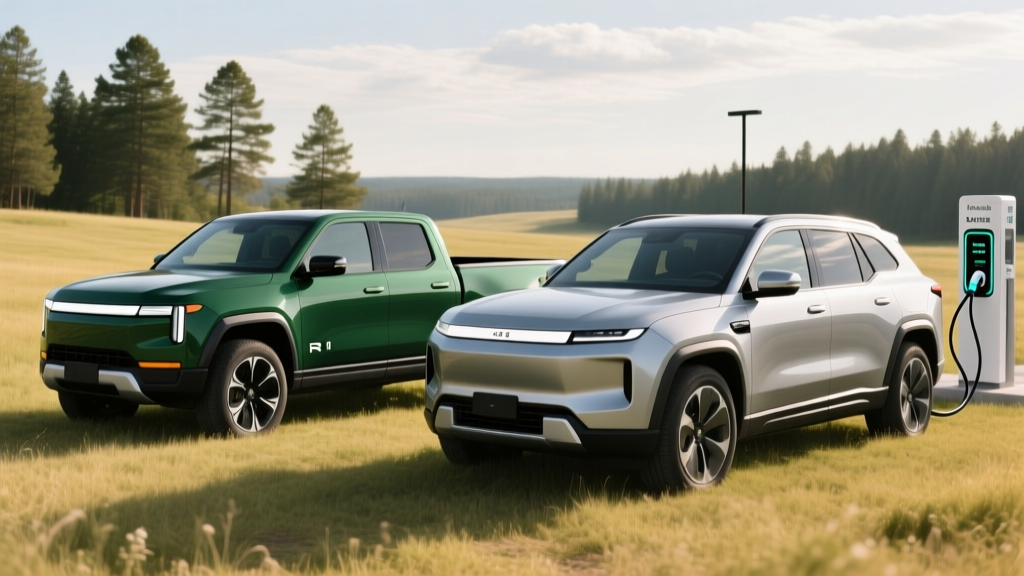
Rivian's R1T pickup and R1S SUV remain two of the most capable electric vehicles on the road in 2026, blending serious off-road hardware with genuine daily-driver practicality. But with dual-motor and quad-motor powertrains, multiple battery options, and a starting price that now begins under $70,000, choosing the right configuration requires sorting through a lot of variables. This review breaks down every number that matters — EPA range, real-world efficiency, charging curves, cargo space, and what you'll actually pay after the federal tax credit.
Rivian EV Quick Verdict
The R1T and R1S are best understood as premium adventure vehicles that happen to be electric. If you need a truck that can tow 11,000 pounds, ford 36 inches of water, and still deliver a 4.5-second 0-60 run on the way to the trailhead, Rivian is the only brand offering all three in one package. The tradeoff is efficiency — these are heavy, boxy vehicles, and highway range drops noticeably compared to the EPA sticker. For buyers who prioritize range-per-dollar above all else, a Tesla Model Y or Hyundai Ioniq 5 will stretch further per kWh. For those who need truck or three-row SUV utility with zero tailpipe emissions, Rivian's 2026 lineup has no direct equal at this price point.
EPA Range vs. Real-World Expectations
The Dual-Motor R1T with the Standard battery (95 kWh usable) carries an EPA estimate of 270 miles. In mixed highway driving at 70-75 mph, expect roughly 230-245 miles before needing a charger. In sub-freezing temperatures (below 32°F), plan for 190-215 miles of usable range. The Max battery pack (141 kWh usable, NMC chemistry) pushes the EPA estimate to 410 miles on the Dual-Motor R1T — and realistically delivers 340-360 miles on the highway in moderate weather.
Rivian offers three battery configurations for 2026. The Standard pack uses lithium iron phosphate (LFP) chemistry — heavier but more durable over thousands of cycles and less expensive to produce. The Large (115 kWh usable, NMC) and Max (141 kWh usable, NMC) packs use nickel-manganese-cobalt cells for higher energy density. LFP's key advantage for daily drivers: you can charge it to 100% regularly without accelerating degradation, unlike NMC packs where 80-90% daily limits are recommended.
| Configuration | Battery (kWh usable) | Chemistry | EPA Range (mi) | Real-World Highway |
|---|---|---|---|---|
| Dual-Motor Standard | 95 | LFP | 270 | ~230-245 |
| Dual-Motor Large | 115 | NMC | 330 | ~280-295 |
| Dual-Motor Max | 141 | NMC | 410 | ~340-360 |
| Quad-Motor Large | 115 | NMC | 328 | ~270-285 |
Source: fueleconomy.gov and Rivian specifications. Real-world estimates based on 70-75 mph highway driving in 50-75°F conditions.
Charging Speed: DC Fast Charge and Home Level 2
Rivian's charging architecture supports up to 220 kW peak DC fast charging on Dual-Motor models with the Large and Max packs. The Standard (LFP) pack peaks lower, at approximately 170 kW. Quad-Motor models peak at roughly 190 kW. The important nuance here is the charge curve — peak speed is sustained only between roughly 15-40% state of charge, after which the rate tapers progressively. A 10-80% session on a 350 kW-capable Electrify America or Tesla Supercharger (via Rivian's NACS adapter, now standard) takes approximately 28-32 minutes for the Large pack and 38-42 minutes for the Max pack.
| Charging Level | Power (kW) | Speed | Time / Notes |
|---|---|---|---|
| Level 1 (120V household) | ~1.4 kW | ~4 mi/hr | Emergency/trickle only |
| Level 2 (240V home, 48A) | 11.5 kW | ~31 mi/hr | 0-100% in ~10-12 hrs |
| DC Fast (Standard LFP) | 170 kW peak | ~140 mi in 20 min | 10-80% in ~28 min |
| DC Fast (Large NMC) | 220 kW peak | ~160 mi in 20 min | 10-80% in ~28-32 min |
| DC Fast (Max NMC) | 220 kW peak | ~170 mi in 20 min | 10-80% in ~38-42 min |
For home charging, Rivian's onboard charger accepts up to 11.5 kW on a 48-amp Level 2 circuit (requiring a 60-amp breaker). This adds roughly 31 miles of range per hour, which is sufficient to fully replenish even the Max pack overnight. Rivian's Wall Connector is available, but any quality J1772/NACS Level 2 unit from ChargePoint, Emporia, or Enel X will work. Budget $500-$1,200 for the charger hardware and $800-$2,500 for professional electrical installation depending on your panel capacity and conduit run distance.
Performance and Drivetrain Specifications
The Dual-Motor setup provides all-wheel drive via one motor per axle, producing 533 horsepower and 610 lb-ft of torque in Standard output. The Performance dual-motor tune bumps this to 665 hp. The Quad-Motor variant — one motor per wheel with independent torque vectoring — delivers 1,025 horsepower and a 0-60 mph time of 3.0 seconds flat, making it one of the quickest pickups ever sold.
| Spec | Dual-Motor | Dual-Motor Perf. | Quad-Motor |
|---|---|---|---|
| Horsepower | 533 hp | 665 hp | 1,025 hp |
| Torque | 610 lb-ft | 829 lb-ft | 1,198 lb-ft |
| 0-60 mph | 4.5 sec | 3.5 sec | 3.0 sec |
| Drivetrain | AWD | AWD | AWD (torque vectoring) |
| Towing Capacity | 11,000 lbs | 11,000 lbs | 11,000 lbs |
| Ground Clearance | 14.9 in (max) | 14.9 in (max) | 14.9 in (max) |
| Water Fording | 36 in | 36 in | 36 in |
Efficiency ranges from approximately 2.0 MPGe (kWh/100mi) depending on configuration. The Dual-Motor Standard achieves an EPA-rated 73 MPGe combined (approximately 46 kWh/100 miles). The Quad-Motor drops to roughly 70 MPGe. These figures are typical for a 7,000+ pound electric truck — they're not competitive with lighter EVs, but they're honest physics.
Pricing, Trim Levels, and Federal Tax Credit
For 2026, Rivian has simplified its trim structure. The R1T Dual-Motor with the Standard battery starts at $69,900 (including destination). The R1S three-row SUV starts at $74,900. Here's how the lineup prices out before incentives:
| Model | Base MSRP | As-Tested (Typical) |
|---|---|---|
| R1T Dual-Motor Standard | $69,900 | $73,500 |
| R1T Dual-Motor Large | $77,400 | $81,000 |
| R1T Dual-Motor Max | $87,400 | $92,000 |
| R1T Quad-Motor Large | $89,900 | $95,000 |
| R1S Dual-Motor Standard | $74,900 | $78,500 |
| R1S Dual-Motor Max | $92,400 | $97,500 |
Federal tax credit eligibility (§30D): Under current IRS rules, the Rivian R1T qualifies for the full $7,500 federal clean vehicle credit, as it is assembled in Normal, Illinois, meets battery component and critical mineral sourcing thresholds, and its base MSRP falls under the $80,000 truck/SUV cap. The R1S also qualifies under the $80,000 SUV cap for most trims. Buyer income caps apply: modified adjusted gross income cannot exceed $300,000 (joint filers), $225,000 (head of household), or $150,000 (individual). The credit can be transferred to the dealer at point of sale as an upfront price reduction. Consult a tax professional to confirm your eligibility — rules are subject to legislative change.
Choose the Dual-Motor Standard (LFP) if: You want the lowest entry price (~$62,400 after credit), plan to charge to 100% daily, and 270 miles of EPA range covers your commute plus weekend trips.
Choose the Dual-Motor Large (NMC) if: You regularly drive 200+ miles between charging stops and want the 330-mile EPA buffer for cold-weather road trips.
Choose the Max pack if: You tow frequently (towing cuts EV range by 40-50%) or live in a region with sparse DC fast-charging infrastructure.
Cargo, Passenger Space, and Utility
The R1T's 4-foot-6-inch bed is shorter than a full-size truck's, but the 11.0-cubic-foot front trunk (frunk) and the Gear Tunnel — a 11.7-cubic-foot lockable pass-through compartment between the cab and bed — add genuine utility. Total enclosed cargo volume with the tonneau cover and frunk combined exceeds 30 cubic feet of weather-sealed storage.
Passenger space is generous for a midsize pickup: 41.5 inches of front legroom and 38.2 inches in the rear. The R1S adds a third row suitable for children or short-trip adults, with 36.8 inches of second-row legroom and 28.4 inches in the third row. Behind the third row, the R1S offers 10.4 cubic feet; fold the third row and you get 46.7 cubic feet; fold both rear rows for 91.6 cubic feet.
Technology, Driver Assistance, and Notable Drawbacks
Rivian's 15.6-inch center touchscreen runs a proprietary operating system that handles navigation, vehicle settings, climate, and media. The interface is responsive, with over-the-air updates adding features regularly — Rivian pushed 20+ OTA updates in the 2024-2025 cycle alone. The digital driver display is a 12.3-inch cluster, and a dedicated phone-as-key system works via Bluetooth LE.
Rivian's Driver+ system is a SAE Level 2 driver-assistance suite combining adaptive cruise control, lane centering, and hands-on-wheel monitoring. It is not autonomous driving — you must keep your hands on the wheel and eyes on the road at all times. Unlike GM's Super Cruise or Ford's BlueCruise, Rivian does not currently offer hands-free driving on mapped highways, though the hardware (cameras, radar, ultrasonic sensors) is capable of future upgrades.
Rivian Driver+ is SAE Level 2 — the driver must remain fully engaged. It does not navigate stoplights, handle construction zones autonomously, or replace attentive driving. It performs comparably to Tesla Autopilot or Toyota Safety Sense in highway lane-keeping but requires hands-on-wheel contact. Do not confuse this with Level 4 robotaxi services like Waymo.
- Class-leading off-road capability (36" water fording, air suspension, tank turns on Quad)
- 11,000-lb towing capacity with integrated trailer brake controller
- Gear Tunnel and frunk offer versatile enclosed storage
- LFP Standard pack allows 100% daily charging without degradation concerns
- Qualifies for full $7,500 federal tax credit
- Excellent build quality and materials for the price segment
- Efficiency is poor vs. lighter EVs (~46 kWh/100mi highway)
- No hands-free highway driving mode (Driver+ requires hands-on)
- Max pack charging takes 38-42 minutes 10-80% — slow vs. Hyundai/Kia E-GMP
- Bed is only 4'6" — shorter than standard midsize trucks
- No Apple CarPlay or Android Auto (proprietary system only)
- Service center network still limited outside major metros
Warranty Coverage
Rivian backs both the R1T and R1S with a 5-year/60,000-mile limited vehicle warranty and an 8-year/175,000-mile battery and drive unit warranty. The battery warranty guarantees retention of at least 70% of original capacity during the coverage period — a competitive threshold that matches or exceeds most rivals. Rivian also includes 24/7 roadside assistance for 5 years/60,000 miles.
Who Should Buy a Rivian EV?
Best for: Outdoor enthusiasts who need a truck or three-row SUV with real off-road chops, families who tow boats or campers on weekends, and buyers in states with strong charging infrastructure who want something distinctive from the Tesla/Ford mainstream. The R1S is one of the only electric three-row SUVs with genuine third-row usability and available AWD.
Look elsewhere if: You commute 100+ miles daily on the highway and prioritize efficiency (a Hyundai Ioniq 5 or Tesla Model Y will cost significantly less per mile), you need a full 6-foot truck bed for work, or you live in a rural area with limited Rivian service access and sparse DC fast-charging infrastructure.
Frequently Asked Questions
What is the real-world highway range of the Rivian R1T?
The Dual-Motor Standard (270 mi EPA) delivers approximately 230-245 miles at highway speeds in moderate temperatures. The Max pack (410 mi EPA) realistically provides 340-360 highway miles. Cold weather (below freezing) reduces these figures by 15-25%. Towing a trailer cuts range roughly in half regardless of pack size.
How fast does the Rivian R1T charge at home and on the road?
At home on a 48-amp Level 2 charger (11.5 kW), the R1T gains approximately 31 miles of range per hour, fully charging overnight in 10-12 hours depending on pack size. On DC fast chargers, the Large pack peaks at 220 kW and reaches 10-80% in about 28-32 minutes. The Max pack takes 38-42 minutes for the same session due to its larger capacity.
Does the 2026 Rivian R1T qualify for the federal EV tax credit?
Yes — the R1T and most R1S trims qualify for the full $7,500 federal clean vehicle credit under IRS §30D, provided the buyer meets income limits ($300K joint / $150K individual MAGI) and the vehicle's MSRP stays under the $80,000 cap for trucks/SUVs. The credit can be applied as a point-of-sale price reduction at the dealer. Always verify current rules at irs.gov and consult a tax professional.
Is the Rivian R1T worth buying over the Ford F-150 Lightning or Tesla Cybertruck?
The R1T offers superior off-road capability (adjustable air suspension, 36" fording, Quad-Motor torque vectoring) and a more premium interior than the F-150 Lightning, but the Lightning is less expensive and has a larger 5.5-foot bed. The Cybertruck offers comparable performance and a stainless-steel exoskeleton but has polarizing styling and a smaller service network. If off-road adventure and build quality are your priorities, the R1T is the strongest pick. If you need maximum bed length or the lowest price, the Lightning wins.
Does Rivian offer Apple CarPlay or Android Auto?
No. Rivian uses a proprietary infotainment system with native navigation, Spotify, and other integrated apps. There is no smartphone projection via CarPlay or Android Auto. This is a common pain point for buyers who prefer their phone's interface — test-drive the system before committing.
What is Rivian's service and support network like in 2026?
Rivian operates approximately 60+ service centers and mobile service fleets across the U.S., concentrated in major metropolitan areas. Mobile service vans handle many routine repairs and recalls at your home or office. Coverage in rural areas and the Mountain West remains limited compared to Ford or Toyota. Check Rivian's service locator for your region before purchasing.