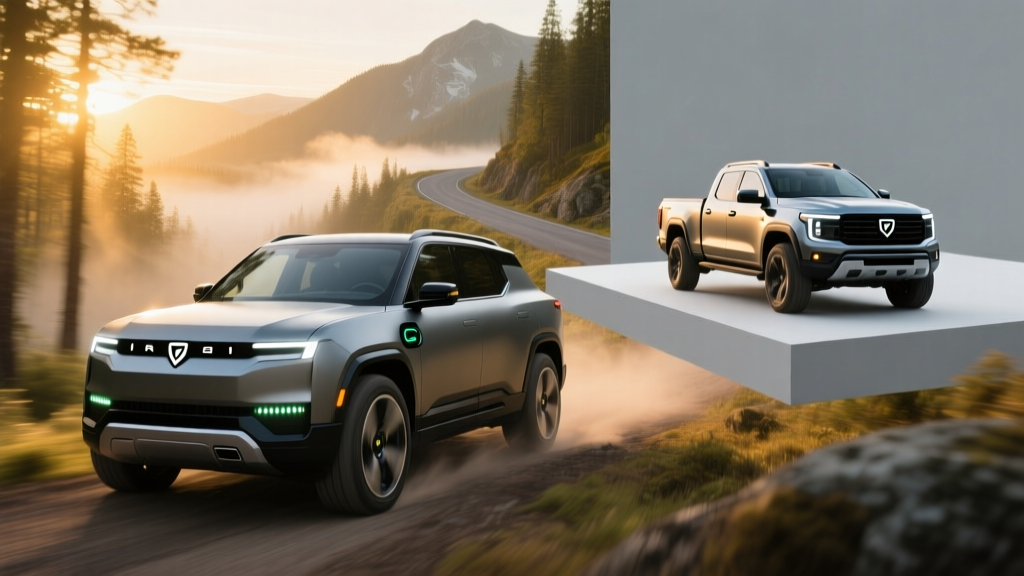
If you've been searching for Rivian electric bikes, you're not alone — the brand's adventure-focused identity has led many shoppers to wonder whether Rivian makes an e-bike or electric bicycle. The short answer: as of 2026, Rivian does not manufacture electric bikes. The company's entire lineup consists of battery-electric vehicles (BEVs) — specifically the R1S three-row SUV and the R1T pickup truck. Rivian did previously design an electric delivery van for Amazon, but it has never entered the e-bike, scooter, or micromobility market.
What Rivian does make are some of the most capable electric SUVs and trucks on the road. For the 2026 model year, both the R1S and R1T have received significant powertrain, battery, and software updates that improve range, charging speed, and performance. Below, we break down everything you need to know about Rivian's current EV lineup — including real-world range, charging specs, pricing, and whether these vehicles qualify for the federal tax credit.
2026 Rivian R1S: Three-Row Electric SUV
The R1S remains one of the few three-row electric SUVs available in the U.S. market, competing directly with the Tesla Model X and the upcoming electric offerings from legacy automakers. For 2026, Rivian offers the R1S with a refreshed dual-motor and a new tri-motor configuration, along with updated battery packs that push range higher.
| Spec | Dual-Motor (Standard) | Tri-Motor (Performance) |
|---|---|---|
| EPA Range | 352 miles | 321 miles |
| Battery (usable) | 109 kWh (NMC) | 109 kWh (NMC) |
| Max DC Fast Charge | 200 kW peak | 220 kW peak |
| 10–80% DC Charge | ~28 minutes | ~25 minutes |
| Level 2 Home Charge | 11.5 kW (~25 mi/hr) | 11.5 kW (~25 mi/hr) |
| 0–60 mph | 4.5 seconds | 2.9 seconds |
| Horsepower | 533 hp | 850 hp |
| Drivetrain | AWD (dual-motor) | AWD (tri-motor) |
| Efficiency | 73 MPGe / 46 kWh/100mi | 69 MPGe / 49 kWh/100mi |
| Cargo (behind 3rd row) | 20.0 cu ft | 20.0 cu ft |
| Cargo (all rows folded) | 104.7 cu ft | 104.7 cu ft |
| Base MSRP | $79,900 | $99,900 |
2026 Rivian R1T: Electric Pickup Truck
The R1T continues as a mid-size electric pickup that punches well above its weight class in both performance and off-road capability. It shares the same updated platform and battery architecture as the R1S for 2026.
| Spec | Dual-Motor | Tri-Motor |
|---|---|---|
| EPA Range | 352 miles | 328 miles |
| Battery (usable) | 109 kWh (NMC) | 109 kWh (NMC) |
| Max DC Fast Charge | 200 kW peak | 220 kW peak |
| 10–80% DC Charge | ~28 minutes | ~25 minutes |
| Level 2 Home Charge | 11.5 kW (~25 mi/hr) | 11.5 kW (~25 mi/hr) |
| 0–60 mph | 4.5 seconds | 2.9 seconds |
| Horsepower | 533 hp | 850 hp |
| Drivetrain | AWD (dual-motor) | AWD (tri-motor) |
| Towing Capacity | 11,000 lbs | 11,000 lbs |
| Bed Length | 54.0 inches (4.5 ft) | 54.0 inches (4.5 ft) |
| Efficiency | 73 MPGe / 46 kWh/100mi | 68 MPGe / 49 kWh/100mi |
| Base MSRP | $74,800 | $94,800 |
The R1T's defining feature remains its gear tunnel — a lockable, pass-through storage compartment behind the cab that adds roughly 11.7 cu ft of weather-sealed cargo space. Combined with the 11.0 cu ft front trunk (frunk) and the bed, the R1T offers storage versatility that no conventional mid-size pickup can match.
Charging Infrastructure & Speeds
Rivian owners get access to the Rivian Adventure Network, the company's proprietary DC fast-charging network placed along popular outdoor routes, as well as compatibility with the broader Tesla Supercharger network via a NACS adapter (now standard on 2026 models). Here's how charging breaks down across levels:
| Charging Level | Power | Speed (approx.) | Use Case |
|---|---|---|---|
| Level 1 (120V) | 1.4 kW | ~3 miles per hour | Overnight trickle / emergencies |
| Level 2 (240V home) | 11.5 kW | ~25 miles per hour | Daily home charging (8–10 hr full charge) |
| DC Fast Charge | Up to 220 kW peak | ~140 miles in 15 min | Road trips; tapers above 80% SoC |
Charging curve reality: Like most NMC-based EVs, the Rivian's peak charge rate of 200–220 kW is sustained only between roughly 10–40% State of Charge (SoC). From 40–60%, the rate tapers to approximately 150 kW; from 60–80%, it drops further to around 90–100 kW. Charging from 80–100% is very slow (under 30 kW) and should be avoided on road trips unless you need the full battery for the final leg. For daily driving, Rivian recommends charging to 80% to preserve long-term battery health.
Pricing, Trims & Federal Tax Credit Eligibility
Rivian's pricing places the R1S and R1T in the premium segment. Here's the 2026 lineup at a glance:
| Model / Trim | Base MSRP | As-Tested (typical) | §30D Federal Credit Eligible? |
|---|---|---|---|
| R1T Dual-Motor Standard | $74,800 | $79,500–$84,000 | Yes (subject to income & sourcing rules) |
| R1T Tri-Motor Performance | $94,800 | $102,000+ | Yes (under $80K truck MSRP cap — see note) |
| R1S Dual-Motor Standard | $79,900 | $85,000–$90,000 | Yes (subject to income & sourcing rules) |
| R1S Tri-Motor Performance | $99,900 | $108,000+ | No — exceeds $80K SUV MSRP cap |
Federal tax credit rules (§30D) — critical details: Under current IRS guidelines, the new clean vehicle credit provides up to $7,500, but eligibility depends on multiple factors:
- MSRP cap: SUVs (including the R1S) must have an MSRP of $80,000 or less. Trucks, vans, and SUVs classified as trucks (including the R1T) have an $80,000 cap. The R1S Dual-Motor at $79,900 barely qualifies; the Tri-Motor R1S at $99,900 does not.
- Buyer income limits: Modified adjusted gross income (MAGI) must not exceed $150,000 (single), $225,000 (head of household), or $300,000 (joint filers).
- Battery sourcing requirements: A portion of the credit depends on critical minerals and battery components being sourced from the U.S. or free-trade-agreement countries. These requirements tighten annually — check IRS §30D guidance for the current year's thresholds.
- Point-of-sale transfer: As of 2024, buyers can transfer the credit to the dealer at point of sale for an immediate price reduction, rather than waiting to claim it on their tax return.
Because Rivian's battery supply chain has been evolving, confirm exact credit eligibility with your dealer and a tax professional before purchasing. Do not assume the full $7,500 applies.
Tech, Driver Assists & Interior
Rivian's in-house software platform remains one of the most responsive in the EV space, built on a 15.6-inch center touchscreen with a dedicated 12.3-inch driver cluster. Key tech features for 2026:
- Rivian Driver+: A Level 2 driver-assistance system combining adaptive cruise control and lane centering on highways. It is not a hands-free system like GM's Super Cruise — you must keep your hands on the wheel. Rivian has been testing hands-free capability, but as of early 2026, it remains supervised.
- Over-the-air (OTA) updates: Rivian regularly pushes software updates that add features, improve efficiency, and refine the drive experience. Major updates have historically added new drive modes, improved regenerative braking profiles, and enhanced navigation.
- Off-road modes: Dedicated Snow, Sand, Rock Crawl, and All-Purpose modes adjust torque distribution, suspension height, and throttle response. The available air suspension provides up to 14.9 inches of ground clearance.
- Vehicle-to-load (V2L): The R1T and R1S can output up to 3.6 kW of AC power, enough to run campsite equipment, power tools, or serve as emergency home backup for essentials.
- Adventure Network integration: Built-in navigation automatically routes through Rivian chargers and third-party networks, preconditioning the battery for optimal charge speed on arrival.
The interior uses premium, sustainably sourced materials — vegan leather, ash wood trim, and recycled fabrics. However, some owners report that the second-row seats in the R1S are relatively flat and lack the long-distance comfort of competitors like the BMW iX. Third-row space is best suited for children or short trips.
Warranty & Ownership Costs
Rivian backs both the R1S and R1T with competitive warranty coverage:
- Battery & powertrain: 8 years / 175,000 miles (whichever comes first), with a guaranteed minimum 70% battery capacity retention over that period.
- Bumper-to-bumper: 5 years / 60,000 miles.
- Corrosion: 12 years / unlimited miles.
- Roadside assistance: 5 years / 60,000 miles, including flat-tire service and out-of-charge towing to the nearest charger.
Insurance costs for Rivian vehicles tend to run 15–25% higher than comparable gas-powered SUVs and trucks, reflecting the higher repair costs associated with EV battery packs and advanced sensor suites. Expect annual premiums in the $2,800–$4,200 range depending on your location, driving record, and coverage level.
On the cost-of-energy side, charging a Rivian at home at the national average electricity rate of $0.17/kWh costs approximately $18.53 for a full 109 kWh charge — translating to roughly $0.05–$0.06 per mile. Compare that to a gas truck averaging 18 MPG at $3.40/gallon, which costs about $0.19 per mile. Over 15,000 miles per year, the fuel savings alone can reach $1,950–$2,100.
Pros and Cons
Pros
- Class-leading off-road capability with air suspension and quad/tri-motor torque vectoring
- 352 miles EPA range (Dual-Motor) — competitive with the best in the segment
- Gear tunnel (R1T) and spacious frunk offer unmatched storage versatility
- OTA software updates continuously improve the vehicle post-purchase
- V2L capability for camping and emergency power
- Access to Rivian Adventure Network plus Tesla Superchargers via NACS
- Premium, sustainable interior materials
Cons
- High starting price — Dual-Motor models begin near $75K–$80K
- Tri-Motor R1S exceeds the $80K MSRP cap for the federal tax credit
- DC fast charging peaks at 200–220 kW, slower than Hyundai Ioniq 5 (350 kW) or Lucid Air (300+ kW)
- Second-row seat comfort in the R1S is average for the price point
- Insurance premiums run significantly above segment average
- Service center network still expanding — wait times in some regions
- R1T bed is only 4.5 feet — shorter than most mid-size gas trucks
Who Should Buy a Rivian — And Who Shouldn't
Buy a Rivian if: You need a capable, premium electric SUV or truck for outdoor adventures, family hauling, or light towing. The R1S is ideal for families who want three rows and genuine off-road ability. The R1T suits buyers who want a daily-drivable truck with a short bed but enormous enclosed storage via the gear tunnel and frunk. If you regularly drive to trailheads, ski resorts, or campsites and want to arrive on electric power with V2L capability, Rivian is purpose-built for you.
Look elsewhere if: You prioritize the absolute fastest DC charging speeds (the Hyundai Ioniq 5 and Kia EV6 charge significantly faster at 800V-capable stations), you need a full-size truck bed (consider the Ford F-150 Lightning or Chevrolet Silverado EV), or your budget is under $65,000. The Tesla Model X offers comparable three-row SUV utility at a similar price point with faster Supercharger access and a more mature service network.
Frequently Asked Questions
Does Rivian make electric bikes or e-bikes?
No. As of 2026, Rivian manufactures only battery-electric vehicles — the R1S SUV and R1T pickup truck. The company has no announced plans to produce electric bicycles, scooters, or other micromobility products. If you're looking for an electric bike, brands like Rad Power, Specialized, and Trek offer dedicated e-bike lineups.
What is the real-world range of the Rivian R1S and R1T?
The EPA rates the 2026 Dual-Motor R1S and R1T at 352 miles. In real-world highway driving at 70–80 mph, expect 280–310 miles. In cold weather below freezing, range drops to approximately 245–280 miles. Using the vehicle's heat pump and preconditioning features can mitigate some cold-weather loss.
How fast does a Rivian charge at home and on the road?
At home on a 240V Level 2 charger (11.5 kW), a Rivian adds about 25 miles of range per hour — a full charge takes roughly 9–10 hours. On DC fast chargers, the Dual-Motor peaks at 200 kW (10–80% in ~28 minutes) and the Tri-Motor at 220 kW (10–80% in ~25 minutes). Charge speed tapers significantly above 80% SoC.
Does the Rivian R1S or R1T qualify for the $7,500 federal EV tax credit?
The R1S Dual-Motor ($79,900 MSRP) and R1T Dual-Motor ($74,800 MSRP) fall under the IRS §30D MSRP cap and may qualify, subject to buyer income limits and battery-sourcing requirements. The Tri-Motor R1S ($99,900) exceeds the $80,000 SUV cap and does not qualify. Always verify current-year rules with a tax professional.
How does Rivian compare to the Tesla Model X and Ford F-150 Lightning?
Against the Model X, the R1S offers superior off-road capability and a more traditional SUV design, though the Model X has faster charging, a more mature Supercharger network, and a slightly roomier third row. Against the F-150 Lightning, the R1T is more compact with a shorter bed but provides better range, the gear tunnel, and more premium interior materials. The Lightning starts at a significantly lower price point and is better suited for traditional truck work.
What battery chemistry does Rivian use?
Rivian's 2026 R1S and R1T use NMC (nickel manganese cobalt) lithium-ion cells in a 109 kWh usable battery pack. NMC offers higher energy density than LFP (lithium iron phosphate), which is important for achieving 350+ miles of range in a vehicle of this size and weight. The trade-off is that NMC batteries are best kept between 20–80% SoC for daily use to maximize long-term health, whereas LFP packs can be charged to 100% regularly without degradation concerns.