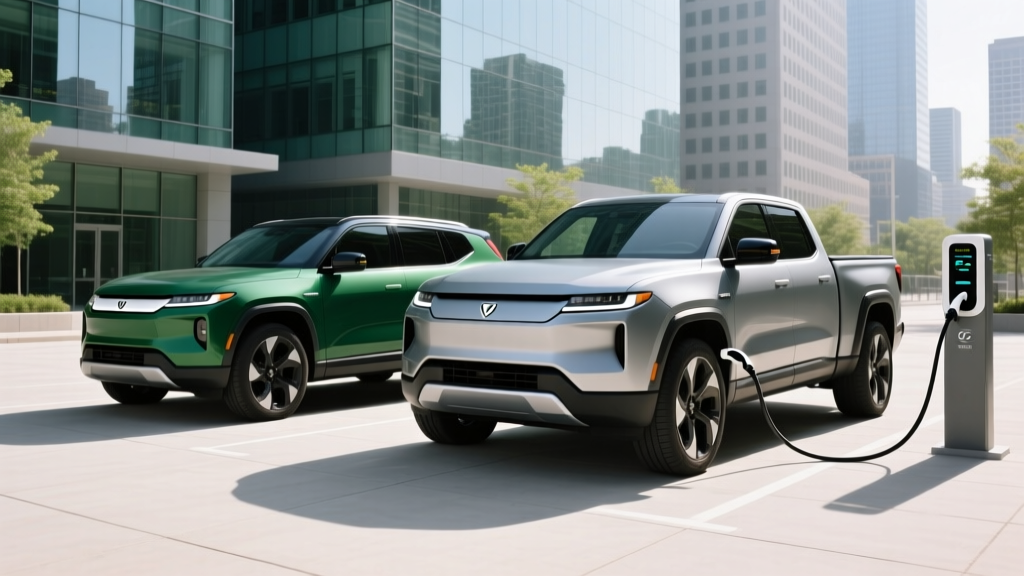
If you're researching the Rivian EV credit, you've likely seen conflicting information. The federal tax credit landscape shifted dramatically after the Inflation Reduction Act, and Rivian's positioning — premium electric trucks and SUVs built in Normal, Illinois — places it in a unique spot relative to MSRP caps, income limits, and battery-sourcing requirements. This guide cuts through the noise with 2026 model-year pricing, current IRS §30D rules, and a full 5-year total cost of ownership analysis for the R1S SUV and R1T pickup.
Does Rivian Qualify for the Federal EV Tax Credit?
The short answer: it depends on the trim, your income, and current battery-sourcing rules. The Rivian R1S and R1T are assembled in the United States (Normal, Illinois), which clears the North American final-assembly requirement. But that's just the first hurdle. Under current IRS §30D rules, several additional gates determine whether you can claim up to $7,500 — or anything at all.
§30D Federal Tax Credit Checklist for Rivian (2026)
- Final assembly: Must occur in North America. ✅ Rivian R1S and R1T are built in Illinois.
- MSRP cap: Vans, SUVs, and pickups are capped at $80,000 MSRP. Sedans and other passenger vehicles are capped at $55,000. The R1S (SUV) and R1T (pickup) fall under the $80,000 threshold — but higher trims like the R1S Quad Motor with Max Pack can exceed this.
- Buyer income limits: Modified adjusted gross income (MAGI) must not exceed $300,000 for joint filers, $225,000 for heads of household, or $150,000 for single filers.
- Battery components: A percentage of battery components must be manufactured or assembled in North America (threshold increases annually).
- Critical minerals: A percentage of critical minerals must be sourced from the U.S. or FTA-partner countries (threshold also increases annually).
- Point-of-sale transfer: As of 2024, eligible buyers can transfer the credit to the dealer at purchase, receiving it as an immediate price reduction rather than waiting to claim it on their tax return.
- One credit per VIN: Each vehicle qualifies only once, and you are limited to one §30D credit transfer per year (two for joint filers).
Source: IRS §30D Clean Vehicle Credit. Rules are subject to legislative and regulatory changes. Consult a tax professional for your specific situation.
The critical-minerals and battery-component sourcing requirements are where many EVs — including certain Rivian configurations — can lose partial or full credit eligibility from year to year. Rivian has worked to localize its supply chain, but the specific cell chemistry and supplier mix for each battery pack (Standard, Large, Max) determines the credit amount. Always verify current eligibility on fueleconomy.gov before purchasing.
Rivian R1S and R1T: 2026 Pricing vs. the $80,000 MSRP Cap
Here's where trim selection becomes a tax strategy. The §30D MSRP cap for SUVs and pickups is $80,000. Let's look at where 2026 Rivian models land:
| Model / Trim | Approx. Base MSRP | Under $80K Cap? | Potential Credit |
|---|---|---|---|
| R1T Dual Motor (Standard Battery) | ~$71,700 | Yes | Up to $7,500 |
| R1T Dual Motor (Large Battery) | ~$77,700 | Yes | Up to $7,500 |
| R1T Tri Motor | ~$101,000 | No | $0 |
| R1S Dual Motor (Standard Battery) | ~$76,900 | Yes | Up to $7,500 |
| R1S Dual Motor (Large Battery) | ~$82,900 | No | $0 |
| R1S Quad Motor (Max Pack) | ~$105,000+ | No | $0 |
MSRP figures are approximate for 2026 model year and subject to change. Destination charges and dealer-installed accessories may push a borderline configuration over the cap. Always confirm the exact MSRP on the window sticker before purchase.
The takeaway: if the Rivian EV credit is a deciding factor, the Dual Motor with Standard or Large Battery on the R1T, or the Dual Motor Standard Battery on the R1S, are your most likely paths to eligibility. Adding options or stepping up to Tri/Quad Motor eliminates credit qualification entirely.
5-Year Total Cost of Ownership: Rivian R1T Dual Motor
To understand what owning a Rivian actually costs, we modeled a 5-year / 75,000-mile ownership cycle for the R1T Dual Motor Large Battery. This is where the numbers get real — because while the Rivian EV credit reduces your effective purchase price, insurance and depreciation offset some of the fuel and maintenance savings.
Estimated 5-Year TCO: Rivian R1T Dual Motor Large Battery (AWD)
| Cost Category | 5-Year Estimate | Notes |
|---|---|---|
| Purchase price (Dual Motor Large) | $77,700 | Before incentives |
| Federal tax credit (§30D) | −$7,500 | If eligible (see checklist above) |
| Effective purchase price | $70,200 | Before state/utility incentives |
| Home charging (electricity) | $4,200–$5,600 | Based on $0.14–$0.19/kWh avg, 2.0 mi/kWh |
| Public DC fast charging | $1,200–$2,000 | Assuming ~15% of charging on road trips at $0.35–$0.48/kWh |
| Insurance (5 years) | $14,000–$18,000 | Higher than gas trucks — see insurance section |
| Maintenance & repairs | $1,800–$2,800 | No oil changes; tire rotation, cabin filter, wiper fluid, brake inspection |
| Tires (replacement set) | $1,400–$2,200 | EVs wear tires faster due to weight and instant torque |
| Depreciation (est. 5-yr) | $28,000–$36,000 | ~40–50% of purchase; EV depreciation has been volatile |
| Estimated 5-yr total cost | ~$51,000–$66,000 | Net of credit, inclusive of depreciation |
Assumes 15,000 miles/year, home Level 2 charging for 85% of sessions. Electricity rates and insurance premiums vary significantly by region. Depreciation estimates are based on current market trends and may shift.
Fuel Cost Reality: Electricity vs. Gas for the R1T
The Rivian R1T Dual Motor Large Battery carries an EPA efficiency rating of approximately 2.0 miles per kWh (combined). With a usable battery capacity around 128.9 kWh (Large Pack), that yields an EPA-estimated range of approximately 352 miles (real-world highway and cold-weather driving will reduce this to roughly 270–310 miles depending on conditions).
Cost Per Mile: Rivian R1T vs. Comparable Gas Truck
| Rivian R1T (Home Charging) | Rivian R1T (DC Fast) | Gas Truck (20 MPG) | |
|---|---|---|---|
| Energy cost | $0.16/kWh avg | $0.40/kWh avg | $3.60/gallon |
| Efficiency | 2.0 mi/kWh | 2.0 mi/kWh | 20 MPG combined |
| Cost per mile | $0.08 | $0.20 | $0.18 |
| Annual fuel (15K mi) | $1,200 | $3,000 | $2,700 |
Gas truck comparison based on a body-on-frame midsize pickup averaging 20 MPG combined at $3.60/gal. Electricity rates based on U.S. residential average. DC fast charging rates reflect Electrify America and Tesla Supercharger typical pricing in 2026.
Home charging delivers a clear per-mile advantage — roughly $0.08/mile vs. $0.18/mile for a comparable gas truck, saving approximately $1,500 per year or $7,500 over five years if you charge primarily at home. However, if you rely heavily on public DC fast charging (common for apartment dwellers or frequent road-trippers), the cost advantage narrows significantly. At $0.40/kWh, you're actually paying more per mile than gasoline.
This is why home Level 2 charging access is the single biggest variable in EV ownership economics. A Level 2 home charger (240V, 40–48 amps) delivers roughly 11.5 kW of charging power, adding about 23 miles of range per hour — enough to fully replenish the R1T overnight.
Maintenance Savings: What You Actually Skip
EVs eliminate the maintenance items tied to internal combustion: oil changes, spark plugs, timing belts, fuel filters, and exhaust system repairs. Regenerative braking also dramatically reduces brake pad wear — many EV owners report original brake pads lasting 80,000+ miles.
Typical Maintenance: Rivian R1T vs. Gas Pickup (5 Years / 75K Miles)
| Service Item | Rivian R1T | Gas Pickup |
|---|---|---|
| Oil changes (synthetic) | $0 | $600–$900 |
| Transmission fluid | $0 (single-speed) | $200–$350 |
| Spark plugs | $0 | $200–$400 |
| Air filter / cabin filter | $100–$200 | $150–$250 |
| Brake pads (front + rear) | $0–$400 | $500–$900 |
| Coolant / fluid services | $100–$200 | $300–$500 |
| Tire rotation | $250–$400 | $250–$400 |
| Total estimated | $450–$1,200 | $2,200–$3,700 |
EV maintenance savings are real but not zero. The R1T's 7,000+ lb curb weight and instant torque mean tire wear is accelerated — budget for at least one replacement set over 75,000 miles ($1,400–$2,200 for all-terrain or highway tires in the R1T's 20–22" sizes).
Rivian offers a 5-year / 60,000-mile bumper-to-bumper warranty and an 8-year / 175,000-mile battery and drive unit warranty, which provides substantial coverage during the typical ownership window. The battery warranty guarantees a minimum capacity retention (typically 70% State of Health), protecting against premature degradation.
The Insurance Reality for Rivian Owners
This is where the ownership math gets less comfortable. Rivian insurance premiums are typically 25–45% higher than comparable gas-powered trucks and SUVs. For the R1T and R1S, expect annual premiums in the range of $2,800–$3,600 depending on your state, driving record, age, and coverage levels.
Why the premium? Several factors:
- Repair costs: Rivian's aluminum-intensive body structure, integrated battery pack, and specialized components mean collision repairs are expensive. Fewer body shops have Rivian-specific training and equipment.
- Vehicle price: Higher MSRP means higher insured value, driving up comprehensive and collision premiums.
- Parts availability: As a lower-volume manufacturer, Rivian parts can take longer to source after a collision, increasing rental car costs that insurers factor in.
- Claims data: Insurers are still building actuarial data on EVs, and early data shows higher average claim severity for electric vehicles across brands.
Some insurers offer EV-specific discounts (typically 5–10%), and Rivian has partnered with select insurance providers to offer competitive rates. Always get quotes from at least three insurers before purchasing — the spread between the cheapest and most expensive quote for a Rivian can exceed $1,000/year.
Depreciation and Resale Value
EV depreciation has been one of the most volatile metrics in the auto market over the past few years. After aggressive price cuts by Tesla and intensifying competition, many EVs — including Rivians — experienced steeper-than-expected depreciation in 2023–2025.
Current trends for the Rivian R1T and R1S:
- 1-year depreciation: 15–25% (improved from the 30%+ seen during the 2023–2024 price war period)
- 3-year depreciation: 35–45%
- 5-year depreciation: 40–55% (highly dependent on battery health, mileage, and market conditions)
For a $77,700 R1T Dual Motor Large, that translates to roughly $31,000–$43,000 in depreciation over five years. However, if you claimed the full $7,500 federal credit, your cost basis drops to $70,200, reducing your effective depreciation loss to $23,500–$35,500.
Factors that help Rivian's resale value: the brand's strong enthusiast community, over-the-air software updates that add features post-purchase, the R1T's unique positioning as the only premium electric pickup, and Rivian's expanding service network. Factors that hurt it: rapid EV technology advancement making older models feel dated, uncertainty around long-term battery replacement costs (estimated at $15,000–$25,000 out of warranty), and the general premium-EV market softening.
State, Local, and Utility Incentives Beyond Federal
Additional Incentives Vary Significantly by Location
The federal §30D credit is only one piece of the incentive puzzle. Depending on where you live and which utility serves your home, you may qualify for additional savings:
- State rebates: States like California (CVRP, up to $7,000 for income-qualified buyers), Colorado (up to $5,000 state tax credit), Massachusetts, New York, and others offer additional purchase incentives. These programs have their own income caps, price caps, and funding availability — check your state's energy office for current status.
- Utility rebates: Many utilities offer $500–$1,500 rebates for purchasing an EV and/or installing a Level 2 home charger. Examples include PG&E, SCE, Xcel Energy, ConEdison, and dozens of municipal utilities.
- HOV lane access: Several states grant EVs single-occupant HOV lane access (California, Colorado, Florida, Georgia, and others), which has significant time-value for commuters.
- Reduced registration fees: Some states waive or reduce EV registration fees; others actually charge higher fees to offset lost gas tax revenue.
Always verify current state and utility incentive availability through official sources — programs can expire, run out of funding, or change eligibility rules without notice. The Alternative Fuels Data Center maintains a state-by-state incentive database.
Rivian EV Credit FAQ
How much does it really cost to own a Rivian over 5 years?
For the R1T Dual Motor Large Battery, expect a 5-year total cost of approximately $51,000–$66,000 including depreciation, electricity, insurance, maintenance, and tires — net of the $7,500 federal credit if eligible. The biggest variables are your insurance premium ($14,000–$18,000 over 5 years) and how much you charge at home vs. public DC stations. Home charging is roughly half the per-mile cost of gasoline; exclusive DC fast charging can exceed it.
Do I qualify for the federal Rivian EV tax credit?
You may qualify for up to $7,500 under §30D if: (1) you purchase a Rivian configuration with an MSRP at or below $80,000 (R1T Dual Motor Standard/Large, R1S Dual Motor Standard); (2) your MAGI is under $300K joint / $225K head of household / $150K single; (3) the specific battery pack meets current critical-minerals and battery-component sourcing thresholds; and (4) the vehicle is delivered new to you. Check fueleconomy.gov for the most current eligibility list and consult a tax professional.
How much do I save on fuel and maintenance with a Rivian?
Charging at home at the U.S. residential average (~$0.16/kWh), the R1T costs approximately $0.08/mile to fuel vs. $0.18/mile for a comparable 20-MPG gas truck — saving roughly $1,500/year or $7,500 over five years. Maintenance savings add another $1,000–$2,500 over five years from eliminated oil changes, spark plugs, and reduced brake wear. Combined fuel + maintenance savings: approximately $8,500–$10,000 over five years for a typical driver.
Are Rivians more expensive to insure than gas trucks?
Yes. Expect Rivian insurance premiums to run 25–45% higher than a comparable gas-powered midsize pickup — roughly $2,800–$3,600/year depending on your profile. The higher cost is driven by expensive collision repairs (aluminum body, integrated battery), limited body shop familiarity, and higher vehicle value. Over five years, that's an additional $3,500–$7,000 in insurance costs compared to a gas truck, which partially offsets fuel and maintenance savings.
How well do Rivians hold their value?
Rivian depreciation has moderated but remains steeper than many gas vehicles. Expect approximately 40–55% depreciation over five years, translating to $31,000–$43,000 in value loss on a $77,700 R1T. The federal tax credit, if claimed, effectively reduces your cost basis and thus your net depreciation loss. Rivian's strong brand loyalty, OTA updates, and the R1T's unique market position provide some resale support, but rapid EV technology evolution and battery replacement cost uncertainty remain headwinds.
Can I get the Rivian EV credit as a point-of-sale discount?
Yes. Under current §30D rules, eligible buyers can elect to transfer the credit to the dealer at the time of purchase, receiving it as an immediate reduction in the purchase price (or down payment) rather than claiming it on their federal tax return the following year. The dealer must be registered with the IRS Energy Credits portal. This makes the credit accessible even if you wouldn't have sufficient tax liability to use the full credit on your return.