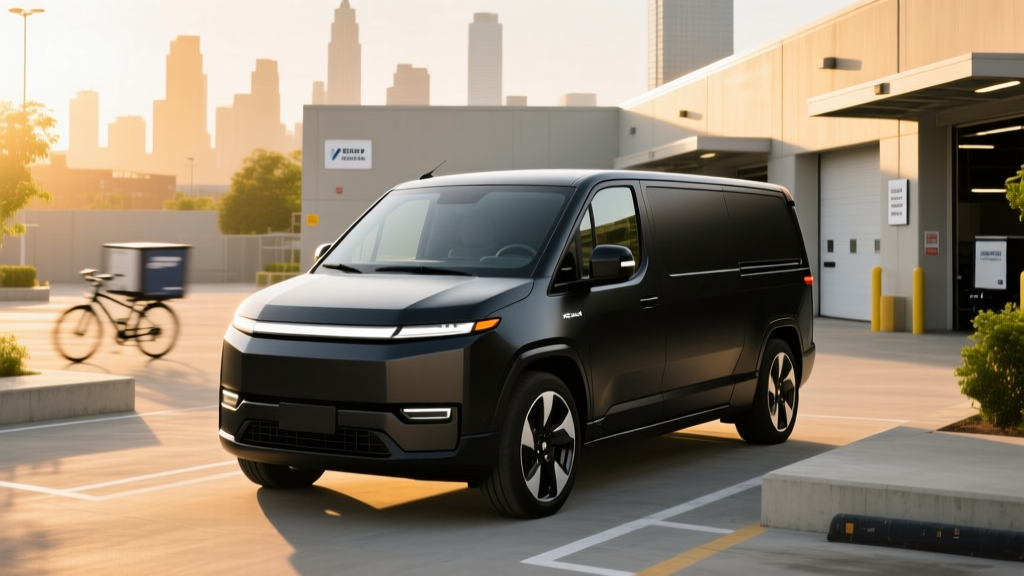
If you've searched for an electric work van and typed Rivian Sprinter van into a search bar, you're not alone — but you won't find a badge that says "Sprinter" on a Rivian. The vehicle you're actually looking for is the Rivian EDV (Electric Delivery Van), a purpose-built commercial EV that Rivian designed in partnership with Amazon. While Mercedes-Benz offers the eSprinter under the Sprinter nameplate, Rivian's EDV occupies a parallel lane: a boxy, right-hand-drive-capable, high-roof electric cargo van aimed squarely at last-mile delivery fleets and commercial operators.
As of the 2026 model year, Rivian has expanded EDV availability beyond Amazon's exclusive fleet, opening orders to qualified commercial buyers. Here's everything you need to know about range, charging, cargo dimensions, pricing, and whether this van fits your operation.
Quick Verdict: Who the Rivian EDV Is For
The Rivian EDV is not a consumer vehicle. You won't find it in a showroom alongside the R1S or R1T. It's a Class 2b commercial delivery van built for stop-and-go urban and suburban routes. If you run a delivery fleet, a courier service, or a mobile business and want to eliminate diesel fuel costs and emissions in a metro area, the EDV is one of the most capable electric vans on the market. If you need a long-haul interstate hauler or a passenger-configured van, look at the Mercedes-Benz eSprinter or Ford E-Transit instead.
Look elsewhere if: You need highway-speed long-range hauling, passenger seating for more than two, or a consumer-purchasable van you can drive home today without a fleet agreement.
Rivian EDV Specs at a Glance
| Spec | Rivian EDV 500 (Standard) | Rivian EDV 700 (Large) | Rivian EDV 900 (Max) |
|---|---|---|---|
| EPA Est. Range | ~150 mi | ~161 mi | ~161 mi |
| Battery Capacity | ~105 kWh (NMC) | ~149 kWh (NMC) | ~149 kWh (NMC) |
| Max DC Fast Charge | ~150 kW | ~150 kW | ~150 kW |
| 10–80% DC Charge | ~45 min | ~60 min | ~60 min |
| Level 2 Rate | ~11.5 kW (~18 mi/hr) | ~11.5 kW (~18 mi/hr) | ~11.5 kW (~18 mi/hr) |
| Horsepower | ~275 hp | ~275 hp | ~275 hp |
| 0–60 mph | ~8.0 sec | ~8.5 sec | ~9.0 sec |
| Drivetrain | RWD (single motor) | RWD (single motor) | RWD (single motor) |
| Cargo Volume | ~500 cu ft | ~680 cu ft | ~840 cu ft |
| Efficiency | ~1.8 MPGe (kWh/mi: ~0.65) | ~1.8 MPGe (~0.70 kWh/mi) | ~1.8 MPGe (~0.72 kWh/mi) |
| Base MSRP (Fleet) | ~$70,000 | ~$80,000 | ~$90,000 |
Note: Rivian does not publish consumer-facing MSRP for the EDV the way it does for the R1T and R1S. Pricing above reflects reported fleet-unit costs and industry estimates as of early 2026. Contact Rivian Commercial for binding quotes.
Real-World Range: What the EPA Sticker Doesn't Tell You
Real-World Expectation: 110–135 miles in mixed urban delivery use; 90–115 miles in cold weather (below 32°F) or on sustained highway segments above 65 mph.
The EDV's range figure looks modest compared to consumer EVs, but context matters. This is a 7,000–9,000 lb GVWR box van making 80–150 stops per day with constant acceleration, regenerative braking, and HVAC load. In EPA testing cycles, the van achieves its rated figures under standardized conditions. In actual fleet operations — particularly Amazon's — the EDV typically covers 100–130 miles per shift before returning to depot.
Cold-weather impact is real. NMC battery chemistry loses roughly 20–30% of usable capacity in sub-freezing temperatures without active preconditioning. Rivian's thermal management system helps mitigate this, but fleet operators in northern climates should plan routes 25% shorter in winter or budget for mid-shift opportunity charging.
Highway efficiency penalty: The EDV's tall, flat-fronted aerodynamic profile creates substantial drag above 55 mph. If your routes include extended freeway segments, expect efficiency to drop to ~0.75–0.80 kWh/mile, cutting effective range to ~110 miles on the EDV 500.
Charging Speed: Depot and Public DC Fast Charging
Charging infrastructure is the make-or-break factor for commercial EV adoption. The EDV supports three charging tiers:
| Level | Power | Miles Added/Hr | Use Case |
|---|---|---|---|
| Level 1 (120V) | ~1.4 kW | ~2 mi/hr | Emergency trickle only |
| Level 2 (240V) | ~11.5 kW | ~18 mi/hr | Overnight depot charging (8–10 hr for full) |
| DC Fast Charge | Peak ~150 kW | ~120 mi/hr (at peak) | 10–80% in ~45–60 min |
Charging curve reality: The EDV's peak 150 kW rate is not sustained across the full session. Like all lithium-ion packs, the charge rate tapers significantly above 80% state of charge to protect cell longevity. Expect the 10–80% window to average around 100–120 kW on the EDV 700 and 900, with the final 80–100% stretch adding another 30–40 minutes. Fleet best practice is to charge to 80% and dispatch, avoiding the slow taper entirely.
Depot charging is the primary strategy. Most EDV operators install multiple Level 2 stations at fleet depots, charging overnight at ~$0.08–0.14/kWh depending on utility commercial rates. A full overnight charge on the EDV 700 costs roughly $12–21 in electricity — compared to $35–55 in diesel for an equivalent Sprinter route.
The EDV uses a CCS1 connector for DC fast charging, compatible with Electrify America, EVgo, and most public networks. However, public DC charging for a van this size is impractical at most retail locations due to stall dimensions and weight limits.
Performance and Drivetrain
The Rivian EDV uses a single rear-mounted motor producing approximately 275 horsepower and 350 lb-ft of torque. Unlike Rivian's consumer vehicles (which offer dual- and quad-motor AWD), the EDV is rear-wheel drive only. This is deliberate: RWD reduces complexity, weight, and cost for a vehicle that rarely encounters unpaved or low-traction surfaces in urban delivery use.
Acceleration is brisk for a commercial van — 0–60 mph in roughly 8.0–9.0 seconds depending on body length and payload. That's meaningfully quicker than a diesel Sprinter (which typically runs 12–15 seconds to 60) and makes merging onto freeways and navigating stop-and-go traffic noticeably easier.
Regenerative braking is aggressive and well-tuned for delivery work. The one-pedal driving mode recovers significant energy during the hundreds of daily deceleration events, extending effective range and reducing brake wear. Fleet operators report brake pad intervals of 80,000–100,000+ miles, a major maintenance savings over diesel equivalents.
Cargo Space and Dimensions
The EDV comes in three body lengths, each with a different cargo volume and wheelbase:
- EDV 500: ~500 cu ft cargo volume, ~250-inch overall length, low roof
- EDV 700: ~680 cu ft cargo volume, ~290-inch overall length, high roof
- EDV 900: ~840 cu ft cargo volume, ~330-inch overall length, high roof
Interior cargo height on the high-roof models is approximately 84 inches — a full 6 inches taller than a high-roof Mercedes-Benz Sprinter 2500. The EDV 900's 840 cu ft cargo area rivals the largest Sprinter configurations, and the flat floor (no transmission tunnel) maximizes usable space.
The cab seats two (driver and passenger) with a fold-down workstation between them. There is no rear seating. The driver's position is configurable for right-hand or left-hand drive — a critical advantage for curb-side delivery in dense urban environments.
Pricing, Fleet Costs, and Tax Credit Eligibility
Rivian does not publish consumer MSRPs for the EDV. Reported fleet pricing places the EDV 500 at approximately $70,000, the EDV 700 at ~$80,000, and the EDV 900 at ~$90,000 before incentives. For comparison, a diesel Mercedes-Benz Sprinter 2500 cargo van starts around $48,000, and the Ford E-Transit starts at ~$45,000.
Federal Tax Credit: The §30D and §45W Landscape
Commercial EV tax incentives are complex and differ from consumer credits. Here's what applies to the EDV:
- §30D Clean Vehicle Credit (consumer): The EDV is a commercial vehicle and generally does not qualify for the consumer §30D credit, which has MSRP caps ($80,000 for vans/SUVs/trucks), buyer income limits ($300k joint / $150k individual), and battery-sourcing/critical-mineral requirements. Consult IRS guidance on §30D and a tax professional.
- §45W Commercial Clean Vehicle Credit: Fleet buyers and businesses can claim up to $7,500 for vehicles under 14,000 lb GVWR (the EDV qualifies) or up to $40,000 for heavier vehicles. This credit is claimed by the business entity, not an individual, and has different sourcing rules. See IRS §45W guidance.
- State and utility incentives: Many states (California HVIP, New York Truck Voucher Incentive, etc.) offer additional $20,000–$60,000 in point-of-sale rebates for commercial EVs. Check your state's clean-truck program.
After the §45W credit and state incentives, effective acquisition cost for the EDV 700 can drop to $50,000–65,000, narrowing the gap with diesel Sprinters significantly — and the per-mile operating cost advantage is immediate.
Warranty and Long-Term Ownership
Rivian provides the following warranty coverage for the EDV:
- Battery pack: 8 years / 100,000 miles (whichever comes first), with a minimum 70% capacity retention guarantee
- Powertrain (motor, inverter, reduction gear): 8 years / 100,000 miles
- Bumper-to-bumper: 5 years / 60,000 miles
- Corrosion: 12 years / unlimited miles
The 70% capacity retention threshold is standard across the industry. In practice, NMC packs in commercial stop-and-go service typically retain 80–85% capacity at 100,000 miles if DC fast charging is limited to 80% SoC and the thermal management system is maintained. Battery replacement cost, if needed out of warranty, is estimated at $18,000–$25,000 for the larger pack — a significant expense, but one that most fleet operators will not face within the vehicle's primary service life.
Tech, Driver Assists, and Standout Features
The EDV's technology suite is commercial-focused rather than luxury-oriented:
- 15.6-inch central touchscreen with fleet management integration, route optimization, and telematics
- Rivian Driver+ (SAE Level 2): Adaptive cruise control, lane-keeping assist, automatic emergency braking, blind-spot monitoring. This is not autonomous driving — the driver must remain engaged at all times.
- 360-degree camera system for tight urban maneuvering
- Over-the-air updates for software improvements and feature additions
- Integrated shelving and bulkhead options designed with Amazon's delivery workflow in mind
Pros and Cons
- Massive cargo volume (up to 840 cu ft) with flat floor
- Dramatically lower per-mile fuel cost vs diesel (~$0.12/mi vs ~$0.45/mi)
- Reduced brake wear from regen (100k+ mi intervals)
- Right-hand-drive option for curb-side delivery
- Quiet operation ideal for early-morning residential routes
- Over-the-air updates keep fleet software current
- Limited range (~150 mi EPA; less in cold/highway use)
- RWD only — not suited for snow-belt routes without dedicated winter tires
- Fleet-only sales model limits individual/small-business access
- High upfront cost vs diesel Sprinter (offset by incentives and fuel savings)
- DC fast charging is slow relative to consumer EVs (60 min 10–80%)
- Limited public charging infrastructure for large commercial vehicles
Rivian EDV vs Competitors: Ford E-Transit and Mercedes eSprinter
| Spec | Rivian EDV 700 | Ford E-Transit (High Roof) | Mercedes eSprinter (2500) |
|---|---|---|---|
| EPA Range | ~161 mi | ~126 mi | ~200 mi (est.) |
| Battery | ~149 kWh NMC | 68 kWh NMC | ~113 kWh NMC |
| Max DC kW | ~150 kW | ~115 kW | ~115 kW |
| Cargo Volume | ~680 cu ft | ~487 cu ft | ~533 cu ft |
| Base Price (est.) | ~$80,000 | ~$52,000 | ~$75,000 |
| RHD Option | Yes | No | Limited |
The EDV 700 offers the most cargo volume of the three and the largest battery, but at a higher entry price. The Ford E-Transit is the value play — significantly cheaper, widely available, and adequate for shorter routes. The eSprinter sits in between with decent range but less cargo space. For Amazon-scale operations with right-hand-drive needs, the EDV is the clear winner. For smaller fleets on a budget, the E-Transit is the pragmatic choice.
Frequently Asked Questions
What is the real-world range of the Rivian EDV?
The EPA rates the EDV 700 at approximately 161 miles. In real-world urban delivery use, expect 110–135 miles per charge. In cold weather (below 32°F) or on highway-heavy routes, plan for 90–115 miles. Fleet operators should size routes to ~80% of the real-world figure to maintain a safety buffer.
How fast does the Rivian EDV charge at home and on DC?
On Level 2 (240V, 11.5 kW), the EDV adds roughly 18 miles of range per hour — a full overnight charge takes 8–10 hours. On DC fast charging, it peaks at ~150 kW and charges from 10–80% in approximately 45–60 minutes depending on pack size. The charge rate tapers significantly above 80%.
How much does the Rivian EDV cost after tax credits?
Fleet pricing starts around $70,000–$90,000 depending on body length. The §45W Commercial Clean Vehicle Credit provides up to $7,500, and state incentives (e.g., California HVIP) can add $20,000–$60,000. Effective cost after incentives: $50,000–$65,000 for the EDV 700. Always verify current incentive availability with your state program and a tax professional.
Is the Rivian EDV worth buying vs the Ford E-Transit or Mercedes eSprinter?
For large-scale last-mile delivery with right-hand-drive needs and routes under 130 miles, the EDV is the most purpose-built option available. For smaller fleets, owner-operators, or businesses needing consumer-style purchasing, the Ford E-Transit at ~$52,000 is a more accessible entry point with lower upfront cost. The eSprinter is competitive on range but trails on cargo volume.
Does the Rivian EDV qualify for the federal EV tax credit?
The EDV qualifies for the §45W Commercial Clean Vehicle Credit (up to $7,500 for vehicles under 14,000 lb GVWR), not the consumer §30D credit. §45W has different eligibility rules and is claimed by the business entity. Consult IRS §45W guidance and a qualified tax professional to confirm your fleet's eligibility.
Can individual consumers buy a Rivian EDV?
As of 2026, Rivian sells the EDV primarily to fleet and commercial buyers through direct fleet agreements. Individual consumer purchases are not part of Rivian's current sales model for this vehicle. If you're a small business owner, contact Rivian Commercial to inquire about minimum-order requirements.
Sources: fueleconomy.gov, IRS §45W Commercial Clean Vehicle Credit, Rivian Commercial specifications (reported). All specifications are estimates based on available fleet data and may vary by configuration and model year.