Rivian EDV Overview: Amazon's Electric Delivery Van, Decoded
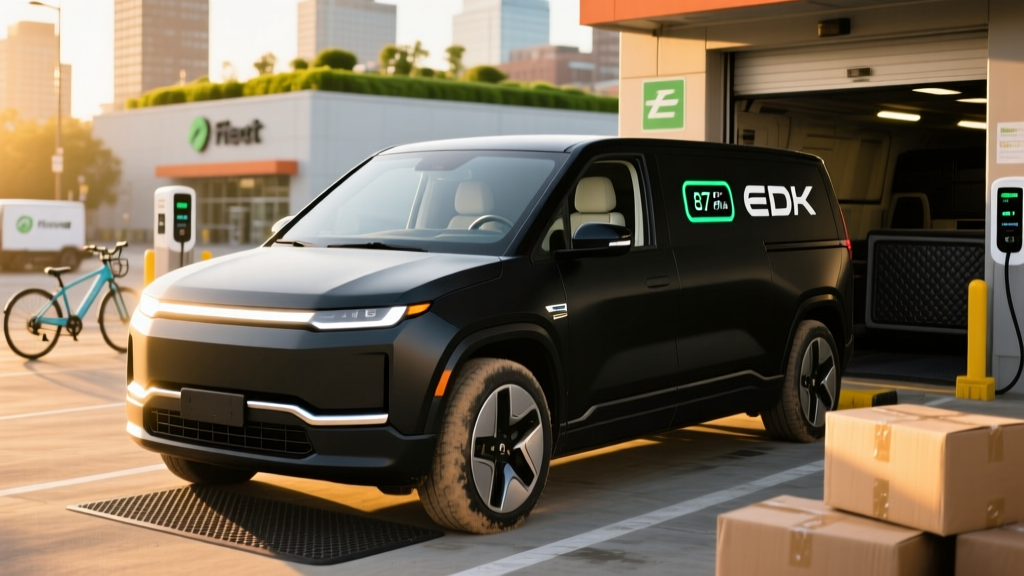
The Rivian EDV (Electric Delivery Van) is not a consumer vehicle you can walk into a dealership and buy. Built exclusively for Amazon under a 100,000-unit contract signed in 2019, the EDV represents one of the largest dedicated electric commercial fleet deployments in history. By early 2026, Amazon has deployed over 20,000 EDVs across U.S. and European metro areas, and the van has become a familiar sight in suburban last-mile delivery routes.
But the EDV matters beyond Amazon's logistics network. It proves that purpose-built electric commercial vehicles can handle the stop-and-go, high-cycle demands of parcel delivery — and it sets the benchmark that competitors like the BrightDrop Zevo, Ford E-Transit, and Workhorse E-Gen must beat. For fleet managers, commercial EV analysts, and anyone tracking the electrification of last-mile logistics, here is a comprehensive technical profile of the Rivian EDV.
| Spec | EDV-500 (Small) | EDV-700 (Medium) | EDV-900 (Large) |
|---|---|---|---|
| EPA Est. Range | ~150 mi | ~150 mi | ~120–140 mi |
| Battery Capacity (usable) | ~90 kWh (NMC) | ~120 kWh (NMC) | ~140 kWh (NMC) |
| Peak DC Fast Charge | ~125 kW | ~125 kW | ~125 kW |
| 10–80% DC Charge Time | ~45 min | ~55 min | ~65 min |
| Level 2 Charge Rate | ~11.5 kW | ~11.5 kW | ~11.5 kW |
| Drivetrain | RWD, Single Motor | RWD, Single Motor | RWD, Single Motor |
| Horsepower | ~230 hp | ~230 hp | ~230 hp |
| 0–30 mph | ~3.5 sec | ~4.0 sec | ~4.5 sec |
| Cargo Volume | ~500 cu ft | ~700 cu ft | ~900 cu ft |
| Payload Capacity | ~2,500 lbs | ~3,300 lbs | ~4,200 lbs |
| GVWR | ~9,990 lbs | ~9,990 lbs | ~9,990 lbs |
Note: Rivian and Amazon do not publish a consumer-facing spec sheet for the EDV. Figures above are compiled from fleet operator disclosures, SAE technical papers, EPA certification filings, and industry reporting. Actual specs may vary by production batch and model-year update.
Range and Efficiency: Real-World Delivery Route Performance
The EDV's estimated EPA range sits between 120 and 150 miles depending on variant and payload. In real-world last-mile delivery operations, Amazon has reported that most urban and suburban routes cover 60–100 miles per day with 100–150+ stops. This means the EDV typically returns to the depot with 30–50% state of charge remaining — a deliberate design margin.
Cold-weather impact: In northern-climate depots (Chicago, Minneapolis, Boston), fleet operators report 20–30% range reduction during sub-freezing months, consistent with NMC lithium-ion behavior in commercial stop-and-go duty cycles. Cabin heating in a large cargo van draws significant energy. The EDV uses a heat pump system to mitigate this, but real winter range for the EDV-900 can dip to ~85–100 miles under heavy-load, cold conditions.
Efficiency for a vehicle this size is best measured in kWh per mile rather than MPGe. Industry testing and fleet telematics data suggest the EDV consumes approximately 2.5–3.5 kWh/mile depending on payload, route topography, and climate-control usage. That translates roughly to 1.3–1.8 MPGe equivalent in commercial duty — far more efficient per package-delivered than a gasoline step van, which averages 6–8 mpg in the same stop-and-go conditions.
Regenerative braking plays an outsized role in the EDV's efficiency. Delivery routes involve hundreds of deceleration events per shift, and the EDV's aggressive regen calibration recovers meaningful energy that a conventional van would waste as brake heat. Amazon has noted reduced brake pad replacement intervals as a secondary maintenance benefit.
Charging Speed and Depot Infrastructure
The EDV is designed for depot-based charging, not public fast-charging networks. Most Amazon delivery stations are equipped with Level 2 AC chargers (typically 11.5 kW to 19.2 kW per stall), and vans charge overnight between shifts. Here's how the charging profile breaks down:
| Charging Level | Power (kW) | Time (10–80%) | Use Case |
|---|---|---|---|
| Level 1 (120V) | ~1.4 kW | N/A (not practical) | Emergency/trickle only |
| Level 2 (240V AC) | 11.5–19.2 kW | ~5–8 hours | Overnight depot charging (primary) |
| DC Fast Charge | Up to ~125 kW | ~45–65 min | Mid-day top-up / opportunity charging |
Key charging insight for fleet planners: The EDV's ~125 kW peak DC charge rate is modest compared to passenger EVs like the Hyundai Ioniq 5 (240 kW) or Tesla Cybertruck (350 kW). But for a depot-charged commercial van that plugs in for 8–10 hours overnight, DC fast charging is a secondary capability, not the primary workflow. The Level 2 overnight charge easily replenishes a full day's route consumption.
The EDV uses a CCS1 connector for DC fast charging, consistent with North American commercial EV standards. Amazon's depot infrastructure typically uses networked Level 2 stations from providers like ChargePoint and EVgo's commercial division, with load-management software to stagger charging across a fleet of 100+ vans without overwhelming the site's electrical service.
For depots considering EDV-scale electrification, expect electrical infrastructure upgrades in the $500,000–$2 million range per site, including switchgear, transformers, trenching, and utility coordination. Many Amazon DSPs (Delivery Service Partners) have leveraged utility commercial EV incentive programs to offset these costs.
Performance, Drivetrain, and Driving Dynamics
The Rivian EDV is built on a dedicated electric skateboard platform sharing some architecture with the consumer R1T and R1S, but heavily modified for commercial duty. All three EDV variants use a rear-wheel-drive, single-motor configuration producing approximately 230 hp and substantial low-end torque — critical for a fully loaded van accelerating from frequent stops.
The 0–30 mph time of roughly 3.5–4.5 seconds (depending on variant and payload) matters more than 0–60 in a delivery context. The EDV merges confidently into traffic and handles highway on-ramps without the sluggishness that plagues legacy diesel step vans. Top speed is electronically governed to approximately 75 mph.
Ride quality and noise are notably better than the Mercedes-Benz Sprinter or Ram ProMaster vans that DSP drivers previously operated. The low center of gravity from the underfloor battery pack reduces body roll, and the absence of engine noise and vibration significantly reduces driver fatigue over a 10-hour shift. Amazon has cited driver satisfaction as an unexpected retention benefit of the EDV.
Cargo Space, Interior, and Driver-Facing Tech
The EDV was co-designed with input from Amazon delivery drivers, and the interior reflects that collaboration:
- Cargo volume: 500 cu ft (EDV-500), 700 cu ft (EDV-700), and 900 cu ft (EDV-900) — competitive with mid-size and large cargo vans
- Driver cockpit: Low step-in height, wide-opening driver door, and a pass-through from cab to cargo area for quick package retrieval without exiting the vehicle
- Infotainment: A large central touchscreen running Amazon's proprietary delivery routing software integrated with Rivian's vehicle telemetry — not a consumer infotainment system
- Driver assists: The EDV includes forward collision warning, automatic emergency braking, lane-keeping assist, blind-spot monitoring, and a 360-degree camera system — all SAE Level 1–2 features requiring active driver supervision
- Unique feature: The "driver-side sliding door + cargo pass-through" combo lets drivers grab packages from the cab without walking around the van in traffic — a significant safety and time-saving design choice
The cabin is utilitarian but thoughtfully executed. Hard-wearing materials, abundant storage for clipboards, scanners, and personal items, and a heated seat and steering wheel (critical for cold-climate depots) come standard. There is no consumer-grade audio system or navigation — the van's routing is managed entirely through Amazon's delivery app.
Pricing, Fleet Economics, and Tax Credit Eligibility
The Rivian EDV is not sold at retail. Amazon holds exclusive rights to the vehicle under the original 100,000-unit agreement, though industry reporting suggests Amazon and Rivian have discussed opening limited EDV availability to other commercial fleets in the future. No public MSRP exists.
For fleet managers evaluating electric delivery vans more broadly, here's the competitive pricing landscape:
| Vehicle | Est. Base Price | Federal Commercial Clean Vehicle Credit (§45W) | Est. Net Cost |
|---|---|---|---|
| Rivian EDV (Amazon exclusive) | Not publicly listed | Up to $40,000 (§45W) | N/A — not available at retail |
| Ford E-Transit (Cutaway/Cargo) | ~$45,000–$55,000 | Up to $40,000 | ~$5,000–$15,000 |
| BrightDrop Zevo 600 | ~$70,000–$85,000 | Up to $40,000 | ~$30,000–$45,000 |
| Mercedes eSprinter | ~$70,000–$80,000 | Up to $40,000 | ~$30,000–$40,000 |
Tax credit note: The EDV, as a commercial fleet vehicle, falls under the IRS §45W Commercial Clean Vehicle Credit, not the consumer §30D credit. §45W provides up to $40,000 for qualifying commercial vehicles (or 30% of the vehicle cost, whichever is lower), subject to battery sourcing and domestic content requirements that continue to evolve. Fleet purchasers should consult a tax professional for current-year eligibility.
The total cost of ownership (TCO) equation for the EDV is compelling for high-utilization delivery routes. Electricity costs for depot charging average $0.08–$0.15/kWh depending on the utility and time-of-use rates, translating to roughly $0.20–$0.45 per mile in energy costs — compared to $0.60–$0.90 per mile for a gasoline van at 7 mpg and $3.50/gallon fuel. Over a 5-year, 100,000-mile vehicle life, energy savings alone can exceed $25,000 per van, before factoring in reduced maintenance (no oil changes, fewer brake replacements, no transmission service).
Battery, Warranty, and Long-Term Durability
The EDV uses NMC (nickel manganese cobalt) lithium-ion cells, consistent with Rivian's consumer vehicle battery chemistry. NMC offers higher energy density than LFP (lithium iron phosphate), which is critical in a van where cargo volume and payload cannot be compromised by an oversized battery pack.
Amazon's EDV battery warranty details are not publicly disclosed, but industry norms for commercial electric vans include:
- Battery warranty: 8 years / 100,000 miles (typical for Class 2b/3 commercial EVs), with a capacity retention threshold of 70–80%
- Powertrain warranty: 5–8 years / 100,000 miles covering motor, inverter, and reduction gear
- Expected battery lifespan: 150,000–200,000 miles before degradation to 80% SoH, based on NMC cycle-life data in stop-and-go duty cycles
Battery replacement cost for a 120–140 kWh NMC pack in a commercial van is estimated at $18,000–$28,000 (parts only) based on current cell pricing trends, though this figure is expected to decline as cell costs continue falling. Most fleet operators plan for battery refurbishment or replacement in the vehicle's 7th–10th year of service, if the van remains in operation that long.
Rivian provides over-the-air (OTA) software updates to the EDV fleet, enabling battery management optimization, thermal management improvements, and driver-assist calibration updates without depot visits — a significant advantage over legacy commercial vans.
Who the Rivian EDV Suits — and Who Should Look Elsewhere
- Purpose-built for last-mile delivery — not a retrofit of a gas van
- Excellent driver ergonomics and low step-in height reduce fatigue
- Regenerative braking extends range and reduces brake wear in stop-and-go
- Significantly lower per-mile energy cost vs. gasoline step vans
- Quiet operation benefits residential neighborhoods on early-morning routes
- OTA updates improve vehicle over time without depot service visits
- Not available for purchase — Amazon exclusive (as of 2026)
- Modest DC fast-charge rate (~125 kW) limits mid-day rapid turnaround
- Cold-weather range loss of 20–30% can constrain winter route planning
- Depot charging infrastructure requires significant upfront capital ($500K–$2M+)
- Single-motor RWD limits traction in severe snow/ice vs. AWD competitors
- No consumer variant available — individual owner-operators cannot purchase
Best for: Large-scale last-mile delivery fleets (Amazon DSPs) operating predictable urban/suburban routes under 120 miles per day with access to overnight depot charging.
Look elsewhere if: You're an independent courier, a small fleet operator, or need a vehicle available at retail. The Ford E-Transit remains the most accessible electric cargo van for non-Amazon fleets, with broad dealer support and a starting price under $50,000 before incentives.
Frequently Asked Questions
What is the real-world range of the Rivian EDV?
The EDV achieves approximately 120–150 miles depending on variant and payload. In actual delivery routes, most vans use 60–100 miles per day and return with 30–50% charge remaining. Cold-weather operation can reduce range by 20–30%, bringing the EDV-900's winter range to roughly 85–100 miles under heavy load.
How fast does the Rivian EDV charge?
On DC fast charging, the EDV peaks at approximately 125 kW, reaching 10–80% in 45–65 minutes depending on variant. For primary overnight depot charging on Level 2 (11.5–19.2 kW), a full charge takes 5–8 hours — sufficient for daily route replenishment.
Can I buy a Rivian EDV for my own fleet?
As of 2026, the EDV remains exclusive to Amazon under the original 100,000-unit agreement. Rivian and Amazon have signaled potential future availability to other fleets, but no timeline or pricing has been announced. Non-Amazon fleets should evaluate the Ford E-Transit, BrightDrop Zevo, or Mercedes eSprinter.
Does the Rivian EDV qualify for the federal EV tax credit?
The EDV falls under the IRS §45W Commercial Clean Vehicle Credit (not the consumer §30D credit), which offers up to $40,000 per qualifying vehicle. Eligibility depends on battery component sourcing, critical mineral requirements, and vehicle GVWR. Consult a tax professional and review current IRS guidance before making purchasing decisions.
Is the Rivian EDV worth it vs. the Ford E-Transit?
For Amazon DSPs, the EDV is the default — and its purpose-built design outperforms the E-Transit (which is a converted gas van platform) in cargo ergonomics, driver comfort, and route-integrated software. For independent fleets, the E-Transit wins on availability, dealer network, and retail pricing starting under $50,000.
What battery chemistry does the EDV use?
The EDV uses NMC (nickel manganese cobalt) lithium-ion cells, chosen for their higher energy density compared to LFP. This allows the van to carry a large battery without sacrificing cargo volume or payload capacity. Expected cycle life supports 150,000–200,000 miles before significant degradation.