Quick Verdict: Rivian's Electric Delivery Van Platform
Rivian's Electric Delivery Van (EDV) lineup — built on a dedicated commercial skateboard platform — represents the most significant electrification of last-mile logistics since the UPS step van. As of 2026, the EDV family includes three body configurations (EDV 500, EDV 700, and EDV 900), with Amazon remaining the anchor customer while Rivian expands fleet sales to other commercial operators. These aren't consumer vehicles, but their engineering directly informs Rivian's consumer platform, and fleet buyers need hard data on range, charging, payload, and total cost of ownership.
This review covers everything fleet managers and commercial EV analysts need: real-world range under load, DC fast-charge curves, battery chemistry trade-offs, depot charging infrastructure, and how the EDV stacks up against competitors like the Ford E-Transit and BrightDrop Zevo 600.
EDV Lineup Overview and Platform Architecture
Rivian's EDV rides on a dedicated commercial platform distinct from the R1T/R1S consumer skateboard. The architecture prioritizes a low step-in height, maximum cargo volume, and a flat load floor over performance metrics. All three EDV variants share the same core powertrain and battery system, differing primarily in wheelbase and roof height.
| Spec | EDV 500 | EDV 700 | EDV 900 |
|---|---|---|---|
| Cargo Volume | ~420 cu ft | ~540 cu ft | ~660 cu ft |
| Wheelbase | ~149 in | ~170 in | ~192 in |
| Overall Length | ~243 in | ~272 in | ~301 in |
| Payload Capacity | ~2,500 lbs | ~2,500 lbs | ~2,300 lbs |
| Gross Vehicle Weight Rating | ~9,500 lbs | ~9,990 lbs | ~9,990 lbs |
| EPA Estimated Range | ~150 mi | ~150 mi | ~120 mi |
| Battery Pack (usable) | ~105 kWh (NMC) | ~105 kWh (NMC) | ~105 kWh (NMC) |
| Drivetrain | Single-motor FWD | Single-motor FWD | Single-motor FWD |
| Horsepower | ~275 hp | ~275 hp | ~275 hp |
| Torque | ~350 lb-ft | ~350 lb-ft | ~350 lb-ft |
| 0–30 mph | ~4.5 sec | ~4.8 sec | ~5.2 sec |
| Top Speed | ~75 mph (governed) | ~75 mph (governed) | ~75 mph (governed) |
The single-motor front-wheel-drive configuration is deliberate: last-mile delivery routes rarely require all-wheel drive, and FWD reduces cost, weight, and maintenance complexity. Rivian's dual-motor AWD system is reserved for its consumer R1 platform.
Battery Chemistry, Capacity, and Degradation
The EDV uses a ~105 kWh (usable) NMC (nickel manganese cobalt) lithium-ion battery pack. Rivian selected NMC over LFP (lithium iron phosphate) for the commercial van primarily because of energy density — the EDV needs to maximize range within a fixed underfloor package space that cannot compromise cargo volume or ground clearance.
EPA estimated: ~150 miles (EDV 500/700), ~120 miles (EDV 900)
Real-world expectation: In city delivery cycles with frequent stops and regenerative braking, expect 130–155 miles from the EDV 500/700. Highway-heavy routes at sustained 65 mph reduce range to ~100–115 miles. In cold weather (below 32°F), plan for a 20–30% range reduction — meaning the EDV 900 may deliver as little as 85–95 miles on a winter route. Amazon's own operational data has confirmed that the EDV 700 reliably completes 120–140 mile urban routes in moderate climates year-round.
NMC chemistry typically retains 80–85% of original capacity after 1,000 full charge cycles. For a delivery van charged once daily, five days a week, that translates to roughly 3.8 years before hitting the 80% threshold. However, commercial fleets rarely cycle from 0–100% — most operate between 20–90% SoC (State of Charge), which significantly extends cycle life. Rivian's battery management system actively manages cell balancing and thermal conditioning to mitigate degradation.
Charging Speed: Depot DC Fast Charge and Level 2
Commercial vans live and die by depot charging. The EDV supports DC fast charging via a CCS1 connector at up to 150 kW peak. However, as with all EVs, peak rate is not sustained rate — the charge curve tapers significantly above 60% SoC to protect cell longevity.
| Charging Level | Power | Time / Rate | Use Case |
|---|---|---|---|
| Level 1 (120V) | ~1.4 kW | ~3–4 mi/hr | Emergency/trickle only |
| Level 2 (240V, 48A) | ~11.5 kW | ~8–9 hours (0–100%) | Overnight depot charging |
| Level 2 (240V, 32A) | ~7.7 kW | ~12–13 hours (0–100%) | Standard depot/wall connector |
| DC Fast Charge | Up to 150 kW peak | ~45 minutes (10–80%) | Mid-day top-up, opportunity charging |
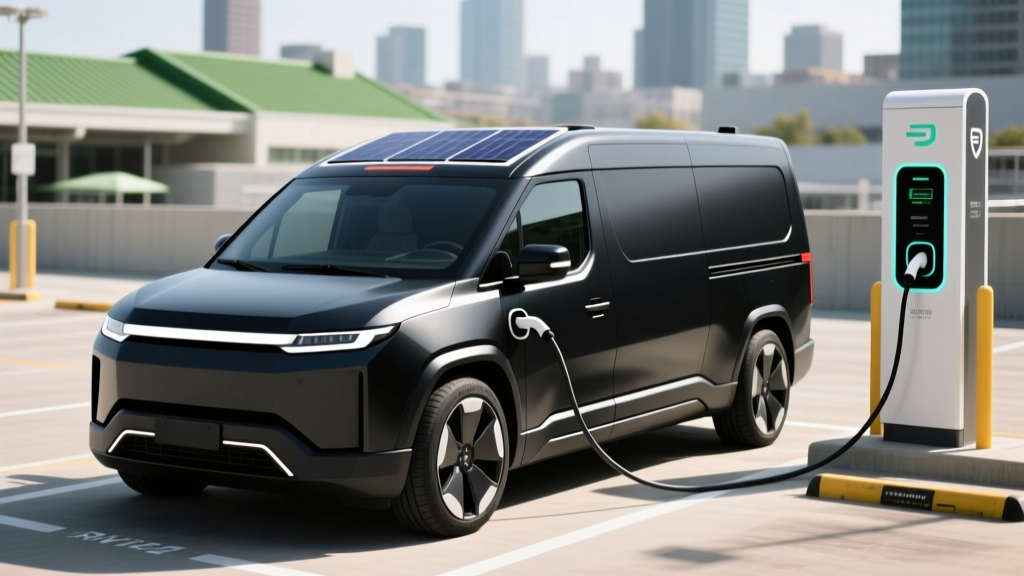
The 10–80% DC fast-charge time of approximately 45 minutes reflects the NMC pack's thermal management strategy. The van's battery preconditioning system warms the pack before a scheduled fast-charge session, which is critical for cold-climate depots. Fleet managers should plan depot infrastructure around Level 2 overnight charging (11.5 kW per stall) as the primary strategy, with DC fast chargers available for mid-shift top-ups on longer routes.
At 11.5 kW, a fully depleted EDV 700 gains roughly 105 kWh in about 9 hours — sufficient for overnight turnaround on a two-shift operation. For fleets running the EDV 900 on extended routes, a 20-minute mid-day DC fast-charge session can recover ~40–50 miles of range, enough to complete a second delivery loop.
Efficiency, Drivetrain, and On-Road Performance
The EDV's efficiency varies significantly by load and route profile. An unloaded EDV 500 achieves approximately 2.0–2.2 kWh/mile (roughly equivalent to ~1.5 MPGe in energy terms, though MPGe is a consumer metric less meaningful for commercial duty cycles). Under a full 2,500-lb payload with frequent stop-and-go, consumption rises to 2.5–3.0 kWh/mile.
The 275 hp single front motor provides more than adequate acceleration for merging and urban driving. The 0–30 mph time of ~4.5 seconds (EDV 500) means the van can pull into traffic confidently even when loaded. Top speed is electronically governed to 75 mph — appropriate for a vehicle that spends its life below 55 mph on delivery routes.
Regenerative braking is aggressive and configurable via the fleet management dashboard. In maximum regen mode, the EDV approaches one-pedal driving in stop-and-go traffic, recovering significant energy on urban routes. Amazon drivers have reported that regen extends effective range by 10–15% on dense urban routes compared to highway-only driving.
Cargo Space, Driver Environment, and Technology
The EDV's cargo area is its primary selling point. The EDV 700's ~540 cu ft of volume accommodates standard palletized loads and bulk parcels with a flat, unobstructed floor. The low step-in height (~20 inches to the cargo floor) reduces driver fatigue over hundreds of daily entries and exits — a critical ergonomic advantage over traditional step vans.
The driver's cockpit is purpose-built for delivery work:
- Digital instrument cluster: 12.3-inch display showing range, SoC, route status, and energy consumption
- Central touchscreen: 15.6-inch infotainment display with integrated route optimization, Alexa compatibility, and fleet telematics
- ADAS suite: Forward collision warning, automatic emergency braking, lane-keeping assist, blind-spot monitoring, and a 360-degree camera system — all standard
- Driver monitoring: Camera-based attention alert (SAE Level 2 driver assistance — the driver must remain fully engaged at all times)
The EDV's driver-assistance features (lane-keeping, adaptive cruise, AEB) constitute SAE Level 2 automation. The driver must maintain full situational awareness and control at all times. This is not a self-driving or autonomous vehicle. Rivian does not offer Level 4 driverless capability in the EDV.
Notable drawbacks include the absence of a passenger-side sliding door (the bulkhead separates the driver from the cargo area, requiring the driver to exit the cab to access packages — a design choice that improves security but adds steps per delivery) and limited HVAC vent adjustability in the cargo zone, which matters for temperature-sensitive deliveries.
Pricing, Fleet Economics, and Tax Credit Eligibility
Rivian does not publish consumer MSRP for the EDV because it is sold exclusively through fleet and commercial channels, not retail dealerships. Industry estimates place the EDV 700 at approximately $70,000–$80,000 per unit before incentives, depending on configuration and volume commitment. Amazon's exclusive-order period has largely concluded, and Rivian is actively selling to other fleet operators including Rivian Commercial direct sales.
| Item | Amount |
|---|---|
| EDV 700 Estimated Base Price | ~$75,000 |
| Federal Commercial Clean Vehicle Credit (§45W) | Up to $7,500 (vehicles <14,000 lbs GVWR) |
| Estimated Net Price After Credit | ~$67,500 |
| Estimated 5-Year Fuel Savings vs. Diesel Step Van | $12,000–$18,000 |
| Estimated 5-Year Maintenance Savings | $5,000–$8,000 |
Important tax credit distinction: Commercial and fleet vehicles do not qualify for the consumer §30D Clean Vehicle Credit (which has MSRP caps, buyer income limits, and battery-sourcing requirements). Instead, fleet purchasers may be eligible for the §45W Commercial Clean Vehicle Credit, which provides up to $7,500 for vehicles under 14,000 lbs GVWR and up to $40,000 for heavier vehicles. Eligibility depends on battery component and critical mineral sourcing requirements, and fleets should consult a tax professional for specific guidance. The EDV's GVWR of ~9,500–9,990 lbs places it in the $7,500 credit tier.
Total cost of ownership (TCO) heavily favors the EDV over diesel alternatives for urban delivery routes. A diesel step van averages 6–8 mpg and costs ~$0.55–$0.65/mile in fuel alone. The EDV, at ~$0.12–$0.18/mile in electricity (depending on depot utility rates), delivers fuel savings of $0.37–$0.50 per mile. Over 25,000 miles/year, that's $9,250–$12,500 in annual fuel savings per vehicle.
Warranty, Service, and Fleet Support
Rivian backs the EDV with a commercial-grade warranty structure designed for fleet confidence:
- Battery pack: 8 years / 100,000 miles (retaining at least 70% of original capacity)
- Powertrain (motor, inverter, reduction gear): 8 years / 100,000 miles
- Bumper-to-bumper: 5 years / 60,000 miles
- Corrosion perforation: 5 years / unlimited miles
Rivian operates a mobile service fleet for commercial customers, performing many routine repairs at the depot rather than requiring vehicles to travel to a service center. For major battery or drivetrain work, Rivian's dedicated commercial service hubs handle warranty repairs with loaner vehicle support to minimize fleet downtime.
Competitive Landscape: EDV vs. Ford E-Transit vs. BrightDrop Zevo
The EDV competes primarily with two other electric delivery platforms:
- Ford E-Transit: EPA range ~126 miles (low-roof cargo van), 68 kWh usable battery (LFP), 266 hp, CCS1 DC fast charge up to 115 kW (10–80% in ~45 min). Base price ~$52,000. Smaller cargo volume (~487 cu ft max) and shorter range, but significantly lower entry price and Ford's vast dealer/service network.
- BrightDrop Zevo 600: EPA range ~250 miles (estimated), 165 kWh battery, 300+ hp, DC fast charge up to 150+ kW. Higher range and payload, but production volumes remain limited and pricing is estimated above $90,000.
- Purpose-built for delivery (not a converted ICE van)
- Class-leading cargo volume in EDV 900 (~660 cu ft)
- Low step-in height reduces driver fatigue
- Strong regenerative braking extends urban range
- Integrated fleet telematics and route optimization
- Comprehensive ADAS suite standard
- Range limited to ~150 mi (EDV 500/700) — not suitable for regional routes
- Higher estimated base price (~$75K) vs. Ford E-Transit (~$52K)
- No passenger-side sliding door
- Cold-weather range loss of 20–30% requires route planning
- Limited public service center network vs. legacy OEMs
- Single-motor FWD only — no AWD option for snow-belt depots
Who Should Buy the Rivian EDV?
- Your fleet runs urban/suburban last-mile delivery routes under 120 miles/day
- You need maximum cargo volume (EDV 900) in an electric platform
- Driver ergonomics and low step-in height are operational priorities
- You can install depot Level 2 charging infrastructure for overnight turnaround
- You want integrated telematics without third-party fleet management add-ons
- Budget is the primary constraint (E-Transit starts ~$23K lower)
- You need an existing dealer service network in rural or secondary markets
- Your routes are shorter (under 100 miles/day) and cargo volume needs are moderate
- Your routes exceed 150 miles/day and you need extended range
- You're willing to accept limited production availability for higher capability
Frequently Asked Questions
What is the real-world range of Rivian electric delivery vans?
In urban delivery cycles with frequent stops and regenerative braking, the EDV 500 and EDV 700 deliver approximately 130–155 miles on a full charge. Highway-heavy routes at 65 mph reduce this to 100–115 miles. The larger EDV 900 achieves 100–125 miles in urban driving and 85–100 miles on highway routes. Cold weather (below 32°F) reduces all figures by 20–30%.
How fast do Rivian electric delivery vans charge?
On a DC fast charger, the EDV peaks at 150 kW (CCS1) and charges from 10–80% in approximately 45 minutes. For overnight depot charging, Level 2 at 11.5 kW (240V, 48A) fully recharges the ~105 kWh battery in about 9 hours. A standard 32A Level 2 connection takes 12–13 hours.
How much do Rivian electric delivery vans cost after tax credits?
The EDV 700 is estimated at approximately $75,000 before incentives. Fleet buyers may qualify for the federal §45W Commercial Clean Vehicle Credit of up to $7,500 (for vehicles under 14,000 lbs GVWR), bringing the net cost to roughly $67,500. Eligibility depends on battery sourcing requirements — consult IRS guidance on §45W and a tax professional for your fleet's specific situation.
Does the Rivian EDV qualify for the $7,500 federal EV tax credit?
Not the consumer §30D credit — the EDV is a commercial vehicle sold to fleets, not retail buyers. Instead, fleet purchasers may claim the §45W Commercial Clean Vehicle Credit, which offers up to $7,500 for qualifying vehicles under 14,000 lbs GVWR. The EDV's GVWR (~9,500–9,990 lbs) falls within this tier. Battery component and critical mineral sourcing rules apply.
Is the Rivian EDV worth buying vs. the Ford E-Transit?
It depends on your operational priorities. The EDV offers significantly more cargo volume (up to ~660 cu ft vs. ~487 cu ft), a lower step-in height, and purpose-built delivery ergonomics. The Ford E-Transit costs roughly $23,000 less, has a wider service network, and is sufficient for shorter routes under 100 miles/day. For high-volume urban last-mile operations, the EDV's cargo advantage and driver experience justify the premium. For budget-constrained fleets with moderate volume needs, the E-Transit is the pragmatic choice.
What battery chemistry does the Rivian EDV use?
The EDV uses NMC (nickel manganese cobalt) lithium-ion cells in a ~105 kWh usable pack. NMC was chosen over LFP for its higher energy density, which allows the battery to fit underfloor without intruding on cargo space. The trade-off is that NMC cells have a slightly shorter cycle life than LFP and require more active thermal management.
Can the Rivian EDV tow a trailer?
Rivian has not published an official tow rating for the EDV. The platform is designed for cargo-carrying, not towing, and fleet operators should not plan on trailer use. The single-motor FWD drivetrain and ~9,990 lb GVWR are optimized for payload, not tow capacity.
What is the warranty on the EDV battery?
Rivian covers the EDV battery pack for 8 years or 100,000 miles, whichever comes first, guaranteeing at least 70% of original capacity retention. The powertrain (motor, inverter, reduction gear) carries the same 8-year/100,000-mile coverage.