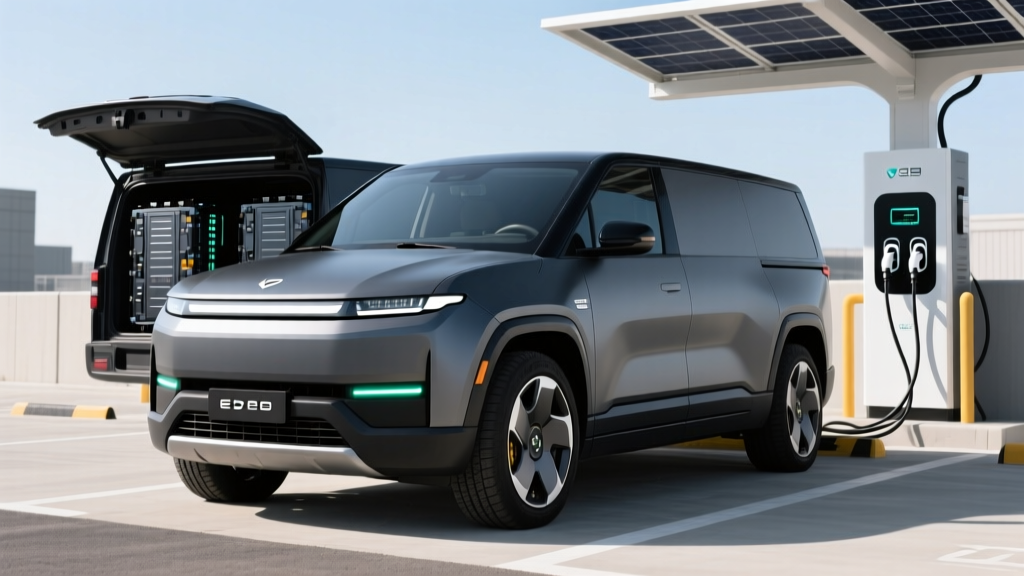
The Rivian EDV (Electric Delivery Van) 700 Series is the largest of three commercial vans Rivian builds exclusively for Amazon's last-mile delivery network. While you cannot walk into a dealership and buy one as a private consumer in 2026, the EDV 700 represents a critical proving ground for electric commercial fleet vehicles — and understanding its specs matters for fleet operators, commercial EV watchers, and anyone tracking where Rivian's commercial ambitions are heading next.
This profile breaks down the EDV 700's range, battery architecture, charging behavior, cargo dimensions, and ownership economics based on publicly available fleet data and Rivian's commercial disclosures.
Quick Verdict: Purpose-Built for Depot-Based Routes
The EDV 700 is engineered for a very specific mission: high-volume, stop-and-go urban and suburban delivery routes that return to a depot each night. Its 149 kWh LFP battery provides enough energy for roughly 130–150 real-world miles of loaded delivery work, and its 150 kW DC fast-charging capability means mid-route top-ups are viable when needed. It is not a general-purpose commercial van — it is a route-optimized tool that excels within its design envelope and would struggle on long-haul or rural applications.
Range, Efficiency & Real-World Expectations
Real-World Expectation: 120–145 miles under typical loaded delivery conditions; 100–120 miles in cold weather (below 32°F) with cabin heating and frequent door openings.
The EPA range figure for the EDV 700 assumes ideal conditions — moderate temperatures, flat terrain, and a standard payload. In Amazon's actual fleet operations, several factors compress that number meaningfully:
- Frequent stops and starts: While regenerative braking recovers energy during deceleration, the constant acceleration from 0–30 mph with a heavy payload consumes more energy than steady-state cruising.
- Cargo weight: A fully loaded EDV 700 can carry over 2,500 lbs of packages, directly increasing energy consumption per mile.
- Climate control: Delivery drivers open and close cargo doors dozens of times per hour, making cabin temperature maintenance a constant energy drain — especially in winter.
- Accessory loads: The EDV 700 powers interior cargo lighting, barcode scanners, telematics, and fleet management systems continuously.
Rivian's commercial vans use a lithium iron phosphate (LFP) battery chemistry. LFP trades some energy density for superior cycle life, thermal stability, and lower cost per kWh — exactly the right trade-off for a fleet vehicle expected to complete 2,000+ charge cycles over its service life. Amazon's depot-based model means most EDVs charge overnight at Level 2 and rarely need DC fast charging, which further preserves long-term battery health.
Battery, Powertrain & Performance
| Specification | EDV 700 Series |
|---|---|
| Battery Capacity (Usable) | ~149 kWh (LFP chemistry) |
| Drivetrain | Rear-wheel drive, single motor |
| Horsepower | ~275 hp |
| Torque | ~350 lb-ft |
| 0–60 mph (estimated) | ~8.5 seconds (loaded) |
| Gross Vehicle Weight Rating | ~10,000 lbs (Class 2b) |
| Max Payload Capacity | ~2,530 lbs |
| Cargo Volume | ~420 cu ft |
| Efficiency (estimated) | ~2.0–2.4 kWh/mile (loaded delivery cycle) |
The EDV 700 uses a single rear-mounted motor rather than the dual-motor AWD setup found in Rivian's consumer vehicles (R1T, R1S). This is deliberate: rear-wheel drive reduces cost, weight, and energy consumption — all priorities for a delivery van that rarely encounters unpaved or low-traction surfaces in urban environments.
The ~275 hp motor provides adequate acceleration for merging onto highways and navigating traffic, though the EDV 700 is tuned for low-end torque and drivability at delivery speeds (0–45 mph) rather than outright performance. The LFP battery's flat discharge curve means power delivery remains consistent from 100% down to roughly 15% state of charge — a meaningful advantage for fleet operations where drivers need predictable performance throughout a shift.
Charging: DC Fast, Level 2 & Depot Infrastructure
| Charging Level | Power (kW) | Rate / Time | Use Case |
|---|---|---|---|
| Level 1 (120V) | ~1.4 kW | ~3 miles per hour | Emergency / trickle only |
| Level 2 (240V, 48A) | ~11.5 kW | ~23 miles per hour; full charge in ~13 hrs | Overnight depot charging |
| Level 2 (240V, 80A) | ~19.2 kW | ~38 miles per hour; full charge in ~8 hrs | High-power depot charging |
| DC Fast Charge | ~150 kW peak | 10–80% in ~60 minutes | Mid-route top-up or rapid depot turnaround |
The EDV 700's charging profile reflects its depot-centric operating model. Amazon has invested heavily in depot-level charging infrastructure, installing hundreds of Level 2 chargers at delivery stations across the U.S. Most EDVs plug in at the end of a route and charge overnight — a full 149 kWh replenishment at 19.2 kW takes roughly 8 hours, fitting neatly within a driver's off-hours.
DC fast charging at 150 kW peak is respectable for a vehicle of this size, though the large battery means the 10–80% session still takes approximately 60 minutes. The LFP chemistry's charge curve is relatively flat through the mid-range, then tapers above 85% SoC — fleet managers typically charge to 90–95% overnight rather than relying on daytime DC top-ups.
Charging connector: The EDV 700 uses a CCS1 connector for DC fast charging and a J1772 inlet for Level 2, consistent with commercial EV standards. Amazon's depot chargers are predominantly hardwired Level 2 units from providers like ChargePoint and EVgo Commercial.
Cargo Space, Dimensions & Practical Features
The EDV comes in three sizes — the 500, 700, and 900 series — with the 700 occupying the middle-to-large position:
- EDV 500: ~350 cu ft cargo volume (shorter wheelbase)
- EDV 700: ~420 cu ft cargo volume (standard long wheelbase)
- EDV 900: ~480+ cu ft cargo volume (extended body, largest variant)
The EDV 700's cargo area features a low, flat load floor designed for shelving systems and rolling carts. The driver's compartment is separated from the cargo area by a bulkhead, and the van includes a unique curbside sliding door that opens wider than conventional commercial vans — a direct input from Amazon's delivery drivers who needed faster package access on residential streets.
Notable design features include:
- Low step-in height: Reduces driver fatigue over hundreds of daily exits and re-entries
- 360-degree exterior cameras: Provide a bird's-eye view on the dashboard screen, critical for navigating tight urban streets
- Automatic parking brake: Engages every time the driver unbuckles, preventing rollaway incidents
- Integrated fleet telematics: Real-time GPS tracking, route optimization, and battery state-of-charge monitoring visible to dispatchers
Driver Assistance, Technology & Safety
The EDV 700 includes a suite of driver-assistance features calibrated for commercial use rather than consumer convenience:
- Automatic Emergency Braking (AEB): With pedestrian and cyclist detection — critical in dense urban delivery zones
- Lane Departure Warning: Alerts rather than active lane-keeping, appropriate for commercial drivers who prefer full steering control
- Blind Spot Monitoring: Extended coverage for the van's long body
- Forward Collision Warning: With audible and visual alerts on the central display
- Speed Limiting: Fleet-configurable top speed governor (typically set to 65–70 mph)
Rivian deliberately excluded hands-free driving features from the EDV. For a commercial fleet vehicle carrying valuable cargo through residential neighborhoods, the liability and training complexity of Level 2 driver-assist systems outweighed the benefits. Drivers receive alerts and automatic safety interventions — nothing more.
The infotainment system is a purpose-built 15.6-inch touchscreen running Rivian's commercial OS, which integrates directly with Amazon's delivery management platform. Navigation, package manifests, and route sequencing all appear on the central display. There is no Apple CarPlay or Android Auto — this is a closed, fleet-managed system.
Pricing, Tax Credits & Fleet Economics
The Rivian EDV 700 is not sold through traditional retail channels. It is produced under a multi-year supply agreement with Amazon, and pricing is negotiated at the fleet-contract level rather than published as MSRP. Industry estimates place the per-unit cost in the $90,000–$110,000 range depending on configuration, volume commitments, and the inclusion of depot charging infrastructure.
| Cost Factor | Estimated Amount |
|---|---|
| Estimated Per-Unit Vehicle Cost | $90,000–$110,000 (fleet contract pricing) |
| Federal Commercial EV Credit (§45W) | Up to $7,500 for vehicles under 14,000 lbs GVWR |
| Depot Charger Installation (per stall) | $4,000–$12,000 (Level 2, including electrical work) |
| Estimated Annual Electricity Cost (30,000 mi/yr) | $3,600–$5,400 (at $0.12–$0.18/kWh commercial rate) |
| Estimated Annual Diesel Equivalent (ICE van) | $8,500–$11,000 (at $3.80–$4.50/gal, 12 mpg) |
| Annual Fuel Savings vs. Diesel | $4,000–$6,500 per vehicle |
Tax credit note: Commercial fleet EVs do not qualify for the consumer §30D clean vehicle credit. Instead, they may be eligible for the §45W Commercial Clean Vehicle Credit, which provides up to $7,500 for vehicles under 14,000 lbs GVWR (the EDV 700 qualifies at ~10,000 lbs). Eligibility depends on battery sourcing requirements and the purchasing entity's tax situation. Consult IRS guidance on §45W and a qualified tax professional for fleet-specific eligibility.
The total cost of ownership equation strongly favors the EDV 700 over diesel alternatives like the Mercedes-Benz Sprinter or Ram ProMaster when vehicles operate on predictable depot-return routes. The fuel savings alone can pay back the higher upfront cost within 5–7 years, and the LFP battery's extended cycle life reduces the risk of costly mid-life battery replacement.
Warranty & Long-Term Battery Outlook
Rivian provides a commercial warranty package for the EDV fleet:
- Battery & Powertrain: 8 years / 100,000 miles (whichever comes first), with a guaranteed minimum capacity retention of 70% over the warranty period
- Bumper-to-Bumper: 5 years / 60,000 miles
- Corrosion Perforation: 5 years / unlimited miles
The LFP chemistry is a significant long-term advantage here. Industry data from NREL battery lifecycle studies shows LFP cells typically retain 85–90% capacity after 2,000 full charge-discharge cycles, compared to 75–80% for NMC cells under equivalent conditions. For a delivery van charging once daily, 2,000 cycles represents roughly 5.5 years of service — and most fleet vehicles charge to 90% rather than 100%, further extending battery life.
Rivian's modular battery pack design allows individual cell modules to be replaced rather than requiring a full pack swap — a cost-saving feature that matters enormously for fleet operators managing hundreds of vehicles.
Competitor Comparison: EDV 700 vs. Alternatives
The EDV 700 operates in a niche with few direct electric competitors, but fleet operators evaluating commercial EVs typically cross-shop these options:
- BrightDrop Zevo 600 (formerly GM): ~250-mile EPA range, ~200 cu ft cargo, ~160 kW DC charging. Brighter range but significantly smaller cargo volume. BrightDrop has faced production and financial challenges through 2025–2026.
- Ford E-Transit (cargo van): ~126-mile EPA range, ~78 kWh battery, ~250 cu ft max cargo. Lower range and cargo capacity, but available through standard Ford commercial dealers — a major advantage for fleets without Amazon-scale infrastructure.
- Mercedes-Benz eSprinter: ~203-mile EPA range (2025+ models with 113 kWh battery), ~150 kW DC charging. More range than the EDV 700, but higher per-unit cost and smaller cargo volume in most configurations.
The EDV 700's key differentiator is not any single spec — it is the tight integration between vehicle, route software, and depot charging infrastructure. No competitor offers that vertically integrated ecosystem, because no competitor has Amazon as a captive customer.
Pros, Cons & Who This EV Suits
- Massive 420 cu ft cargo volume with low, flat load floor
- LFP battery offers superior cycle life and thermal safety for daily fleet use
- Purpose-built driver ergonomics reduce fatigue over 150+ stops/day
- Integrated telematics and route management eliminates aftermarket upfit costs
- Strong fuel cost savings vs. diesel ($4,000–$6,500/yr per vehicle)
- Regenerative braking reduces brake wear significantly in stop-and-go driving
- Not available for retail purchase — Amazon-exclusive through current contract
- 161-mile EPA range limits use to depot-return routes; not viable for long-haul
- Cold-weather range loss (20–30%) can compress routes in northern climates
- 150 kW peak DC charging is slower than some competitors (BrightDrop, eSprinter)
- No Level 2 driver-assist features (adaptive cruise, lane-keeping) — by design, but limits highway comfort
- Closed infotainment ecosystem with no third-party app integration
Who this EV suits best: Large-scale last-mile delivery fleets operating depot-return routes under 130 miles per day. The EDV 700 is purpose-built for exactly the mission Amazon assigns it — high-stop-count urban and suburban package delivery with overnight depot charging. It is not a candidate for regional haul, rural routes, or owner-operator applications.
Frequently Asked Questions
What is the real-world range of the Rivian EDV 700?
The EPA estimates approximately 161 miles for the EDV 700 with its largest battery. In real-world delivery operations with a full payload, frequent stops, and climate control running, expect 120–145 miles in moderate weather and 100–120 miles in cold conditions below freezing.
How fast does the EDV 700 charge?
On DC fast charging, the EDV 700 peaks at approximately 150 kW, reaching 10–80% in about 60 minutes. On Level 2 at 19.2 kW (80A), a full charge takes roughly 8 hours — ideal for overnight depot charging. At a standard 48A Level 2 (11.5 kW), a full charge takes approximately 13 hours.
Can I buy a Rivian EDV 700 as a private business?
As of 2026, the EDV is produced exclusively for Amazon under a multi-year supply agreement. Rivian has indicated it plans to offer commercial vans to other fleet customers in the future, but no retail ordering channel currently exists. Small businesses looking for electric cargo vans should consider the Ford E-Transit, Mercedes-Benz eSprinter, or BrightDrop Zevo.
Does the EDV 700 qualify for the federal EV tax credit?
The EDV 700 does not qualify for the consumer §30D credit because it is a commercial fleet vehicle. It may qualify for the §45W Commercial Clean Vehicle Credit (up to $7,500 for vehicles under 14,000 lbs GVWR), subject to battery component sourcing rules and the purchasing entity's tax liability. See IRS §45W guidance for details.
What battery chemistry does the EDV 700 use?
The EDV 700 uses lithium iron phosphate (LFP) cells. LFP offers longer cycle life (2,000+ cycles to 85%+ capacity retention), better thermal stability, and lower cost per kWh compared to NMC — at the trade-off of slightly lower energy density. For a fleet vehicle with predictable daily routes, LFP is the optimal chemistry choice.
How does the EDV 700 compare to the Ford E-Transit?
The EDV 700 offers significantly more cargo volume (420 vs. ~250 cu ft) and a larger battery (~149 vs. 68 kWh), but the E-Transit is available through standard Ford commercial dealers and has a lower entry price (~$55,000 MSRP). The E-Transit's 126-mile EPA range suits shorter routes, while the EDV 700 handles longer urban circuits. The E-Transit is the realistic choice for most non-Amazon fleets.
What is the EDV 700's maintenance cost vs. a diesel van?
Electric delivery vans eliminate oil changes, fuel filter replacements, exhaust system repairs, and most transmission maintenance. Fleet operators report 30–50% lower maintenance costs per mile for EVs vs. diesel equivalents. Regenerative braking also extends brake pad life by 2–3x in stop-and-go delivery driving. The primary long-term cost risk is battery replacement outside warranty, though LFP chemistry makes this less likely within a typical 8–10 year fleet lifecycle.
Sources: U.S. EPA fueleconomy.gov, IRS Commercial Clean Vehicle Credit (§45W), Rivian commercial vehicle disclosures and fleet operator data.