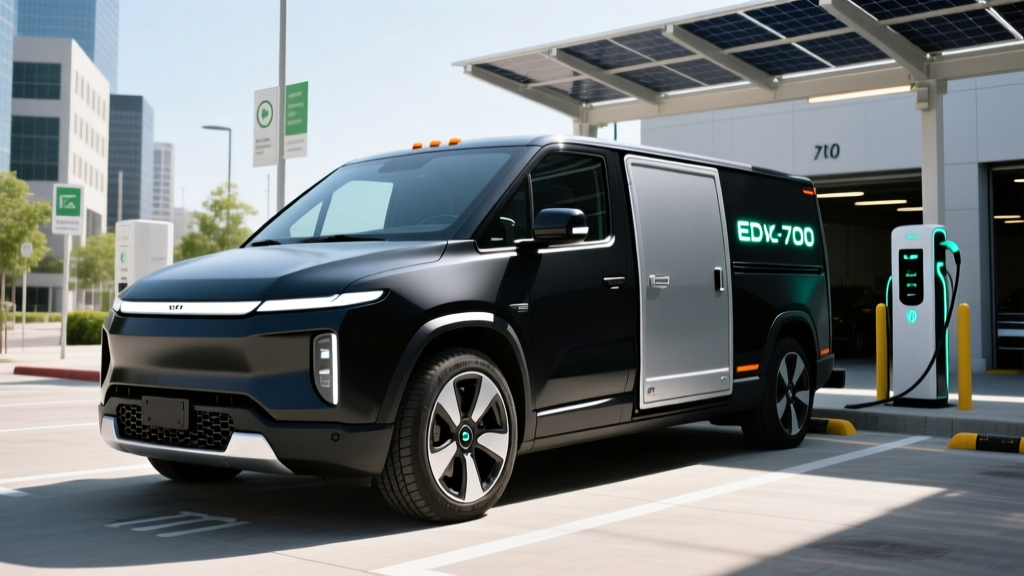
The Rivian EDV-700 (Electric Delivery Van, 700 cubic feet of cargo volume) is the mid-size workhorse in Rivian's commercial fleet lineup, built exclusively for Amazon's last-mile delivery network and select enterprise fleet operators. Unlike consumer EVs you can walk into a dealership and buy, the EDV-700 exists in a different purchasing reality — and that distinction matters for anyone researching this vehicle, whether you're a logistics manager, an EV fleet analyst, or a curious consumer who keeps spotting these blue-and-gray vans in your neighborhood.
This profile breaks down the EDV-700's real-world range, charging infrastructure requirements, battery chemistry, cargo engineering, and total cost of ownership — the data points fleet operators actually use when evaluating electric commercial vehicles against diesel Sprinters and gasoline Transit vans.
EDV-700 Specifications at a Glance
| Specification | Value |
|---|---|
| EPA Estimated Range | ~150 miles (loaded) |
| Real-World Range (mixed urban/highway) | 120–145 miles |
| Battery Capacity (usable) | ~111 kWh, NMC chemistry |
| Max DC Fast Charge Rate | ~125 kW peak |
| 10–80% DC Charge Time | ~45–55 minutes |
| Level 2 Charge Rate | ~19.2 kW (80A circuit) |
| Level 2 Miles Added Per Hour | ~35–40 mi/hr |
| Drivetrain | Single-motor RWD (front axle) |
| Horsepower | ~250 hp |
| 0–60 mph | ~8.0 seconds (estimated, unloaded) |
| Cargo Volume | ~660 cu ft (EDV-700 designation) |
| Payload Capacity | ~2,500 lbs |
| Efficiency | ~1.8–2.0 kWh/mile (loaded) |
| Battery/Powertrain Warranty | 8 years / 100,000 miles |
| Base Fleet MSRP (estimated) | Not publicly listed; estimated $70,000–$80,000 per unit |
Range: EPA Sticker vs. the Delivery Route Reality
EPA Estimate: ~150 miles
Real-World Urban Delivery Route: 120–145 miles (stop-and-go, loaded to 60–80% payload)
Real-World Highway (65 mph, loaded): ~110–130 miles
Cold-Weather Impact (below 30°F): Expect 15–25% range reduction, dropping effective range to ~100–125 miles on urban routes
The EDV-700's ~150-mile EPA figure is calibrated for last-mile delivery work, not cross-country road trips. In practice, Amazon delivery routes average 80–120 miles per shift with hundreds of stops, meaning most EDV-700s return to the depot with 20–40% State of Charge remaining — a comfortable buffer that accounts for detours, HVAC use, and seasonal range loss.
Regenerative braking is the EDV-700's secret weapon in urban environments. Every stop at a residential curb feeds energy back into the 111 kWh NMC (nickel manganese cobalt) battery pack. On dense delivery routes with 150+ stops, regen can extend effective range by 10–15% compared to steady-state highway driving, where aerodynamic drag dominates and the van's boxy profile (optimized for cargo volume, not slipperiness) works against efficiency.
Cold weather is the real variable for northern-climate fleets. Rivian equips the EDV-700 with a thermal management system that includes battery preconditioning, but the physics of lithium-ion chemistry in sub-freezing temperatures still exact a toll. Fleet operators in Chicago, Minneapolis, and Boston typically spec their winter routes 20% shorter or add a mid-day opportunity charge to compensate.
Charging: Depot-Based Strategy, Not Public Network Reliance
The EDV-700 was never designed to pull up to an Electrify America or Tesla Supercharger. Its charging ecosystem is the fleet depot — purpose-built with rows of Level 2 chargers or, increasingly, depot-scale DC fast-charging infrastructure.
| Charging Level | Power (kW) | Time / Rate |
|---|---|---|
| Level 1 (120V — emergency only) | ~1.4 kW | ~5–6 miles per hour |
| Level 2 (240V, 80A circuit) | ~19.2 kW | ~35–40 miles per hour; full charge in ~6–7 hours |
| DC Fast Charge (CCS1) | ~125 kW peak | 10–80% in ~45–55 minutes |
The DC fast-charge curve is where fleet planners need to pay attention. The EDV-700 peaks around 125 kW at low State of Charge but tapers significantly above 80% — a characteristic of NMC chemistry that protects long-term battery health but means charging from 80–100% can take as long as the initial 10–80% session. For depot operations, this isn't a problem: vans plug in at shift end and charge overnight on Level 2, with DC fast chargers reserved for mid-day top-ups or quick-turnaround vehicles.
Home charging is technically possible via the CCS1 connector and a hardwired Level 2 unit, but the EDV-700's commercial registration, size, and fleet-management telematics make personal ownership impractical. This van lives at the depot.
Battery Chemistry & Long-Term Degradation
The EDV-700 uses an NMC (nickel manganese cobalt) lithium-ion battery pack with approximately 111 kWh of usable capacity. Rivian selected NMC over LFP (lithium iron phosphate) for this application because energy density matters in a delivery van — every pound of battery weight is a pound subtracted from payload capacity.
NMC trade-offs are well-documented: higher energy density and better cold-weather performance than LFP, but slightly faster long-term degradation and higher raw-material costs. For fleet operators running 250–300 charge cycles per year, Rivian's 8-year / 100,000-mile battery warranty provides a defined cost horizon. Amazon's own sustainability reporting indicates that early EDV deployments have shown manageable degradation curves, with most vans retaining above 85% battery capacity after 3 years of intensive use.
Rivian's warranty guarantees that the battery will retain at least 70% of its original capacity during the 8-year / 100,000-mile term — a threshold consistent with industry standards. Fleets that exceed 100,000 miles typically budget for battery replacement or module refurbishment in the vehicle's second life cycle, with estimated pack replacement costs in the $15,000–$25,000 range based on current NMC cell pricing trajectories.
Cargo Engineering & Driver Experience
The "700" in EDV-700 refers to approximately 660–700 cubic feet of cargo volume — the mid-size option between the smaller EDV-500 (~500 cu ft) and the larger EDV-900 (~900 cu ft). This positions the EDV-700 as a direct competitor to the Mercedes-Benz Sprinter 2500 and Ford Transit 250 in terms of load space.
Key cargo and cabin dimensions:
- Cargo floor length: ~120 inches
- Cargo height (interior): ~84 inches (standing room for most drivers)
- Cargo width (between wheel wells): ~54 inches
- Payload capacity: ~2,500 lbs
- Driver seat adjustments: 6-way manual, heated
- Cabin storage: Multiple shelving units, document trays, cup holders designed for shift-length use
The driver environment reflects Amazon's input. The bulkhead between cabin and cargo area is reinforced and includes a pass-through for long items. The infotainment system is a custom 15-inch touchscreen integrated with Amazon's delivery app — route optimization, package scanning, and customer notification all run through the van's native system. There's no Apple CarPlay or Android Auto; this is a purpose-built commercial tool, not a consumer vehicle.
Driver-assist features include a comprehensive suite Rivian calls Driver+:
- Forward collision warning with automatic emergency braking
- Lane-keeping assist (SAE Level 1 — steering support only, not autonomous)
- 360-degree camera system with curb-view (critical for tight residential streets)
- Blind-spot monitoring with trailer-length detection
- Adaptive cruise control (for highway segments between delivery zones)
The EDV-700's Driver+ system provides driver-assist features (adaptive cruise, lane-keeping) but requires full driver engagement at all times. This is not an autonomous vehicle. The driver must maintain hands on the wheel and eyes on the road. Only purpose-built robotaxis (Waymo, Zoox) currently operate at Level 4 without a human driver.
Pricing, Fleet Acquisition & Tax Credit Eligibility
Rivian does not publish consumer-facing MSRPs for the EDV line because these vehicles are not sold through retail dealerships. The EDV-700 is acquired through fleet purchase agreements, with Amazon holding exclusive rights to the design through 2026 under the original partnership agreement. After that exclusivity window, Rivian has signaled plans to offer EDV variants to other commercial fleets.
Industry estimates place the EDV-700's per-unit cost at $70,000–$80,000 before incentives — a premium over a comparable diesel Sprinter (~$50,000–$60,000) that fleet operators offset through fuel savings, reduced maintenance (no oil changes, fewer brake replacements thanks to regen), and lower per-mile energy costs.
Federal Tax Credit: §30D vs. Commercial Clean Vehicle Credit (§45W)
Because the EDV-700 is a commercial vehicle typically acquired by fleet operators rather than individual consumers, the relevant federal incentive is often the Commercial Clean Vehicle Credit (§45W), not the consumer-facing §30D credit. Key distinctions:
- §45W (Commercial): Up to $7,500 for vehicles under 14,000 lbs GVWR; up to $40,000 for heavier vehicles. No MSRP cap, no buyer income cap. Subject to battery sourcing requirements.
- §30D (Consumer): If an EDV-700 were purchased by an individual (unlikely given commercial registration), it would face the $80,000 MSRP cap for vans, buyer income limits ($300,000 joint / $225,000 head of household / $150,000 individual), and critical mineral + battery component sourcing requirements.
- Point-of-sale transfer: Both credits can be transferred to the dealer/seller at purchase, reducing upfront cost rather than waiting for a tax refund.
Fleet operators should consult a tax professional and review current IRS guidance on clean vehicle credits before modeling acquisition costs, as sourcing requirements and credit availability shift with regulatory updates.
Who Should Consider the EDV-700 (and Who Shouldn't)
- Last-mile delivery fleets (Amazon DSPs, FedEx Ground contractors)
- Urban and suburban routes under 120 miles/day
- Operators with depot-based charging infrastructure
- Fleets targeting ESG/sustainability reporting goals
- Businesses modeling 5-year TCO advantages over diesel
- Individual consumers (not available retail)
- Long-haul routes exceeding 150 miles without mid-day charging
- Operators without depot charging access or upgrade budget
- Cold-climate fleets unwilling to adjust winter route lengths
- Businesses needing AWD or off-road capability
Pros, Cons & the Fleet Decision
- Purpose-built for delivery: cargo layout, bulkhead, shelving all optimized
- Strong regenerative braking extends urban range 10–15%
- Lower per-mile energy cost vs. diesel (~$0.08–$0.12/mi electricity vs. ~$0.25–$0.35/mi diesel)
- Minimal scheduled maintenance (no oil, no transmission fluid, reduced brake wear)
- Quiet operation in residential neighborhoods — fewer noise complaints
- Integrated delivery software eliminates third-party tablet mounts
- Not available for individual purchase (Amazon exclusivity through 2026)
- ~150-mile range limits use to short-haul and last-mile only
- Depot charging infrastructure requires significant upfront investment ($50,000–$200,000+ for multi-stall installs)
- Cold-weather range loss of 15–25% requires route planning adjustments
- NMC battery replacement cost ($15,000–$25,000 estimated) at end of life
- No consumer infotainment features (no CarPlay, no premium audio)
- Single-motor RWD limits traction in snow/ice vs. AWD alternatives
Competitive Landscape: EDV-700 vs. Alternatives
The EDV-700 occupies a niche with surprisingly few direct electric competitors in 2026. Here's how it stacks up:
| Vehicle | Range (EPA) | Cargo Volume | Est. Price | Availability |
|---|---|---|---|---|
| Rivian EDV-700 | ~150 mi | ~660 cu ft | $70,000–$80,000 | Fleet only (Amazon primary) |
| Ford E-Transit (250) | 126 mi | 487 cu ft | $55,000–$65,000 | Retail fleet & commercial |
| Mercedes eSprinter (250) | ~200 mi | 533 cu ft | $75,000–$85,000 | Retail fleet & commercial |
| BrightDrop Zevo 600 | ~250 mi | 600 cu ft | $75,000–$90,000 | Limited fleet production |
The Ford E-Transit is the most accessible competitor — widely available, lower upfront cost, and backed by Ford's commercial dealer network. But it sacrifices range (126 miles EPA) and cargo volume. The Mercedes eSprinter offers the best range but at a premium price and with less purpose-built delivery optimization. The BrightDrop Zevo 600 (backed by GM/FedEx) is the closest functional rival but remains in limited production.
The EDV-700's advantage is integration: it was designed from the ground up for package delivery, not adapted from an ICE van platform. The disadvantage is access — if you're not in Amazon's delivery network, you likely can't get one until Rivian opens EDV sales to broader fleets post-2026.
Frequently Asked Questions
What is the real-world range of the Rivian EDV-700?
On a typical urban delivery route with 100–150 stops and 60–80% payload, expect 120–145 miles of usable range from the ~150-mile EPA estimate. Highway driving at 65 mph drops that to ~110–130 miles. In sub-freezing temperatures, plan for 100–125 miles on urban routes due to battery chemistry limitations and HVAC energy draw.
How fast does the EDV-700 charge?
On a DC fast charger (CCS1), the EDV-700 peaks at approximately 125 kW and charges from 10–80% in 45–55 minutes, with significant taper above 80%. On a depot Level 2 charger (240V, 80A / 19.2 kW), expect ~35–40 miles of range added per hour and a full overnight charge in 6–7 hours. Level 1 (120V) is emergency-only at ~5–6 miles per hour.
How much does the EDV-700 cost after tax credits?
The EDV-700 is not sold at retail, so there's no consumer sticker price. Estimated fleet acquisition cost is $70,000–$80,000 per unit. Fleet operators typically qualify for the §45W Commercial Clean Vehicle Credit (up to $7,500 for vehicles under 14,000 lbs GVWR), subject to battery sourcing requirements. Actual net cost depends on fleet size, negotiation, and current incentive rules — consult a tax professional for your specific situation.
Can I buy a Rivian EDV-700 as an individual?
No. The EDV-700 is a commercial vehicle currently produced under an exclusivity agreement with Amazon through 2026. Individual consumers cannot purchase one through retail channels. Rivian has indicated plans to offer EDV variants to other fleets after the exclusivity period, but consumer retail sales are not part of the current plan.
Is the EDV-700 worth it vs. a Ford E-Transit or Mercedes eSprinter?
For Amazon DSP operators, the EDV-700 is the default — and the right tool for the job given its purpose-built design. For independent fleets, the Ford E-Transit offers easier acquisition and lower upfront cost, while the Mercedes eSprinter delivers superior range. The EDV-700's advantage is delivery-specific engineering; its limitation is availability. Once Rivian opens broader fleet sales post-2026, it will likely be competitive on TCO for high-stop-count urban routes.
Does the EDV-700 qualify for the federal EV tax credit?
As a commercial fleet vehicle, the EDV-700 typically falls under the §45W Commercial Clean Vehicle Credit rather than the consumer §30D credit. §45W provides up to $7,500 for qualifying vehicles under 14,000 lbs GVWR, with no MSRP or buyer income caps, but with battery-sourcing requirements. Eligibility depends on the purchasing entity's tax situation and current IRS rules — always verify with the IRS and a qualified tax advisor before modeling costs.