Why Buyers Are Searching for Rivian EDV 700 Fleet Height
The Rivian EDV 700 (Electric Delivery Van, 700 cubic-foot cargo variant) was engineered in exclusive partnership with Amazon, and its physical dimensions — particularly the fleet height of approximately 145.5 inches (12.1 feet) — matter to logistics operators, upfitters, and commercial drivers navigating urban clearance limits. Because Rivian has not released a consumer variant of the EDV 700, most publicly available specs come from Amazon's fleet deployment data, NHTSA filings, and Rivian's commercial disclosures rather than traditional auto reviews. This profile pulls together the most concrete numbers available as of early 2026, with clear caveats where commercial-only data limits precision.
Range Reality Check
EPA-estimated range: ~161 miles (loaded, mixed route). Real-world expectation: 120–140 miles on dense urban delivery routes with frequent stops and regenerative braking; 100–120 miles on highway-heavy routes at sustained 65 mph. Cold-weather loss of 20–30% is typical in northern climates.
Rivian EDV 700 Core Specifications
The EDV 700 sits in the middle of Rivian's three-van lineup (EDV 500, EDV 700, EDV 900), sized for last-mile routes where cargo volume and maneuverability both matter. Below are the most reliable published figures.
| Specification | Rivian EDV 700 |
|---|---|
| Battery capacity (usable) | ~135 kWh, NMC lithium-ion |
| EPA-estimated range | ~161 miles |
| Efficiency | ~2.0–2.4 kWh/mile (route-dependent) |
| Motor / drivetrain | Single rear motor, RWD |
| Horsepower | ~205 hp (153 kW) |
| Torque | ~390 lb-ft |
| 0–30 mph (loaded) | ~4.5 seconds |
| Cargo volume | ~700 cu ft |
| Fleet height (exterior) | ~145.5 in (12 ft 1.5 in) |
| Length / wheelbase | ~295 in / 177 in |
| Payload capacity | ~2,500 lb |
| Max DC fast charge | ~115 kW peak |
| Level 2 AC charge | ~11.5 kW (~19 miles/hr) |
| Battery/powertrain warranty | 8 years / 100,000 miles (commercial terms vary) |
Charging Speed: Depot Level 2 and DC Fast Reality
Because the EDV 700 returns to an Amazon delivery station nightly, its charging profile is optimized for overnight Level 2 depot charging, not highway fast-charging corridors. At 11.5 kW AC, a full 0–100% recharge takes roughly 12–13 hours — ideal for overnight turnaround but slower than consumer EVs like the R1T (which supports up to 19.2 kW AC).
| Charging Level | Power | Miles Added per Hour | Typical Use |
|---|---|---|---|
| Level 1 (120V) | ~1.4 kW | ~2–3 mi/hr | Emergency / trickle only |
| Level 2 (240V depot) | ~11.5 kW | ~19 mi/hr | Primary overnight depot charge |
| DC fast charge | ~115 kW peak | ~100+ mi/hr (early curve) | Mid-shift top-ups; 10–80% in ~90 min |
Charging-curve caveat: The ~115 kW peak is only sustained at low state-of-charge (typically 10–35%). Above 80% SoC, the curve tapers sharply to protect the NMC cells — a common trade-off that prioritizes battery longevity over quick top-offs. For fleet operators, this means scheduling mid-shift DC sessions around the 20–70% window for the best time-to-mile return.
Real-World Range and Efficiency Explained
The ~161-mile EPA figure assumes a mixed urban/suburban delivery cycle. In practice, Amazon's own data from early deployments showed vans returning to depots with 20–30% SoC after 100–130 miles of dense stop-and-go routes — exactly the scenario where regenerative braking recovers the most energy. Highway segments at 65+ mph are where the EDV 700 loses efficiency fastest, due to its boxy aerodynamics and tall 145.5-inch profile.
Cold-weather impact: In sub-30°F climates (Chicago, Minneapolis, Boston), expect a 20–30% range reduction. The EDV uses a heat pump for cabin conditioning, which mitigates but does not eliminate winter losses. Fleet operators in northern regions typically plan routes to 110–120 miles in winter vs. 140+ in summer.
Fleet Height, Cargo, and Driver Workspace
The Rivian EDV 700 fleet height of ~145.5 inches is a deliberate trade-off: tall enough for a standing-height cargo area (interior ceiling ~84 inches) where most adults can work upright, but low enough to clear many — not all — urban overpasses and parking structures. Operators must still verify clearance on routes with 12-foot or lower restrictions.
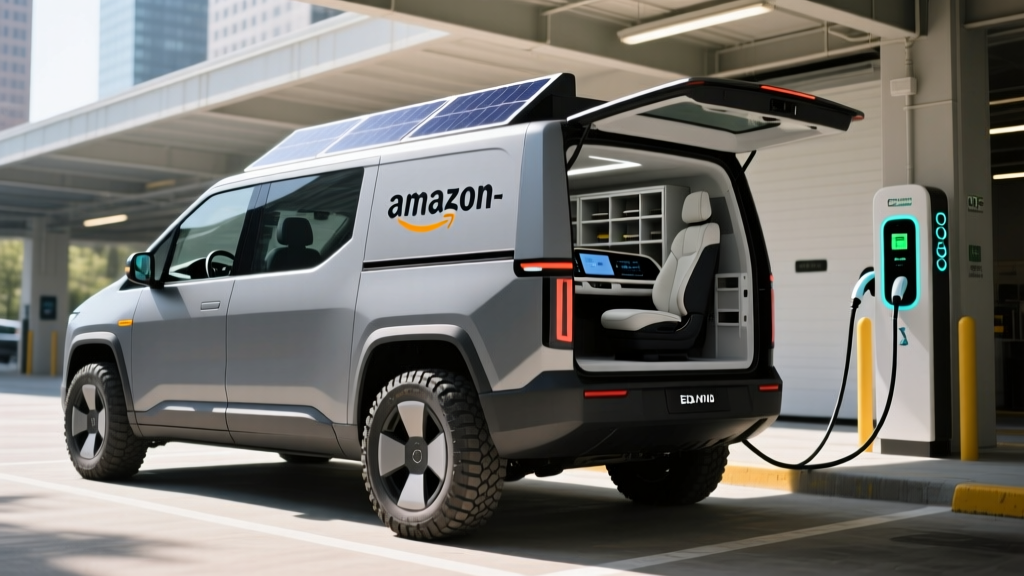
Inside, the cargo area is configured for Amazon's delivery workflow: modular shelving, a powered bulkhead door between cab and cargo, and a curbside sliding door wide enough for oversized packages. The driver's cockpit is pared down for productivity — a digital instrument cluster, integrated route tablet mount, and heavy-duty vinyl seating designed for 100+ daily ingress/egress cycles.
Pricing, Fleet Contracts, and Tax Credit Context
The EDV 700 is not sold to individual consumers. It is produced under an exclusive agreement with Amazon, which held exclusivity rights through 2023 and retains priority allocation through at least 2026. Rivian has indicated it may open EDV sales to other fleets (e.g., FedEx, UPS, regional carriers) in limited volumes, but pricing is negotiated via commercial contract, not published MSRP.
| Cost Factor | Consumer EV (Benchmark) | Rivian EDV 700 (Fleet) |
|---|---|---|
| Approximate unit cost | $50,000–$90,000 MSRP | Estimated $85,000–$110,000 (contract) |
| Federal §30D tax credit | Up to $7,500 (income/MSRP/sourcing rules) | Not eligible — §30D applies to personal-use vehicles |
| Commercial EV credit (§45W) | Not applicable | Potential up to $7,500 (GVWR <14,000 lb) or $40,000 (heavy-duty) per IRS §45W |
| Depot charger install | $500–$2,000 home | $5,000–$15,000 per stall (commercial) |
Fleet buyers should consult the IRS Commercial Clean Vehicle Credit (§45W) rather than the consumer §30D credit. Eligibility depends on vehicle GVWR, battery sourcing, and business tax liability — work with a tax professional before budgeting around the incentive.
Who the Rivian EDV 700 Suits Best
This van is purpose-built for a narrow use case: high-volume last-mile delivery in metro and suburban corridors with depot-based overnight charging. It is not a consumer vehicle, not a road-trip EV, and not suited to operators who need long highway range or public fast-charging flexibility.
Pros
- Standing-height cargo area reduces driver fatigue
- Regen-heavy urban routes maximize efficiency
- Low operating cost vs. diesel/gas step vans (~60% lower fuel cost per mile)
- Integrated route-tech and driver-assist suite (AEB, lane-keep, 360° cameras)
- Heat pump preserves range in cold climates
Cons
- Not available to consumers or most independent fleets
- 145.5-inch height excludes some low-clearance urban routes
- DC fast charge capped at ~115 kW — slow vs. modern consumer EVs
- Real-world range drops to ~100 miles on highway-heavy routes
- Commercial-only service network; no consumer dealership support
Competitive Context: EDV 700 vs. Alternatives
For fleets that can't access the EDV 700, the closest alternatives include the BrightDrop Zevo 600 (GM-backed, ~250-mile range, available to broader fleets) and the Ford E-Transit (lower range at ~126 miles EPA, but widely available and consumer-purchasable in cargo-van form). The EDV 700's advantage is its Amazon-tailored workflow integration; its disadvantage is exclusivity and a lower EPA range than newer competitors.
FAQ: Rivian EDV 700 Fleet Height and Ownership
What is the exact Rivian EDV 700 fleet height?
Approximately 145.5 inches (12 feet 1.5 inches) exterior. Interior cargo ceiling is roughly 84 inches, allowing most adults to stand upright.
What is the real-world range of the EDV 700?
Expect 120–140 miles on urban delivery routes and 100–120 miles on highway-heavy routes, with a further 20–30% loss in sub-30°F weather.
How fast does the EDV 700 charge?
About 19 miles per hour on Level 2 depot chargers (11.5 kW), and roughly 90 minutes for a 10–80% DC fast-charge session at ~115 kW peak.
Does the EDV 700 qualify for the federal EV tax credit?
Not the consumer §30D credit. Fleet buyers may qualify for the §45W Commercial Clean Vehicle Credit, subject to GVWR, sourcing, and tax-liability rules.
Can I buy a Rivian EDV 700 as a private owner?
No. As of 2026, the EDV 700 remains a commercial-only vehicle built primarily for Amazon. Rivian has not announced a consumer variant.
Is the EDV 700 worth it vs. the Ford E-Transit or BrightDrop Zevo?
For Amazon-contracted routes, yes — its workflow integration is unmatched. For independent fleets, the BrightDrop Zevo 600 offers longer range and broader availability, while the E-Transit is more accessible for smaller operators.