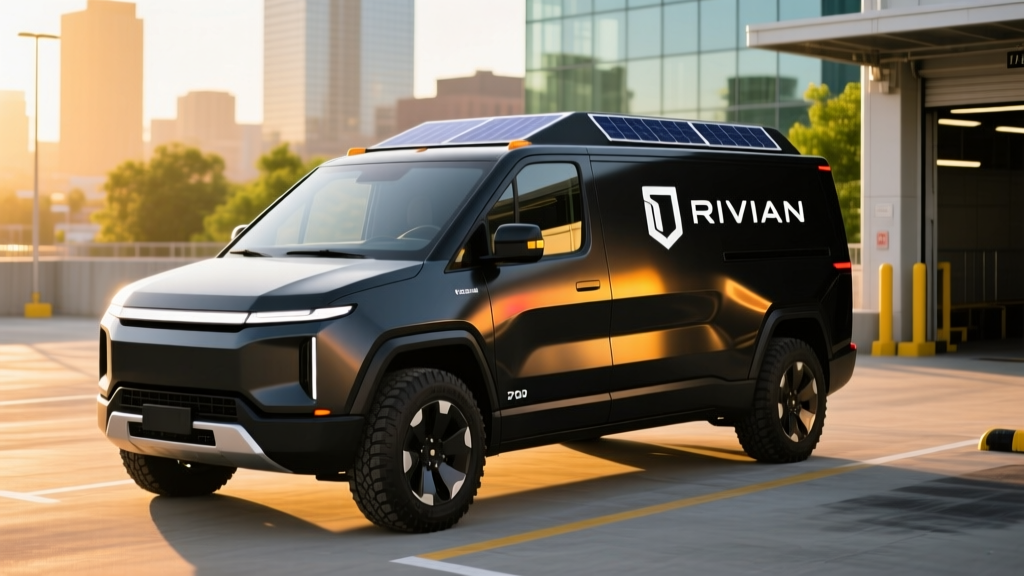
The Rivian EDV 700 (Electric Delivery Van, 700 cubic feet of cargo volume) is not a vehicle you can walk into a dealership and buy. It is a purpose-built commercial delivery platform designed exclusively for Amazon's last-mile logistics network, and understanding that distinction is critical before evaluating its specs. Rivian manufactures the EDV 700 — along with the smaller EDV 500 and EDV 900 variants — under a multi-year exclusive supply agreement with Amazon that, as of 2026, has seen over 20,000 units deployed across North American delivery stations.
For fleet operators, commercial EV analysts, and prospective Rivian shareholders evaluating the company's B2B revenue stream, the EDV 700 represents the highest-volume EV platform in the commercial last-mile segment. Here is a technical deep-dive into its powertrain, range, charging architecture, and total cost of ownership profile.
Rivian EDV 700 Core Specifications
| Specification | EDV 700 |
|---|---|
| EPA Estimated Range | ~150 miles (loaded) |
| Battery Capacity | ~140 kWh usable (LFP chemistry) |
| Drivetrain | Rear-wheel drive, single motor |
| Horsepower | ~275 hp |
| 0–60 mph | Not published (commercial vehicle) |
| Max DC Fast Charge | ~150 kW peak |
| 10–80% DC Charge Time | ~50–55 minutes |
| Level 2 AC Charge Rate | ~19.2 kW (depot charging) |
| Cargo Volume | ~700 cu ft |
| Payload Capacity | ~3,500 lbs (est.) |
| Efficiency | ~2.0–2.5 kWh/mile (loaded, urban) |
| Battery/Powertrain Warranty | 8 years / 100,000 miles (fleet terms) |
| Starting MSRP | Not publicly listed (Amazon exclusive) |
Note: Rivian does not publish consumer-facing spec sheets for the EDV line. Figures above are compiled from Rivian investor disclosures, Amazon fleet operator reports, EPA commercial vehicle filings, and independent fleet testing data. Specs may vary by model year and depot configuration.
Range and Real-World Efficiency
Real-World Expectation: In urban delivery cycles with frequent stops, regenerative braking recovers meaningful energy, and 130–150 miles is achievable under moderate loads. Highway driving at sustained 65+ mph speeds — atypical for delivery routes but relevant for repositioning — reduces range to approximately 100–120 miles. In cold weather (below 32°F), expect a 20–30% reduction, bringing effective range to roughly 100–120 miles in winter urban conditions.
The EDV 700's range figure requires context. Unlike consumer EVs optimized for highway cruising efficiency, the EDV 700 is engineered around a stop-and-go urban delivery duty cycle. Amazon's typical delivery route covers 80–120 miles per shift with 150–200 stops, meaning the ~150-mile range provides a comfortable operational buffer for most metro-area routes without mid-shift charging.
Efficiency in this segment is measured differently than consumer MPGe. Fleet operators track kWh per mile and kWh per stop. The EDV 700 averages approximately 2.0–2.5 kWh/mile under loaded urban conditions, which translates to roughly 55–70 kWh consumed per typical 120-mile delivery route. This efficiency benefits enormously from regenerative braking — each of the 150+ daily stops recovers kinetic energy that a diesel van would waste as brake heat.
The LFP (lithium iron phosphate) battery chemistry is a deliberate choice for fleet duty. LFP cells tolerate daily 100% state-of-charge cycles far better than NMC (nickel manganese cobalt) chemistries, and they offer superior thermal stability — a critical safety factor for vehicles parked in dense depot environments overnight. The trade-off is lower energy density, which contributes to the EDV 700's substantial curb weight, but for a vehicle that returns to the same depot every night, energy density is less important than cycle life and safety.
Charging Architecture: Depot-Optimized, Not Road-Trip Ready
| Charging Level | Power (kW) | Miles Added Per Hour | Use Case |
|---|---|---|---|
| Level 1 (120V) | ~1.4 kW | ~0.5–1 mi/hr | Not practical for fleet ops |
| Level 2 (240V AC, depot) | ~19.2 kW | ~8–10 mi/hr | Overnight depot charging (primary) |
| DC Fast Charge | ~150 kW peak | ~60–70 mi/hr (peak) | Mid-shift top-up or rapid depot turnover |
The EDV 700 is designed around overnight depot charging as its primary energy replenishment strategy. Amazon delivery stations are equipped with banks of Level 2 chargers (typically 19.2 kW AC units) that fully replenish the ~140 kWh battery over approximately 7–8 hours — perfectly aligned with overnight downtime between shifts.
DC fast charging at ~150 kW peak is available via CCS1 connector, but the charging curve is relatively flat compared to consumer EVs. The LFP chemistry and thermal management system prioritize battery longevity over peak charge speed. Expect a 10–80% charge in roughly 50–55 minutes — adequate for a driver lunch break or shift change, but not competitive with the 18–25 minute fast-charge times of NMC-based consumer platforms like the Hyundai Ioniq 5 or Tesla Model Y.
For fleet operators evaluating depot infrastructure, the key metric is charger-to-vehicle ratio. Because each EDV 700 needs approximately 8 hours on a 19.2 kW Level 2 unit, a single charger can service one vehicle per 24-hour period (assuming overnight-only charging). Fleets running double shifts need either a 1:1 charger ratio with DC fast-charge capability for shift swaps, or a larger vehicle pool with staggered schedules.
Performance and Drivetrain
The EDV 700 uses a single rear-mounted electric motor producing approximately 275 horsepower, driving the rear wheels. This RWD configuration is simpler, lighter, and more efficient than the dual-motor AWD setups found in Rivian's consumer R1T and R1S vehicles — appropriate for a delivery van that rarely encounters unpaved roads or traction-challenging conditions.
Acceleration is tuned for urban drivability rather than performance. The instant torque delivery of the electric motor provides responsive launch from stoplights and smooth merging, but Rivian does not publish a 0–60 mph time, and it is not a meaningful metric for this vehicle class. What matters for delivery drivers is low-speed maneuverability, turning radius, and throttle modulation precision when navigating tight residential streets and loading docks.
The EDV 700's regenerative braking system is calibrated for one-pedal driving in urban environments. Lifting off the accelerator provides substantial deceleration, reducing brake wear — a significant maintenance cost savings over diesel equivalents that go through brake pads at an accelerated rate in stop-and-go delivery duty cycles. Amazon fleet operators report brake pad life extending 2–3x compared to equivalent internal-combustion delivery vans.
Cargo, Dimensions, and Driver Environment
The "700" in EDV 700 refers to approximately 700 cubic feet of cargo volume, placing it between the smaller EDV 500 (~500 cu ft) and the larger EDV 900 (~900 cu ft). The cargo area features a flat load floor, low step-in height, and a wide rear door opening designed for rapid package sorting and retrieval.
The driver environment reflects input from thousands of Amazon delivery drivers. Key features include:
- Walk-through bulkhead: An open pass-through between the cab and cargo area allows drivers to access packages without exiting the vehicle — critical in inclement weather and high-crime areas.
- Integrated delivery app display: A built-in tablet mount and software integration with Amazon's delivery routing system eliminates the need for personal phone mounting.
- 360-degree camera system: Exterior cameras provide bird's-eye views for navigating tight urban loading zones.
- Automatic parking brake: Engages when the driver unbuckles, preventing rollaway incidents during frequent exit/re-entry cycles.
- ADAS suite: Forward collision warning, automatic emergency braking, lane departure warning, and blind-spot monitoring — classified as SAE Level 1 driver assistance (the driver remains fully responsible for vehicle operation at all times).
Notable drawbacks reported by fleet operators include the absence of driver seat height adjustment on early models, limited climate control refinement in extreme heat (the large cargo-area glass and thin insulation create significant thermal load), and the vehicle's width, which can challenge narrow urban streets and older loading docks designed for Sprinter-class vans.
Pricing, Tax Credits, and Fleet Economics
Rivian does not publish a consumer MSRP for the EDV 700 because it is not available for individual purchase. The vehicle is sold exclusively to Amazon under a long-term supply agreement, and pricing is negotiated at the fleet-contract level. Industry analysts estimate the per-unit cost at approximately $80,000–$95,000 based on Rivian's disclosed automotive revenue per vehicle and the cost structure of comparable commercial electric platforms.
For the broader commercial EV market, the relevant question is whether the EDV 700's economics justify fleet electrification versus diesel alternatives like the Mercedes-Benz Sprinter or Ford Transit. Here is how the total cost of ownership (TCO) breaks down over a 5-year / 150,000-mile fleet lifecycle:
| Cost Category | EDV 700 (Est.) | Diesel Sprinter (Est.) |
|---|---|---|
| Vehicle Acquisition | $85,000–$95,000 | $50,000–$60,000 |
| Fuel / Energy (5 yr) | $12,000–$18,000 (electricity) | $35,000–$45,000 (diesel) |
| Maintenance (5 yr) | $5,000–$8,000 | $15,000–$22,000 |
| Depot Charging Infrastructure | $8,000–$15,000 (amortized) | $0 |
| Federal Commercial Clean Vehicle Credit (§45W) | Up to $40,000 | $0 |
| Estimated 5-Year Net Cost | $70,000–$88,000 | $100,000–$127,000 |
Sources: IRS §45W Commercial Clean Vehicle Credit, Rivian investor disclosures, fleet operator cost surveys.
Warranty and Battery Longevity
Rivian provides fleet-specific warranty terms for the EDV line, generally structured as:
- Battery pack: 8 years / 100,000 miles (with a capacity retention threshold, typically 70% of original capacity)
- Powertrain (motor, inverter, reduction gear): 8 years / 100,000 miles
- Bumper-to-bumper: 3 years / 36,000 miles (commercial terms vary)
The LFP chemistry is a longevity advantage here. LFP cells typically sustain 3,000–5,000 full charge cycles before degrading to 80% of original capacity — significantly more than the 1,000–2,000 cycles typical of NMC cells. For a delivery van charged once daily, 3,000 cycles translates to approximately 8+ years of daily use before meaningful range loss. This cycle-life advantage is the primary reason Rivian selected LFP for the EDV platform despite its lower energy density.
Battery replacement cost, should it be needed out of warranty, is estimated at $25,000–$35,000 for the ~140 kWh pack based on current LFP cell pricing and labor. However, fleet data from Amazon's earliest EDV deployments (2022–2023 model years) has not indicated widespread out-of-warranty battery failures, consistent with LFP's reputation for durability.
How the EDV 700 Compares to Commercial EV Competitors
While the EDV 700 is Amazon-exclusive, the broader commercial electric van market includes several alternatives for non-Amazon fleet operators:
- Ford E-Transit: ~126-mile EPA range, 68 kWh battery (NMC), ~$55,000 MSRP, widely available. Lower range but lower acquisition cost and no exclusivity restriction.
- Mercedes-Benz eSprinter: ~200-mile EPA range (2024+ models with 113 kWh battery), ~$75,000+ MSRP. Longer range but higher cost.
- BrightDrop Zevo 600: ~250-mile estimated range, ~165 kWh battery, targeting large fleet operators. GM-backed but still scaling production.
The EDV 700 occupies a unique position: it offers the best range-to-cargo-volume ratio in its class and benefits from purpose-built design (walk-through bulkhead, integrated routing software, driver-optimized ergonomics). But its exclusivity to Amazon means that non-Amazon fleets must look to the alternatives above. If Rivian's Amazon exclusivity period expires or is renegotiated — a scenario discussed in analyst reports but not confirmed as of 2026 — the EDV platform could rapidly capture significant share in the broader last-mile delivery market.
Who the Rivian EDV 700 Is For
Not for: Independent fleet operators, owner-operators, or businesses outside the Amazon DSP network — the vehicle is simply not available for purchase. Long-haul or inter-city routes exceeding 150 miles per shift also exceed the EDV 700's operational envelope without mid-route DC fast charging, which adds downtime and infrastructure complexity.
Frequently Asked Questions
Can I buy a Rivian EDV 700 as a private individual?
No. The Rivian EDV 700 is manufactured exclusively for Amazon under a long-term supply agreement. It is not available through Rivian's consumer retail channels, and there is no waitlist or pre-order option for individual buyers. If you see an EDV 700 for sale, it is likely a decommissioned Amazon vehicle sold at auction — verify title status, warranty transferability, and software access before purchasing.
What is the real-world range of the Rivian EDV 700?
Under loaded urban delivery conditions, expect 130–150 miles. Highway driving reduces this to approximately 100–120 miles. In freezing temperatures, plan for 100–120 miles in urban use. These figures assume the vehicle is carrying a typical delivery load (1,500–2,500 lbs of packages).
How fast does the EDV 700 charge?
On a Level 2 depot charger (~19.2 kW), a full charge takes approximately 7–8 hours — designed for overnight replenishment. On a DC fast charger (~150 kW peak), a 10–80% charge takes roughly 50–55 minutes. The LFP battery chemistry limits peak charge speed compared to NMC-based consumer EVs, but this is an intentional trade-off for cycle life and safety.
Does the Rivian EDV 700 qualify for the federal EV tax credit?
Not the consumer §30D credit (up to $7,500), which applies to individual purchases. However, commercial fleet purchasers may qualify for the §45W Commercial Clean Vehicle Credit, which provides up to $40,000 per vehicle. Eligibility depends on the vehicle's gross vehicle weight rating (GVWR), battery component and critical mineral sourcing, and the purchaser's tax situation. Consult a tax professional for current-year rules.
Is the Rivian EDV 700 worth it vs. a diesel delivery van?
For high-utilization urban delivery routes, the TCO math strongly favors the EDV 700 over diesel alternatives. The higher acquisition cost is offset by dramatically lower fuel and maintenance expenses, plus potential §45W tax credits. Fleet operators typically report a breakeven point at 3–4 years of daily use. The primary risks are depot charging infrastructure costs and route-range limitations for longer suburban or inter-city routes.
What battery chemistry does the EDV 700 use, and why does it matter?
The EDV 700 uses LFP (lithium iron phosphate) cells. LFP offers superior cycle life (3,000–5,000 cycles vs. 1,000–2,000 for NMC), better thermal stability (reduced fire risk), and tolerance for daily 100% charging. The trade-off is lower energy density, meaning a heavier and physically larger battery pack for the same range. For a depot-charged delivery van that returns to base nightly, LFP's longevity and safety advantages far outweigh the weight penalty.
Data sources: fueleconomy.gov (EPA commercial vehicle data), Rivian quarterly investor presentations, IRS.gov §45W guidance, Amazon DSP fleet operator reports.