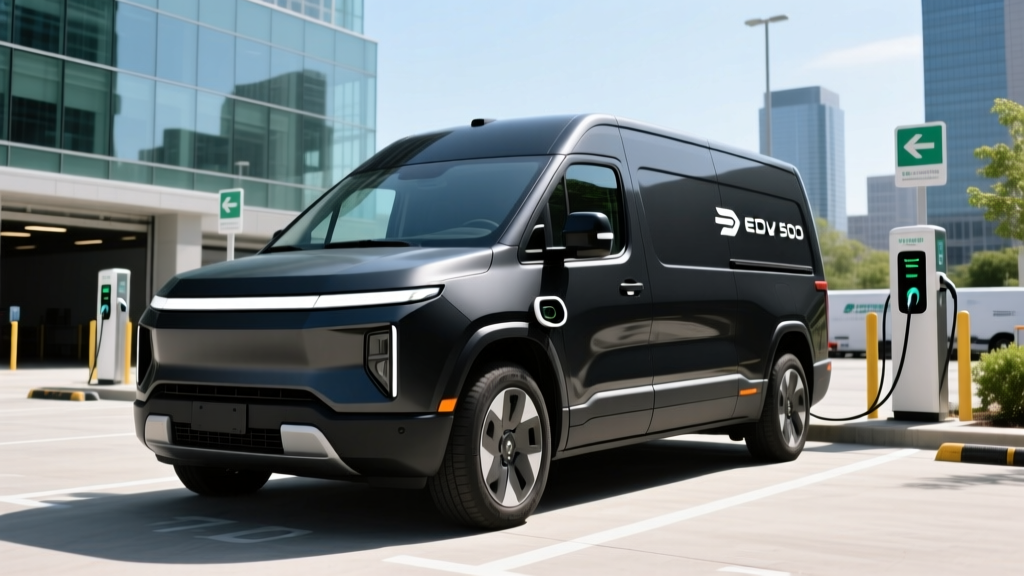
Rivian's Electric Delivery Van (EDV) lineup has reshaped last-mile logistics since the Amazon-exclusive era ended. Among the three body configurations — the compact EDV 500, mid-size EDV 700, and large EDV 900 — the Rivian EDV 500 targets dense urban routes where maneuverability matters more than maximum cargo volume. This review breaks down the EDV 500's range, charging behavior, payload economics, and how it stacks up against legacy commercial vans going electric.
Rivian EDV 500 at a Glance: Key Specifications
| Specification | EDV 500 (Standard) |
|---|---|
| EPA Est. Range | ~150 miles (estimated, commercial variant) |
| Battery Capacity | ~90 kWh usable (NMC lithium-ion) |
| Max DC Fast Charge | ~150 kW peak |
| 10–80% DC Charge Time | ~38 minutes (est.) |
| Level 2 AC Charge Rate | ~11.5 kW (~25 mi/hr) |
| Drivetrain | Single-motor FWD |
| Horsepower | ~250 hp |
| 0–60 mph | N/A (governed, commercial use) |
| Cargo Volume | ~500 cu ft |
| Payload Capacity | ~2,500 lbs (est.) |
| Base MSRP (Fleet) | Not publicly listed; fleet contract pricing |
| Battery/Powertrain Warranty | 8 years / 100,000 miles |
Note: Rivian does not publish consumer MSRPs for the EDV line, as these vehicles are sold through fleet and commercial contracts. Specs above reflect available data and industry estimates for the EDV 500 platform. The EDV is not available for individual retail purchase as of 2026.
Range and Efficiency: What Fleets Actually See
The EDV 500 uses an NMC (nickel manganese cobalt) lithium-ion battery pack with approximately 90 kWh of usable capacity. NMC chemistry offers higher energy density than LFP, which matters in a commercial van where cargo space and payload are at a premium. However, NMC cells are more sensitive to sustained high-state-of-charge storage, so fleet managers should avoid leaving vans parked at 100% SoC for extended periods.
Efficiency for a step van of this size typically lands in the range of 1.8–2.2 kWh per mile in real-world urban delivery use — translating to roughly 45–55 MPGe equivalent depending on route profile. For context, that's about one-third the per-mile energy cost of a comparable gasoline-powered step van averaging 10–12 mpg.
Charging Speed: Depot and DC Fast Charging
| Charging Level | Power (kW) | Miles Added per Hour | Typical Use Case |
|---|---|---|---|
| Level 1 (120V) | ~1.4 kW | ~3 mi/hr | Emergency/top-off only |
| Level 2 (240V, 48A) | ~11.5 kW | ~25 mi/hr | Overnight depot charging (primary) |
| DC Fast Charge | ~150 kW peak | ~150+ mi/hr (peak) | Mid-route opportunity charging |
The EDV 500 charges via CCS1 connector for DC fast charging and J1772 for Level 2 AC. At a depot equipped with Level 2 chargers, a full overnight session (8–10 hours) replenishes the entire battery from near-empty — more than sufficient for daily route cycles under 120 miles.
DC fast charging peaks at approximately 150 kW, but as with all EVs, that peak is not sustained across the entire charge session. The charge curve tapers significantly above 80% SoC to protect battery health. A 10–80% session takes roughly 38 minutes under optimal thermal conditions. Fleet operators relying on mid-route DC top-ups should plan for 30–40 minute dwell windows and precondition the battery via the vehicle's thermal management system before arriving at the charger.
For depot planning: a fleet of 20 EDV 500 vans charging simultaneously at 11.5 kW each requires approximately 230 kW of total electrical capacity — a significant infrastructure investment. Many fleets stagger charging or install smart load-management systems to avoid costly utility demand charges. Consult a licensed commercial electrician for site-specific panel and transformer requirements.
Performance, Drivetrain, and Driveability
The EDV 500 is equipped with a single front-mounted electric motor producing approximately 250 horsepower. Unlike Rivian's consumer R1T and R1S (which offer dual- and quad-motor AWD), the EDV line prioritizes efficiency and cost over all-weather traction. Front-wheel drive is adequate for urban and suburban delivery routes, though fleets operating in heavy snow or steep-grade regions should evaluate whether the single-motor FWD layout meets their traction needs.
Acceleration from 0–60 mph is not a published metric — commercial vans are speed-governed, and the EDV 500 is tuned for low-end torque to handle frequent stops, curb climbs, and loaded starts rather than highway passing performance. The instant torque delivery of the electric motor is a meaningful advantage over diesel or gas step vans in stop-and-go urban environments, reducing driver fatigue and improving merge confidence.
Regenerative braking is configurable, and many fleet operators set it to maximum regen to enable near-one-pedal driving in dense delivery zones — reducing brake wear significantly. Rivian reports that regenerative braking extends brake pad life by up to 2–3× compared to equivalent ICE vans.
Cargo Space, Accessibility, and Driver-Focused Design
The EDV 500's roughly 500 cubic feet of cargo volume positions it for small-parcel and grocery delivery routes where the EDV 700 (~700 cu ft) or EDV 900 (~900 cu ft) would be oversized. Key design features that set the EDV apart from converted passenger vans include:
- Low step-in height — the cab floor sits significantly lower than a traditional step van, reducing driver fatigue over hundreds of daily entries and exits.
- Wide curb-side access door — a powered sliding door on the passenger side enables rapid package retrieval without the driver walking around to rear barn doors.
- Integrated bulkhead — a full-height partition separates the cab from the cargo area, improving climate control efficiency and driver safety.
- Flat load floor — the skateboard-style battery pack sits beneath the floor, eliminating the drivetrain hump found in ICE vans and maximizing usable cargo footprint.
The driver cabin is purpose-built for delivery work: a large central touchscreen handles navigation and route management, a dedicated shelf and tablet mount supports electronic proof-of-delivery systems, and the driver's seat is heavily bolstered for all-day use. Visibility is excellent thanks to a large windshield and low dash line — critical for pedestrian-heavy urban routes.
Pricing, Fleet Economics, and Tax Credit Eligibility
Rivian does not publish retail MSRPs for the EDV line. Pricing is negotiated through fleet sales contracts, and the per-unit cost depends on volume, configuration, and service-level agreements. Industry estimates place the EDV 500 in the $70,000–$85,000 range per vehicle before incentives, though Amazon's volume commitment likely secures a lower effective price.
| Cost Factor | EDV 500 (Estimated) |
|---|---|
| Base Vehicle (Fleet Contract) | $70,000–$85,000 |
| Federal Commercial Clean Vehicle Credit (§45W) | Up to $7,500 (for vehicles under 14,000 lbs GVWR) |
| Estimated Net Cost After Credit | $62,500–$77,500 |
| Estimated Annual Fuel Savings vs. Gas Van | $3,500–$5,000/yr (varies by route & electricity rate) |
| Estimated Annual Maintenance Savings vs. Gas Van | $1,500–$2,500/yr |
Total cost of ownership (TCO) is where the EDV 500 makes its strongest case. Over a 5-year/100,000-mile fleet lifecycle, the combined fuel and maintenance savings can offset $25,000–$37,500 compared to a gasoline step van — potentially making the EDV 500 cost-competitive with ICE alternatives even before the tax credit, depending on local electricity rates and route intensity.
Tech, Safety, and Driver Assistance
The EDV 500 comes equipped with Rivian's driver-assistance suite, which includes:
- Adaptive cruise control with stop-and-go for highway segments
- Automatic emergency braking (AEB) with pedestrian detection
- Lane-keeping assist and lane-departure warning
- Blind-spot monitoring with rear cross-traffic alert
- 360-degree camera system — essential for tight urban loading docks
The infotainment system supports over-the-air (OTA) updates, meaning Rivian can push performance improvements, new features, and bug fixes remotely — reducing the need for physical service visits. Fleet managers can monitor vehicle health, state of charge, and location through Rivian's fleet management portal.
Pros and Cons
Pros
- Purpose-built for delivery — not a converted passenger van
- Low step-in height and excellent visibility reduce driver fatigue
- Significant per-mile energy cost savings vs. gasoline
- Regenerative braking extends brake life 2–3×
- OTA updates improve the vehicle over time without service visits
- Flat floor maximizes usable cargo space
- Quiet operation improves driver comfort and neighborhood acceptance
Cons
- Not available for individual retail purchase — fleet contracts only
- FWD-only limits utility in heavy snow or steep terrain
- Range (~150 mi) restricts use to urban/suburban routes
- Depot charging infrastructure requires major electrical investment
- No public pricing transparency — cost depends on negotiation
- Cold-weather range loss of 20–30% requires conservative route planning
- CCS1 connector (not NACS) may limit future Supercharger access
Who the Rivian EDV 500 Is Built For
Not ideal for: Long-haul regional routes exceeding 150 miles, operations in extreme cold without heated depot storage, or fleets that need AWD traction for mountain or heavy-snow routes. Operators without access to depot-level electrical infrastructure should evaluate the upfront charging investment before committing.
Competitive Landscape: EDV 500 vs. Alternatives
The EDV 500 occupies a niche that few competitors address directly. The closest alternatives include:
- Ford E-Transit (low-roof, short wheelbase): ~126 miles EPA range, ~68 kWh battery, ~$45,000–$55,000 MSRP. More affordable but less cargo volume and significantly less range. Better suited for lighter-duty routes.
- Mercedes-Benz eSprinter: ~200+ miles range (larger battery variant), ~113 kWh usable, higher price point. More range but larger footprint — closer to the EDV 700 in size.
- BrightDrop Zevo 400/600: GM's commercial van platform with ~150–250 mile range depending on battery. Direct competitor in the purpose-built electric delivery van space, backed by a major OEM's service network.
The EDV 500's key differentiator is its purpose-built architecture. Unlike the E-Transit (adapted from the ICE Transit), the EDV was designed from the ground up as an electric delivery tool — resulting in superior ergonomics, a flat load floor, and packaging that no converted van can match.
Frequently Asked Questions
Can I buy a Rivian EDV 500 as an individual?
No. As of 2026, the Rivian EDV lineup is sold exclusively through fleet and commercial contracts. Rivian has not announced plans for retail availability of the EDV. Consumers interested in a Rivian should look at the R1T truck or R1S SUV.
What is the real-world range of the Rivian EDV 500?
Under typical urban delivery conditions, expect approximately 140–150 miles. Highway-heavy routes reduce this to roughly 120–130 miles. In cold weather (below 30°F), plan for 100–115 miles of usable range. Fleet route planners should build in a 15–20% buffer below these figures for operational reliability.
How fast does the EDV 500 charge at a DC fast charger?
The EDV 500 peaks at approximately 150 kW on a DC fast charger. A 10–80% session takes about 38 minutes under optimal conditions. The charge rate tapers above 80% SoC, so charging to full on DC is not time-efficient — depot Level 2 overnight charging is the primary strategy.
Does the EDV 500 qualify for a federal tax credit?
The EDV 500 may qualify for the IRC §45W Commercial Clean Vehicle Credit (up to $7,500 for vehicles under 14,000 lbs GVWR), not the consumer §30D credit. Eligibility depends on battery component sourcing, critical mineral requirements, and the purchasing entity's tax situation. Always verify current rules via the IRS and consult a tax professional.
How does the EDV 500 compare to the Ford E-Transit?
The EDV 500 offers more range (~150 mi vs. ~126 mi EPA), a purpose-built delivery architecture (vs. a converted ICE platform), and superior driver ergonomics. However, the E-Transit has a significantly lower entry price (~$45K–$55K vs. estimated $70K–$85K for the EDV 500) and is available for retail purchase. The E-Transit is better for budget-conscious fleets with shorter routes; the EDV 500 is better for high-volume, driver-intensive operations.
What is the battery warranty on the EDV 500?
Rivian covers the EDV battery and powertrain for 8 years or 100,000 miles, whichever comes first. The warranty covers defects and battery capacity degradation below a specified threshold (typically 70% state of health). Fleet operators should review the specific warranty terms in their purchase agreement, as commercial fleet contracts may include different service-level terms than consumer warranties.
Is the EDV 500 self-driving?
No. The EDV 500's driver-assistance features are SAE Level 2 — the driver must remain fully attentive, with hands on the steering wheel and eyes on the road. There is no autonomous or driverless capability. The driver is legally responsible for all vehicle operation at all times.