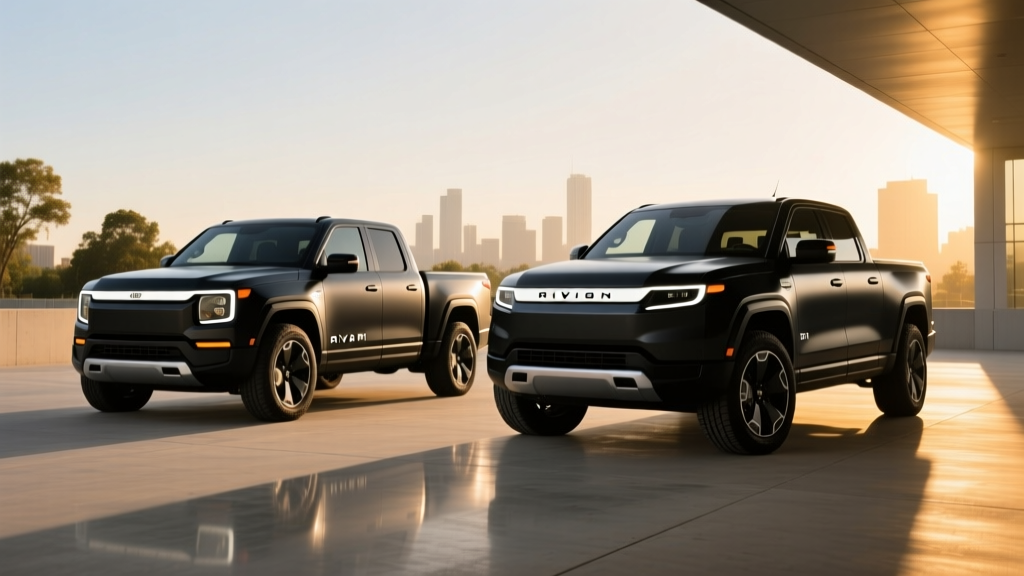
Rivian's decision to discontinue the Dual Standard battery configuration for both the R1T pickup and R1S SUV marks a significant shift in the automaker's lineup strategy. For buyers who valued the Dual Standard as a more affordable entry point into the Rivian ecosystem, this change demands a clear-eyed look at what's still available, what you're losing, and how the remaining configurations stack up against competitors like the Ford F-150 Lightning, Chevrolet Silverado EV, and Tesla Cybertruck.
This guide covers the outgoing Dual Standard specs in detail—so you can evaluate remaining inventory or decide whether stepping up to a Dual Large or Tri-Motor configuration makes financial and practical sense for your use case.
| Spec | R1T Dual Standard | R1S Dual Standard |
|---|---|---|
| Battery Capacity (Usable) | ~106 kWh (NMC) | ~106 kWh (NMC) |
| EPA Range | 270 mi (est.) | 260 mi (est.) |
| Drivetrain | Dual-Motor AWD | Dual-Motor AWD |
| Horsepower | 533 hp | 533 hp |
| 0-60 mph | ~4.5 sec | ~4.6 sec |
| Max DC Fast Charge | ~200 kW peak | ~200 kW peak |
| 10-80% DC Charge Time | ~30 min | ~30 min |
| Level 2 Home Charge Rate | 11.5 kW (~25 mi/hr) | 11.5 kW (~25 mi/hr) |
| Towing Capacity | 7,700 lbs | 7,700 lbs |
| Base MSRP (at discontinuation) | ~$71,700 | ~$76,700 |
| Battery/Powertrain Warranty | 8 yr / 175,000 mi | 8 yr / 175,000 mi |
Why Rivian Is Discontinuing the Dual Standard
Rivian's move to sunset the Dual Standard pack reflects a combination of production economics and buyer behavior. The Dual Standard, which pairs Rivian's dual-motor AWD powertrain with the smaller of the available NMC (nickel-manganese-cobalt) battery packs, occupied an awkward middle ground. It offered meaningful range and performance but at a price point that still exceeded the IRS §30D MSRP cap for trucks ($80,000), making the federal tax credit difficult to claim for many buyers.
Meanwhile, the majority of Rivian buyers have been selecting the Dual Large or Max configurations, which offer substantially more range and better long-distance road-trip practicality. By streamlining the lineup, Rivian can reduce manufacturing complexity, improve margins, and focus on the higher-capacity packs that its customers actually want.
For the 2026 model year onward, Rivian's R1T and R1S lineup is expected to consolidate around the Dual Large, Tri-Motor, and (potentially) a refreshed standard pack with updated chemistry—though final 2026 specs should be confirmed directly with Rivian's configurator before ordering.
Real-World Range: What the EPA Number Doesn't Tell You
Real-World Expectation: Plan for 220–240 mi on highway road trips at 70-75 mph. In cold weather (below 32°F), expect a 15–25% reduction, dropping usable range to roughly 180–210 mi depending on cabin heat usage and terrain.
The EPA range figure is a blended cycle that includes low-speed city driving where regenerative braking recovers significant energy. On the highway—where most EV range anxiety actually manifests—the R1T Dual Standard's large frontal area, all-terrain tires (if equipped), and truck aerodynamics work against efficiency.
In real-world highway testing at sustained 70-75 mph speeds, dual-motor Rivian vehicles with the standard pack typically deliver between 220 and 240 miles before requiring a charge stop. Add winter conditions, and that number contracts further. The R1T's available heat pump helps mitigate cold-weather losses compared to resistive heating, but physics remains physics: a cold NMC battery has higher internal resistance, and cabin heating draws heavily from the pack.
If your typical drive involves mostly suburban and city miles with frequent stops (allowing regen to work), you'll see figures much closer to the EPA sticker. For a daily commuter covering 40-60 round-trip miles, the Dual Standard provides ample buffer with home charging.
Charging Speed and Infrastructure
Charging speed is where the Dual Standard's limitations become most apparent for road-trippers. While Rivian has access to the Tesla Supercharger network via its NACS adapter (included with newer deliveries), the Standard pack's smaller battery and charge-curve characteristics mean longer stops compared to the Large or Max packs.
| Charging Level | Power (kW) | Approximate Speed |
|---|---|---|
| Level 1 (120V household) | ~1.4 kW | ~3 mi/hr |
| Level 2 (240V home, 48A) | 11.5 kW | ~25 mi/hr |
| DC Fast Charge (peak) | ~200 kW | 10-80% in ~30 min |
| DC Fast Charge (sustained avg) | ~130-150 kW | Varies by SoC and temp |
Understanding kW vs kWh here is critical: kW is the rate of energy flow (like water pressure from a hose), while kWh is total energy stored (like the size of the tank). The Dual Standard's ~106 kWh battery is the tank; the 200 kW peak is the maximum flow rate—but that peak is only sustained briefly, typically between 10-30% State of Charge (SoC).
Above 50% SoC, the charge rate tapers significantly. By 80%, you're typically seeing 50-70 kW, which is why the industry standard measurement is 10-80% time rather than a full charge. On a road trip, plan your stops around the 10-80% window for maximum efficiency—charging beyond 80% at a DC fast charger is painfully slow and rarely worth the wait unless you're at your destination overnight.
For home charging, a Level 2 wall connector on a 60A circuit (delivering 48A to the vehicle) will replenish the Dual Standard pack from empty in roughly 9-10 hours. Most owners charge overnight, waking to a full battery every morning. According to fueleconomy.gov, the R1T Dual Standard achieves approximately 73 MPGe combined (roughly 46 kWh/100 mi), which translates to about $0.13-$0.15 per mile at the national average electricity rate—roughly one-third the per-mile fuel cost of a comparable gas truck.
Performance and Capability
Even with the smaller battery, the Dual Standard powertrain is no slouch. The dual-motor AWD system produces 533 horsepower and 610 lb-ft of torque, delivering a 0-60 mph time of approximately 4.5 seconds for the R1T. That's sports-car acceleration in a body-on-frame pickup—a reality that still surprises first-time EV truck drivers.
The AWD system uses independent front and rear motors with torque vectoring, providing genuine off-road capability. Rivian's quad-motor configurations get more attention, but the dual-motor setup handles snow, mud, and moderate trail work with ease. The air suspension (standard on most trims) provides up to 14.9 inches of ground clearance in its highest setting and can automatically lower for highway efficiency.
Towing capacity for the Dual Standard is rated at 7,700 pounds. However—and this is a critical real-world caveat—towing at or near max capacity will cut range by 40-50%. If you're pulling a 6,000-pound trailer on the highway, plan for 120-140 miles of range between charge stops. For frequent heavy towing, the Dual Large or Max pack is strongly recommended.
Pricing, Tax Credits, and What It Actually Costs
At the time of discontinuation, the R1T Dual Standard started at approximately $71,700 (including destination), while the R1S Dual Standard started around $76,700. Options like the Adventure package, upgraded wheels, and premium interior could push as-tested prices into the $78,000-$82,000 range.
| Item | R1T Dual Standard | R1S Dual Standard |
|---|---|---|
| Base MSRP | ~$71,700 | ~$76,700 |
| Typical As-Tested | $75,000–$80,000 | $78,000–$82,000 |
| §30D MSRP Cap (Trucks/SUVs) | $80,000 | $80,000 |
| Federal Tax Credit (max) | Up to $7,500* | Up to $7,500* |
| Income Cap (Married Filing Jointly) | $300,000 MAGI | $300,000 MAGI |
| Point-of-Sale Transfer | Available* | Available* |
*Eligibility for the full $7,500 §30D credit depends on battery critical-mineral sourcing, buyer income, MSRP at time of purchase, and current IRS rules. The credit can be transferred to the dealer as a point-of-sale discount if all requirements are met. Consult IRS §30D guidelines and a tax professional before relying on credit eligibility.
The MSRP cap for trucks, vans, and SUVs under §30D is $80,000. A base Dual Standard R1T at ~$71,700 clears this threshold, but once you add popular options, you risk crossing the line and losing credit eligibility entirely. This is a real trap for buyers who configure aggressively without tracking the running total. The R1S Dual Standard, starting closer to the cap, is even more vulnerable to this issue with add-ons.
Additionally, the §30D credit's battery-sourcing requirements (critical minerals and battery components must meet escalating domestic-content thresholds) mean that not every Rivian delivery qualifies for the full $7,500. Some may qualify for $3,750 (half-credit) depending on the manufacturing batch and sourcing at time of assembly. Always verify with your dealer and cross-reference the DOE's qualifying vehicle list before finalizing a purchase.
Cargo, Passenger Space, and Daily Livability
The R1T's party trick remains the Gear Tunnel—a 11.7 cubic-foot pass-through compartment behind the rear seats that's ideal for skis, camping gear, or groceries you want to keep out of the cabin. The 4.5-foot bed (extendable with the tailgate down) offers 20.7 cu ft of volume, and the 11 cu ft front trunk (frunk) provides lockable, weatherproof storage that gas trucks simply can't match.
The R1S, as a three-row SUV, seats up to seven passengers. Second-row legroom measures approximately 38.5 inches, while the third row is best suited for children or short trips at around 30.5 inches of legroom. Cargo space behind the third row is modest at about 10.4 cu ft, expanding to 54.2 cu ft with the third row folded and 104.7 cu ft with both rear rows down.
Both vehicles feature Rivian's minimalist interior with a 15.6-inch center touchscreen and a 12.3-inch driver display. The software is responsive and receives regular over-the-air updates. Notable tech includes the built-in air compressor (available with certain packages), Camp Kitchen accessory for the Gear Tunnel, and a robust set of driver-assistance features branded as Driver+.
Important SAE automation note: Rivian's Driver+ is a Level 2 driver-assistance system per SAE J3016. It provides adaptive cruise control and lane-centering on highways, but the driver must remain fully engaged, with hands on or near the wheel and eyes on the road. It is not autonomous driving.
Pros and Cons of the Dual Standard
Pros
- Lowest entry price into the Rivian platform
- 533 hp dual-motor AWD with genuine off-road capability
- 270 mi EPA range is adequate for most daily and commuter use
- Air suspension, Gear Tunnel, and frunk are class-leading features
- Access to Tesla Supercharger network via NACS adapter
- 8-year/175,000-mile battery warranty provides long-term peace of mind
Cons
- Road-trip range is limited—expect 220-240 mi highway, less in cold
- Towing at max capacity cuts range by 40-50%
- DC fast charging peaks at ~200 kW; slower than competitors like the F-150 Lightning Extended Range
- Options can push MSRP above the §30D $80,000 cap, eliminating tax credit
- Now discontinued—remaining inventory only, no new orders
- Service center network still expanding; wait times can be long in some regions
Is It Worth Buying vs. Key Competitors?
With the Dual Standard discontinued, buyers evaluating remaining dealer or direct inventory should weigh it against these alternatives:
- Ford F-150 Lightning (Extended Range, ~320 mi EPA): More range, larger bed, broader dealer service network. Less off-road sophistication. Starts around $60,000-$70,000 depending on trim.
- Chevrolet Silverado EV (4WT / 3WT): Work-oriented trims with up to 400+ mi range on higher configurations. Fleet-heavy availability; consumer trims still ramping.
- Tesla Cybertruck (AWD): ~340 mi EPA, faster charging, polarizing design. Build quality and panel gaps remain inconsistent; service experiences vary widely.
- Rivian R1T Dual Large (remaining configuration): ~350 mi EPA, faster DC charging (~220 kW peak), better road-trip and towing practicality. Starts around $79,000+—watch the MSRP cap carefully.
If your driving is primarily commuting and weekend adventures within a 200-mile radius, a remaining Dual Standard at a negotiated price can still be an excellent value—especially if you can secure the §30D credit at point of sale. If you road-trip frequently, tow regularly, or live in a cold climate, invest in the Dual Large or look to the F-150 Lightning Extended Range.
Frequently Asked Questions
What is the real-world range of the Rivian R1T Dual Standard?
The EPA estimates approximately 270 miles for the R1T Dual Standard and 260 miles for the R1S. In real-world highway driving at 70-75 mph, expect 220-240 miles. In cold weather (below freezing), plan for 180-210 miles due to increased battery resistance and cabin heating draw.
How fast does the Dual Standard charge at home and on the road?
At home on a Level 2 (240V, 48A) charger, the Dual Standard adds approximately 25 miles of range per hour, with a full charge taking roughly 9-10 hours. On DC fast chargers, it peaks at approximately 200 kW, achieving a 10-80% charge in about 30 minutes. Charging above 80% slows dramatically and is not recommended at public stations unless necessary.
How much does the R1T or R1S Dual Standard cost after tax credits?
Base pricing starts around $71,700 (R1T) and $76,700 (R1S). If you qualify for the full $7,500 §30D federal credit—and your configured MSRP stays under $80,000—the effective price drops to approximately $64,200 for the R1T and $69,200 for the R1S. Eligibility depends on income limits, battery sourcing, and MSRP caps. Always verify current rules at IRS.gov.
Does the Dual Standard qualify for the federal EV tax credit?
It can, but with important caveats. The vehicle must have an MSRP at or below $80,000 (the truck/SUV cap). Buyer modified adjusted gross income must not exceed $300,000 (married filing jointly), $225,000 (head of household), or $150,000 (single). Battery critical-mineral and component sourcing requirements also apply and change annually. Point-of-sale transfer is available if all criteria are met.
Is the Dual Standard still available to order new?
No. Rivian has discontinued the Dual Standard configuration for both the R1T and R1S. Remaining inventory may be available through Rivian's direct sales channel or authorized dealers. For new orders, buyers will need to select from the remaining available configurations (Dual Large, Tri-Motor, or future pack options as announced).
What battery chemistry does the Dual Standard use?
The Dual Standard uses NMC (nickel-manganese-cobalt) lithium-ion cells. NMC offers higher energy density than LFP (lithium iron phosphate), which is why it's used in range-optimized configurations. However, NMC batteries benefit from being kept between 20-80% SoC for daily use to minimize long-term degradation. Rivian's battery management system includes buffers to protect the pack, and the 8-year/175,000-mile warranty covers capacity below a specified threshold.
Should I buy a remaining Dual Standard or wait for Rivian's next configuration?
If you find a Dual Standard in your preferred spec at a price that works—and you can confirm tax credit eligibility—it remains a capable, well-built EV truck or SUV. However, if range and road-trip flexibility are priorities, the Dual Large is meaningfully better. If you're not in a rush, waiting for Rivian's 2026+ lineup updates may yield improved battery chemistry or pricing, though specific specs should not be assumed until officially announced.
Sources: fueleconomy.gov (EPA range and efficiency data), Rivian official specifications, IRS §30D Clean Vehicle Credit guidelines.