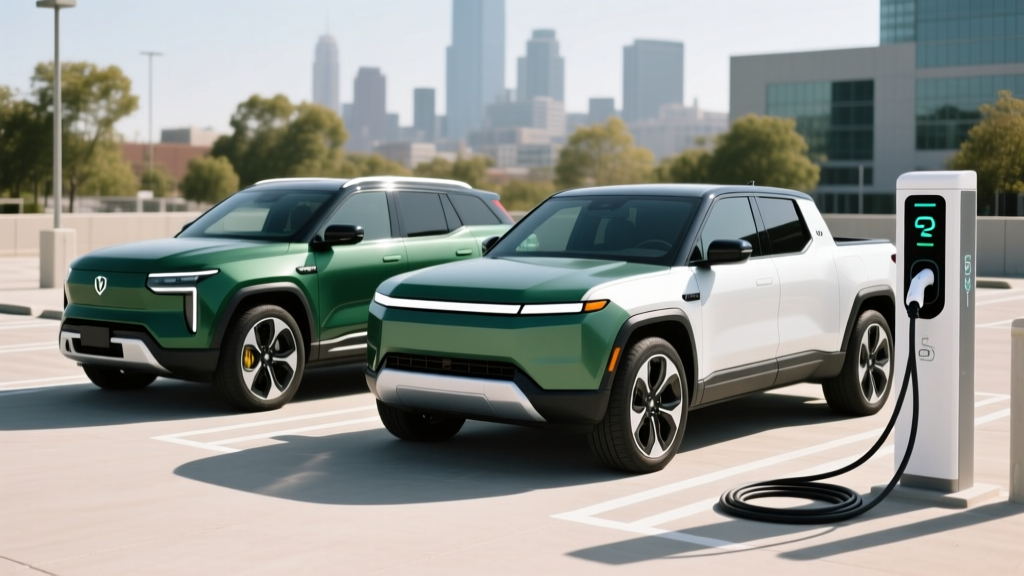
Rivian's Q3 2025 delivery numbers landed, and they tell a story of a company hitting its stride after a turbulent transition to its second-generation R1 platform. With 13,603 vehicles delivered in the quarter — a meaningful jump from prior quarters — the Illinois-built R1T pickup and R1S SUV are reaching more driveways than ever. But delivery volume is only half the equation. For buyers researching whether to join the queue, the real question is whether the Gen 2 R1T and R1S deliver on the spec sheet, at the charger, and on the balance sheet.
This review breaks down the 2025 Rivian R1T and R1S (Gen 2) across every metric that matters: real-world range versus EPA estimates, DC fast-charging curves, home Level 2 practicality, performance data, cargo dimensions, pricing after federal tax credits, and how these trucks stack up against the Ford F-150 Lightning, Tesla Cybertruck, and Chevrolet Silverado EV. We'll also unpack what the Q3 2025 delivery surge means for production stability and buyer confidence heading into 2026.
Rivian Q3 2025 Deliveries: What the Numbers Signal
Rivian reported 13,603 total deliveries in Q3 2025, encompassing both R1 vehicles and EDV commercial vans. The R1 line specifically saw strong uptake of the refreshed Gen 2 models, which introduced a revised electrical architecture, updated battery packs, and the new Dual-Motor Standard and Max configurations. Production cadence at the Normal, Illinois facility has stabilized after the retooling downtime earlier in 2025, and delivery lead times have shortened from the 10–14 week estimates of early 2025 to roughly 6–8 weeks for most Dual-Motor configurations as of late 2025.
For buyers, this matters: shorter wait times, more predictable build slots, and a growing service network (Rivian now operates over 50 service centers and 45+ mobile service vans nationwide) all reduce the ownership friction that plagued early R1 adopters in 2022–2023.
Gen 2 R1T and R1S: Core Specifications at a Glance
| Spec | R1T Dual-Motor Max Pack | R1T Tri-Motor | R1S Dual-Motor Max Pack | R1S Tri-Motor |
|---|---|---|---|---|
| EPA Range (est.) | 420 mi | 390 mi | 410 mi | 380 mi |
| Battery (usable kWh) | ~149 kWh (NMC) | ~149 kWh (NMC) | ~149 kWh (NMC) | ~149 kWh (NMC) |
| Standard Pack (EPA) | 270 mi (~92 kWh, LFP) | N/A | 270 mi (~92 kWh, LFP) | N/A |
| Horsepower | 533 hp | 850 hp | 533 hp | 850 hp |
| 0–60 mph | 4.5 sec | 2.9 sec | 4.6 sec | 3.0 sec |
| Drivetrain | AWD (dual-motor) | AWD (tri-motor) | AWD (dual-motor) | AWD (tri-motor) |
| Max DC Charge Rate | 220 kW (peak) | 220 kW (peak) | 220 kW (peak) | 220 kW (peak) |
| 10–80% DC Time | ~42 min | ~42 min | ~42 min | ~42 min |
| Level 2 Home Rate | 11.5 kW (~25 mi/hr) | 11.5 kW (~25 mi/hr) | 11.5 kW (~25 mi/hr) | 11.5 kW (~25 mi/hr) |
| Towing Capacity | 11,000 lb | 11,000 lb | 7,700 lb | 7,700 lb |
| Base MSRP (2025) | $89,900 | $105,900 | $84,900 | $99,900 |
Note: The Standard Pack uses LFP (lithium iron phosphate) chemistry, which trades energy density for longevity and lower cost. The Max Pack uses NMC (nickel manganese cobalt) for maximum range. Rivian's Large Pack (approx. 109 kWh NMC, ~330 mi EPA in the R1T) sits between them.
Real-World Range: EPA Sticker vs. Highway and Cold-Weather Reality
EPA Estimate: 420 miles (R1T Dual-Motor Max Pack)
Real-World Highway (70–80 mph, moderate temps): ~330–360 miles
Real-World Cold Weather (below 32°F, highway): ~260–300 miles
City / Mixed Driving (moderate temps): ~380–410 miles
Regenerative braking recovers more energy in stop-and-go city driving. Highway speeds above 75 mph and cold temperatures both reduce range significantly — expect a 15–25% drop on the highway and up to 30–35% in sub-freezing conditions without preconditioning.
Rivian's 420-mile EPA figure for the R1T Max Pack is among the highest of any production EV, but large, heavy pickups face outsized aerodynamic drag at highway speeds. In independent real-world testing at 70 mph on flat terrain in 65°F conditions, the R1T Max Pack typically achieves 340–360 miles before reaching a 5% state of charge. That's still exceptional — enough to cover most interstate corridors between DC fast-charger stops — but it's meaningfully less than the sticker.
Cold weather compounds the penalty. LFP chemistry in the Standard Pack is particularly sensitive to low temperatures, losing more capacity temporarily and accepting charge more slowly until the pack warms. NMC packs in the Large and Max configurations handle cold somewhat better, but preconditioning (navigating to a charger in the infotainment system to warm the battery before arrival) remains essential for maximizing charge speed in winter.
Efficiency for the R1T Dual-Motor Max Pack is rated at approximately 48 kWh/100 mi (combined), translating to roughly 70 MPGe. That's thirstier than a sedan-class EV but competitive with the F-150 Lightning Extended Range (~49 kWh/100 mi) and far more efficient than any gas-powered full-size truck.
Charging Speed: DC Fast Charging and Home Level 2 Breakdown
Charging is where the Gen 2 R1 platform shows its most meaningful improvement over the original. Rivian upgraded the charge architecture to accept higher sustained power, though peak rates still taper significantly past 80% state of charge — a reality for all lithium-ion packs to protect cell longevity.
| Charging Level | Power (kW) | Miles Added per Hour | Notes |
|---|---|---|---|
| Level 1 (120V household) | ~1.4 kW | ~3 mi/hr | Emergency/trickle only; 140+ hrs for full Max Pack |
| Level 2 (240V home, 48A) | 11.5 kW | ~25 mi/hr | Full Standard Pack overnight (~10 hrs); Max Pack ~14 hrs |
| DC Fast Charge (peak) | 220 kW | ~500+ mi/hr (at peak) | Sustained only to ~30% SoC; tapers progressively |
| DC Fast 10–80% (Max Pack) | ~42 min avg | — | Average rate ~140 kW across the curve |
| DC Fast 10–80% (Standard Pack) | ~30 min avg | — | Smaller pack charges faster in absolute time |
The 220 kW peak rate is achievable at V3-class chargers (Tesla Supercharger with Magic Dock, Electrify America 350 kW stalls, Rivian Adventure Network). However, the charge curve tells the real story: the Max Pack sustains roughly 200–220 kW only from about 10% to 25% SoC, then tapers to ~150 kW through 50%, and drops further to ~80–100 kW past 65%. The 10–80% time of approximately 42 minutes is competitive but not class-leading — the Hyundai Ioniq 5 and Kia EV9, with their 800V architectures, achieve 10–80% in roughly 18–25 minutes at comparable chargers.
For home charging, the 11.5 kW onboard charger is robust. With a hardwired Level 2 wall connector on a 60-amp circuit, you'll add roughly 25 miles of range per hour. Most R1 owners who commute under 80 miles round-trip will wake up fully replenished every morning, even with the Max Pack, provided they plug in nightly. A NEMA 14-50 outlet on a 50-amp circuit delivers about 9.6 kW — slightly slower but still sufficient for daily needs.
NACS adoption: Gen 2 Rivians ship with a NACS (Tesla-style) charge port, granting native access to the Tesla Supercharger network without an adapter. This is a significant usability win over the CCS-port Gen 1 vehicles, which require a NACS adapter for Supercharger access.
Performance and Drivetrain: Dual-Motor vs. Tri-Motor
Rivian offers two powertrain configurations for the Gen 2 R1T and R1S:
- Dual-Motor (AWD): One motor per axle, producing 533 hp and 610 lb-ft of torque. The 0–60 mph time of 4.5 seconds (R1T) is quick for a 7,000+ lb vehicle and more than adequate for merging, passing, and daily driving.
- Tri-Motor (AWD): One front motor and two rear motors, producing 850 hp and a staggering 1,100+ lb-ft. The 2.9-second 0–60 time (R1T) puts it in supercar territory and makes it the quickest production pickup ever sold. This is a performance halo configuration, not a rational efficiency choice.
Rivian's torque vectoring and quad-motor-derived software (even on the dual-motor, which can brake individual wheels to simulate torque vectoring) give the R1 platform genuinely capable off-road manners. Ground clearance adjusts from 7.9 to 14.9 inches via the air suspension, and the wade mode allows water fording up to 36 inches (R1T). This isn't a pavement-only truck.
Pricing, Tax Credits, and Total Cost of Ownership
| Configuration | Base MSRP | §30D Federal Credit | Effective Price (if eligible) |
|---|---|---|---|
| R1S Dual-Motor Standard Pack | $74,900 | $7,500 | ~$67,400 |
| R1S Dual-Motor Large Pack | $79,900 | $7,500 | ~$72,400 |
| R1T Dual-Motor Standard Pack | $69,900 | $7,500 | ~$62,400 |
| R1T Dual-Motor Max Pack | $89,900 | $7,500 | ~$82,400 |
| R1T Tri-Motor Max Pack | $105,900 | $0 (MSRP cap) | $105,900 |
Federal tax credit eligibility under IRS §30D requires navigating several rules that change frequently:
- MSRP Cap: Vans, SUVs, and pickups qualify up to $80,000 MSRP. The R1T is classified as a pickup (also $80,000 cap). This means the Dual-Motor Standard and Large Pack configurations generally qualify, while Max Pack and all Tri-Motor trims exceed the cap and do not.
- Buyer Income Cap: Modified adjusted gross income must not exceed $150,000 (single), $225,000 (head of household), or $300,000 (joint filers).
- Battery Sourcing: At least a percentage of critical minerals and battery components must be sourced from the U.S. or free-trade-agreement partners. Rivian has worked to qualify its supply chain, but eligibility can shift — always verify on fueleconomy.gov before purchasing.
- Point-of-Sale Transfer: As of 2024, the credit can be transferred to the dealer at purchase, reducing the purchase price directly rather than waiting for a tax refund. This effectively functions as an instant discount if you qualify.
On total cost of ownership, the R1T Dual-Motor Standard Pack at an effective ~$62,400 undercuts a well-equipped Ford F-150 Lariat PowerBoost hybrid when you factor in five years of fuel savings (electricity at $0.14/kWh vs. gas at $3.50/gallon yields roughly $6,000–$8,000 in fuel savings over 75,000 miles). Insurance premiums for the R1 platform run 15–25% higher than comparable gas trucks, however — budget accordingly.
Cargo, Passenger Space, and Daily Livability
R1T (pickup):
- Bed length: 4.5 ft (54 in) — shorter than a traditional short-bed truck
- Gear Tunnel: 11.0 cu ft lockable pass-through storage behind the rear seats (unique to Rivian)
- Frunk (front trunk): 11.0 cu ft
- Total enclosed cargo: ~30+ cu ft (frunk + gear tunnel + bed with tonneau)
- Rear legroom: 38.4 in
R1S (3-row SUV):
- Cargo behind 3rd row: 10.6 cu ft
- Cargo behind 2nd row (3rd row folded): 46.7 cu ft
- Cargo behind 1st row (all rear folded): 88.2 cu ft
- Third-row legroom: 30.4 in (tight for adults on long trips)
- Second-row legroom: 39.5 in
The R1T's 4.5-foot bed is the truck's most polarizing feature. It handles camping gear, bikes, and home-improvement runs well, but full sheets of plywood (4×8 ft) won't fit flat. The gear tunnel is a brilliant solution for secure, weatherproof storage that no competitor offers. The R1S third row is best reserved for children or short trips — adults will find it cramped compared to the Chevrolet Tahoe or even the Tesla Model X.
Tech, Driver Assistance, and Standout Features
The Gen 2 R1 platform introduced a complete electrical architecture overhaul, including a new zonal controller design that reduced wiring harness weight and complexity. Key technology highlights:
- Infotainment: 15.6-inch center display running Rivian's proprietary OS. Responsive, clean interface with native navigation, streaming apps, and over-the-air update capability. No Apple CarPlay or Android Auto — a dealbreaker for some buyers who prefer phone projection.
- Driver Assistance (Rivian Driver+): SAE Level 2 system with adaptive cruise control, lane centering, and automatic lane changes on divided highways. Competent and smooth, but not class-leading — Ford's BlueCruise and GM's Super Cruise both offer hands-free operation on mapped roads, while Rivian still requires hands on the steering wheel.
- Air Suspension: Standard across all trims, with adjustable ride height, automatic load leveling when towing, and a kneel mode for easier bed/cargo access.
- Camp Kitchen & Gear Guard: Available slide-out camp kitchen (integrates with the gear tunnel) and integrated bed tie-down system with built-in air compressor.
- Vehicle-to-Load (V2L): Can power external devices up to 3.5 kW via bed outlets — enough for power tools, a campsite, or emergency home backup for essential circuits.
Rivian Driver+ is an SAE Level 2 driver-assistance system. It is not autonomous or self-driving. The driver must remain engaged, keep hands on the wheel, and monitor the road at all times. Hands-free operation is not supported. Always verify system limitations in the owner's manual.
Warranty Coverage and Long-Term Battery Outlook
Rivian provides the following warranty coverage for the 2025 R1T and R1S:
- Battery Pack: 8 years / 175,000 miles (whichever comes first), with a capacity retention threshold of 70% or greater
- Powertrain (motors, reducers): 8 years / 175,000 miles
- Bumper-to-Bumper: 5 years / 60,000 miles
- Corrosion Perforation: 12 years / unlimited miles
The 175,000-mile battery warranty is among the most generous in the industry, exceeding the federal minimum of 8 years / 100,000 miles. The 70% capacity retention threshold is standard — if your Max Pack degrades below 294 miles of range within the warranty period, Rivian will repair or replace the pack. Early Gen 1 data suggests degradation is modest, with most vehicles retaining 92–95% capacity after 50,000 miles, though long-term data beyond 100,000 miles is still accumulating.
Pros and Cons
- Class-leading 420-mile EPA range (Max Pack)
- Native NACS port — full Supercharger access
- Unique gear tunnel storage (R1T)
- Best-in-class 11,000 lb towing (R1T)
- Air suspension with adjustable ride height
- Generous 8yr/175,000mi battery warranty
- Strong OTA update track record
- No Apple CarPlay / Android Auto
- Driver+ requires hands-on-wheel (no hands-free)
- DC charging curve tapers heavily past 65% SoC
- Short 4.5-ft bed limits utility vs. traditional trucks
- High MSRP — most trims exceed §30D tax credit cap
- Insurance premiums 15–25% above gas trucks
- R1S third row too tight for adults
Who Should Buy the Gen 2 R1T or R1S?
Choose the R1T if: You need a genuine pickup for towing (boats, trailers, campers up to 11,000 lb), want maximum EV range for road trips, value the gear tunnel for adventure gear, and don't need a full 6.5-ft bed for flat-sheet materials.
Choose the R1S if: You want a 3-row family SUV with electric efficiency, need up to 410 miles of range, and can accept that the third row is child-sized. It's a compelling alternative to the Tesla Model X at a lower price point.
Look elsewhere if: You need hands-free highway driving (BlueCruise/Super Cruise), require Apple CarPlay, need a traditional long bed, or your budget is under $65,000 after incentives (consider the Ford F-150 Lightning Pro or Chevrolet Silverado EV Work Truck).
Frequently Asked Questions
What is the real-world range of the 2025 Rivian R1T Max Pack?
The EPA rates the R1T Dual-Motor Max Pack at 420 miles. In real-world highway driving at 70–80 mph in moderate temperatures, expect 330–360 miles. In sub-freezing conditions, that drops to roughly 260–300 miles. City and mixed driving recovers more energy through regenerative braking and can approach the EPA figure.
How fast does the Gen 2 Rivian charge on DC fast chargers?
The Gen 2 R1 platform peaks at 220 kW on compatible DC fast chargers, but the sustained average across a 10–80% session is closer to 140 kW due to charge-curve tapering. Expect 10–80% in approximately 42 minutes for the Max Pack and ~30 minutes for the Standard Pack. At home on Level 2 (11.5 kW), you'll add about 25 miles of range per hour.
Does the 2025 Rivian R1 qualify for the $7,500 federal EV tax credit?
It depends on the trim and your income. Under IRS §30D, pickups and SUVs must have an MSRP at or below $80,000 to qualify. This means the Dual-Motor Standard Pack and Large Pack configurations are generally eligible, while Max Pack and Tri-Motor trims exceed the cap. Buyer income must also fall under $150K (single), $225K (head of household), or $300K (joint). Battery sourcing requirements also apply — verify current eligibility on fueleconomy.gov before purchasing.
Is the Rivian R1T worth buying over the Ford F-150 Lightning or Tesla Cybertruck?
The R1T excels in range (420 mi vs. Lightning's 320 mi Extended Range), build quality, and adventure-oriented features like the gear tunnel. The F-150 Lightning offers a larger bed (5.5 ft), broader dealer service network, and lower entry pricing. The Cybertruck offers polarizing styling and 470-V architecture but has limited availability and a smaller service footprint. If range and adventure utility are your priorities, the R1T is the strongest choice. If you need maximum bed length or the lowest price, the Lightning wins.
What are the biggest drawbacks of the Rivian R1 platform?
The most common owner complaints center on the lack of Apple CarPlay/Android Auto, the hands-on-wheel requirement for Driver+ (no hands-free highway driving), the short 4.5-foot bed on the R1T, and the high price of Max Pack and Tri-Motor configurations that exceed the federal tax credit cap. Insurance costs also run higher than comparable gas trucks.
How did Rivian deliveries perform in Q3 2025?
Rivian delivered 13,603 vehicles in Q3 2025 (R1 + EDV combined), reflecting stabilized Gen 2 production and improving demand. Delivery lead times for Dual-Motor configurations shortened to approximately 6–8 weeks by late 2025, a significant improvement from earlier in the year.