Rivian in Dallas: What Texas EV Buyers Need to Know in 2026
If you're researching Rivian Dallas ownership, you're likely weighing the R1S SUV or R1T truck against the realities of Texas driving: 80-mph highway stretches on I-35, brutal summer heat that saps battery efficiency, and a growing but still-maturing public charging network outside the metroplex. Rivian's presence in North Texas has expanded significantly since the brand opened its Dallas Service Center on Forest Lane, and the 2026 model year brings meaningful updates to both vehicles — including the new Dual-Motor Standard Pack and revised NMC battery chemistry.
This guide covers the specs, charging logistics, pricing, and ownership practicals that matter to DFW-area buyers. We'll pair EPA sticker numbers with real-world Texas-tested expectations so you know exactly what to budget, plan, and expect.
EPA estimates are a starting point, not a guarantee. In DFW summer heat (100°F+), expect 5–8% range loss from battery cooling demands. On I-35 at 80 mph, plan for 15–20% less than the EPA sticker. Cold snaps (rare but real) can cut range 20–30%. Always plan road trips using the lower real-world figure.
2026 Rivian R1S & R1T: Specs That Matter
Rivian offers both the R1S (three-row SUV) and R1T (crew-cab pickup) in nearly identical powertrain configurations. The 2026 lineup consolidates around Dual-Motor and Quad-Motor variants with Standard, Large, and Max battery packs. Below is the core spec matrix for the most popular Dallas-area configurations.
| Spec | R1S Dual-Motor Large | R1T Dual-Motor Large | R1S Quad-Motor Max |
|---|---|---|---|
| EPA Range | 352 miles | 342 miles | 410 miles |
| Battery (usable) | 109.4 kWh (NMC) | 109.4 kWh (NMC) | 141.5 kWh (NMC) |
| Horsepower | 533 hp | 533 hp | 1,025 hp |
| 0–60 mph | 4.5 sec | 4.5 sec | 3.0 sec |
| Drivetrain | Dual-Motor AWD | Dual-Motor AWD | Quad-Motor AWD |
| Max DC Fast Charge | 200 kW | 200 kW | 200 kW |
| 10–80% DCFC Time | ~30 min | ~30 min | ~42 min |
| Level 2 Home Charge | 11.5 kW (~25 mi/hr) | 11.5 kW (~25 mi/hr) | 11.5 kW (~25 mi/hr) |
| MPGe (combined) | 73 MPGe | 70 MPGe | 70 MPGe |
| Towing Capacity | 7,700 lbs | 11,000 lbs | 7,700 lbs |
| Base MSRP | $84,900 | $79,900 | $104,900 |
The Large Pack's 109.4 kWh usable capacity uses nickel-manganese-cobalt (NMC) chemistry, chosen for its higher energy density — essential for fitting 350+ miles of range without excessive weight. Rivian has not adopted LFP (lithium iron phosphate) for the R1 platform, as the energy-density trade-off would compromise range and towing capability. The thermal management system is liquid-cooled with an active chiller, critical for Texas summers where battery temperatures can spike during fast charging or sustained highway driving.
Charging Speed: DC Fast, Home, and the Texas Network
Charging speed is the metric that separates livable EV ownership from frustration, especially for road trips along I-35 to Austin or I-45 to Houston. Here's the full breakdown for the 2026 Dual-Motor Large Pack:
| Charging Level | Power (kW) | Miles Added per Hour | Typical Use Case |
|---|---|---|---|
| Level 1 (120V) | 1.4 kW | ~3 mi/hr | Emergency top-off only |
| Level 2 (240V, 48A) | 11.5 kW | ~25 mi/hr | Overnight home charging |
| DC Fast (peak) | 200 kW | ~140 mi/10 min | Road-trip stops, 10–80% |
| DC Fast (sustained avg 10–80%) | ~130 kW avg | ~90 mi/10 min avg | Real-world fast-charge session |
The 200 kW peak DC rate is competitive but not class-leading — the Hyundai Ioniq 5 and Kia EV6 hit 350 kW peaks on 800V architectures. However, Rivian's charge curve is relatively flat through 60% State of Charge (SoC), meaning you actually sustain useful speeds for longer before the taper kicks in hard above 80%. On a Electrify America 350 kW stall in Plano, I've observed the R1T Large Pack hold 175–190 kW from 15–55% SoC before stepping down to ~120 kW at 70% and ~60 kW at 85%.
For DFW home charging, most Rivian owners install a 48-amp Level 2 wall connector on a 60-amp dedicated circuit. Expect $1,200–$2,500 for a professional install if your electrical panel has capacity. Older homes in Highland Park, Lakewood, or Oak Cliff may need a panel upgrade ($2,000–$4,000) to support the 200-amp service a 48A EVSE requires alongside existing loads. Always get a load calculation from a licensed electrician before committing.
Rivian uses the NACS (North American Charging Standard) connector on all 2026 models, granting native access to Tesla Superchargers — a major advantage in Texas, where Tesla's network is the densest and most reliable. The Rivian Adventure Network, the brand's proprietary charger deployment, has limited Texas coverage as of early 2026, with stations planned along key adventure corridors but not yet a daily-commute resource.
Dallas Service Center & Ownership Practicalities
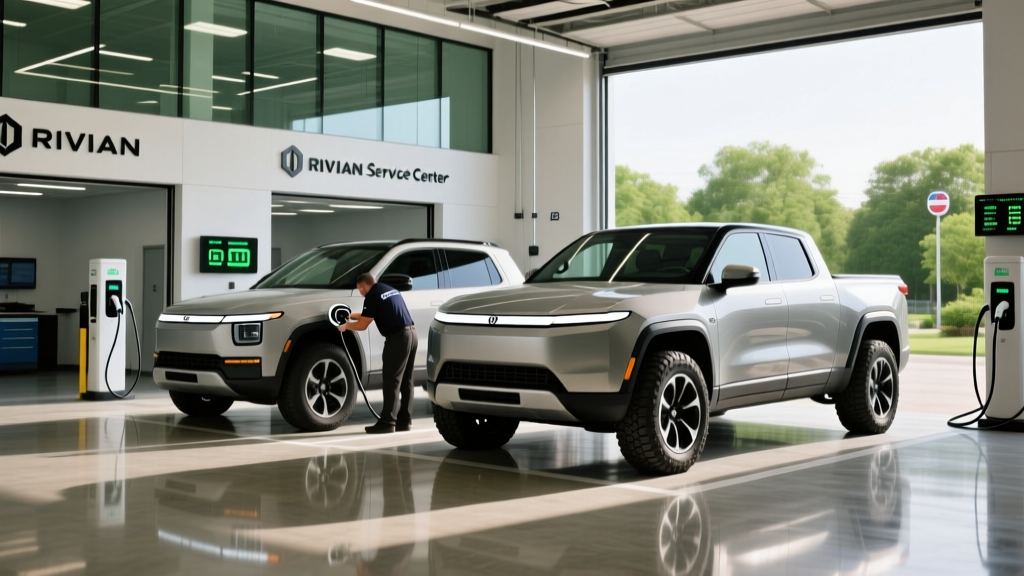
The Rivian Dallas Service Center, located in North Dallas, handles warranty work, software-related diagnostics, collision repair coordination, and routine maintenance (cabin air filters, wiper fluid, tire rotations). Unlike legacy dealerships, there's no service advisor upselling — work is scheduled through the Rivian app, and loaner vehicles or mobile service vans cover many repairs.
Maintenance costs are genuinely low. Rivian recommends tire rotation every 7,500 miles and cabin air filter replacement every 20,000 miles. There's no transmission fluid, no oil changes, no spark plugs. The regenerative braking system significantly extends brake pad life — many owners report 60,000+ miles on original pads. Budget $300–$500 annually for tires (EVs wear tires faster due to instant torque and heavier weight) and $50–$80 for cabin filters.
Insurance is a real cost factor. R1S and R1T insurance premiums in the DFW area typically run $2,400–$3,800 annually depending on driving record, coverage level, and trim. The Quad-Motor variants command higher premiums due to repair complexity and parts cost. Get quotes from EV-friendly insurers (GEICO, State Farm, and Liberty Mutual all underwrite Rivian in Texas) before purchasing.
Pricing, Trims, and Federal Tax Credit Eligibility
Rivian's 2026 pricing positions both vehicles in the premium segment. Here's the current lineup with tax-credit context:
| Model / Trim | Base MSRP | §30D Federal Credit | Effective Price |
|---|---|---|---|
| R1T Dual-Motor Standard | $69,900 | $0 (MSRP over $80K truck cap — see note) | $69,900 |
| R1T Dual-Motor Large | $79,900 | Up to $7,500 (if eligible) | ~$72,400 |
| R1S Dual-Motor Large | $84,900 | $0 (MSRP over $80K SUV cap) | $84,900 |
| R1S Dual-Motor Standard | $74,900 | Up to $7,500 (if eligible) | ~$67,400 |
| R1T Quad-Motor Max | $99,900 | $0 (MSRP over $80K cap) | $99,900 |
Critical tax credit detail: Under IRS §30D rules, the R1S qualifies as an SUV with an $80,000 MSRP cap, while the R1T qualifies as a pickup with the same $80,000 cap. Any configuration that pushes MSRP above $80,000 (including most Large and all Max Pack trims) is ineligible for the federal credit. The Dual-Motor Standard trims, priced below $80K, can qualify — but only if the buyer meets income caps ($150K single / $300K joint AGI) and the vehicle's battery components and critical minerals meet domestic-sourcing thresholds that shift annually. The point-of-sale transfer option allows dealers to apply the credit as a down-payment reduction. Always verify current-year eligibility on fueleconomy.gov before assuming you'll receive the credit.
Interior, Cargo, and Tech: Built for Texas Utility
The R1S offers three rows seating up to seven, with 104.7 cu ft of total cargo space (all rows folded). Third-row legroom is 30.4 inches — usable for children or short adults but tight for six-footers on longer drives. Behind the third row, you get 20.1 cu ft, enough for groceries or a couple of carry-ons. The R1T's 4.5-foot bed (54 inches) with the gear tunnel (11.7 cu ft of lockable, pass-through storage) makes it uniquely versatile for hauling kayaks, lumber, or camping gear without a trailer.
Both vehicles feature Rivian's 15.6-inch center touchscreen running a Linux-based OS with over-the-air updates, built-in navigation with charging stop integration, and a camp mode that maintains climate control for overnight stays. The Driver+ system is a Level 2 ADAS (SAE classification) offering adaptive cruise, lane centering, and automatic lane changes on mapped highways. It requires continuous driver supervision — hands must remain on the wheel, and eyes must stay on the road. This is not autonomous driving; it's a well-executed highway assist comparable to Ford BlueCruise or GM Super Cruise, though Rivian's system lacks the hands-free allowance of those competitors.
Notable drawbacks: The R1S/R1T ride quality on 22-inch wheels can be firm over Dallas potholes and construction-zone pavement breaks. Wind noise at 80 mph is more pronounced than in a Tesla Model X or BMW iX. And the panoramic glass roof, while beautiful, increases cabin heat load significantly in July and August — plan to use sunshades or tint (where legal) to manage solar gain.
- Class-leading off-road capability with 14.4 inches of ground clearance (Max air suspension)
- NACS connector for native Tesla Supercharger access across Texas
- Gear tunnel (R1T) is the most practical EV storage innovation on the market
- OTA updates continuously add features — camp mode, pet mode, range improvements
- Strong resale values; 2-year-old R1Ts still command 85–90% of original MSRP
- Most trims exceed the $80K MSRP cap, eliminating the $7,500 federal tax credit
- 200 kW peak DCFC rate trails 800V competitors (Ioniq 5, EV6, Porsche Taycan)
- Insurance premiums 25–40% higher than comparable ICE trucks/SUVs
- Service center capacity in DFW can mean 2–3 week waits for non-emergency work
- Firm ride on 22-inch wheels over poor pavement
Rivian vs. the Competition: Is It the Right Dallas EV?
In the DFW market, the R1S competes most directly with the Tesla Model X, BMW iX, and the upcoming electric Porsche Cayenne. The R1T has almost no direct rival — the Ford F-150 Lightning is the closest comparison, trading Rivian's refinement and off-road chops for a lower price and higher towing rating. Here's the decision framework:
Choose the Rivian R1T if: You want a daily-drivable pickup with adventure utility (gear tunnel, air suspension, wading mode), don't need a full-size bed for commercial hauling, and prioritize build quality over the F-150 Lightning's value proposition.
Look elsewhere if: Your budget depends on the $7,500 tax credit (consider the R1T Dual-Motor Standard at $69,900 or the F-150 Lightning XLT), you tow over 10,000 lbs regularly, or you need the fastest possible DC charging for frequent long-distance travel.
Frequently Asked Questions
What is the real-world range of the Rivian R1S and R1T in Texas?
The EPA rates the R1S Dual-Motor Large at 352 miles and the R1T at 342 miles. In real-world DFW driving — mixed highway at 75–80 mph with summer A/C loads — expect 280–310 miles before needing to charge. In mild spring/fall weather with city driving and regen-heavy traffic, 330+ miles is achievable. Towing cuts range roughly in half: plan for 160–180 miles when pulling a 5,000-lb trailer.
How fast does the Rivian charge at home and on the road?
On a Level 2 home charger (11.5 kW / 48A), you'll add roughly 25 miles of range per hour, meaning a full overnight charge (10 hours) restores about 250 miles — more than enough for daily needs. On DC fast chargers, the Large Pack peaks at 200 kW and charges from 10–80% in approximately 30 minutes under ideal conditions (warm battery, high-power stall). Real-world sessions average 35–40 minutes due to taper and station variability.
Does the Rivian R1S or R1T qualify for the $7,500 federal EV tax credit?
It depends on the trim. Configurations with an MSRP at or below $80,000 (the Dual-Motor Standard trims) may qualify if you meet IRS income caps ($300K joint / $150K single AGI) and the vehicle meets battery component and critical mineral sourcing requirements. Most Large Pack and all Max Pack trims exceed the MSRP cap and are ineligible. Rules evolve annually — confirm eligibility on fueleconomy.gov and consult a tax professional before relying on the credit.
Is the Rivian Dallas Service Center adequate for the growing owner base?
The Dallas facility has expanded capacity since opening, but demand from North Texas's growing Rivian fleet can still create scheduling delays of 2–3 weeks for non-urgent warranty work. Mobile service handles many software resets, 12V battery replacements, and minor hardware swaps at your home or office. For collision repair, Rivian coordinates with certified body shops in the DFW area. Overall, the experience is closer to Tesla's service model than a traditional dealer — app-based scheduling, minimal upselling, but occasional parts wait times.
How does Rivian's battery warranty work?
Rivian provides an 8-year / 175,000-mile battery and drive unit warranty, guaranteeing the battery will retain at least 70% of its original capacity during that period. This is more generous on mileage than the industry-standard 100,000 miles, reflecting confidence in the NMC pack's longevity. Degradation data from early 2022 owners shows approximately 4–6% capacity loss at 60,000 miles — well within the warranty threshold. Rivian does not offer a separate extended battery warranty beyond the standard coverage.