Rivian in Orange County: Why Costa Mesa Matters for Local Buyers
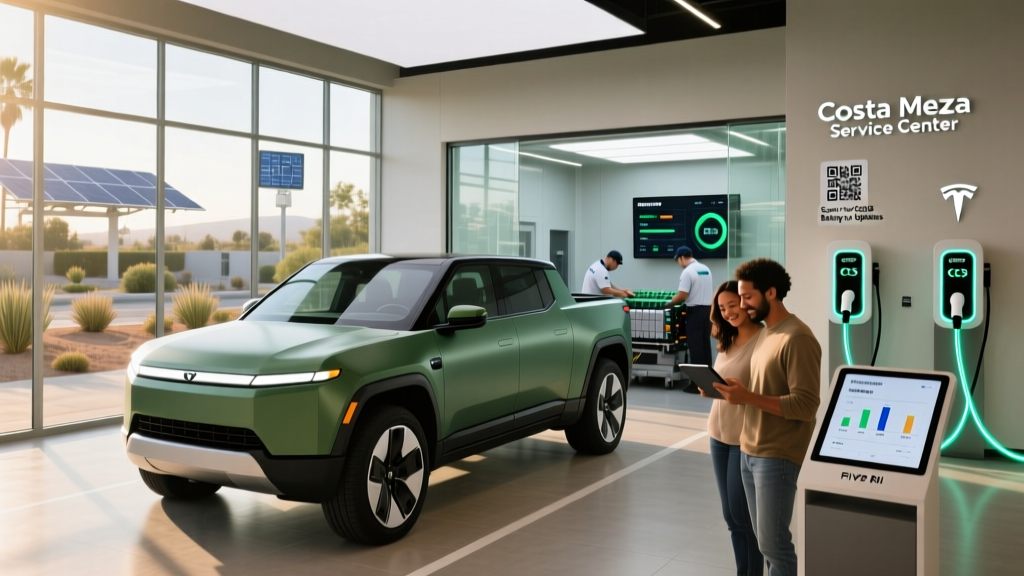
If you're researching a Rivian purchase in Southern California, you've likely searched "Rivian Costa Mesa" and found the brand's prominent Service Center and delivery hub located in the heart of Orange County. For prospective R1T and R1S owners, this facility is more than a repair shop — it's the primary touchpoint for test drives, vehicle delivery, warranty service, and software-related diagnostics in the region.
Unlike legacy automakers with sprawling dealer lots, Rivian operates a direct-to-consumer model. The Costa Mesa location serves as both a Service Center and a delivery/pickup point for vehicles ordered online. Understanding what this facility offers — and what the R1T and R1S actually deliver in range, charging speed, and daily usability — is critical before committing $75,000+ to an electric adventure vehicle.
This guide covers the 2026 Rivian lineup specs, real-world ownership considerations for Orange County drivers, and how the Costa Mesa service infrastructure factors into your buying decision.
2026 Rivian R1T and R1S: Specs at a Glance
Rivian updated the R1 platform significantly for the 2025 model year, and those improvements carry into 2026 production. The dual-motor and quad-motor configurations remain the core offerings, with the Max battery pack providing the longest range. Here's what the numbers look like across trims:
| Spec | R1T Dual-Motor (Standard) | R1T Dual-Motor (Max Pack) | R1T Quad-Motor |
|---|---|---|---|
| EPA Range | 270 mi | 420 mi | 328 mi |
| Battery Capacity | 106 kWh (NMC) | 149 kWh (NMC) | 149 kWh (NMC) |
| Horsepower | 533 hp | 533 hp | 1,025 hp |
| 0-60 mph | 4.5 sec | 4.5 sec | 3.0 sec |
| Drivetrain | AWD (Dual-Motor) | AWD (Dual-Motor) | AWD (Quad-Motor) |
| Max DC Fast Charge | 200 kW | 200 kW | 200 kW |
| 10-80% DC Charge | ~29 min | ~42 min | ~42 min |
| Level 2 Home Charging | 11.5 kW (~25 mi/hr) | 11.5 kW (~25 mi/hr) | 11.5 kW (~25 mi/hr) |
| MPGe (Combined) | 70 MPGe | 65 MPGe | 59 MPGe |
| Efficiency | 48 kWh/100mi | 52 kWh/100mi | 57 kWh/100mi |
| Base MSRP | $69,900 | $83,900 | $99,900 |
| Towing Capacity | 11,000 lbs | 11,000 lbs | 11,000 lbs |
| Battery Warranty | 8 yr / 175,000 mi | 8 yr / 175,000 mi | 8 yr / 175,000 mi |
The R1S SUV variant shares identical powertrain specs with the R1T, though its slightly heavier curb weight reduces EPA range by approximately 5-10 miles across equivalent trims. Both use NMC (nickel manganese cobalt) battery chemistry, prioritizing energy density over the cycle-life advantages of LFP — a trade-off that makes sense for vehicles designed to maximize range in a large, heavy platform.
Real-World Range: What Orange County Drivers Should Expect
EPA sticker: 420 miles
Real-world highway (70-80 mph, SoCal conditions): ~340-360 miles
Real-world mixed city/highway (OC commute): ~370-390 miles
Cold-weather mountain trips (Big Bear, 30°F): ~290-320 miles
The 420-mile EPA figure on the Max Pack R1T is genuinely impressive, but real-world conditions in Southern California reveal the typical gaps between sticker and reality. Highway driving at sustained speeds of 70-80 mph on the 405 or 5 freeways will consume energy faster than the EPA's mixed-cycle test. Expect roughly 15-20% reduction from the EPA number on pure highway road trips.
For Costa Mesa commuters doing mostly city and suburban driving — stop-and-go on Bristol Street, surface streets to Newport Beach, or the 73 toll road at moderate speeds — the R1T Dual-Motor Max Pack can approach or even slightly exceed its EPA estimate thanks to aggressive regenerative braking recapturing energy.
The critical range scenario for Orange County owners is the mountain trip. Head to Big Bear or Idyllwild in winter, and the combination of elevation gain (which demands significant energy for climbing), cold temperatures (reducing battery efficiency by 10-20%), and cabin heating loads can compress range substantially. Plan for roughly 70% of your EPA sticker in these conditions, and precondition your battery before departure to mitigate losses.
According to fueleconomy.gov, the R1T Dual-Motor Standard Pack achieves 70 MPGe combined, which translates to 48 kWh per 100 miles. That's thirsty by EV standards — comparable to other large electric trucks but far less efficient than a Tesla Model Y or Hyundai Ioniq 5. The physics of a 7,000+ lb vehicle with the aerodynamic profile of a truck bed are unavoidable.
Charging Speed: DC Fast Charging and Home Setup
Rivian's DC fast-charging capability has been a point of criticism since launch, and the 2026 models retain the same 200 kW peak charge rate. While competitors like the Hyundai Ioniq 5 (peaking at 240 kW) and the Chevrolet Silverado EV (up to 350 kW) have moved ahead, 200 kW remains adequate for most use cases — with an important caveat about charge curve behavior.
| Charging Level | Power / Rate | Miles Added | Time to Charge |
|---|---|---|---|
| Level 1 (120V household) | 1.4 kW | ~3 mi/hr | Standard → Full: ~72 hours |
| Level 2 (240V home, 48A) | 11.5 kW | ~25 mi/hr | Standard → Full: ~9 hours; Max: ~13 hours |
| DC Fast Charge (peak) | 200 kW | ~140 mi in 20 min | 10-80%: ~29 min (Standard), ~42 min (Max) |
| Tesla Supercharger (via NACS adapter) | Up to 200 kW | ~140 mi in 20 min | Varies by station output |
Charging curve reality: The 200 kW peak is not sustained. On the Standard Pack, you'll see peak rates between 10-40% state of charge, tapering to roughly 120 kW by 60% and further declining above 80%. The Max Pack's larger 149 kWh battery means a longer time at peak rate, but the 10-80% window still takes approximately 42 minutes — a noticeable wait on road trips compared to vehicles with 800V architectures.
Rivian now ships all new vehicles with a NACS (North American Charging Standard) port, granting native access to Tesla's Supercharger network — the most reliable DC fast-charging infrastructure in the U.S. For Costa Mesa owners, this is significant: there are multiple Supercharger stations within 10 minutes of the city (Irvine Spectrum, Fashion Island, South Coast Plaza), and the Rivian Adventure Network continues to expand along key road-trip corridors.
Home charging for Costa Mesa residents: A Level 2 home charger (11.5 kW, 48-amp circuit on a 60-amp breaker) will add roughly 25 miles of range per hour, fully replenishing the Standard Pack overnight in about 9 hours. Installation costs in Orange County typically run $800-$2,500 depending on panel proximity and whether your home's electrical panel requires an upgrade to 200 amps. SCE (Southern California Edison) offers EV rate plans that make overnight charging significantly cheaper — often under $0.08/kWh off-peak, meaning a full Standard Pack charge costs roughly $8.50.
Pricing, Trims, and Federal Tax Credit Eligibility
The 2026 Rivian R1T starts at $69,900 for the Dual-Motor Standard configuration and climbs to $99,900 for the Quad-Motor. The R1S SUV commands a $5,000 premium across equivalent trims. These prices place Rivian firmly in the luxury truck segment, competing with the Ford F-150 Lightning Platinum, GMC Hummer EV, and Tesla Cybertruck.
| Trim | MSRP | Federal §30D Credit | Effective Price |
|---|---|---|---|
| R1T Dual-Motor Standard | $69,900 | Up to $7,500* | ~$62,400 |
| R1T Dual-Motor Max Pack | $83,900 | $0 (MSRP cap exceeded) | $83,900 |
| R1T Quad-Motor | $99,900 | $0 (MSRP cap exceeded) | $99,900 |
| R1S Dual-Motor Standard | $74,900 | $0 (SUV MSRP cap: $80k) | $74,900 |
Tax credit critical details: Under current IRS §30D rules, the federal EV tax credit of up to $7,500 applies only to trucks (like the R1T) with an MSRP at or below $80,000, and SUVs (like the R1S) with an MSRP at or below $80,000. The R1T Dual-Motor Standard at $69,900 qualifies — but only if you also meet income caps (modified adjusted gross income ≤ $300,000 for joint filers, ≤ $150,000 for single filers) and the vehicle's battery meets critical mineral and component sourcing requirements.
As of 2026, Rivian has been working to qualify its battery supply chain for the full $7,500 credit, but the exact amount can vary based on the specific battery pack and production batch. The credit is now available as a point-of-sale transfer, meaning you can apply it directly to your purchase price at delivery rather than waiting for a tax refund. Always verify current eligibility at IRS.gov before finalizing your order, as sourcing rules are subject to change.
California buyers should also investigate the state's CVRP (Clean Vehicle Rebate Project) and any local SCE or air-district incentives, though these programs have fluctuating funding and eligibility requirements that change frequently.
Performance, Interior, and Daily Livability
The R1T's performance credentials are undeniable. Even the base Dual-Motor's 533 hp and 4.5-second 0-60 time demolish any internal-combustion truck in the segment. The Quad-Motor's 1,025 hp and 3.0-second sprint are supercar territory in a vehicle with an 11,000-pound towing rating.
But the everyday experience is what matters for Costa Mesa owners who'll use this as a daily driver:
- Ride quality: The air suspension delivers a composed, comfortable ride on broken pavement and speed bumps. It also enables up to 14.9 inches of ground clearance for off-road use and drops for easy highway cruising.
- Cabin noise: Exceptionally quiet at highway speeds — among the quietest vehicles in its class.
- Infotainment: Rivian's 15.6-inch center display runs a proprietary OS that has improved markedly through OTA updates. Wireless Apple CarPlay and Android Auto are supported. The interface is clean, though some owners report the navigation system lags behind Apple Maps or Google Maps for real-time traffic.
- Driver assistance: Rivian's Highway Assist is a Level 2 driver-assistance system (SAE classification) — it handles steering, acceleration, and braking on divided highways but requires continuous driver attention. It is not self-driving. Expect capability similar to Ford BlueCruise or GM Super Cruise, though Rivian does not yet offer hands-free operation on mapped highways.
Cargo and passenger space:
- R1T bed length: 4.5 feet (with the gear tunnel, total cargo capacity is significantly more versatile than a traditional truck bed)
- R1T gear tunnel: 11.7 cu ft of lockable, pass-through storage
- R1S cargo behind 3rd row: 10.4 cu ft; behind 2nd row: 46.7 cu ft; max (all seats folded): 104.7 cu ft
- Front trunk (frunk): 11.1 cu ft — large enough for a carry-on suitcase or charging cables
- Rear legroom (R1T): 36.4 inches — adequate for adults but tighter than a full-size crew cab
The gear tunnel is Rivian's killer feature for active lifestyles. This lockable, weatherproof pass-through compartment (accessible from both sides of the truck) is ideal for skis, surfboards, camping gear, or groceries. It's a design innovation that legacy truck makers haven't matched.
Service and Ownership: The Costa Mesa Advantage
Rivian's direct service model is a double-edged sword. There are no dealers to negotiate with, and software updates are delivered over-the-air. But when physical service is needed, you're dependent on Rivian's own Service Centers and mobile service vans.
The Rivian Costa Mesa Service Center is one of the highest-volume locations in Southern California, serving all of Orange County and parts of LA. Here's what local buyers should understand:
- Delivery: Many Orange County buyers pick up their R1T or R1S at the Costa Mesa location. The process is streamlined — typically 1-2 hours for orientation, key handoff, and a vehicle walkthrough.
- Service appointments: Wait times can stretch 2-4 weeks for non-urgent warranty work during peak demand. Mobile service vans handle many simpler repairs (software resets, 12V battery replacements, minor hardware swaps) at your home or office.
- Loaner vehicles: Availability is limited. Rivian prioritizes loaners for multi-day repairs, but the fleet in Costa Mesa is finite. Plan ahead if you have a single-car household.
- Body repair: Rivian has partnered with certified collision centers in the region. Aluminum body panels require specialized repair equipment, so not every body shop can service an R1T. This can extend repair timelines after a collision.
For Costa Mesa and Newport Beach residents, proximity to this service hub is a genuine advantage over buyers in more remote areas. The ability to drop off a vehicle locally rather than driving to LA or San Diego reduces the friction of EV ownership considerably.
Pros and Cons: An Honest Assessment
Pros
- Class-leading adventure versatility — gear tunnel, air suspension, 11,000-lb towing
- Max Pack range (420 mi EPA) eliminates range anxiety for most road trips
- NACS port provides native Tesla Supercharger access — the best DC network
- OTA updates continuously improve the vehicle post-purchase
- Build quality has improved significantly since 2022-2023 early production
- Strong community and owner events, especially in SoCal
- Costa Mesa service center provides robust local support
Cons
- DC fast charging at 200 kW lags competitors (Ioniq 5, Silverado EV)
- High price — even the base model is $70K before options
- Efficiency is poor (48-57 kWh/100mi) — expensive to charge vs. smaller EVs
- Rear seat space is tighter than full-size trucks (F-150, Silverado)
- Highway Assist requires hands-on-wheel — no hands-free driving mode yet
- Insurance costs are above average for the segment
- Service appointment wait times can be long at busy centers
Who Should Buy a Rivian in Orange County?
Choose the R1T if: You need a truck for towing, hauling, or adventure sports; you want EV performance with genuine off-road capability; you can install a Level 2 charger at home; you value the gear tunnel and frunk versatility for surfboards, bikes, or camping gear.
Choose the R1S if: You need three rows of seating for family duty; you want the adventure capability of the R1T platform in a more traditional SUV form factor; you prioritize passenger space over a truck bed.
Look elsewhere if: Your primary need is commuting efficiency (a Tesla Model Y or Hyundai Ioniq 5 will cost far less to charge); you don't have home charging access; you need a full-size crew cab rear seat for regular adult passengers; you're budget-sensitive below $65,000.
For Orange County specifically, the Rivian is an outstanding fit for the coastal-active lifestyle. The ability to tow a boat to Dana Point, carry kayaks to Huntington, or drive to Mammoth with ski gear — all without burning gas — resonates with the SoCal buyer demographic. The Costa Mesa service infrastructure makes ownership practical in a way it wouldn't be in a rural market without a nearby Service Center.
Frequently Asked Questions
What is the real-world range of the Rivian R1T?
The EPA estimates 270 miles for the Standard Pack and 420 miles for the Max Pack. In real-world Southern California mixed driving, expect approximately 230-250 miles (Standard) or 370-390 miles (Max). Highway-only trips at 75+ mph reduce these figures by 15-20%. Cold mountain driving can reduce range by up to 30%.
How fast does the Rivian charge at home and on DC fast chargers?
At home on a Level 2 (240V, 48A) charger, the R1T adds approximately 25 miles of range per hour, fully charging the Standard Pack in about 9 hours and the Max Pack in about 13 hours. On DC fast chargers, peak rate is 200 kW, achieving 10-80% in approximately 29 minutes (Standard) or 42 minutes (Max). The charge rate tapers significantly above 80%.
Does the Rivian R1T qualify for the $7,500 federal EV tax credit?
The R1T Dual-Motor Standard ($69,900 MSRP) can qualify for up to $7,500 under IRS §30D, provided the buyer meets income caps ($300,000 joint / $150,000 single MAGI) and the vehicle's battery meets critical-mineral and component-sourcing requirements. The Max Pack ($83,900) and Quad-Motor ($99,900) exceed the $80,000 truck MSRP cap and are not eligible. Always verify current eligibility at IRS.gov before purchasing.
Is the Rivian worth buying over the Ford F-150 Lightning or Tesla Cybertruck?
The R1T excels in adventure versatility (gear tunnel, air suspension, off-road clearance) and build quality. The F-150 Lightning offers a more traditional truck experience with a larger rear seat and lower starting price. The Cybertruck undercuts on price and charges faster, but its polarizing design and panel-gap quality concerns deter some buyers. If your use case centers on outdoor recreation and you value premium fit and finish, the R1T is the strongest choice.
What are the biggest drawbacks of owning a Rivian?
The primary limitations are DC fast-charging speed (200 kW peak, slower than rivals), high energy consumption (48-57 kWh/100mi, making charging more expensive), premium pricing across all trims, and service center dependency — though the Costa Mesa location mitigates this for Orange County owners. Insurance costs also trend higher than the segment average.
Can I use Tesla Superchargers with a Rivian?
Yes. All 2026 Rivian vehicles ship with a native NACS charge port, providing direct access to the Tesla Supercharger network without an adapter. This gives Rivian owners access to the most extensive and reliable DC fast-charging network in the United States, with multiple Supercharger stations within minutes of Costa Mesa.
Specs and pricing reflect 2026 model year data as of publication. Tax credit eligibility is subject to IRS rule changes. Verify all figures with Rivian.com and fueleconomy.gov before ordering.