The Rivian Charge Port: Location, Design, and Why It Matters
If you're researching the Rivian charge port before buying an R1T truck or R1S SUV, you're asking the right question. The charge port is one of those everyday details that shapes your entire ownership experience — where you pull into a charging stall, how easy it is to plug in at home, and whether the cable reaches when you're towing. Rivian made a deliberate engineering choice here that differs from most competitors, and it's worth understanding before you sign the paperwork.
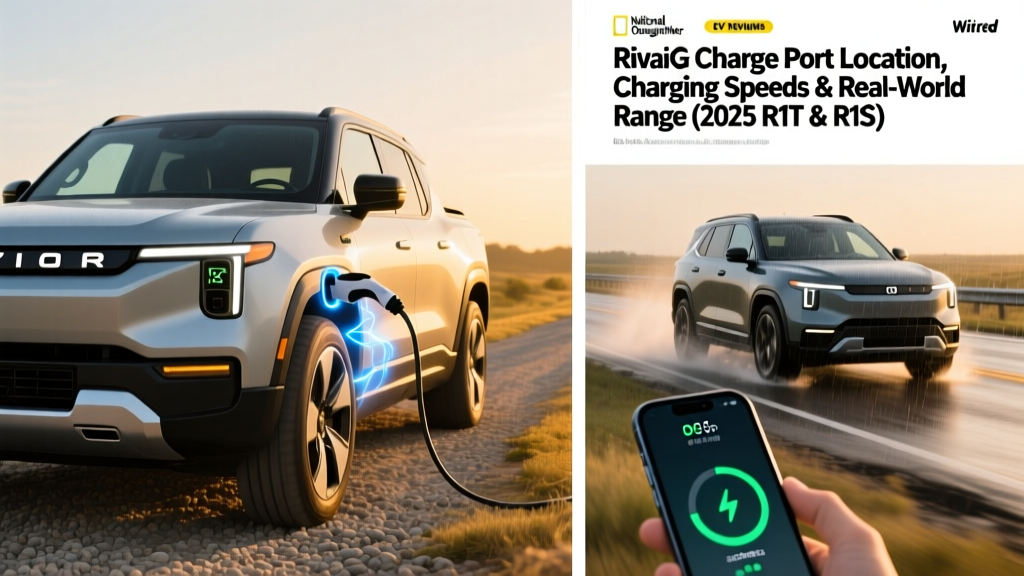
Both the Rivian R1T (truck) and R1S (SUV) place their charge port on the driver-side front fender, just ahead of the front wheel well. This is a notable departure from Tesla, Ford, and Hyundai, which typically locate the port on the rear quarter panel. Rivian's front-fender placement has distinct trade-offs: it keeps the charge cable away from the tailgate when you're loading the bed, and it makes plugging in at a curbside Level 2 charger more natural when parallel parked. However, it also means that at some DC fast-charging stalls with short cables, you may need to pull forward slightly or park at an angle to reach.
The port itself uses the NACS (North American Charging Standard) connector on all 2025 and later Rivian vehicles, following the industry-wide shift. Rivian began delivering vehicles with native NACS ports in late 2024, eliminating the need for a CCS-to-NACS adapter at Tesla Superchargers. Earlier models shipped with a CCS1 port and Rivian provides an adapter for NACS access. The charge door is power-operated — press it or use the infotainment screen, and it opens automatically, revealing a well-illuminated port with status LEDs that indicate charging state at a glance.
Rivian R1T & R1S Charging Speeds: DC Fast Charge and Home Level 2
Charging speed is where Rivian's second-generation architecture (introduced for the 2025 model year) made its biggest leap. The Dual-Motor and Tri-Motor configurations now support significantly faster DC fast charging than the original Quad-Motor launch vehicles.
| Charging Level | Connector | Max Rate | Practical Speed |
|---|---|---|---|
| DC Fast Charge (Peak) | NACS (native) | 225 kW (Large Pack) | 10–80% in ~21 minutes (Dual-Motor Large) |
| DC Fast Charge (Max Pack) | NACS (native) | 225 kW | 10–80% in ~28 minutes (larger battery absorbs longer) |
| Level 2 Home Charging | NACS (J1772 adapter avail.) | 11.5 kW (48A) | ~25–30 miles of range per hour |
| Level 2 Home Charging (Dual Charger option) | NACS | 19.2 kW (80A) | ~40–48 miles of range per hour |
| Level 1 Trickle (120V) | J1772 adapter | 1.4 kW (12A) | ~3–4 miles of range per hour |
The 225 kW peak rate applies to the Large battery pack (approximately 109 kWh usable). The Max pack (~141 kWh usable) accepts the same peak rate but requires more time to reach 80% due to its larger capacity. In real-world DC fast charging, expect the R1T to sustain roughly 180–200 kW through the 20–60% state-of-charge window before tapering to ~100 kW near 80%. This charge curve is managed by Rivian's thermal preconditioning system, which warms or cools the battery when you navigate to a charger in the infotainment system — always precondition before a DC fast charge session to avoid slower speeds in cold weather.
For home charging, the standard 11.5 kW onboard charger is adequate for overnight replenishment. If you drive 60+ miles daily or tow frequently, the optional dual onboard charger (19.2 kW) cuts home charging time nearly in half but requires a 100-amp dedicated circuit and a hardwired Level 2 wall connector — factor in $800–$1,500 for electrical panel upgrades if your home doesn't already support it.
EPA Range vs. Real-World Range: What Rivian Owners Actually See
EPA estimates are measured under controlled conditions. In real-world highway driving at 70–75 mph, expect 10–15% less range than the EPA sticker. In freezing temperatures (below 32°F), range can drop 20–30% due to battery chemistry limitations and cabin heating demands. Towing a 5,000-lb trailer can cut range by 40–50%.
| Model | Battery Pack | Drivetrain | EPA Range | Real-World Highway Est. | Cold-Weather Est. |
|---|---|---|---|---|---|
| R1T Dual-Motor | Standard (~92 kWh, LFP) | AWD | 270 mi | ~230–245 mi | ~190–215 mi |
| R1T Dual-Motor | Large (~109 kWh, NMC) | AWD | 328 mi | ~280–295 mi | ~230–260 mi |
| R1T Dual-Motor | Max (~141 kWh, NMC) | AWD | 420 mi | ~355–380 mi | ~295–335 mi |
| R1T Tri-Motor | Max (~141 kWh, NMC) | AWD | 400 mi | ~340–360 mi | ~280–320 mi |
| R1S Dual-Motor | Large (~109 kWh, NMC) | AWD | 330 mi | ~285–300 mi | ~235–265 mi |
| R1S Tri-Motor | Max (~141 kWh, NMC) | AWD | 390 mi | ~335–350 mi | ~275–310 mi |
The Standard pack uses LFP (lithium iron phosphate) chemistry, which is heavier and less energy-dense but offers longer cycle life and can be charged to 100% daily without degradation concerns. The Large and Max packs use NMC (nickel manganese cobalt) chemistry for higher energy density. For daily driving, Rivian recommends charging NMC packs to 85–90% and reserving 100% for road trips.
According to fueleconomy.gov, the 2025 R1T Dual-Motor Large achieves 73 MPGe combined (city/highway). In terms of efficiency, that translates to roughly 46 kWh per 100 miles — competitive for a 7,000-lb electric truck but noticeably thirstier than a sedan-class EV.
Performance, Powertrain, and Driving Dynamics
Rivian's second-gen drive units deliver meaningful performance upgrades. Here's what the numbers look like across the current lineup:
| Configuration | Horsepower | Torque (lb-ft) | 0–60 mph | Drivetrain |
|---|---|---|---|---|
| Dual-Motor (Standard/Large) | 533 hp | 610 | 4.5 sec | AWD (dual-motor) |
| Dual-Motor Performance | 665 hp | 826 | 3.4 sec | AWD (dual-motor) |
| Tri-Motor (Max only) | 850 hp | 1,103 | 2.9 sec | AWD (tri-motor, rear torque vectoring) |
The Tri-Motor configuration uses two rear motors for torque vectoring across the rear axle, giving the R1T genuinely impressive cornering composure for a vehicle with a 135-inch wheelbase. The Dual-Motor Performance is the sweet spot for most buyers — 665 hp and a 3.4-second 0–60 time is supercar-quick while preserving the range and price advantages of the Large pack.
Towing capacity is rated at 11,000 lbs for the R1T and 7,700 lbs for the R1S. However, be realistic: towing near max capacity at highway speeds will slash your range to roughly 150–200 miles depending on conditions. Plan charging stops accordingly.
Pricing, Trim Levels, and Federal Tax Credit Eligibility
| Model & Trim | Base MSRP | Federal §30D Credit | Effective Price (with credit) |
|---|---|---|---|
| R1T Dual-Motor Standard | $69,900 | Up to $7,500* | ~$62,400 |
| R1T Dual-Motor Large | $75,900 | Up to $7,500* | ~$68,400 |
| R1T Dual-Motor Perf. Large | $84,900 | Up to $7,500* | ~$77,400 |
| R1T Tri-Motor Max | $99,900 | Up to $7,500* | ~$92,400 |
| R1S Dual-Motor Standard | $74,900 | Up to $7,500* | ~$67,400 |
| R1S Dual-Motor Large | $79,900 | Up to $7,500* | ~$72,400 |
| R1S Tri-Motor Max | $104,900 | Up to $7,500* | ~$97,400 |
*Federal EV tax credit eligibility is subject to IRS §30D rules. Key requirements for 2025:
- MSRP cap: Vans, SUVs, and pickup trucks must have an MSRP at or below $80,000. Several R1T and R1S configurations exceed this threshold and are ineligible.
- Buyer income cap: Modified adjusted gross income (MAGI) must not exceed $150,000 (single), $225,000 (head of household), or $300,000 (joint filing).
- Battery sourcing: Critical minerals and battery components must meet phased-in domestic/free-trade sourcing thresholds, which tighten annually. Verify current-year compliance on the vehicle's Monroney label or at irs.gov.
- Point-of-sale transfer: Eligible buyers can transfer the credit to the dealer at purchase, reducing the purchase price upfront rather than waiting for a tax refund.
Because Rivian's R1T qualifies as a pickup truck under the §30D MSRP cap, configurations priced at or below $80,000 are potentially eligible. The Dual-Motor Standard and Dual-Motor Large R1T trims fall within the cap; the Performance Large and all Tri-Motor variants exceed it. Always confirm eligibility with a tax professional before relying on the credit in your purchase decision.
Cargo, Passenger Space, and Practical Utility
The R1T's party trick is the gear tunnel — a full-width, lockable pass-through compartment between the cab and bed that provides 11.6 cubic feet of enclosed storage. Combined with the 4.5-foot bed (11.0 cu ft) and a small front trunk (frunk, 11.0 cu ft), the R1T offers versatile cargo solutions that a conventional truck bed can't match for secure, weatherproof storage.
| Dimension | R1T (Truck) | R1S (SUV) |
|---|---|---|
| Bed / Rear Cargo (behind 2nd row) | 11.0 cu ft (4.5-ft bed) | 46.7 cu ft |
| Gear Tunnel / Behind 3rd Row | 11.6 cu ft | 10.4 cu ft |
| Frunk | 11.0 cu ft | 11.0 cu ft |
| Max Cargo (seats folded) | N/A (fixed bed) | 104.7 cu ft |
| Front Legroom | 41.3 in | 41.3 in |
| Rear Legroom (2nd row) | 37.3 in | 36.8 in |
| 3rd-Row Legroom (R1S only) | N/A | 30.1 in |
| Seating Capacity | 5 passengers | 7 passengers |
The R1S's third row is best suited for children or short trips — 30.1 inches of legroom is tight for adults on long drives. With all three rows in use, cargo space behind the third row is limited to 10.4 cu ft, enough for a few grocery bags but not luggage for seven people. Fold the third row and the R1S becomes a genuinely spacious five-passenger SUV.
Standout Technology and Driver Assistance
Rivian's infotainment runs on a proprietary operating system displayed on a 15.6-inch landscape touchscreen. The interface is clean, responsive, and includes native route planning with integrated charging stops — the system calculates battery state-of-charge at arrival and can precondition the battery automatically when you navigate to a DC fast charger. Over-the-air (OTA) updates add features regularly; Rivian has a strong track record of meaningful software improvements post-delivery.
The Rivian Driver+ system is a SAE Level 2 driver-assistance suite. It includes adaptive cruise control, lane centering, and automatic lane changes on divided highways. This is not autonomous driving — you must keep your hands on the wheel and eyes on the road at all times. Unlike Ford's BlueCruise or GM's Super Cruise, Rivian's system does not yet offer hands-free operation on pre-mapped highways, though Rivian has announced development of enhanced hands-free capability for future OTA releases.
Rivian Driver+ is a Level 2 system: the vehicle can control steering and acceleration simultaneously, but the driver remains fully responsible for monitoring the road and intervening at any moment. This is fundamentally different from Level 4 robotaxi services (Waymo, Zoox) that operate without a human driver.
Other notable tech features include:
- Vehicle-to-Load (V2L): The R1T and R1S can power external devices through bed outlets (up to 6.6 kW combined), useful for camping, tailgating, or emergency backup power.
- Camp Kitchen (R1T option): A slide-out kitchen module integrates into the gear tunnel with an induction cooktop, sink, and utensil storage.
- Powered tonneau cover: Available on the R1T, it retracts electronically and integrates with the bed's built-in air compressor.
- Digital key and phone-as-key: Unlock and start via smartphone without a physical fob.
Warranty Coverage and Battery Longevity
Rivian's warranty package is competitive but not class-leading:
- Basic vehicle warranty: 5 years / 60,000 miles
- Battery and drive unit warranty: 8 years / 175,000 miles (retains ≥70% of original capacity)
- Roadside assistance: 5 years / 60,000 miles
The 8-year/175,000-mile battery warranty exceeds the federal minimum (8 years / 100,000 miles) and is one of the more generous mileage thresholds in the EV truck segment. The 70% capacity retention threshold is industry-standard — if your battery drops below 70% of its original usable kWh within the warranty period, Rivian will repair or replace it.
For long-term ownership, the LFP-equipped Standard pack models offer a longevity advantage: LFP chemistry typically degrades more slowly than NMC over thousands of charge cycles and tolerates regular 100% charging without accelerated wear. If you plan to keep the vehicle for 200,000+ miles, the Standard pack's LFP chemistry is worth considering despite the lower range.
Who Should Buy the Rivian R1T or R1S?
Choose the R1T if: You need a pickup bed for work or recreation, value the gear tunnel for secure storage, want V2L capability for off-grid use, and your daily commute is under 100 miles round-trip.
Choose the R1S if: You need seating for up to seven (with children in the third row), prefer SUV cargo flexibility with fold-flat seats, and don't need a truck bed.
Look elsewhere if: You regularly tow heavy trailers over long distances (range drops dramatically), need sub-$50,000 pricing, or require hands-free highway driving like GM Super Cruise.
The Rivian R1T and R1S are best suited for active-lifestyle buyers who need genuine utility — not just the image of it. The combination of strong range (328 miles on the Large pack), capable off-road hardware, the unique gear tunnel, and a well-executed software experience makes these vehicles compelling for outdoor-oriented families, weekend warriors, and truck buyers ready to go electric without sacrificing capability.
Pros
- Class-leading 328–420 mi range (Large/Max packs)
- 225 kW DC fast charging, 10–80% in ~21 min
- Innovative gear tunnel and frunk storage
- Native NACS port (2025+), Tesla Supercharger access
- Tri-Motor performance: 850 hp, 2.9-sec 0–60
- V2L capability up to 6.6 kW
- Strong OTA update track record
- 8-yr/175,000-mi battery warranty
Cons
- Starting MSRP near $70,000; many trims exceed §30D cap
- Front-fender charge port can be awkward at some stalls
- No hands-free highway driving (Level 2 only)
- Towing severely reduces range (40–50% loss)
- R1S third row is cramped for adults
- Service center network still expanding in rural areas
- Insurance premiums run 15–25% above comparable gas trucks
Frequently Asked Questions
Where exactly is the Rivian charge port located?
The charge port is on the driver-side front fender, ahead of the front wheel well. This placement keeps the cable clear of the truck bed and works well for curbside Level 2 charging, but may require positioning adjustments at some DC fast-charging stalls with short cables.
Does the Rivian R1T use NACS or CCS?
2025 and later Rivian vehicles ship with a native NACS (Tesla-style) connector. Earlier models used CCS1 and came with a NACS adapter for Supercharger access. All current models can charge on the Tesla Supercharger network without an adapter.
How long does it take to charge a Rivian at home overnight?
With the standard 11.5 kW (48A) Level 2 charger, expect to add roughly 25–30 miles of range per hour of charging. A full charge from 10% to 90% on the Large pack takes about 8–9 hours — easily achievable overnight. The optional 19.2 kW dual charger cuts this to roughly 5 hours but requires a 100-amp circuit.
Does the Rivian R1T qualify for the $7,500 federal tax credit?
It depends on the configuration. Under IRS §30D rules, pickup trucks with an MSRP at or below $80,000 may qualify, subject to buyer income limits ($300,000 joint / $150,000 single), battery sourcing requirements, and point-of-sale transfer rules. The R1T Dual-Motor Standard ($69,900) and Dual-Motor Large ($75,900) fall under the cap. Higher trims exceed it. Verify current eligibility at irs.gov and consult a tax professional.
What is the real-world highway range of the Rivian R1T?
The EPA rates the R1T Dual-Motor Large at 328 miles. In real-world highway driving at 70–75 mph, expect approximately 280–295 miles. In freezing temperatures, plan for 230–260 miles. Towing a 5,000-lb trailer reduces range to roughly 160–200 miles depending on speed and terrain.
Is the Rivian R1T good for towing?
The R1T is rated to tow up to 11,000 lbs, and it does so with impressive stability thanks to its low center of gravity and dual/tri-motor torque control. However, range drops significantly when towing — expect 40–50% reduction. If you tow frequently on long trips, plan for more frequent charging stops or consider the Max pack for its larger energy buffer.
How does the Rivian charge port handle cold weather?
The charge door is power-operated and includes heating elements to prevent freezing shut in cold climates. The port's status LEDs remain visible in low-light winter conditions. Always precondition the battery via the infotainment system or mobile app before a DC fast-charge session in cold weather — a cold battery will accept charge far more slowly, sometimes dropping to 50–80 kW until it warms up.
Rivian R1T vs. Ford F-150 Lightning vs. Tesla Cybertruck: Which should I buy?
The R1T wins on range (328–420 mi vs. the Lightning's 230–320 mi) and innovative storage (gear tunnel). The F-150 Lightning offers a lower starting price (~$55,000) and a larger 5.5-foot bed. The Cybertruck provides stainless-steel construction and native NACS at a competitive price but has polarizing styling and limited trim availability. If premium build quality, range, and adventure features matter most, the R1T is the strongest pick. If budget or bed length is the priority, the Lightning remains compelling. For detailed comparisons, see our EPA side-by-side tool.