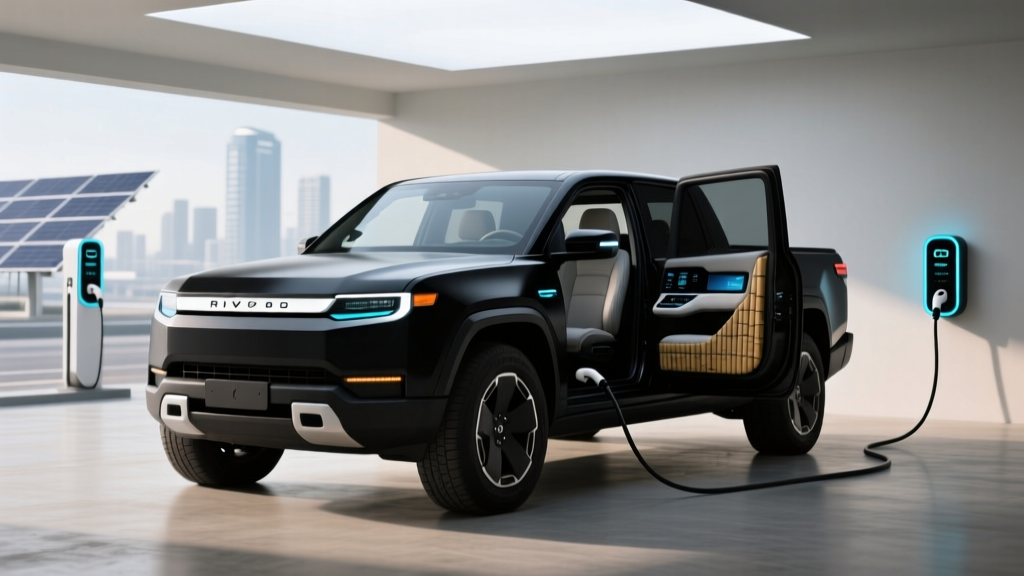
When news broke that Rivian CEO RJ Scaringe's pay package could eventually be worth billions, it raised eyebrows across the EV industry. But what does the Rivian CEO pay package actually mean for people buying an R1T pickup or R1S SUV in 2026? As a publication focused on helping EV buyers make data-driven decisions, we believe executive compensation structures tell you a lot about a company's long-term priorities, financial stability, and product roadmap. Below, we unpack the compensation plan and pair it with a rigorous, spec-driven look at what Rivian's current lineup delivers.
The Rivian CEO Pay Package Explained
In 2024, Rivian's board approved a performance-based compensation plan for founder and CEO RJ Scaringe that could grant him up to 10% of the company's outstanding shares over the following decade. The package is tied to specific market-capitalization and operational milestones — meaning Scaringe only realizes value if Rivian grows substantially. This structure mirrors the approach Tesla used with Elon Musk's 2018 pay package: aligning executive wealth with shareholder outcomes and long-term production scale.
For EV buyers, the key takeaway is stability. A CEO whose personal financial incentive is tied to multi-year market cap growth and production targets is unlikely to abandon the consumer EV segment or pivot abruptly. Rivian's roadmap through 2028 — including the R2 platform launching in 2026 — depends heavily on sustained R&D investment and manufacturing execution. Scaringe's pay package locks him into that mission.
Rivian R1T and R1S: 2026 Lineup at a Glance
Rivian's second-generation R1T and R1S received significant powertrain, battery, and software updates for the 2025 model year that carry into 2026 production. Here's the spec sheet for the core configurations:
| Spec | Dual-Motor (Standard Battery) | Dual-Motor (Large Battery) | Tri-Motor (Max Battery) |
|---|---|---|---|
| EPA Range | ~270 mi | ~352 mi (R1T) / ~340 mi (R1S) | ~420 mi (est.) |
| Battery Usable Capacity | ~92 kWh (LFP) | ~128 kWh (NMC) | ~149 kWh (NMC) |
| Horsepower | 533 hp | 533 hp | 850+ hp |
| 0–60 mph | 4.5 sec | 4.5 sec | ~2.9 sec |
| Drivetrain | AWD (dual-motor) | AWD (dual-motor) | AWD (tri-motor) |
| Max DC Fast Charge | 200 kW | 220 kW | 220+ kW |
| 10–80% DC Charge Time | ~28 min | ~30 min | ~36 min |
| Level 2 Home Charge Rate | 11.5 kW (~25 mi/hr) | 11.5 kW (~25 mi/hr) | 11.5 kW (~25 mi/hr) |
| MPGe (combined) | ~73 MPGe | ~73 MPGe | ~70 MPGe (est.) |
| Efficiency | ~46 kWh/100mi | ~46 kWh/100mi | ~48 kWh/100mi |
| Towing Capacity | 11,000 lbs | 11,000 lbs | 11,000 lbs |
Charging Speed and Infrastructure
Rivian's second-gen architecture moved to a higher-voltage system that improved DC fast-charge speeds meaningfully over the 2022–2023 launch models. Here's what the charging experience looks like across levels:
| Charging Level | Power | Miles Added per Hour | Use Case |
|---|---|---|---|
| Level 1 (120V household) | ~1.4 kW | ~3 mi/hr | Emergency / overnight trickle |
| Level 2 (240V home) | 11.5 kW | ~25 mi/hr | Daily home charging |
| DC Fast Charge | Up to 220 kW | ~140 mi in 20 min | Road trips / public stations |
Rivian vehicles come with access to the Rivian Adventure Network — the company's proprietary DC fast-charging corridors along popular outdoor routes — plus full compatibility with the Tesla Supercharger network via the NACS adapter Rivian began shipping in 2024. CCS1 compatibility is also maintained through the native port, giving R1T and R1S owners access to Electrify America, EVgo, and ChargePoint stations.
One charging-curve reality worth noting: peak 220 kW rates are sustained only between roughly 10–40% state of charge. Above 60%, the curve tapers significantly, and charging from 80–100% is notably slow. For road trips, the practical strategy is to charge from 10–80% (about 30 minutes on the Large Battery) and move on — not sit at the charger topping off.
Pricing, Trims, and Federal Tax Credit Eligibility
Rivian positions the R1T and R1S as premium adventure vehicles, and pricing reflects that. Here's where the lineup stands for 2026:
| Configuration | Base MSRP | Federal §30D Credit Eligibility | Effective Price (est.) |
|---|---|---|---|
| R1T Dual-Motor Standard Battery | ~$69,900 | Varies — see below | ~$62,400–$69,900 |
| R1T Dual-Motor Large Battery | ~$75,900 | Varies — see below | ~$68,400–$75,900 |
| R1S Dual-Motor Standard Battery | ~$74,900 | Varies — see below | ~$67,400–$74,900 |
| R1S Tri-Motor Max Battery | ~$99,000+ | Subject to MSRP cap | Varies |
- MSRP Cap: Vans, SUVs, and pickup trucks must be under $80,000 MSRP. Most R1T configs qualify; R1S Tri-Motor may exceed the cap.
- Buyer Income Cap: Modified AGI must not exceed $150,000 (single), $225,000 (head of household), or $300,000 (joint).
- Battery Sourcing: Critical minerals and battery component requirements phase in annually. Verify current-year compliance on the DOE/IRS qualifying vehicle list.
- Point-of-Sale Transfer: Eligible buyers can transfer the credit to the dealer at purchase, reducing the purchase price directly.
Always consult a tax professional and check IRS.gov for current-year rules before purchasing. Eligibility varies by build date, battery sourcing, and buyer income.
Interior, Cargo, and Practicality
The R1T's party trick remains the gear tunnel — a 11.7-cubic-foot pass-through compartment behind the rear seats that's ideal for skis, camping gear, or groceries. Combined with the 54.9-inch bed (roughly 11.0 cu ft of bed volume) and a usable front trunk (frunk) of about 11.0 cu ft, total cargo flexibility is among the best in any vehicle, electric or otherwise.
The R1S three-row SUV offers 104.8 cu ft of total cargo space behind the front seats (all rows folded) and comfortable seating for up to seven. Third-row legroom is approximately 32.3 inches — usable for children or short-trip adults but tight for long highway stretches. Second-row legroom is a generous 39.5 inches.
Both vehicles feature Rivian's 15.6-inch center touchscreen running a proprietary infotainment system with built-in navigation, trip planning with charger routing, and over-the-air software updates. The driver display is a clean 12.3-inch digital cluster. Apple CarPlay and Android Auto are not supported — Rivian insists on its native system, which is capable but a dealbreaker for buyers who prefer phone projection.
Driver Assistance and Safety
Rivian's Driver+ system works well on divided highways with clear lane markings, but it's not competitive with GM's Super Cruise or Ford's BlueCruise in terms of hands-free operation on mapped roads. Rivian has been developing a more advanced system, but as of early 2026, it remains a hands-on Level 2 feature. Both the R1T and R1S have earned strong safety ratings, with IIHS Top Safety Pick designations in prior model years.
Warranty and Long-Term Ownership
Rivian's warranty structure is competitive with the EV segment:
- Battery & Drive Units: 8 years / 175,000 miles (whichever comes first), with capacity retention guaranteed above 70%.
- Limited Vehicle Warranty: 5 years / 60,000 miles bumper to bumper.
- Corrosion Perforation: 8 years / unlimited miles.
The 175,000-mile battery warranty is notably generous compared to the industry-standard 100,000 miles, which matters for high-mileage commuters and overlanding enthusiasts who put serious distance on their vehicles.
Pros and Cons
- Class-leading off-road capability and 11,000-lb towing in an EV
- Over 400 miles of EPA range available (Max Battery)
- Generous 175,000-mile battery warranty
- Unique gear tunnel and frunk for unmatched cargo flexibility
- NACS Supercharger access plus CCS1 compatibility
- Over-the-air updates continue to add features post-purchase
- Premium pricing — most trims $70,000–$100,000+
- No Apple CarPlay or Android Auto
- Driver+ system trails competitors in hands-free capability
- Efficiency drops significantly when towing (expect ~50% range loss)
- Service center footprint still expanding — rural owners may face long drives for warranty work
Who Is the Rivian R1T/R1S For?
Choose the R1S if: You need three rows for family duty, want EV range for road trips to national parks, and prefer a premium interior with genuine off-road capability over a luxury crossover.
Look elsewhere if: You need Apple CarPlay, you want hands-free highway driving, your budget is under $60,000, or you live far from a Rivian service center and need easy dealer access.
Frequently Asked Questions
What is the real-world range of the Rivian R1T?
The EPA rates the R1T Dual-Motor Large Battery at 352 miles. Real-world highway driving at 75 mph yields approximately 290–310 miles. In cold weather below 30°F, expect 240–260 miles on a full charge. Towing cuts range roughly in half regardless of conditions.
How fast does the Rivian R1T charge at home and on the road?
On a Level 2 home charger (240V, 48A), the R1T charges at 11.5 kW, adding roughly 25 miles of range per hour — a full overnight session restores the battery. On DC fast chargers, the Large Battery peaks at 220 kW and charges from 10–80% in approximately 30 minutes, though the curve tapers above 60% SoC.
Does the Rivian R1T qualify for the federal EV tax credit?
Many R1T configurations fall under the $80,000 MSRP cap for trucks and SUVs under IRS §30D rules. However, buyer income caps ($150K single / $300K joint), battery critical-mineral sourcing requirements, and build-date eligibility all factor in. Always verify on fueleconomy.gov and consult a tax professional before purchasing.
Is the Rivian R1T worth buying vs. the Ford F-150 Lightning or Chevy Silverado EV?
The R1T excels in off-road capability, build quality, and adventure-oriented features (gear tunnel, quad-motor torque vectoring). The F-150 Lightning offers a lower starting price and broader dealer service network. The Silverado EV (4WT and Trail Boss trims) targets fleet and work use. If premium adventure utility is your priority, the R1T is the segment leader; if budget or service convenience matters more, cross-shop the Lightning.
How does the Rivian CEO pay package affect vehicle buyers?
Indirectly, the performance-based compensation structure signals that Rivian's leadership is financially incentivized to scale production, improve vehicle quality, and grow market cap over a multi-year horizon. This reduces the risk of strategic pivots away from the consumer EV market and suggests sustained investment in the R1 platform, service network, and charging infrastructure through the late 2020s.