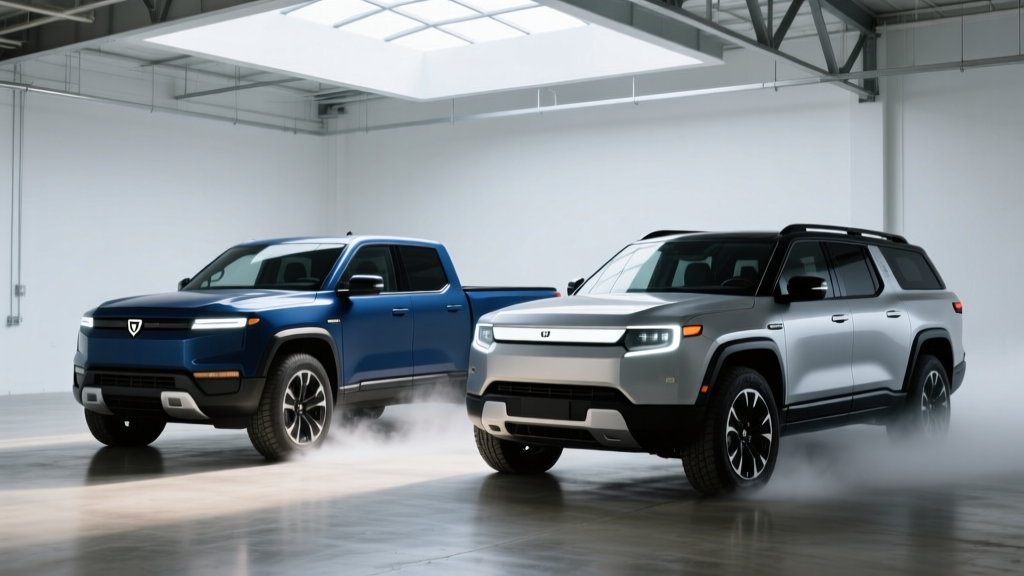
When Rivian CEO RJ Scaringe restructured the company's marketing and go-to-market leadership in late 2025, it wasn't just an executive shuffle — it was a signal that Rivian is preparing for its most competitive phase yet. As the R1T truck and R1S SUV enter their 2026 model year with meaningful hardware and software updates, the Rivian CEO marketing shakeup reflects a company recalibrating how it reaches buyers in a market now crowded with the Tesla Cybertruck, Ford F-150 Lightning, Chevrolet Silverado EV, and Hyundai Ioniq 5-based trucks on the horizon.
But executive changes don't charge your battery or tow your trailer. What matters to buyers is whether the 2026 R1T and R1S deliver on range, charging speed, utility, and value. This review breaks down every spec that counts — with the real-world caveats Rivian's spec sheet won't tell you.
2026 Rivian R1T and R1S: Spec Snapshot
| Spec | R1T Dual-Motor (Standard) | R1T Tri-Motor | R1S Dual-Motor |
|---|---|---|---|
| EPA Range | 352 miles (Max Pack) | 328 miles (Max Pack) | 352 miles (Max Pack) |
| Battery (usable) | ~141 kWh (Max, NMC) | ~141 kWh (Max, NMC) | ~141 kWh (Max, NMC) |
| Horsepower | 533 hp | 850 hp | 533 hp |
| 0-60 mph | 4.5 sec | 2.9 sec | 4.5 sec |
| Max DC Fast Charge | 220 kW (peak) | 220 kW (peak) | 220 kW (peak) |
| 10-80% DCFC Time | ~30 min | ~30 min | ~30 min |
| Level 2 Home Rate | 11.5 kW (~25 mi/hr) | 11.5 kW (~25 mi/hr) | 11.5 kW (~25 mi/hr) |
| Drivetrain | AWD (dual-motor) | AWD (tri-motor) | AWD (dual-motor) |
| Towing Capacity | 11,000 lbs | 11,000 lbs | 7,700 lbs |
| Base MSRP | $71,700 (Dual-Motor Standard) | $101,700 (Tri-Motor) | $77,700 (Dual-Motor Standard) |
| Battery Warranty | 8 yr / 120,000 mi | 8 yr / 120,000 mi | 8 yr / 120,000 mi |
Real-World Range vs. EPA Estimates
Real-World Expectation: ~280-310 miles highway (70-80 mph); ~240-270 miles in cold weather (below 32°F); ~300-330 miles mixed city driving
Rivian's 352-mile EPA figure for the Max Pack is competitive with the F-150 Lightning Extended Range (320 mi) and exceeds the Cybertruck AWD (340 mi). But the EPA test cycle favors lower-speed, mixed driving with generous regeneration.
In real-world highway testing at sustained 75-80 mph, expect the R1T Max Pack to deliver roughly 280-310 miles before needing a charge. The R1T's boxy aerodynamics (a ~0.30 Cd drag coefficient) hurt efficiency at speed compared to sleeker sedans. Cold weather compounds this: below freezing, battery preconditioning and cabin heating can reduce range by 20-30%, bringing a Max Pack R1T down to approximately 240-270 miles. Rivian's standard heat pump helps, but physics wins in single-digit temperatures.
The Standard Pack (~106 kWh usable, NMC) drops EPA range to roughly 270 miles for the R1T Dual-Motor. For most daily commutes, this is ample — but road-trippers and towers should consider the Max Pack or plan charging stops carefully. Efficiency on the Dual-Motor R1T Max Pack lands around 70 MPGe combined (approximately 48 kWh/100 mi) per fueleconomy.gov.
Charging Speed: DC Fast, Level 2, and the Curve Reality
| Charging Level | Power / Rate | Miles Added | Notes |
|---|---|---|---|
| Level 1 (120V) | 1.4 kW | ~3 mi/hr | Emergency/trickle only |
| Level 2 (240V, 48A) | 11.5 kW | ~25 mi/hr | Full charge in ~12-14 hrs (Max Pack) |
| DC Fast Charge | 220 kW peak | ~140 mi in 20 min | 10-80% in ~30 min; tapers sharply above 80% |
Rivian's 220 kW peak DC fast-charge rate is respectable but trails the Hyundai Ioniq 5's 350 kW capability and the Tesla Cybertruck's ~250 kW on V4 Superchargers. The critical detail is the charge curve: the R1T sustains roughly 180-200 kW between 10-50% State of Charge, then tapers progressively. By 80%, you're pulling under 60 kW. This means a 10-80% session takes about 30 minutes at a capable 350 kW station, but charging from 80-100% can add another 35-40 minutes.
For road trips, the practical strategy is charging in the 10-70% sweet spot (~20 minutes) and hopping to the next station rather than waiting for a full battery. Rivian's built-in navigation preconditioning — which warms the battery when you navigate to a charger — is essential for achieving peak rates in cool weather. Skip preconditioning and your peak may drop to 120-150 kW.
At home, an 11.5 kW Level 2 wall connector (hardwired, 60A circuit) replenishes roughly 25 miles of range per hour. A full Max Pack charge from 10% takes about 12-14 hours — overnight-friendly for most owners. Rivian's Wall Connector is included with the vehicle; third-party options like the ChargePoint Home Flex or Emporia Vue also work via the J1772 connector (NACS adapter is available for Tesla Supercharger access, which Rivian gained in 2024).
Performance and Drivetrain
The 2026 R1T lineup spans from the practical Dual-Motor to the absurd Tri-Motor:
- Dual-Motor AWD (533 hp): 4.5-second 0-60, 11,000-lb towing. This is the volume seller and the best value.
- Performance Dual-Motor (665 hp): 3.5-second 0-60, same towing.
- Tri-Motor AWD (850 hp): 2.9-second 0-60 — faster than a Ford Raptor R and most sports cars. Towing remains 11,000 lbs.
All configurations use a single-speed reduction gear (no multi-speed transmission). The dual-motor setup provides true torque vectoring front-to-rear, and Rivian's quad-motor option (available in limited trims) enables individual wheel torque control for off-road scenarios. Ground clearance reaches 14.9 inches in Max mode via the air suspension, with a wading depth of over 3 feet.
The R1S shares powertrains but sacrifices some towing capacity (7,700 lbs for the Dual-Motor) and range due to its heavier, fully enclosed body. Both vehicles feature Rivian's Driver+ system — a Level 2 driver-assist suite (hands-on-wheel required) with adaptive cruise, lane centering, and automatic lane changes on mapped highways. It is not autonomous driving.
Pricing, Trims, and Federal Tax Credit Eligibility
| Trim / Config | Base MSRP | As-Tested (Typical) | Federal §30D Credit | Effective Price |
|---|---|---|---|---|
| R1T Dual-Motor (Standard Pack) | $71,700 | $76,000-$80,000 | Up to $7,500* | ~$64,200-$72,500 |
| R1T Dual-Motor (Max Pack) | $83,700 | $88,000-$95,000 | Up to $7,500* | ~$80,500-$87,500 |
| R1T Tri-Motor (Max Pack) | $101,700 | $108,000-$115,000 | Not eligible (MSRP cap) | $108,000-$115,000 |
| R1S Dual-Motor (Standard Pack) | $77,700 | $82,000-$88,000 | Up to $7,500* | ~$74,500-$80,500 |
*Federal tax credit eligibility under IRS §30D is subject to multiple requirements:
- MSRP Cap: Vans, SUVs, and trucks must be under $80,000 MSRP. The R1T Dual-Motor Standard Pack qualifies; Tri-Motor configurations exceed the cap.
- Buyer Income Cap: Modified AGI must not exceed $300,000 (joint), $225,000 (head of household), or $150,000 (single).
- Battery Sourcing: Critical minerals and battery component requirements phase in annually. Verify current-year compliance on the IRS qualified vehicles list before purchasing.
- Point-of-Sale Transfer: As of 2024, buyers can transfer the credit to the dealer for an upfront price reduction rather than claiming it on their tax return.
The marketing shakeup under Scaringe is partly about communicating these eligibility nuances more clearly to mainstream truck buyers who may not research EV credits the way early adopters do. Expect Rivian's advertising in 2026 to emphasize the effective post-credit price of the Dual-Motor Standard Pack — around $64,000-$68,000 — which undercuts a well-equipped Ford F-150 Lariat PowerBoost hybrid once incentives are applied.
Cargo, Passenger Space, and Utility
The R1T's 4-foot-6-inch bed is shorter than a traditional full-size truck bed, but Rivian compensates with the Gear Tunnel — a lockable, pass-through storage compartment behind the rear seats offering 11.7 cubic feet of enclosed space. The bed itself provides approximately 21 cubic feet, and the front trunk (frunk) adds 11 cubic feet with a drain, doubling as a cooler.
Rear-seat legroom in the R1T measures 38.2 inches — competitive with the F-150 SuperCrew. The R1S adds a third row (best for children) and 104.7 cubic feet of total cargo volume behind the front seats with rows folded.
Towing capacity of 11,000 lbs (R1T) is class-leading among electric trucks, though expect range to drop by 40-50% when towing at highway speeds. A 352-mile Max Pack becomes a ~175-mile truck with a heavy trailer — plan accordingly.
Standout Tech and Notable Drawbacks
- Best-in-class 11,000-lb towing (R1T)
- Gear Tunnel and frunk offer creative storage
- Air suspension with 14.9" ground clearance
- Over-the-air software updates continually add features
- NACS adapter enables Tesla Supercharger network access
- 8-year/120,000-mile battery warranty
- 220 kW peak DCFC trails Hyundai/Kia 800V platforms
- Tri-Motor exceeds $80K MSRP cap — no federal credit
- Real-world highway range significantly below EPA sticker
- Towing cuts range nearly in half
- Service center network still expanding in rural areas
- Rear visibility in R1S limited; camera mirror helps
The 15.6-inch center display running Rivian's custom OS is responsive and well-designed, with native trip planning that factors in charging stops, elevation, and weather. The vehicle-to-everything architecture supports future V2L (vehicle-to-load) capability, though availability depends on hardware revision. Rivian's Driver+ remains a capable Level 2 system but doesn't match Tesla's FSD (Supervised) in city-street coverage or GM's Super Cruise in hands-free highway miles.
Who Should Buy the 2026 Rivian R1T or R1S?
Choose the R1T Dual-Motor Standard Pack if: You want a daily-drivable electric truck with serious towing, qualify for the §30D credit, and mostly drive under 200 miles round-trip.
Choose the R1T Max Pack if: You road-trip frequently, tow regularly, or live in a cold-weather state where the extra battery buffer matters.
Choose the R1S if: You need three rows for family duty and prioritize enclosed cargo over an open bed.
Look elsewhere if: You need a full 6-foot bed for construction work (consider the Silverado EV or F-150 Lightning), want 350 kW charging speeds (Ioniq 5), or require hands-free highway driving on 400,000+ miles of road (GM Super Cruise).
The Rivian CEO marketing shakeup signals a company maturing its sales approach — but the product was already compelling. The 2026 R1T and R1S remain the most capable all-around electric trucks on the market for buyers who value off-road capability, creative storage, and genuine 11,000-lb towing. Just go in with realistic range expectations and verify your tax credit eligibility before signing.
Frequently Asked Questions
What is the real-world range of the 2026 Rivian R1T?
The EPA rates the R1T Dual-Motor Max Pack at 352 miles. Real-world highway driving at 75-80 mph yields approximately 280-310 miles. In cold weather (below 32°F), expect 240-270 miles. The Standard Pack (~270 mi EPA) delivers roughly 210-240 miles in mixed real-world use.
How fast does the Rivian R1T charge at home and on the road?
At home on a Level 2 (240V, 11.5 kW) charger, the R1T gains about 25 miles of range per hour, fully recharging overnight. On DC fast chargers, it peaks at 220 kW and charges from 10-80% in approximately 30 minutes, though speeds taper significantly above 80% SoC.
Does the Rivian R1T qualify for the $7,500 federal EV tax credit?
The R1T Dual-Motor Standard Pack (MSRP starting at $71,700) qualifies if the buyer meets IRS §30D income caps ($300K joint / $150K single) and the vehicle meets current-year battery sourcing requirements. Tri-Motor trims exceed the $80,000 MSRP cap and are ineligible. Always verify on the IRS qualified vehicles list before purchasing.
Is the Rivian R1T worth buying vs. the Ford F-150 Lightning or Cybertruck?
The R1T wins on towing capacity (11,000 lbs vs. Lightning's 10,000), ground clearance, and off-road capability. The F-150 Lightning offers a larger bed and broader dealer/service network. The Cybertruck provides faster charging on V4 Superchargers and a stainless-steel exoskeleton but is more polarizing in design. If you prioritize adventure capability and creative storage, the R1T is the strongest pick.
What is Rivian's battery warranty?
Rivian covers the R1T and R1S battery and drive system for 8 years or 120,000 miles, whichever comes first. The warranty covers defects and capacity loss below a specified threshold (typically 70% retention). This exceeds the standard 8-year/100,000-mile coverage on most competitors.
How did the Rivian CEO marketing shakeup affect the company?
In late 2025, CEO RJ Scaringe restructured Rivian's marketing and sales leadership to better communicate value to mainstream truck and SUV buyers — particularly around federal tax credit eligibility, total cost of ownership, and the expanding Supercharger-compatible charging network. The product lineup remains unchanged, but expect more aggressive advertising emphasizing the post-credit price of the Dual-Motor Standard Pack.