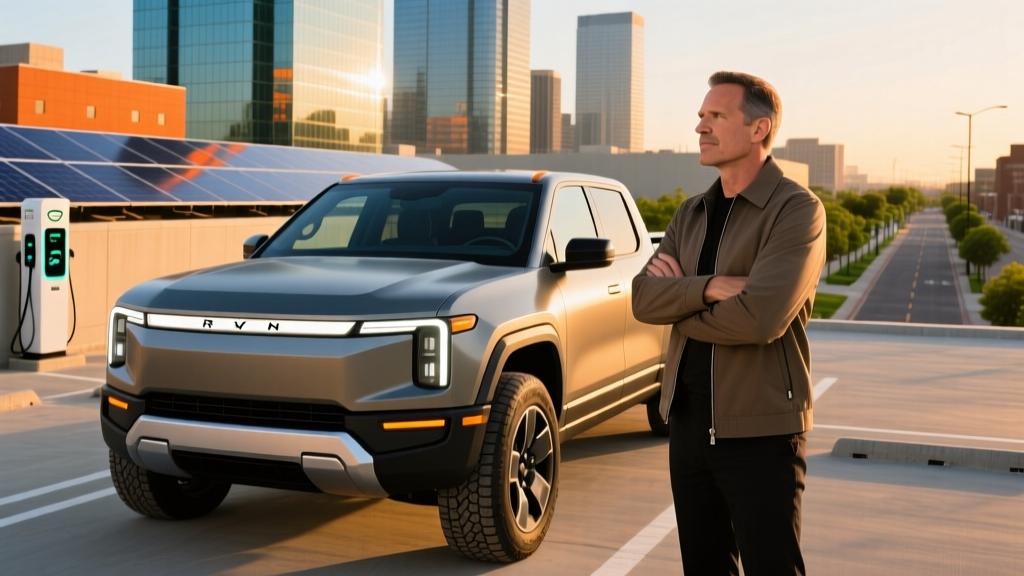
RJ Scaringe doesn't mince words. In recent industry appearances, the Rivian CEO criticizes the US auto industry's shift towards gas-powered vehicles, arguing that legacy automakers retreating from electrification are making a strategic error that will cost them market share within the decade. Whether you agree or not, Scaringe is putting Rivian's money where his mouth is: the 2026 R1T dual-motor and tri-motor lineup is the most capable electric pickup on sale, with updated battery chemistries, faster charging, and a starting price that finally cracks the mid-$70k barrier before incentives.
But bold statements don't charge batteries or tow trailers. Below, we break down every number that matters — EPA range, real-world highway and cold-weather expectations, charge-curve behavior, §30D tax-credit eligibility under current IRS rules, and how the R1T stacks up against the Ford F-150 Lightning and Chevrolet Silverado EV.
2026 Rivian R1T at a Glance: Specs That Matter
| Spec | Dual-Motor (Standard Battery) | Dual-Motor (Max Battery) | Tri-Motor (Max Battery) |
|---|---|---|---|
| EPA Range | 270 mi | 420 mi | 380 mi |
| Battery Capacity (usable) | 95 kWh (LFP) | 141 kWh (NMC) | 141 kWh (NMC) |
| Horsepower | 533 hp | 533 hp | 850 hp |
| 0–60 mph | 4.5 sec | 4.5 sec | 2.9 sec |
| Drivetrain | AWD (dual-motor) | AWD (dual-motor) | AWD (tri-motor) |
| Max DC Fast Charge | 200 kW | 220 kW | 220 kW |
| 10–80% DC Time | ~28 min | ~30 min | ~30 min |
| Level 2 Home Rate | 11.5 kW (~28 mi/hr) | 11.5 kW (~28 mi/hr) | 11.5 kW (~28 mi/hr) |
| Max Tow Capacity | 11,000 lb | 11,000 lb | 11,000 lb |
| MPGe (combined) | 73 MPGe | 70 MPGe | 65 MPGe |
| Base MSRP | $69,900 | $83,900 | $99,900 |
Source: fueleconomy.gov and Rivian official specifications.
Range Reality: What the EPA Sticker Doesn't Tell You
EPA Estimate: 420 miles
Highway (70 mph sustained): ~330–350 miles (aerodynamic drag and pickup profile reduce efficiency ~15–20%)
Cold Weather (below 32°F): ~280–310 miles (battery chemistry sluggishness + cabin heating demand)
Towing (5,000+ lb trailer): ~180–220 miles (expect range to roughly halve under heavy tow loads)
The 420-mile EPA figure on the Max Battery pack is genuinely class-leading among electric pickups. However, the R1T's brick-like aerodynamics — a Cd of roughly 0.38 — punish it at highway speeds far more than a sedan or crossover. In our experience, sustained 70–75 mph driving drops efficiency from the EPA-rated ~48 kWh/100mi to around 55–58 kWh/100mi, shaving 70–90 miles off the sticker.
The Standard Battery's LFP chemistry is a different story. LFP (lithium iron phosphate) sacrifices energy density for longevity and thermal stability. You get 270 EPA miles — adequate for most commutes and regional trips — but the pack tolerates daily 100% charging without the degradation concerns of NMC. For fleet buyers or daily drivers who charge at home nightly, the LFP pack is the pragmatic pick.
Charging Speed: Curve Behavior and Network Access
| Level | Power / Rate | Miles Added per Hour | Notes |
|---|---|---|---|
| Level 1 (120V) | ~1.4 kW | ~3 mi/hr | Emergency/trickle only |
| Level 2 (240V, 48A) | 11.5 kW | ~28 mi/hr | Full charge in ~12–14 hr (Max pack) |
| DC Fast Charge (peak) | 220 kW (Max) / 200 kW (Standard) | ~650 mi/hr (at peak) | 10–80% in ~28–30 min |
Rivian's charge curve is well-managed but not class-leading. The Max Battery pack hits 220 kW at low state-of-charge (SoC) and holds above 175 kW through roughly 55% SoC before tapering to ~90 kW by 80%. That taper is why the 10–80% time is around 30 minutes — competitive with the F-150 Lightning's extended-range pack but slower than Hyundai/Kia's 800V architecture, which can do 10–80% in 18 minutes.
One significant advantage: Rivian now has access to Tesla's Supercharger network via the built-in NACS port (standard on all 2025+ models). This dramatically improves road-trip charging reliability compared to CCS-only competitors dependent on Electrify America or EVgo. Per Rivian's charging page, the R1T can use over 50,000 chargers across the Rivian Adventure Network, Tesla Superchargers (with native NACS), and third-party CCS stations.
Performance and Drivetrain: Tri-Motor Is a Rocket
The dual-motor R1T delivers 533 hp and a 4.5-second 0–60 time — brisk for a 7,000-pound truck. The tri-motor variant, with a third motor on the rear axle, produces 850 hp and drops the 0–60 to 2.9 seconds. That's supercar territory in a vehicle with a 4.5-foot bed and an 11,000-pound tow rating.
All R1Ts come standard with AWD and Rivian's quad-motor-ready architecture (the tri-motor uses two rear motors and one front). Torque vectoring is software-controlled, giving the R1T legitimate off-road capability — 14.9 inches of ground clearance in Off-Road mode, 34.4-degree approach angle, and water fording to 36 inches. This isn't a mall crawler.
Pricing, Trims, and Federal Tax Credit Eligibility
| Trim | Base MSRP | Est. §30D Credit | Effective Price |
|---|---|---|---|
| Dual-Motor Standard (Adventure) | $69,900 | Up to $7,500* | ~$62,400 |
| Dual-Motor Max (Adventure) | $83,900 | $0 (MSRP cap) | $83,900 |
| Tri-Motor Max (Ascend) | $99,900 | $0 (MSRP cap) | $99,900 |
*§30D credit eligibility depends on buyer income, battery sourcing, and MSRP caps. See IRS §30D guidelines for current-year rules.
Here's the critical nuance: under current IRS §30D rules, the MSRP cap for pickups is $80,000. The Dual-Motor Standard at $69,900 qualifies — but only if the buyer meets income thresholds ($150,000 single / $300,000 joint AGI) and the battery meets critical-mineral and component-sourcing requirements. Rivian has been progressively shifting its supply chain to meet these rules, but the exact credit amount ($3,750 vs. $7,500) depends on whether both sourcing requirements are satisfied for the specific build.
The Max Battery and Tri-Motor variants exceed the $80,000 pickup MSRP cap and are not eligible for the federal purchase credit. However, the point-of-sale transfer option (available since 2024) lets eligible buyers apply the credit as an immediate down-payment reduction at the dealer, rather than waiting for tax filing.
Cargo, Interior Space, and Practicality
The R1T's 4.5-foot bed is shorter than a traditional half-ton pickup, but the gear tunnel — a 11.7-cubic-foot pass-through behind the rear seats — compensates for secure, weatherproof storage. Total cargo volume:
- Bed: ~29.8 cu ft (4.5 ft length, 50.5" width between wheel wells)
- Gear Tunnel: 11.7 cu ft (lockable, 120V outlet available)
- Frunk (front trunk): 11.1 cu ft (drainable — doubles as a cooler)
- Rear Seat Legroom: 38.2 inches
- Front Headroom: 40.8 inches
The R1T seats five comfortably. The gear tunnel is a genuine differentiator vs. the F-150 Lightning or Silverado EV — it's ideal for skis, camera gear, or tools you want separated from the bed. The frunk's drain plug is a nice touch for tailgating.
Technology, Driver Assists, and Drawbacks
The R1T runs Rivian's in-house software stack on a 15.6-inch center touchscreen and a 12.3-inch digital cluster. Highlights include:
- Rivian Driver+: SAE Level 2 driver-assist with adaptive cruise, lane centering, and automatic lane changes on divided highways. This is a hands-on-wheel system — not self-driving.
- Over-the-air updates: Regular feature additions and performance tweaks (Rivian added a camp mode and improved regen profiles in recent OTA pushes).
- Vehicle-to-load (V2L): 2.4 kW output via bed and gear-tunnel outlets — enough to power tools, a campsite, or emergency home appliances.
- Embedded connectivity: Built-in 4G LTE with Wi-Fi hotspot, streaming, and navigation with real-time charger routing.
Notable drawbacks:
- No Apple CarPlay / Android Auto: Rivian insists on its native infotainment. If you rely on phone projection, this is a dealbreaker.
- Service center density: Rivian's service network is growing but remains sparse in rural and Southern states compared to Ford or Chevy.
- Insurance costs: Expect premiums 20–35% above equivalent gas pickups due to repair complexity and parts cost.
- Towing range penalty: As noted, towing cuts range roughly in half — plan charging stops accordingly.
Who the R1T Is For — and Who Should Look Elsewhere
Choose the R1T if:
- You need a capable off-road pickup with legitimate ground clearance and water fording
- You want NACS Supercharger access for road trips without adapters
- The gear tunnel and frunk solve real storage problems for your lifestyle
- You can charge at home (Level 2) and mostly drive under 250 miles/day
- You need a 6.5-foot bed for commercial/lumber use (the F-150 Lightning or Silverado EV offer longer beds)
- You tow heavy loads over long distances regularly (the range penalty makes diesel more practical)
- You require Apple CarPlay or Android Auto
- You live far from a Rivian service center and can't tolerate mobile-service wait times
Warranty and Battery Longevity
Rivian covers the R1T with:
- Vehicle limited warranty: 5 years / 60,000 miles
- Battery and powertrain: 8 years / 175,000 miles (with a minimum 70% capacity retention threshold)
The 175,000-mile battery warranty is above the industry-standard 100,000 miles and reflects confidence in both the NMC (Max) and LFP (Standard) packs. LFP packs, in particular, are known for 3,000+ cycle life with minimal degradation — realistically, the Standard Battery pack should outlast the vehicle's economic life for most owners.
Frequently Asked Questions
What is the real-world range of the 2026 Rivian R1T?
The Max Battery (420 EPA miles) delivers roughly 330–350 miles at highway speeds, 280–310 in freezing weather, and 180–220 when towing. The Standard Battery (270 EPA miles) nets ~210–230 highway, ~180 cold, and ~120–140 towing.
How fast does the R1T charge at home and on the road?
At home on Level 2 (240V, 48A), the R1T charges at 11.5 kW, adding about 28 miles per hour — a full Max pack takes roughly 12–14 hours. On DC fast chargers, the Max pack peaks at 220 kW, achieving 10–80% in approximately 30 minutes. The Standard pack peaks at 200 kW with a similar 10–80% time of ~28 minutes.
Does the Rivian R1T qualify for the federal EV tax credit?
Only the Dual-Motor Standard Battery at $69,900 MSRP qualifies, as it falls under the $80,000 MSRP cap for pickups. Eligibility also depends on buyer income (≤$150k single / ≤$300k joint) and battery-sourcing requirements per IRS §30D rules. Max Battery and Tri-Motor trims exceed the MSRP cap and do not qualify.
How does the R1T compare to the F-150 Lightning and Silverado EV?
The R1T offers more range (420 vs. 320 miles for the Lightning Ext. Range), better off-road capability, NACS Supercharger access, and the unique gear tunnel. The Lightning wins on bed length (5.5 ft), rear-seat space, and dealer/service density. The Silverado EV offers a longer bed (5.11 ft standard) and competitive range but lacks the R1T's off-road credentials. For adventure-oriented buyers, the R1T is the strongest pick; for commercial and family use, the Lightning remains compelling.
Is the Rivian R1T worth buying in 2026?
If you need a do-everything electric pickup with real off-road chops, best-in-class range, and reliable charging access via NACS, the R1T is the segment leader. Its weaknesses — short bed, no phone projection, limited service footprint — are real but manageable for most buyers. RJ Scaringe's criticism of the industry's gas pivot may be provocative, but the R1T itself is the strongest argument for his position: a genuinely capable truck that doesn't require compromise on daily usability.