The Short Answer: No Native Apple CarPlay in Rivian (2026)
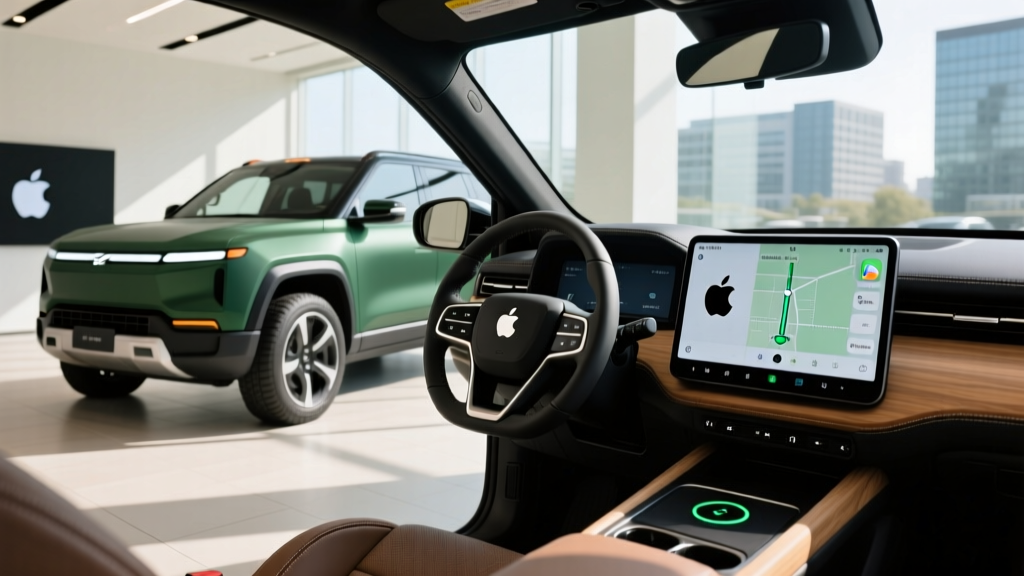
If you're shopping for a new electric truck or SUV and typing "Rivian CarPlay" into your search bar, here's the deal up front: as of the 2026 model year, Rivian does not offer Apple CarPlay or Android Auto on either the R1T pickup or the R1S SUV. Rivian has built its infotainment experience entirely in-house, relying on a proprietary operating system that runs on a 15.6-inch center touchscreen and a 12.3-inch digital instrument cluster.
This decision sets Rivian apart from nearly every other automaker in the EV space. Tesla similarly eschews phone projection, but most competitors — Ford, Hyundai, BMW, GM — offer wired or wireless CarPlay. For some buyers, this is a dealbreaker. For others, Rivian's native system is more than adequate once they learn its strengths and limitations.
Below, we break down exactly what Rivian's infotainment offers, how owners work around the CarPlay gap, and — because an infotainment system doesn't matter if the truck underneath isn't capable — we cover the full picture: range, charging, pricing, and whether the R1T or R1S deserves a spot in your driveway.
What Rivian's Native Infotainment Actually Offers
Rivian's decision to skip CarPlay isn't about cutting costs — it's about control. By building its own software stack, Rivian pushes over-the-air (OTA) updates that can add features, refine the UI, and improve vehicle functions without a dealership visit. Here's what the 2026 Rivian infotainment system includes:
- Native navigation with real-time traffic, EV-aware routing (incorporating charger locations, elevation, and battery preconditioning)
- Streaming music via built-in Spotify, Tidal, and TuneIn radio — logged in directly through the vehicle
- Bluetooth audio for any app on your phone (Apple Music, YouTube Music, podcasts) streamed wirelessly
- Voice commands via steering-wheel button for navigation, media, and climate control
- Phone integration — contacts, call history, and text message read-aloud via Bluetooth
- App ecosystem including a built-in web browser (while parked), weather, and trail maps for off-road navigation
- Digital key via Apple Watch or iPhone, allowing phone-as-key entry and start
The interface is clean, responsive, and organized around a customizable home screen with "panels" you can rearrange — media, navigation, climate, and vehicle status. The 15.6-inch display is bright enough for direct sunlight and supports multi-touch gestures including pinch-to-zoom on maps.
The CarPlay Workaround: What Owners Actually Do
Rivian owners who want their CarPlay apps on the big screen have two practical options:
- Bluetooth streaming — Connect your iPhone via Bluetooth and play any app (Apple Music, Waze audio directions, podcasts) through the vehicle speakers. Navigation remains on the phone's screen or through Rivian's native nav.
- Phone mount + wireless CarPlay adapter — Some owners use a standalone wireless CarPlay display that mounts on the dash or windshield, running CarPlay independently of the Rivian screen. This is an aftermarket solution, not endorsed by Rivian.
Neither solution replicates the seamless integrated CarPlay experience you'd get in a Ford F-150 Lightning or a Hyundai Ioniq 5. If CarPlay is a non-negotiable requirement, this is a genuine limitation to weigh.
2026 Rivian R1T & R1S: Range, Battery, and Real-World Efficiency
The infotainment debate fades quickly if the truck itself delivers. For 2026, Rivian offers the R1T (pickup) and R1S (three-row SUV) with updated Dual-Motor and Quad-Motor powertrains, plus a new Standard battery pack option that lowers the entry price.
| Spec | R1T Dual-Motor (Standard) | R1T Dual-Motor (Large) | R1T Quad-Motor (Max) |
|---|---|---|---|
| EPA Range | ~270 mi | ~352 mi | ~420 mi |
| Battery Capacity (usable) | ~95 kWh (LFP) | ~128 kWh (NMC) | ~149 kWh (NMC) |
| Horsepower | 533 hp | 533 hp | 1,025 hp |
| 0–60 mph | ~4.5 sec | ~4.5 sec | ~3.0 sec |
| Drivetrain | AWD (Dual-Motor) | AWD (Dual-Motor) | AWD (Quad-Motor) |
| Max Tow Capacity | 11,000 lbs | 11,000 lbs | 11,000 lbs |
| MPGe (combined) | ~73 MPGe | ~70 MPGe | ~65 MPGe |
| Efficiency | ~46 kWh/100mi | ~48 kWh/100mi | ~52 kWh/100mi |
The switch to LFP (lithium iron phosphate) chemistry for the Standard pack is a significant development. LFP batteries offer longer cycle life and can be charged to 100% daily without accelerating degradation — a major advantage for commuters who want a full battery every morning. The trade-off is lower energy density (hence the shorter range) and somewhat reduced performance in extreme cold compared to NMC. The Large and Max packs retain NMC (nickel manganese cobalt) chemistry for maximum range and energy density.
Charging Speed: DC Fast Charging and Home Level 2
Charging speed is where Rivian has made meaningful progress for 2026, particularly with the adoption of the NACS (North American Charging Standard) connector, which grants native access to Tesla's Supercharger network without an adapter.
| Charging Level | Power / Rate | Speed / Time |
|---|---|---|
| Level 1 (120V household) | ~1.4 kW | ~3–4 miles per hour |
| Level 2 (240V home, 48A) | ~11.5 kW | ~25–30 miles per hour |
| DC Fast Charge (Dual-Motor) | Peak ~200 kW | 10–80% in ~28 minutes |
| DC Fast Charge (Quad-Motor / Max) | Peak ~220 kW | 10–80% in ~32 minutes |
Understanding kW vs kWh: kW (kilowatts) measures the rate of energy flow — how fast you're charging. kWh (kilowatt-hours) measures total energy stored in the battery. Think of kW as the speed of water flowing through a hose, and kWh as the size of the bucket you're filling.
A critical note on DC fast charging: the peak kW figure is not sustained across the entire session. Rivian's charge curve peaks around 30–40% State of Charge (SoC) and tapers significantly above 80%. This is normal for all lithium-ion batteries — the battery management system slows charging to protect cell health. On a road trip, plan your stops around the 10–80% window for the fastest experience; charging from 80–100% can take nearly as long as the 10–80% segment.
For home charging, a Level 2 wall connector on a 60-amp circuit (delivering 48 amps to the vehicle) will fully replenish the Standard pack overnight in roughly 9–10 hours, and the Large pack in about 12–13 hours. Most owners find this more than sufficient — plug in when you get home, wake up to a full battery. Installation costs for a Level 2 home charger typically run $500–$2,000 depending on your electrical panel capacity and the distance from panel to charger location. Always get a quote from a licensed electrician before committing.
Pricing, Trims, and Federal Tax Credit Eligibility
Rivian's pricing has shifted downward for 2026 thanks to the new Standard battery option and manufacturing cost reductions at their Normal, Illinois facility.
| Trim / Configuration | Base MSRP | Est. Federal Credit (§30D) | Effective Price |
|---|---|---|---|
| R1T Dual-Motor Standard | $69,900 | Up to $7,500* | ~$62,400 |
| R1T Dual-Motor Large | $79,900 | Up to $7,500* | ~$72,400 |
| R1T Quad-Motor Max | $99,900 | Up to $7,500* | ~$92,400 |
| R1S Dual-Motor Standard | $74,900 | Up to $7,500* | ~$67,400 |
| R1S Dual-Motor Large | $84,900 | Up to $7,500* | ~$77,400 |
*Federal tax credit eligibility is subject to IRS §30D requirements. See checklist below.
IRS §30D Tax Credit Eligibility Checklist
The federal EV tax credit is not automatic. To qualify for up to $7,500 on a new Rivian purchase, you must meet all of the following criteria per current IRS rules:
- MSRP cap: The vehicle's base MSRP must not exceed $80,000 for trucks (R1T) or $80,000 for SUVs/vans (R1S). This means the Quad-Motor Max R1T at $99,900 does not qualify.
- Buyer income limits: Modified adjusted gross income (MAGI) must not exceed $300,000 (married filing jointly), $225,000 (head of household), or $150,000 (single filers).
- Battery sourcing requirements: A portion of the credit ($3,750) depends on critical minerals sourcing, and another $3,750 on battery component manufacturing in the U.S. or free-trade-agreement countries. Rivian's sourcing compliance may change — verify at the point of sale.
- Point-of-sale transfer: As of 2024, you can transfer the credit to the dealer at purchase, reducing your out-of-pocket cost immediately rather than waiting to claim it on your tax return.
- North American final assembly: Rivian assembles all vehicles in Normal, Illinois — this requirement is satisfied.
Because battery sourcing rules are complex and subject to annual updates, we strongly recommend checking the latest fueleconomy.gov listings and consulting a tax professional before finalizing your purchase.
Interior, Cargo, and Practicality
The R1T and R1S share Rivian's skateboard platform, but their body styles serve different use cases.
R1T Pickup
- Bed length: 4.5 feet (54 inches) — shorter than a traditional full-size truck bed
- Gear Tunnel: A lockable, pass-through storage compartment (~11 cu ft) behind the rear seats, accessible from both sides — one of the R1T's most distinctive features
- Frunk (front trunk): ~11 cu ft of lockable, drainable storage under the hood — large enough for groceries, a cooler, or charging cables
- Rear seat legroom: ~38.5 inches — comfortable for two adults on longer drives
- Towing: 11,000 lbs maximum across all trims
R1S SUV
- Seating: Three rows, up to seven passengers
- Cargo behind 3rd row: ~10.5 cu ft
- Cargo behind 2nd row: ~46 cu ft
- Maximum cargo (all rows folded): ~104 cu ft
- Towing: 7,700 lbs maximum
Both vehicles feature a minimalist interior with vegan leather (synthetic) upholstery standard, genuine leather available on higher trims, a panoramic glass roof, and a camp kitchen accessory option for the R1T's Gear Tunnel. Build quality has improved noticeably since the 2022 launch, with tighter panel gaps and more refined materials on 2025–2026 models.
Driver Assistance and Safety
Rivian's driver-assistance suite is branded Rivian Driver+ and includes:
- Adaptive cruise control with stop-and-go
- Lane-keeping assist and lane-centering
- Automatic emergency braking (front and rear)
- Blind-spot monitoring with rear cross-traffic alert
- Highway assist (hands-on, lane-centering on divided highways)
Rivian's highway assist is competent but not class-leading. It handles lane centering and adaptive cruise well on clearly marked interstates, but it doesn't offer the hands-free capability of GM's Super Cruise or Ford's BlueCruise on mapped highways. The system requires periodic steering-wheel torque input to confirm driver engagement.
Both the R1T and R1S have earned strong safety ratings, with the NHTSA awarding 5-star overall ratings to previous model years. IIHS testing data should be verified for the latest model year at iihs.org.
Warranty Coverage
| Coverage Area | Term |
|---|---|
| Basic Vehicle (bumper-to-bumper) | 5 years / 60,000 miles |
| Battery & Powertrain | 8 years / 175,000 miles |
| Battery Capacity Retention | 70% minimum over 8 yr / 175,000 mi |
| Roadside Assistance | 5 years / 60,000 miles |
Rivian's battery warranty is competitive, matching or exceeding most rivals in the truck/SUV segment. The 175,000-mile powertrain coverage is particularly strong. The 70% capacity retention threshold is standard for the industry — if your battery drops below 70% of its original capacity within the warranty period, Rivian will repair or replace it.
Who Should Buy a Rivian — and Who Should Look Elsewhere
Choose the Rivian R1T if:
- You want an electric pickup for outdoor recreation, light-to-moderate towing, and daily driving
- You value unique features like the Gear Tunnel and frunk for gear storage
- You're comfortable without Apple CarPlay and can adapt to a native infotainment system
- You want NACS-native Supercharger access for road trips
Choose the Rivian R1S if:
- You need three-row seating for a family but want an electric SUV with genuine off-road capability
- You prioritize build quality and a premium interior over brand heritage
Look elsewhere if:
- Apple CarPlay or Android Auto is a must-have — consider the Ford F-150 Lightning, Chevrolet Silverado EV, or Hyundai Ioniq 5
- You need a full-size truck bed (6.5+ feet) for work use — the R1T's 4.5-foot bed is a limitation
- You want the longest possible range at the lowest price — the Chevy Silverado EV 4WT or Tesla Cybertruck may offer better range-per-dollar
Pros and Cons at a Glance
- Class-leading off-road capability with air suspension and quad-motor torque vectoring
- NACS connector for native Tesla Supercharger access
- Innovative storage (Gear Tunnel, large frunk)
- Strong build quality improvements for 2026
- LFP Standard pack allows daily 100% charging without degradation concerns
- Competitive 8-year/175,000-mile battery warranty
- No Apple CarPlay or Android Auto — a significant gap for many buyers
- Short 4.5-foot bed limits work-truck utility
- Highway assist is hands-on only (no hands-free driving mode)
- Higher trims exceed the $80K MSRP cap for the federal tax credit
- Real-world range drops notably in cold weather and at highway speeds
- Service center network still expanding in some regions
Frequently Asked Questions
Will Rivian ever add Apple CarPlay?
As of early 2026, Rivian has not announced any plans to add Apple CarPlay or Android Auto support. The company has consistently stated that its proprietary infotainment system allows deeper vehicle integration and faster OTA updates. While owner demand for CarPlay is vocal, Rivian appears committed to its native approach. If this changes, it would most likely come via an OTA software update — but there is no timeline or confirmation.
Can I stream Apple Music in a Rivian without CarPlay?
Yes. You can connect your iPhone via Bluetooth and stream audio from any app, including Apple Music, Spotify, podcasts, and audiobooks. The audio quality over Bluetooth is good, though not lossless. Alternatively, you can log into the built-in Spotify or Tidal apps directly on the vehicle's touchscreen using your account credentials.
What is the real-world range of the Rivian R1T?
The EPA-estimated range varies by configuration: approximately 270 miles for the Standard pack, 352 miles for the Large pack, and 420 miles for the Max pack. In real-world highway driving at 70–80 mph, expect roughly 10–15% less than the EPA figure. In cold weather (below 32°F), range can drop 20–30% due to battery chemistry limitations and cabin heating demands. The Quad-Motor Max pack, while rated at 420 miles EPA, may deliver 300–340 miles on a winter road trip.
Does the 2026 Rivian qualify for the $7,500 federal EV tax credit?
It depends on the trim and your income. The Dual-Motor Standard and Dual-Motor Large R1T trims (MSRP at or below $80,000 for trucks) can qualify for up to $7,500, provided your income falls within IRS limits ($150K single / $300K joint) and the battery sourcing requirements are met. The Quad-Motor Max at $99,900 exceeds the MSRP cap and does not qualify. Always verify current eligibility on fueleconomy.gov and consult a tax professional.
How does the Rivian R1T compare to the Ford F-150 Lightning?
The F-150 Lightning offers Apple CarPlay/Android Auto, a larger 5.5-foot bed, and a lower starting price. The Rivian R1T counters with more innovative storage (Gear Tunnel, frunk), standard air suspension, better off-road capability, NACS-native Supercharger access, and a more premium interior. If CarPlay and a work-ready bed are priorities, the Lightning wins. If you want an adventure-oriented lifestyle truck with better trail manners, the R1T is the stronger pick.
Is Rivian's service network adequate?
Rivian operates a growing network of service centers and mobile service vans across the U.S., but coverage is still thinner than legacy automakers in rural areas and some mid-size metro regions. Before purchasing, check Rivian's website for the nearest service location. Mobile service handles many routine repairs and software-related issues, but collision repair and major hardware work may require a tow to a fixed center.