Rivian's Camp Mode is one of the most talked-about software features in the electric-truck and SUV segment — but it's only useful if the underlying vehicle can actually support an off-grid weekend. This review breaks down exactly what Camp Mode does on the 2025/2026 R1S SUV and R1T pickup, then digs into the hardware that makes it possible: EPA range, battery chemistry, DC fast-charging speeds, real-world efficiency, and the total cost after federal incentives.
What Is Rivian Camp Mode and How Does It Work?
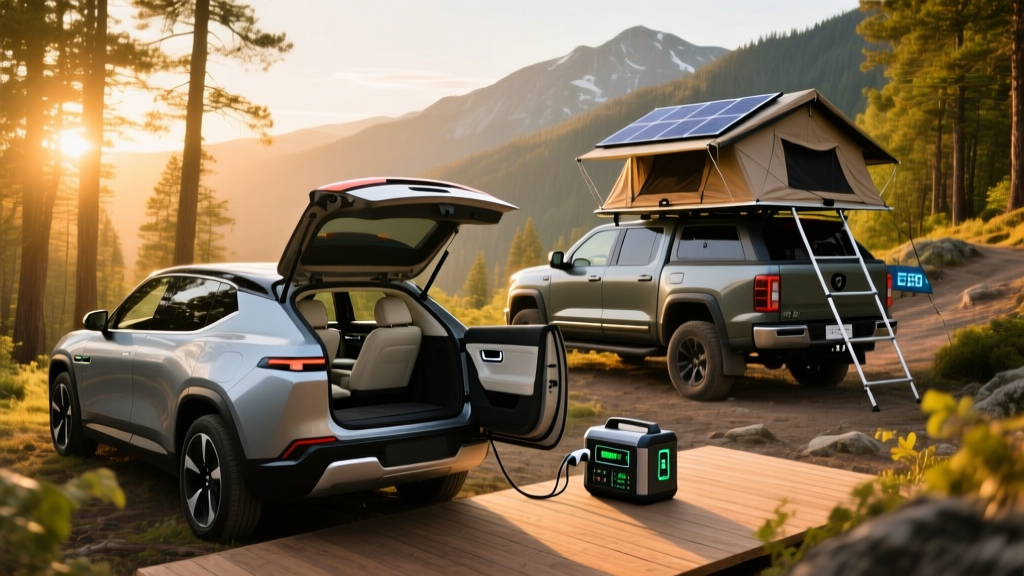
Camp Mode is a dedicated software setting available on all Rivian R1S and R1T vehicles (introduced via OTA update and continuously refined through 2025–2026 software releases). When activated, it reconfigures the vehicle's thermal management, lighting, and accessory systems for stationary, off-grid living.
Here's what Camp Mode actually controls:
- Climate system optimization: The HVAC maintains a set cabin temperature while minimizing energy draw by cycling the heat pump (standard on Dual-Motor and higher trims) more efficiently than in normal drive mode.
- Lighting management: Exterior and interior lights default to low-power states. The camp lighting feature on the R1T's gear tunnel and bed can be controlled via the app or touchscreen.
- Suspension leveling: The air suspension automatically levels the vehicle on uneven terrain — critical for rooftop tents or sleeping in the bed/cargo area.
- Accessory power: The 12V and available 120V outlets remain active, letting you run laptops, portable fridges, or CPAP machines directly from the traction battery.
- Security and notifications: Exterior cameras can be set to monitor surroundings, and the vehicle suppresses non-essential wake-up notifications that would otherwise drain the 12V system.
Energy consumption in Camp Mode varies significantly based on outside temperature. In mild conditions (50–70°F), expect roughly 1–2% battery drain per hour with climate control active. In freezing temperatures (below 32°F), that figure can climb to 3–5% per hour as the heat pump works harder — meaning a full night (8 hours) in sub-freezing temps could consume 25–40% of your battery.
R1S and R1T Specs: Range, Battery, and Efficiency
Camp Mode's usefulness depends entirely on how much energy you have in the pack. Here's the current Rivian lineup at a glance:
| Spec | Dual-Motor (Standard) | Dual-Motor (Large Pack) | Tri-Motor | Quad-Motor |
|---|---|---|---|---|
| Battery Capacity (usable) | ~92 kWh (NMC) | ~128 kWh (NMC) | ~128 kWh (NMC) | ~128 kWh (NMC) |
| EPA Range (R1S) | 270 mi | 352 mi | 321 mi | 285 mi |
| EPA Range (R1T) | 270 mi | 352 mi | 328 mi | 285 mi |
| Efficiency (R1S, combined) | ~2.0 kWh/mi | ~1.9 kWh/mi | ~2.1 kWh/mi | ~2.3 kWh/mi |
| MPGe (R1S, combined) | ~69 MPGe | ~73 MPGe | ~67 MPGe | ~62 MPGe |
| Horsepower | 533 hp | 533 hp | 850 hp | 1,025 hp |
| 0–60 mph | 4.5 sec | 4.5 sec | 2.9 sec | 2.5 sec |
| Drivetrain | AWD (Dual-Motor) | AWD (Dual-Motor) | AWD (Tri-Motor) | AWD (Quad-Motor) |
| Towing Capacity | 7,700 lbs | 7,700 lbs | 7,700 lbs | 7,700 lbs |
The EPA numbers above assume a mix of city and highway driving at moderate speeds. In real-world use:
- Highway cruising at 75 mph: Expect a 10–15% reduction from EPA, putting the Large Pack R1S at roughly 300–315 miles and the Standard at 230–245 miles.
- Cold weather (below 32°F): Range drops an additional 15–25% due to battery chemistry limitations and cabin heating demand. A Large Pack R1T in winter highway conditions may deliver as little as 250–270 miles.
- Towing: Pulling a 5,000-lb trailer cuts range roughly in half — plan for 150–180 miles between charges regardless of pack size.
- Camp Mode impact: If you arrive at a campsite with 80% SoC on a Large Pack (~102 kWh usable remaining), an overnight stay in mild weather will consume roughly 8–16 kWh, leaving you with 70–75% the next morning — plenty for a return trip in most scenarios.
Charging Speeds: DC Fast Charging and Home Level 2
Rivian upgraded the R1's charging architecture significantly with the second-generation platform (2025 model year onward). Here's what you'll see at the plug:
| Charging Level | Power / Rate | Estimated Speed | Notes |
|---|---|---|---|
| Level 1 (120V household) | 1.4 kW | ~3–4 mi/hr | Emergency/trickle only; impractical for daily use |
| Level 2 (240V, 48A home) | 11.5 kW | ~25–28 mi/hr | Full charge in ~11–13 hours (Large Pack) |
| Level 2 (240V, 32A portable) | 7.7 kW | ~17–19 mi/hr | Rivian portable charger included with vehicle |
| DC Fast Charge (CCS) | Peak 200+ kW (Gen 2) | 10–80% in ~25–30 min | Gen 2 platform; Gen 1 peaks ~190 kW |
| DC Fast Charge (NACS adapter) | Peak 200+ kW | 10–80% in ~25–30 min | Tesla Supercharger access via included adapter |
A few practical notes on charging for campers:
- Charge curve taper: Like all NMC packs, the Rivian charges fastest between 10–50% SoC. Above 80%, the rate drops sharply to protect battery health. If you're stopping at a DC fast charger on the way to a campsite, plan to charge to 80% and move on — the last 20% can take as long as the first 70%.
- Preconditioning: Use the Rivian app to precondition the battery before arriving at a fast charger. This warms the cells to optimal temperature and can shave 5–10 minutes off your charging session, especially in cold weather.
- Tesla Supercharger access: Rivian owners gained access to the Tesla Supercharger network using the NACS adapter (included with new vehicles from late 2024 onward). This dramatically expands charging options in rural and remote areas — a major advantage for campers heading off the beaten path.
- Campsite charging: Most campgrounds only offer 120V (Level 1) or occasionally 240V (Level 2) outlets. At Level 1, expect to recover only 25–35 miles overnight — enough for minor top-ups but not a meaningful recharge. If your campsite has a 240V/50A outlet (common at RV parks), you can pull up to 11.5 kW and recover ~200+ miles overnight.
Pricing, Trims, and Federal Tax Credit Eligibility
Rivian pricing has shifted with the introduction of the more accessible Dual-Motor Standard Pack trims. Here's the current MSRP landscape for 2025/2026 models:
| Model / Trim | Base MSRP | As-Tested (typical) | §30D Credit Eligible? |
|---|---|---|---|
| R1T Dual-Motor Standard | $69,900 | $73,000–$78,000 | Yes (MSRP under $80K truck cap) |
| R1T Dual-Motor Large | $75,900 | $80,000–$86,000 | Yes (MSRP under $80K truck cap) |
| R1T Tri-Motor | $99,900 | $105,000+ | No (exceeds $80K MSRP cap for trucks) |
| R1T Quad-Motor | $89,900 | $95,000+ | No (exceeds $80K MSRP cap) |
| R1S Dual-Motor Standard | $74,900 | $78,000–$84,000 | No (exceeds $80K SUV cap) |
| R1S Dual-Motor Large | $79,900 | $85,000–$92,000 | No (exceeds $80K SUV cap) |
| R1S Tri-Motor | $99,900 | $105,000+ | No (exceeds $80K SUV cap) |
Important §30D tax credit caveats: Under current IRS rules (source: IRS.gov), the federal clean vehicle credit offers up to $7,500, but eligibility depends on several factors:
- MSRP caps: Trucks (including the R1T) must have an MSRP at or below $80,000. SUVs (including the R1S) are also capped at $80,000. Only the R1T Dual-Motor Standard and some Dual-Motor Large configurations (at base MSRP) clear this threshold.
- Buyer income limits: Modified adjusted gross income must not exceed $300,000 (married filing jointly), $225,000 (head of household), or $150,000 (single filers).
- Battery sourcing requirements: A portion of the credit depends on critical minerals and battery components being sourced from the U.S. or free-trade-agreement countries. Rivian's supply chain has been evolving — verify current-year compliance on fueleconomy.gov before purchasing.
- Point-of-sale transfer: Eligible buyers can transfer the credit to the dealer at purchase, reducing the upfront price rather than waiting for a tax refund.
Always consult a tax professional to confirm your personal eligibility. State incentives (California, Colorado, and others) may stack on top — check your local DMV or energy office for current programs.
Interior Space, Cargo, and Camping Practicality
The R1T and R1S offer distinct advantages for camping, and Camp Mode leverages both:
R1T Pickup
- Bed dimensions: 54.2" long (tailgate up) × 50.0" wide between wheel wells — fits a full-size air mattress with minimal overhang.
- Gear Tunnel: 11.7 cu ft of sealed, lockable storage running the width of the vehicle between the cab and bed — unique to Rivian and ideal for camping gear, cooking equipment, or wet items.
- Frunk (front trunk): 11.0 cu ft, drainable — perfect for ice, beverages, or muddy boots.
- Total cargo: Bed + Gear Tunnel + Frunk gives the R1T more enclosed/semi-enclosed storage than any conventional midsize truck.
R1S SUV
- Cargo behind 3rd row: 10.8 cu ft
- Cargo behind 2nd row (3rd row folded): 46.7 cu ft
- Cargo behind 1st row (all rows folded): 91.6 cu ft — enough for a full camp setup or a platform bed build.
- Frunk: 11.0 cu ft, drainable.
- Passenger space: Up to 7 passengers (3-row configuration), with 38.6" of front legroom and 36.5" in the second row.
Driver Assistance, Tech, and Notable Drawbacks
Rivian's tech stack is competitive but has real limitations buyers should understand:
Rivian's Driver+ system is a Level 2 driver-assistance feature per SAE classification. It combines adaptive cruise control and lane-centering on compatible highways. The driver must remain fully engaged — hands on or near the wheel, eyes on the road. This is not autonomous or "self-driving" capability.
Infotainment: Rivian runs a proprietary, in-house-developed OS on a 15.6" center touchscreen. It's snappy and well-designed, with native navigation, Spotify, and over-the-air updates. However, there is no Apple CarPlay or Android Auto — a dealbreaker for some buyers who prefer phone-mirroring. Rivian has stated this will not change.
Notable drawbacks:
- No CarPlay/Android Auto: You're locked into Rivian's native software ecosystem.
- Service center availability: Rivian's service network is growing but still sparse outside major metro areas. Rural owners may face long tow distances for warranty repairs.
- Insurance costs: Rivian owners report premiums 20–40% higher than comparable ICE trucks/SUVs due to repair costs and parts availability. Get quotes before purchasing.
- Phantom drain: While improved with software updates, Rivians can lose 1–3 miles of range per day when parked and connected to the app (due to wake-ups). For multi-day camping without charging, disable Sentry-like monitoring features and minimize app checks.
- Weight: The R1T and R1S are heavy — over 7,000 lbs for most configurations. This affects tire wear, braking distances, and efficiency, particularly when towing.
Who Should Buy a Rivian for Camping?
Choose the R1T if:
- You want a dedicated truck bed for tent platforms, bed racks, or gear-hauling.
- The Gear Tunnel appeals to you as a unique, weather-sealed storage solution.
- You qualify for the §30D credit on the Dual-Motor Standard or base Large Pack (MSRP under $80K).
- You tow boats, trailers, or UTVs and need a truck form factor.
Choose the R1S if:
- You need seating for 5–7 passengers on family camping trips.
- You prefer a fully enclosed cargo area for security and weather protection.
- You don't need a truck bed and are willing to pay the SUV MSRP premium (which likely eliminates §30D eligibility).
Look elsewhere if:
- You need 400+ miles of real-world range — no Rivian configuration delivers this. Consider a Lucid Gravity or Tesla Model X if range is the top priority.
- You want Apple CarPlay or Android Auto.
- You live far from a Rivian service center and can't tolerate potential downtime.
Rivian vs. Competitors: How Does It Stack Up?
The Rivian doesn't compete in a vacuum. Here's how it compares to key alternatives for the adventure-camping use case:
| Spec | Rivian R1T (Dual-Motor Large) | Ford F-150 Lightning (Ext. Range) | Tesla Cybertruck (AWD) |
|---|---|---|---|
| EPA Range | 352 mi | 320 mi | 340 mi |
| Battery (usable) | ~128 kWh NMC | ~131 kWh NMC | ~123 kWh NMC |
| DC Fast Charge Peak | 200+ kW | ~150 kW | 250 kW |
| 0–60 mph | 4.5 sec | 3.8 sec | 4.1 sec |
| Towing | 7,700 lbs | 7,700 lbs | 7,500 lbs |
| Unique Camping Feature | Camp Mode + Gear Tunnel | Pro Power Onboard (9.6 kW V2L) | Powershare (11.5 kW V2L) |
| Base MSRP | $75,900 | ~$77,000 | $79,990 |
The F-150 Lightning's Pro Power Onboard is Rivian's closest competitor for campsite utility — it offers true vehicle-to-load (V2L) capability at up to 9.6 kW, meaning you can power high-draw appliances like induction cooktops, microwaves, or power tools directly. Rivian currently offers 120V outlets but not the same high-wattage V2L system. If you need to run serious equipment from your truck, the Lightning has an edge here.
The Cybertruck offers strong range and fast charging, but its polarizing design, stainless-steel exoskeleton (which makes aftermarket accessories like roof racks and bed covers more difficult), and limited service infrastructure make it a riskier camping platform in 2026.
Warranty and Long-Term Battery Outlook
Rivian provides the following warranty coverage:
- Battery & Drive Units: 8 years / 175,000 miles (whichever comes first), with a minimum 70% capacity retention guarantee during the warranty period.
- Limited Vehicle Warranty: 5 years / 60,000 miles bumper-to-bumper.
- Roadside Assistance: 5 years / 60,000 miles.
The 8-year/175,000-mile battery warranty is competitive with the industry standard (source: Rivian). The 70% retention threshold is typical — most NMC packs in liquid-cooled systems like Rivian's degrade roughly 8–12% over the first 100,000 miles based on fleet data from early R1 owners. For camping use, where you may regularly discharge to lower SoC levels and expose the pack to temperature extremes, preconditioning and avoiding frequent 100% charges will help preserve long-term health.
Frequently Asked Questions
What is the real-world range of a Rivian R1T or R1S when camping?
With the Large Pack (128 kWh), expect 300–315 miles on a highway road trip in moderate weather. Arriving at a campsite with 80% charge gives you roughly 100 kWh of usable energy for Camp Mode overnight use plus your return drive. In freezing conditions, plan for 250–270 miles of real-world range before accounting for camping energy use.
How fast does the Rivian charge at home and on the road?
At home on a 240V/48A Level 2 charger, the Rivian adds roughly 25–28 miles per hour (11.5 kW), fully charging the Large Pack in about 11–13 hours. On DC fast chargers, the Gen 2 platform peaks above 200 kW, achieving a 10–80% charge in approximately 25–30 minutes. The included NACS adapter grants access to Tesla Superchargers.
How much does a Rivian cost after the federal tax credit?
The R1T Dual-Motor Standard starts at $69,900 MSRP and qualifies for up to $7,500 in §30D credits (if you meet income and battery-sourcing requirements), bringing the effective price to roughly $62,400. The R1T Dual-Motor Large at $75,900 base may also qualify. Most R1S configurations and all Tri/Quad-Motor trims exceed the $80,000 MSRP cap and are ineligible for the federal credit.
Is Rivian Camp Mode worth it compared to a Ford F-150 Lightning?
It depends on your priorities. Camp Mode offers sophisticated thermal management, suspension leveling, and integrated lighting — ideal for sleeping in or near the vehicle. The F-150 Lightning's Pro Power Onboard provides superior V2L wattage (9.6 kW vs. Rivian's 120V outlets), making it better for powering high-draw equipment. For software-integrated camping comfort, Rivian wins. For raw power output, Ford wins.
Does the Rivian R1T or R1S qualify for the federal EV tax credit?
Select R1T configurations do. The §30D credit requires the vehicle MSRP to be at or below $80,000 (for trucks), buyer income under specified thresholds ($150K single / $300K joint), and compliance with battery sourcing requirements. Verify current eligibility on fueleconomy.gov and consult a tax professional before relying on the credit.
Can I run a CPAP machine or portable fridge overnight in Camp Mode?
Yes. The 12V outlets remain active in Camp Mode and can power a CPAP machine (typically 30–60W) or a 12V portable fridge (30–50W) for an entire night with minimal battery impact — typically less than 1–2 kWh total, or roughly 1–2% of a Large Pack.