If you've searched for "Rivian kitchen" you're almost certainly looking for one thing: the Rivian Camp Kitchen, the $5,000 slide-out cooking system available on the R1T electric pickup. It's the most talked-about overlanding accessory in the EV world, but does it make sense when you factor in the R1T's real-world range hit, added weight, and the current federal tax credit landscape for 2026?
This review covers the Camp Kitchen hardware itself, then puts the R1T it rides in through a full EV buyer's breakdown — EPA range vs. highway reality, DC fast-charge curves, battery chemistry, ownership costs, and whether this rig beats a Tesla Cybertruck or Ford F-150 Lightning for adventure use.
What Exactly Is the Rivian Camp Kitchen?
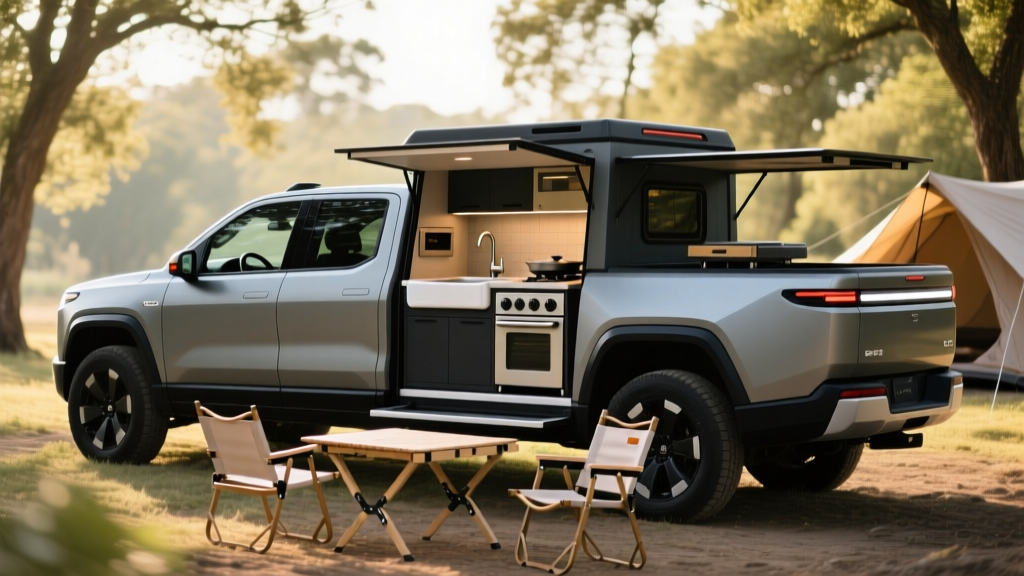
The Camp Kitchen is a powered slide-out module that installs in the R1T's gear tunnel (the pass-through storage between cab and bed). It includes:
- A two-burner induction cooktop (1,800W combined)
- A slide-out pantry with Rivian-designed cookware by Snow Peak
- An integrated sink with a 4.5-gallon fresh water tank and gray water capture
- A pull-out prep counter and utensil organizer
- Dedicated wiring tied to the R1T's 12V and high-voltage systems
Rivian prices the Camp Kitchen at $5,000 when ordered with a new R1T, or approximately $6,000 as a retrofit through a service center (labor included). It's only compatible with the R1T — not the R1S SUV — and it does occupy roughly 60% of the gear tunnel's usable volume.
The Camp Kitchen draws power from the R1T's main traction battery for induction cooking. Rivian estimates about 1–2 miles of range per 10 minutes of cooktop use at medium heat.
2026 Rivian R1T: Full EV Specs at a Glance
| Spec | Dual-Motor Standard | Dual-Motor Max Pack | Tri-Motor (2025.5+) |
|---|---|---|---|
| EPA Range | 270 mi | 420 mi | 380 mi |
| Battery (usable) | 106 kWh (NMC) | 149 kWh (NMC) | 149 kWh (NMC) |
| Horsepower | 533 hp | 533 hp | 850 hp |
| 0-60 mph | 4.5 sec | 4.5 sec | 2.9 sec |
| Drivetrain | AWD (dual-motor) | AWD (dual-motor) | AWD (tri-motor) |
| Max DC Fast Charge | 200 kW | 220 kW | 220 kW |
| 10-80% DC Time | ~30 min | ~42 min | ~42 min |
| Level 2 Home Charge | 11.5 kW (~25 mi/hr) | 11.5 kW (~25 mi/hr) | 11.5 kW (~25 mi/hr) |
| MPGe (combined) | 70 MPGe | 65 MPGe | 62 MPGe |
| Towing Capacity | 11,000 lbs | 11,000 lbs | 11,000 lbs |
| Cargo Bed Volume | 29.3 cu ft | 29.3 cu ft | 29.3 cu ft |
| Gear Tunnel Volume | 11.0 cu ft | 11.0 cu ft | 11.0 cu ft |
| Front Trunk (Frunk) | 11.0 cu ft | 11.0 cu ft | 11.0 cu ft |
| Rear Legroom | 36.5 in | 36.5 in | 36.5 in |
| Battery Warranty | 8 yr / 175,000 mi | 8 yr / 175,000 mi | 8 yr / 175,000 mi |
| Base MSRP | $69,900 | $83,900 | $99,900 |
Source: fueleconomy.gov and Rivian official specifications.
Real-World Range: What the EPA Sticker Doesn't Tell You
Rivian uses NMC (nickel manganese cobalt) lithium-ion cells across all R1T packs. NMC delivers higher energy density than LFP, which is critical in a truck this size, but it is more sensitive to sustained high-state-of-charge storage. Rivian recommends daily charging to 85% and only hitting 100% before long trips.
The quad-motor variant (discontinued after 2024 in favor of the tri-motor) posted even lower real-world efficiency — roughly 1.9–2.1 kWh/mile in mixed driving vs. the dual-motor's 1.5–1.7 kWh/mile.
Charging Speed: DC Fast, Level 2, and Camp Kitchen Power Draw
| Charging Level | Power | Speed (approx.) | Notes |
|---|---|---|---|
| Level 1 (120V) | 1.4 kW | ~3 mi/hr | Emergency/trickle only |
| Level 2 (240V home) | 11.5 kW | ~25 mi/hr | Full charge in ~10-13 hrs |
| DC Fast (Standard) | 200 kW peak | ~140 mi in 20 min | Tapers above 80% |
| DC Fast (Max/Tri) | 220 kW peak | ~150 mi in 20 min | 42-min 10-80% sustained |
| Camp Kitchen Cooktop | 1.8 kW draw | ~1-2 mi range / 10 min | Uses traction battery |
The R1T uses the NACS (Tesla-style) connector as of 2025, giving it direct access to Tesla Supercharger V3 and V4 stations without an adapter. This is a significant advantage over the CCS-only era of early R1T models, which required a Rivian-provided adapter for Supercharger access.
For Camp Kitchen users, the key charging reality is this: a full day of cooking (roughly 2 hours of combined cooktop use) consumes approximately 3.6 kWh, which equates to roughly 10–14 miles of lost driving range. That's manageable, but it means overlanders should plan charging stops accordingly.
Home Level 2 charging requires a 60-amp dedicated circuit for the full 11.5 kW rate. Expect installation costs of $1,200–$2,500 including the Rivian Wall Charger ($550), electrician labor, and permits. Homes with 100-amp electrical panels may need a $2,000–$4,000 panel upgrade.
Performance and Drivetrain: Quick for a 7,000-lb Truck
The dual-motor R1T delivers 533 horsepower and a 4.5-second 0-60 mph time — impressive for a vehicle with a curb weight around 7,100 lbs. The tri-motor variant pushes that to a staggering 2.9 seconds with 850 hp, making it one of the quickest production pickups ever built.
All R1T variants feature standard AWD with independent motor control per axle. The air suspension provides up to 14.9 inches of ground clearance in Off-Road mode and can lower for highway efficiency. Towing capacity is rated at 11,000 lbs, though towing near max capacity will cut real-world range by 40-50%.
Pricing, Trims, and Federal Tax Credit Eligibility
| Configuration | Base MSRP | + Camp Kitchen | As-Tested Total | Est. After §30D Credit |
|---|---|---|---|---|
| Dual-Motor Standard | $69,900 | +$5,000 | $74,900 | $67,400* |
| Dual-Motor Max Pack | $83,900 | +$5,000 | $88,900 | $81,400* |
| Tri-Motor | $99,900 | +$5,000 | $104,900 | Ineligible (MSRP cap) |
*Tax credit estimates assume buyer qualifies under IRS §30D rules. Eligibility requires: modified adjusted gross income below $150,000 (single) or $300,000 (joint); vehicle MSRP under $80,000 for trucks; and battery components/critical minerals meeting US-sourcing thresholds that tighten annually. The Tri-Motor's MSRP exceeds the $80,000 truck cap and is ineligible. The Max Pack's eligibility depends on final as-configured MSRP and current-year sourcing rules — verify with a tax professional.
As of 2026, the §30D credit can be transferred to the dealer at point of sale, reducing your purchase price directly rather than waiting for a tax refund. Rivian participates in this program.
Interior, Tech, and Daily Livability
The R1T cabin seats five with 36.5 inches of rear legroom — adequate but not class-leading compared to the F-150 Lightning's 40.1 inches. The 15.6-inch center touchscreen runs Rivian's proprietary infotainment, which has improved significantly through OTA updates but still lacks Apple CarPlay and Android Auto (a persistent complaint).
Driver assistance comes via Rivian Driver+, a Level 2 SAE system offering adaptive cruise, lane centering, and highway assist. It is not a self-driving system — hands must remain on the wheel and eyes on the road at all times. It's competent but trails Tesla Autopilot and GM Super Cruise in hands-free highway capability.
Storage is where the R1T shines: the 11-cu-ft frunk, 29.3-cu-ft bed, and 11-cu-ft gear tunnel (minus Camp Kitchen intrusion) offer more enclosed storage than any competing EV pickup.
Who Should Buy the R1T With the Camp Kitchen?
- You overland or car-camp 10+ nights per year and want an integrated cooking solution
- You need a daily-driver pickup that can tow 11,000 lbs and hit a trailhead on weekends
- You have reliable home Level 2 charging and access to NACS DC fast chargers on road trips
- Your household income falls under the §30D caps and you can capture the $7,500 credit
- You primarily need a work truck — the kitchen eats gear tunnel space and adds cost without job-site utility
- You regularly drive 300+ miles in cold weather between charges
- You rely on CarPlay/Android Auto for navigation and media
- Your budget is under $70,000 — the F-150 Lightning XLT starts significantly lower
Pros and Cons
- Best-in-class integrated overlanding kitchen — no aftermarket equivalent
- 420-mile Max Pack range leads the EV truck segment
- NACS connector = direct Tesla Supercharger access
- 11,000-lb towing with torque-vectoring AWD
- 8-year/175,000-mile battery warranty (above industry average)
- OTA updates continually add features
- $5,000 kitchen option consumes gear tunnel space
- Real-world highway range 15-20% below EPA sticker
- No Apple CarPlay or Android Auto
- Tri-Motor ineligible for federal tax credit (MSRP cap)
- Rear seat room trails F-150 Lightning
- Insurance premiums run 15-25% above comparable gas trucks
R1T Camp Kitchen vs. Competitors
The Ford F-150 Lightning starts at ~$55,000 and offers more rear-seat space, but has no integrated kitchen option and maxes out at 320 miles EPA range. The Tesla Cybertruck (340-mile EPA, AWD) has no equivalent camp kitchen accessory and remains polarizing in design. The Chevrolet Silverado EV (up to 440 miles EPA on the Max Range trim) offers superior range but no bed-through tunnel for a kitchen module.
The R1T Camp Kitchen occupies a unique niche: it's the only factory-integrated overlanding cooking solution in the EV truck market. If that's your priority, there is no direct substitute.
Frequently Asked Questions
What is the real-world range of the R1T with the Camp Kitchen installed?
The Dual-Motor Standard Pack delivers approximately 205–225 miles of real-world highway range with the Camp Kitchen. The Max Pack provides 325–345 miles. Cold weather (below 30°F) reduces these figures by an additional 15-25%.
How fast does the R1T charge at home and on the road?
At home on a Level 2 (240V, 48-amp) charger, the R1T gains roughly 25 miles of range per hour (11.5 kW). On a DC fast charger, the Standard Pack peaks at 200 kW (10-80% in ~30 min) and the Max/Tri Pack peaks at 220 kW (10-80% in ~42 min). Expect charge speeds to taper significantly above 80% SoC.
Does the R1T with Camp Kitchen qualify for the $7,500 federal EV tax credit?
The Dual-Motor Standard ($74,900 with kitchen) qualifies if the buyer meets IRS income caps ($150K single / $300K joint) and battery sourcing requirements. The Dual-Motor Max Pack ($88,900) exceeds the $80,000 truck MSRP cap and is ineligible for §30D. The Tri-Motor is also ineligible. Always verify current-year rules at irs.gov and consult a tax professional.
Is the Rivian Camp Kitchen worth $5,000?
For frequent overlanders (10+ trips/year), yes — it's a fully integrated, vehicle-powered system that eliminates the need for a separate camp stove, water jug, and cook kit. For casual campers, a $500 portable induction cooktop and cooler achieve 70% of the utility at 10% of the cost. The kitchen also reduces gear tunnel storage by roughly 60%.
Can I install the Camp Kitchen on an existing R1T?
Yes. Rivian offers retrofit installation through its service centers for approximately $6,000 (parts + labor). Availability depends on service center scheduling, which can run 4-8 weeks out in some markets.
Does the Camp Kitchen drain the R1T's main battery?
Yes. The induction cooktop draws from the R1T's high-voltage traction battery. Approximately 2 hours of cooking uses about 3.6 kWh, or roughly 10–14 miles of driving range. This is modest for weekend trips but should be factored into route planning.