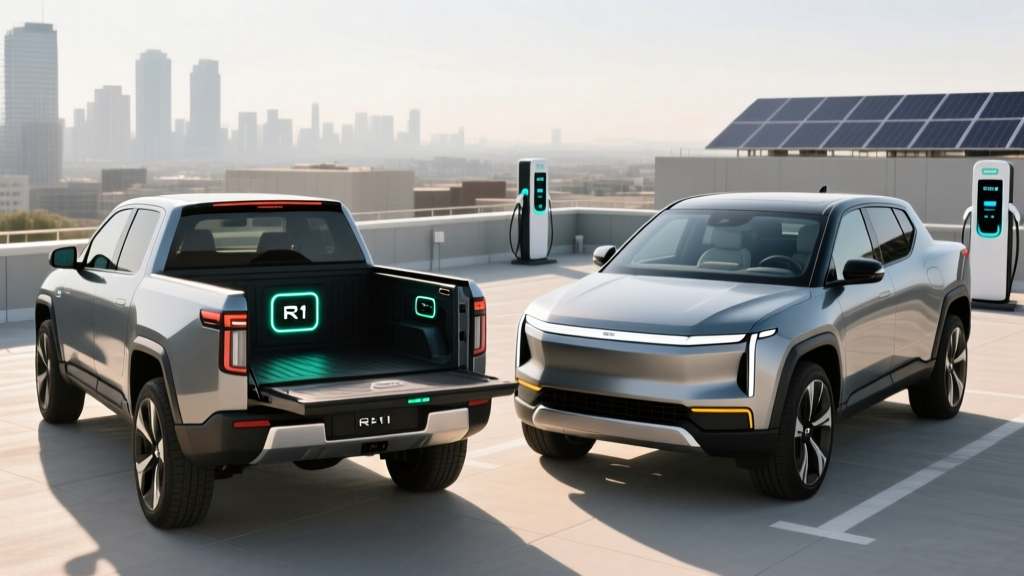
Rivian's annual Autonomy AI Day has become the company's primary stage for revealing software advances, sensor hardware upgrades, and its roadmap toward higher-level driver assistance. But for buyers shopping the R1T pickup or R1S SUV today, the headline question is less about future robotaxis and more about what the current-generation vehicles actually deliver in range, charging speed, daily usability, and value. This review bridges the gap: we unpack the latest Autonomy AI Day reveals while grounding every claim in the hard specs, real-world driving data, and ownership economics of the 2026 Rivian R1T and R1S.
What Rivian Autonomy AI Day Actually Revealed
Rivian's Autonomy AI Day events function similarly to Tesla's AI Day — a technical showcase of the company's in-house autonomy stack rather than a traditional vehicle launch. The most recent presentations emphasized several themes:
- Custom silicon and sensor fusion: Rivian detailed its proprietary compute platform, designed to process data from the vehicle's camera array, radar, and ultrasonic sensors without relying on third-party chips. This vertical integration mirrors the approach Tesla and Mercedes-Benz have taken with their respective stacks.
- Highway Assist evolution: The company demonstrated expanded hands-on-wheel highway driving capabilities, including automated lane changes and navigation-guided on-ramp-to-off-ramp functionality. Crucially, Rivian frames these features as SAE Level 2 driver-assist — the driver must remain engaged and supervise at all times.
- Off-road autonomy research: In a differentiator from competitors focused solely on pavement, Rivian showcased trail-mapping and terrain-recognition algorithms designed for low-speed off-road route guidance.
- Fleet and delivery integration: Updates on the Amazon EDV (Electric Delivery Van) platform's autonomous-readiness hinted at future commercial applications, though these are separate from consumer R1 vehicles.
R1T and R1S: Range, Battery, and Efficiency Specs
Rivian offers the R1T and R1S with multiple battery pack options. The chemistry and capacity vary by configuration, and the choice has meaningful implications for range, charging behavior, and long-term degradation.
| Specification | R1T (Dual-Motor, Standard) | R1S (Dual-Motor, Standard) |
|---|---|---|
| EPA Range | 270 miles | 260 miles |
| Battery Capacity (Usable) | ~95 kWh (NMC) | ~95 kWh (NMC) |
| Max Pack EPA Range | ~420 miles (est.) | ~400 miles (est.) |
| Efficiency (Combined) | 73 MPGe / 46 kWh/100mi | 71 MPGe / 47 kWh/100mi |
| 0–60 mph | 4.5 sec (Dual-Motor) | 4.6 sec (Dual-Motor) |
| Horsepower | 533 hp | 533 hp |
| Drivetrain | AWD (Dual-Motor) | AWD (Dual-Motor) |
| Max Tow Capacity | 11,000 lbs | 7,700 lbs |
| Cargo (Bed / Behind 2nd Row) | 54 cu ft (bed) + 11 cu ft (frunk) | 57 cu ft (behind 2nd) + 11 cu ft (frunk) |
| Battery/Powertrain Warranty | 8 yr / 175,000 mi | 8 yr / 175,000 mi |
Charging Speed: DC Fast Charge and Home Level 2
Charging infrastructure access remains one of the top concerns for EV buyers, and Rivian's charging performance sits in the middle of the pack — adequate but not class-leading compared to 800V architectures from Hyundai/Kia or the latest Tesla platforms.
| Level | Max Power | Speed | Notes |
|---|---|---|---|
| Level 1 (120V) | 1.4 kW | ~3 mi/hr | Emergency/trickle only |
| Level 2 (240V, 48A) | 11.5 kW | ~25 mi/hr | Full overnight charge in ~9–10 hrs |
| DC Fast Charge | ~220 kW peak | 10–80% in ~28 min | Tapers significantly above 80%; add ~15 min for 80–100% |
Rivian uses the NACS (Tesla-style) charge port on newer vehicles and provides access to the Tesla Supercharger network via adapter or native port, depending on build date. This is a significant practical advantage over CCS-only vehicles, given the Supercharger network's superior reliability and coverage density.
Charging curve reality: The ~220 kW peak rate is not sustained. Expect peak speeds between 10–40% State of Charge, with the rate tapering to ~80 kW by 60% and ~40 kW by 80%. On a road trip, plan your stops around the 10–80% window for the best time-to-miles ratio. Preconditioning the battery (initiated automatically when you navigate to a charger in the Rivian app) is essential for achieving peak rates in cold weather.
Pricing, Trim Levels, and Federal Tax Credit
Rivian positions the R1T and R1S as premium adventure vehicles, and pricing reflects that. Here's where the trims land for 2026 and how the federal §30D tax credit factors in.
| Configuration | MSRP (R1T) | MSRP (R1S) | §30D Credit Eligible? |
|---|---|---|---|
| Dual-Motor, Standard Pack | $69,900 | $74,900 | R1T: Yes (under $80K truck cap). R1S: No (over $80K SUV cap) |
| Dual-Motor, Large Pack | $77,900 | $82,900 | R1T: Yes. R1S: No |
| Quad-Motor, Max Pack | $99,000+ | $104,000+ | No (exceeds MSRP cap) |
- MSRP Cap: The §30D credit caps eligibility at $80,000 for trucks/vans/SUVs and $55,000 for sedans. The R1T (classified as a truck) qualifies in base Dual-Motor Standard and Large Pack trims. The R1S (classified as an SUV) only qualifies in its base configuration — and only if MSRP stays under $80,000 before destination.
- Buyer Income Limits: Modified Adjusted Gross Income must not exceed $300,000 (joint filers), $225,000 (head of household), or $150,000 (single). Income is evaluated for the year of delivery or the prior year — whichever is lower.
- Battery Sourcing Requirements: The full $7,500 credit splits into two halves — $3,750 for critical minerals sourcing and $3,750 for battery component manufacturing. As of 2026, stringent FEOC (Foreign Entity of Concern) restrictions apply. Rivian has been working to qualify domestic supply chains, but partial credit ($3,750) is possible if only one of the two criteria is met. Always verify current eligibility at IRS.gov §30D before purchasing.
- Point-of-Sale Transfer: Eligible buyers can transfer the credit to the dealer at purchase, reducing the out-of-pocket price immediately rather than waiting for a tax refund.
Interior, Cargo, and Everyday Usability
Both the R1T and R1S offer thoughtfully designed interiors with a focus on outdoor utility. The R1T's 4.5-foot bed (54 cu ft) is compact for a pickup but supplemented by the signature Gear Tunnel — a full-width, lockable pass-through storage compartment behind the cab that holds roughly 11 cu ft of gear. The front trunk (frunk) adds another 11 cu ft with a drain plug, useful for ice and beverages.
The R1S seats up to seven (with the optional third row), though the third row is best suited for children. Behind the second row, cargo volume measures approximately 57 cu ft, expanding to over 100 cu ft with seats folded. Legroom is generous in the first two rows (41.3" front, 39.5" second), making it a comfortable family hauler.
Tech and infotainment: Rivian runs a proprietary 15.6-inch center touchscreen with a clean, responsive interface. Wireless Apple CarPlay and Android Auto are supported. The digital instrument cluster and optional head-up display round out the driver-facing tech. Over-the-air (OTA) updates are frequent and substantive — a Rivian strength compared to legacy automakers.
Notable drawbacks: The R1T's short bed limits hauling of long lumber or full-size motorcycles without the tailgate down. The R1S's third row is tight for adults. The panoramic glass roof, while beautiful, can create significant cabin heat in summer — the powered shade is a must-have option. And while the infotainment system is polished, Rivian still lacks native integration with some popular third-party apps (e.g., no native Spotify — you must use phone projection).
How Does It Compare to Key Competitors?
The Rivian R1T occupies a unique niche as the only dedicated electric adventure pickup. Its closest competitors vary depending on what the buyer prioritizes:
Pros and Cons: The Honest Assessment
- Class-leading off-road capability with air suspension and up to 14.9" ground clearance
- Unique Gear Tunnel storage (R1T) — no competitor offers this
- Frequent, meaningful OTA updates that add real features
- NACS port / Supercharger network access
- Strong build quality and thoughtful interior design
- 8-year / 175,000-mile battery warranty exceeds many competitors
- R1T Dual-Motor Standard qualifies for partial or full §30D credit
- DC fast charging peaks at ~220 kW and tapers early — slower than 800V competitors
- Real-world highway range falls 10–15% below EPA, worse in cold
- R1S pricing exceeds §30D MSRP cap on most trims
- R1T bed is short (4.5 ft) — limits traditional truck utility
- No Level 3 or hands-free autonomy despite AI Day marketing
- Insurance costs run 20–35% higher than comparable ICE trucks
- Service center network still limited in rural areas
Who Should Buy the Rivian R1T or R1S?
- You want an electric pickup that can genuinely handle off-road trails, ski trips, and camping — not just commute on pavement
- Your daily commute is under 100 miles round-trip and you can charge at home overnight
- You value the Gear Tunnel and frunk for gear-heavy lifestyles (bikes, kayaks, camping equipment)
- You want NACS/Supercharger access for road trips without relying on Electrify America or other CCS networks
- You need three-row seating for a family but want electric powertrain benefits
- You prioritize ground clearance and AWD traction for snow and light trail use
- You can accept that most R1S trims won't qualify for the federal tax credit due to the $80K SUV MSRP cap
- You need maximum towing range — the F-150 Lightning Extended Range or a diesel truck still wins here
- Fast DC charging is your top priority — consider the Kia EV9 or Hyundai Ioniq 5 (800V, ~18 min 10–80%)
- You expect true self-driving capability — no consumer vehicle offers this today, regardless of marketing language at any AI Day
Frequently Asked Questions
What is the real-world range of the Rivian R1T?
The EPA rates the Dual-Motor Standard Pack R1T at 270 miles. In real-world highway driving at 70–75 mph, expect 220–245 miles. In freezing temperatures, plan for 180–210 miles. The Max Pack pushes EPA estimates above 400 miles, which helps absorb these losses significantly.
How fast does the Rivian R1T charge at home and on the road?
At home on a Level 2 (240V, 48A) charger, the R1T adds roughly 25 miles of range per hour, completing a full charge in about 9–10 hours. On a DC fast charger, it peaks at approximately 220 kW, reaching 10–80% in about 28 minutes. Charging slows considerably above 80% — avoid charging past 80% on road trips unless necessary.
How much does the Rivian R1T cost after tax credits?
The base Dual-Motor Standard Pack R1T starts at $69,900. If you qualify for the full §30D credit ($7,500), the effective price drops to approximately $62,400. However, eligibility depends on your income, the vehicle's battery sourcing compliance, and the MSRP cap ($80,000 for trucks). Many buyers will qualify for a partial credit of $3,750, bringing the effective price to ~$66,150. Verify your eligibility on IRS.gov and with your tax professional before committing.
Does the Rivian R1S qualify for the federal EV tax credit?
Only the base R1S Dual-Motor Standard Pack configuration — if its MSRP including destination stays under $80,000 — may qualify. Most R1S builds with options exceed this threshold and are ineligible. The R1T, classified as a truck, has a more favorable MSRP cap situation and qualifies in more configurations.
Is Rivian's autonomy software self-driving?
No. All current Rivian driver-assist features, including Highway Assist, operate at SAE Level 2. The driver must remain fully attentive, hands on or near the wheel, and ready to intervene. Rivian's Autonomy AI Day showcases research and development progress — not a Level 3 or Level 4 system available to consumers today.
Is the Rivian R1T worth buying versus the Ford F-150 Lightning or Tesla Cybertruck?
It depends on your priorities. The R1T wins on off-road capability, build quality, and adventure-focused design (Gear Tunnel, air suspension). The F-150 Lightning wins on bed size, towing familiarity, and dealer service network breadth. The Cybertruck wins on raw acceleration and charging network integration (native Tesla). For buyers who camp, ski, mountain bike, and need a truck that can handle unpaved roads confidently, the R1T is the strongest choice in the segment. For pure work-truck utility, the Lightning is more practical.