When Rivian held its first Autonomy and AI Day in early 2026, the event wasn't just a software roadmap — it was a signal that the company is pivoting hard to compete with Tesla's FSD and GM's Super Cruise on the driver-assistance front. But for actual buyers, the bigger question is how these autonomy ambitions affect the trucks and SUVs sitting in driveways today. Below, we cover what Rivian announced, then dive deep into the 2026 R1T and R1S with the exact range, charging, pricing, and tax-credit data you need to make a purchase decision.
What Rivian's Autonomy and AI Day Actually Revealed
Rivian's Autonomy and AI Day showcased the company's next-generation driver-assistance stack, built on a custom silicon platform and an expanded sensor suite that includes high-resolution cameras, 4D imaging radar, and LiDAR on higher trims. The key announcements:
- Rivian Autonomy Platform (RAP): A proprietary compute module capable of processing over 1,000 TOPS (trillions of operations per second), designed to handle real-time perception and path planning without relying on cloud connectivity.
- Enhanced Highway Assist: Now supporting lane changes, on-ramp-to-off-ramp navigation, and adaptive speed management on divided highways. This remains a SAE Level 2 system — the driver must keep hands on the wheel and eyes on the road at all times.
- Off-Road Autonomy Preview: A demonstration of trail-following and obstacle-avoidance on unpaved terrain — still in testing, not yet available to consumers.
- AI-Driven Battery Management: Machine-learning algorithms that optimize thermal preconditioning and charge-curve prediction based on individual driving patterns and ambient conditions.
2026 Rivian R1T and R1S: Full Spec Breakdown
Whether you're eyeing the R1T pickup or the three-row R1S SUV, the 2026 model year brings updated battery options, refined efficiency, and the new autonomy hardware as standard on Adventure and Ascend trims. Here are the exact numbers.
| Spec | R1T Dual-Motor (Standard Battery) | R1T Dual-Motor (Max Battery) | R1S Dual-Motor (Max Battery) |
|---|---|---|---|
| EPA Range | 270 mi | 352 mi | 340 mi |
| Battery Capacity (usable) | 92 kWh (NMC) | 128 kWh (NMC) | 128 kWh (NMC) |
| Drivetrain | AWD (Dual-Motor) | AWD (Dual-Motor) | AWD (Dual-Motor) |
| Horsepower | 533 hp | 533 hp | 533 hp |
| 0–60 mph | 4.5 sec | 4.5 sec | 4.7 sec |
| Max DC Fast Charge | 200 kW | 220 kW | 220 kW |
| 10–80% DC Charge Time | ~28 min | ~34 min | ~34 min |
| Level 2 Home Charge Rate | 11.5 kW (~25 mi/hr) | 11.5 kW (~25 mi/hr) | 11.5 kW (~25 mi/hr) |
| Efficiency (MPGe) | 73 MPGe combined | 70 MPGe combined | 69 MPGe combined |
| Efficiency (kWh/100 mi) | 46 kWh/100 mi | 48 kWh/100 mi | 49 kWh/100 mi |
| Towing Capacity | 11,000 lbs | 11,000 lbs | 7,700 lbs |
| Base MSRP | $69,900 | $82,400 | $79,900 |
Real-World Range: What the EPA Number Doesn't Tell You
R1T Max Battery — EPA 352 mi. In real-world highway driving at 70–75 mph, expect approximately 290–310 miles. In cold weather (below 32°F), range can drop to 240–270 miles due to battery resistance and cabin heating demands. City driving with heavy regen use can actually exceed the EPA estimate, reaching 340–360 miles in mild conditions.
R1S Max Battery — EPA 340 mi. The heavier SUV body and less aerodynamic profile mean highway range lands around 280–300 miles, with cold-weather drops to 230–260 miles.
Rivian uses NMC (nickel manganese cobalt) chemistry across its Max Battery packs. NMC offers higher energy density than LFP, which is how Rivian fits 128 kWh of usable capacity into the skateboard platform. The trade-off: NMC cells prefer not to sit at 100% state of charge for extended periods. For daily driving, Rivian recommends setting your charge limit to 85–90% to maximize long-term battery health — only charging to 100% before road trips.
Charging Speed: DC Fast Charging and Home Setup
Charging speed is where Rivian owners spend a lot of real-world time thinking. The R1T and R1S with the Max Battery pack peak at 220 kW on a DC fast charger — but as with all EVs, that peak rate is not sustained through the entire session. Here's what the charge curve actually looks like:
| Charging Level | Power | Miles Added/Hour | Notes |
|---|---|---|---|
| Level 1 (120V household) | 1.4 kW | ~3 mi/hr | Emergency/top-up only; full charge takes 3–4 days |
| Level 2 (240V, 48A home charger) | 11.5 kW | ~25 mi/hr | Overnight charge: ~12–14 hours for full Max pack |
| DC Fast Charge (peak) | 220 kW | ~250+ mi/hr (initial) | 10–80% in ~34 min; rate tapers sharply above 80% |
| DC Fast Charge (sustained avg.) | ~140 kW avg | ~160 mi/hr avg | Real-world average across 10–80% session |
The key insight: while Rivian's 220 kW peak is competitive, the charge curve tapers noticeably past 60% state of charge. On a road trip, plan your stops around the 10–80% window for the fastest sessions. Pushing from 80–100% on DC can add another 25–30 minutes — it's almost always faster to charge to 80% and drive on.
For home charging, Rivian's Wall Connector delivers up to 11.5 kW on a 240V/48A circuit. Most owners will need a NEMA 14-50 outlet or hardwired installation. Budget $800–$2,200 for a professional Level 2 home install depending on your electrical panel capacity and run distance. Always consult a licensed electrician for final specs — a 200-amp panel is generally sufficient, but older homes may need an upgrade.
Pricing, Trims, and Federal Tax Credit Eligibility
The 2026 Rivian lineup is offered in Adventure, Adventure with Off-Road Package, and Ascend (premium) trims. Pricing has shifted upward from 2025 due to added autonomy hardware and sensor suites becoming standard.
| Model / Trim | Base MSRP | As-Tested (Typical) | §30D Credit Eligible? |
|---|---|---|---|
| R1T Dual-Motor Standard Battery (Adventure) | $69,900 | $74,500 | Yes — if under MSRP cap* |
| R1T Dual-Motor Max Battery (Adventure) | $82,400 | $89,000 | No — exceeds $80K truck cap |
| R1S Dual-Motor Max Battery (Adventure) | $79,900 | $86,500 | No — exceeds $80K SUV cap |
| R1S Dual-Motor Standard Battery (Adventure) | $74,900 | $79,200 | Yes — if under MSRP cap* |
*Under IRS §30D rules, the MSRP cap is $80,000 for trucks and SUVs/vans. Additionally, buyer income cannot exceed $300,000 (joint) / $150,000 (single), and the vehicle must meet critical-mineral and battery-component sourcing requirements. The credit can now be transferred at the point of sale as a discount. Always verify current-year eligibility with your tax professional and the IRS.
In practice, this means the R1T Standard Battery Adventure and R1S Standard Battery Adventure are the trims most likely to qualify — and only if your income is within limits and the battery sourcing requirements are met at time of purchase. The Max Battery configurations exceed the MSRP cap and are ineligible regardless of income.
Cargo, Passenger Space, and Daily Practicality
The R1T's 54-inch bed (roughly 4.5 feet) is shorter than a full-size truck, but the lockable Gear Tunnel — a pass-through storage compartment behind the cab — adds 11.7 cubic feet of secure, weatherproof cargo space. The front trunk (frunk) contributes another 11.1 cubic feet. Total enclosed storage is remarkably practical for gear-heavy adventures.
The R1S offers three rows with seating for up to seven. Second-row legroom measures 38.6 inches, and the third row fits adults for short trips at 30.2 inches of legroom. Behind the third row, you get 10.4 cu ft of cargo space — fold the third row and it expands to 46.7 cu ft. Fold everything and you're looking at 91.6 cu ft.
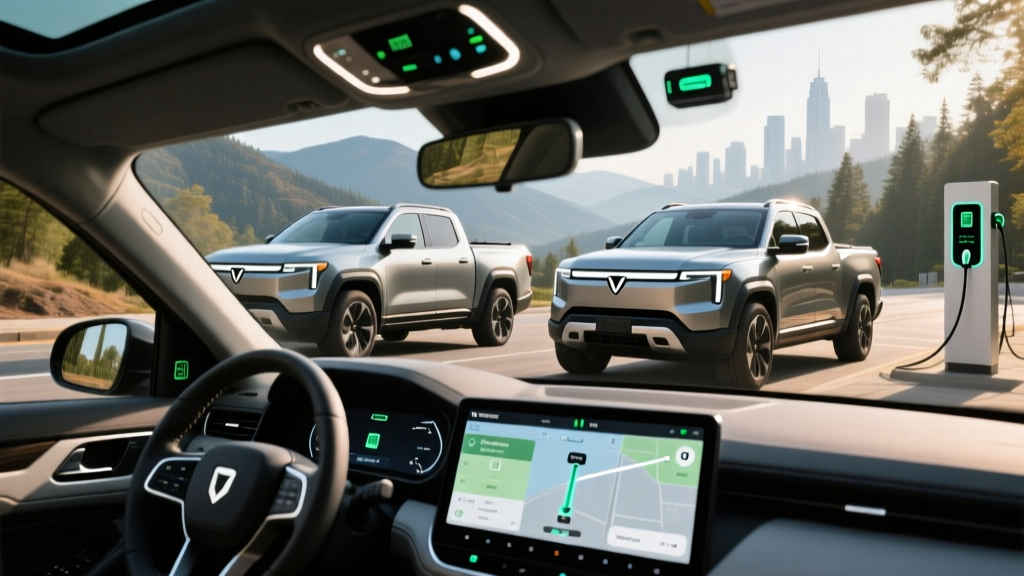
Both vehicles feature Rivian's 15.6-inch central touchscreen with integrated navigation, over-the-air updates, and the new Autonomy visualization display that shows detected vehicles, pedestrians, and lane markings in real time. Wireless Apple CarPlay and Android Auto are standard.
Pros, Cons, and the Verdict
✅ Pros
- Class-leading off-road capability with 14.9 inches of ground clearance and quad-motor torque vectoring (on Tri/Quad trims)
- 352-mile EPA range on Max Battery is among the best in the EV truck segment
- Gear Tunnel and frunk offer uniquely practical storage
- Over-the-air updates continuously improve the vehicle post-purchase
- Strong build quality and premium interior materials
- 11,000-lb towing capacity (R1T) is genuinely useful
❌ Cons
- Max Battery trims exceed $80K MSRP cap — no federal tax credit
- Efficiency is mediocre (46–49 kWh/100 mi) — these are heavy vehicles
- DC fast charging peaks at 220 kW but tapers early; 34 min 10–80% trails Hyundai/Kia's 800V platforms
- R1S third row is tight for adults on longer trips
- Service center network is still expanding — rural owners may face long tow distances for repairs
- Driver-assist system (Level 2) is capable but not class-leading vs. GM Super Cruise on mapped highways
Who Should Buy the 2026 Rivian R1T / R1S?
Choose the R1T if: You need a capable electric truck for weekend adventures, light-to-moderate towing, and want off-road chops that no other EV pickup currently matches. The Standard Battery Adventure trim is the sweet spot for value and potential tax-credit eligibility.
Choose the R1S if: You need three rows for family duty but refuse to drive a minivan, and you want genuine off-road capability for camping and trail driving. Plan your budget around the Standard Battery if the tax credit matters to you.
Look elsewhere if: Maximum highway range and the fastest DC charging are your top priorities (consider the Hyundai Ioniq 5 or Chevrolet Silverado EV), or if you need hands-free Level 2 driving on long highway commutes (GM's Super Cruise currently covers more mapped miles).
Battery Warranty and Long-Term Ownership
Rivian covers the R1T and R1S battery and drive unit with an 8-year / 175,000-mile warranty (whichever comes first), with a capacity retention threshold of 70%. This is one of the more generous mileage limits in the segment — Tesla's Model X covers 8 years / 150,000 miles at the same 70% threshold, while Ford's F-150 Lightning warranty is 8 years / 100,000 miles.
For context on degradation: NMC chemistry in a well-managed thermal system (which Rivian uses, with active liquid cooling and heating) typically loses 10–15% capacity over 150,000 miles of normal use. Following Rivian's recommended charge limits (85–90% daily, 100% only for trips) will help maximize longevity.
The basic vehicle warranty is 5 years / 60,000 miles. Rivian also includes 5 years of roadside assistance. According to NHTSA, the 2025 R1T received no major safety recalls, and IIHS testing is ongoing for the 2026 model year.
Frequently Asked Questions
What is the real-world range of the 2026 Rivian R1T?
The R1T with the Max Battery pack carries an EPA rating of 352 miles. In real-world highway driving at 70–75 mph, expect approximately 290–310 miles. In cold weather below freezing, plan for 240–270 miles. The Standard Battery R1T (EPA 270 mi) delivers roughly 220–240 miles on the highway.
How fast does the Rivian R1T charge at home and on the road?
At home on a Level 2 (240V, 48A) charger, the R1T charges at 11.5 kW, adding about 25 miles of range per hour — a full Max Battery charge takes roughly 12–14 hours overnight. On a DC fast charger, the Max Battery peaks at 220 kW and charges from 10–80% in approximately 34 minutes. The sustained average across that session is closer to 140 kW due to charge-curve taper.
Does the 2026 Rivian R1T qualify for the federal EV tax credit?
Only the Standard Battery Adventure trim (MSRP $69,900) falls under the IRS §30D $80,000 MSRP cap for trucks. Even then, eligibility depends on your modified adjusted gross income (under $300K joint / $150K single), battery-component sourcing, and critical-mineral requirements. The Max Battery trims ($82,400+) exceed the cap and do not qualify. Always confirm with a tax professional before purchase.
Is Rivian's driver-assist system self-driving?
No. Rivian's Enhanced Highway Assist is a SAE Level 2 driver-assistance system. It can manage steering, acceleration, and braking on divided highways, but the driver must remain fully attentive, keep hands on the wheel, and be ready to take over at any time. It is not autonomous driving. Only Level 4 robotaxi services like Waymo operate without a human driver.
How does the Rivian R1T compare to the Ford F-150 Lightning and Tesla Cybertruck?
The R1T is the most off-road-capable of the three, with superior ground clearance and approach/departure angles. The F-150 Lightning offers a larger bed (67 inches vs. 54 inches) and more traditional truck utility. The Cybertruck has faster peak DC charging and a stainless-steel exoskeleton, but polarizing styling and limited service infrastructure. For efficiency and daily commuting, none of these trucks are ideal — they're heavy, and their kWh/100mi figures reflect that.
What did Rivian announce at its Autonomy and AI Day?
Rivian revealed its proprietary Autonomy Platform (RAP) with over 1,000 TOPS of compute, an Enhanced Highway Assist system with on-ramp-to-off-ramp capability (Level 2), an off-road autonomy preview still in testing, and AI-driven battery management that personalizes thermal preconditioning. These features are rolling out via over-the-air updates to 2025 and 2026 models equipped with the new hardware suite.