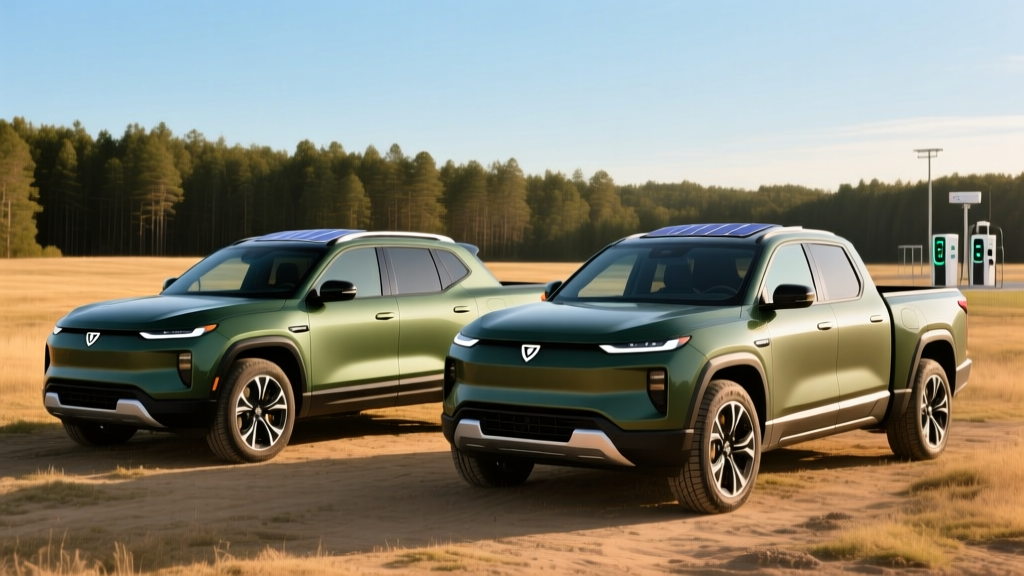
If you've been watching the electric-vehicle space, you've likely asked: how does Rivian Automotive work as a company, and more importantly, do its vehicles actually deliver for daily drivers and adventurers alike? Founded in 2009 by MIT engineer RJ Scaringe, Rivian has carved out a distinct niche in the EV market by building electric adventure vehicles — specifically the R1S three-row SUV and the R1T pickup truck — that prioritize off-road capability, software innovation, and a direct-to-consumer sales model.
Unlike legacy automakers that sell through franchised dealerships, Rivian sells directly to buyers online, similar to Tesla. Vehicles are built at the company's manufacturing plant in Normal, Illinois, and delivered to customers through Rivian's own delivery centers or via at-home delivery in select metro areas. Service is handled through a mix of mobile service vans, Rivian Service Centers, and a growing network of third-party collision repair partners.
But understanding how Rivian works as a business is only half the equation. The real question for buyers is whether the R1S and R1T deliver on range, charging, performance, and value. Let's break down every spec that matters.
Rivian R1S and R1T: Core Specifications at a Glance
| Spec | 2026 R1S (Dual-Motor AWD, Standard Battery) | 2026 R1T (Dual-Motor AWD, Standard Battery) |
|---|---|---|
| EPA Range | 270 miles | 270 miles |
| Battery Capacity | ~106 kWh usable (NMC) | ~106 kWh usable (NMC) |
| Max DC Fast Charge | 200 kW peak | 200 kW peak |
| 10–80% DCFC Time | ~30 minutes | ~30 minutes |
| Level 2 Home Charging | 11.5 kW (~25 mi/hr) | 11.5 kW (~25 mi/hr) |
| 0–60 mph | 4.5 seconds | 4.5 seconds |
| Horsepower | 533 hp | 533 hp |
| Drivetrain | Dual-Motor AWD | Dual-Motor AWD |
| MPGe (Combined) | 73 MPGe | 73 MPGe |
| Base MSRP | $75,900 | $69,900 |
| Battery Warranty | 8 yr / 175,000 mi | 8 yr / 175,000 mi |
Note: Specs reflect the current Dual-Motor Standard configuration. Tri-Motor and Max Battery variants offer different performance and range figures. Always verify with Rivian's official configurator before ordering.
Real-World Range: What the EPA Number Doesn't Tell You
The Dual-Motor Standard R1S and R1T carry an EPA-estimated 270 miles of range. In real-world mixed driving, expect approximately 230–250 miles under normal conditions. Sustained highway driving at 75+ mph can reduce that to roughly 210–230 miles. In cold weather (below 30°F), plan for a 15–25% reduction, putting effective range closer to 200–220 miles without preconditioning. Source: fueleconomy.gov
Rivian offers multiple battery and motor configurations that dramatically alter range. The available Max Battery pack (approximately 149 kWh usable, NMC chemistry) pushes the R1S to an EPA-estimated 410 miles and the R1T to approximately 390 miles in Dual-Motor configuration. However, the Max Battery adds significant weight and cost — roughly $10,000–$12,000 depending on configuration — and extends charging times.
The Tri-Motor performance variant sacrifices some range for acceleration, dropping to around 320 miles EPA with the Max pack but delivering a claimed 0–60 mph time under 3.0 seconds. For most buyers, the Standard Battery Dual-Motor configuration offers the best balance of price, weight, and adequate range for daily use and moderate road trips.
Rivian's thermal management system includes a heat pump for cabin heating, which helps mitigate cold-weather range loss compared to resistive heating systems. Preconditioning the battery — warming it before arriving at a DC fast charger — is essential for achieving peak charge rates in cold conditions. The Rivian app and navigation system handle this automatically when a Supercharger or compatible DCFC station is set as your destination.
Charging Speed: DC Fast Charging and Home Level 2
Charging speed is where Rivian's architecture shows both strengths and limitations relative to competitors like Hyundai's E-GMP platform (which supports 350 kW peak charging).
| Charging Level | Power / Rate | Time / Range Added |
|---|---|---|
| Level 1 (120V household) | ~1.4 kW | ~3 miles per hour |
| Level 2 (240V home, 48A) | 11.5 kW | ~25 miles per hour; full charge in ~10 hours |
| DC Fast Charge (Standard Battery) | 200 kW peak | 10–80% in ~30 minutes |
| DC Fast Charge (Max Battery) | 200 kW peak | 10–80% in ~42 minutes |
The 200 kW peak DC fast-charge rate applies to the Standard Battery pack. The charge curve is relatively flat between 10% and 50% state of charge, then tapers progressively above 80%. This is standard behavior for NMC lithium-ion cells — charging above 80% at high rates accelerates degradation, so Rivian's battery management system intentionally slows the rate to protect long-term cell health.
For home charging, Rivian recommends installing a Level 2 wall connector on a 60-amp circuit (delivering 48 amps continuous to the vehicle). At 11.5 kW, you'll add roughly 25 miles of range per hour, meaning a depleted Standard Battery pack charges fully overnight in approximately 10 hours. Home installation costs typically range from $800 to $2,500 depending on panel capacity, conduit run length, and local permitting requirements — always get a quote from a licensed electrician before committing.
One notable advantage: Rivian vehicles are equipped with NACS (North American Charging Standard) ports on current models, granting native access to Tesla's Supercharger network without an adapter. This significantly expands the available DC fast-charging footprint for road trips, especially in rural areas where Electrify America and EVgo coverage can be sparse.
Performance, Drivetrain, and Off-Road Capability
The Dual-Motor AWD configuration uses one electric motor per axle, delivering 533 horsepower and 610 lb-ft of torque in the Standard Battery setup. The 0–60 mph time of 4.5 seconds is brisk for a vehicle weighing over 6,800 pounds (R1S) or 6,600 pounds (R1T). The Tri-Motor variant adds a third motor to the rear axle, pushing output above 850 horsepower and dropping the 0–60 time to under 3 seconds in Performance mode.
Rivian's quad-motor configuration (available on select trims) enables true torque vectoring at each wheel — a feature that improves both on-road handling precision and off-road traction. The air suspension system offers adjustable ride height with up to 14.4 inches of ground clearance in Off-Road mode, rivaling dedicated off-road SUVs like the Jeep Wrangler Rubicon and Land Rover Defender.
Towing capacity is a key differentiator, especially for the R1T. The R1T is rated to tow up to 11,000 pounds, while the R1S is rated for 7,700 pounds. However, towing at maximum capacity will dramatically reduce range — expect a 40–50% reduction when towing near the limit at highway speeds. This is a physics reality for all EVs, not unique to Rivian, but it's critical to plan for if you intend to tow frequently.
Pricing, Trims, and Federal Tax Credit Eligibility
Rivian's pricing has shifted multiple times since launch, and the 2026 model year reflects a more streamlined trim structure. Here's what buyers should budget for:
| Configuration | R1S MSRP | R1T MSRP |
|---|---|---|
| Dual-Motor, Standard Battery | $75,900 | $69,900 |
| Dual-Motor, Max Battery | $85,900 | $79,900 |
| Tri-Motor, Max Battery | $99,900 | $93,900 |
Destination fees, paint upgrades ($1,500–$2,500), and adventure packages (all-terrain tires, reinforced underbody) can add $3,000–$8,000 to the as-tested price.
Does Rivian Qualify for the Federal EV Tax Credit?
This is where Rivian buyers need to pay close attention. Under the IRS §30D Clean Vehicle Credit rules:
- MSRP Cap: SUVs (R1S) must have an MSRP at or below $80,000. Pickup trucks (R1T) must be at or below $80,000. This means the R1S Dual-Motor Standard at $75,900 qualifies, but the R1S Dual-Motor Max Battery at $85,900 does not.
- Buyer Income Cap: Modified adjusted gross income (MAGI) must not exceed $300,000 (joint filers), $225,000 (head of household), or $150,000 (single filers).
- Battery Sourcing: A percentage of critical minerals and battery components must be sourced from the U.S. or free-trade-agreement countries. These thresholds tighten annually. Rivian has worked to localize its supply chain, but eligibility for the full $7,500 credit versus a partial $3,750 credit can vary by build date and battery batch.
- Point-of-Sale Transfer: As of 2024, buyers can elect to transfer the credit to the dealer (Rivian) at the point of sale, reducing the purchase price upfront rather than waiting for a tax refund.
Because battery-sourcing requirements are complex and change annually, always verify your specific vehicle's eligibility on the fueleconomy.gov tax credit lookup tool and consult a tax professional before relying on the credit in your budget.
Interior Space, Cargo, and Practicality
The R1S is a genuine three-row SUV, though the third row is best suited for children or occasional adult use on short trips. Cargo capacity behind the third row is approximately 10.4 cubic feet, expanding to 46.7 cu ft with the third row folded, and 91.6 cu ft with both rear rows folded flat.
The R1T pickup offers a 4.5-foot bed (shorter than a full-size truck) with a unique feature: the Gear Tunnel, a lockable, pass-through storage compartment that runs horizontally behind the rear seats. It offers approximately 11 cubic feet of secure, weather-sealed storage — ideal for camping gear, skis, or tools. The R1T also features a front trunk (frunk) with roughly 11 cu ft of space, adding practical utility that gas trucks cannot match.
Front-seat legroom is generous at 41.3 inches in both vehicles. Second-row legroom measures 38.2 inches in the R1S and 37.3 inches in the R1T. Interior materials are premium vegan leather and sustainable wood trim, consistent with Rivian's brand positioning.
Tech, Software, and Driver Assistance
Rivian runs its vehicles on a proprietary software stack that receives regular over-the-air (OTA) updates — adding features, refining performance, and occasionally unlocking new drive modes. The 15.6-inch center touchscreen handles navigation, media, climate, and vehicle settings, while a 12.3-inch digital driver display shows speed, range, and ADAS information.
The infotainment system supports wireless Apple CarPlay and Android Auto, integrated navigation with real-time charging station routing, and a built-in Wi-Fi hotspot. One standout feature is the Rivian Waypoints system, which curates adventure routes and camping destinations with community reviews — a reflection of the brand's outdoor-adventure positioning.
Rivian's driver-assistance suite, branded as Driver+, includes adaptive cruise control, lane-centering assist, automatic emergency braking, blind-spot monitoring, and highway assist. This is an SAE Level 2 system — the driver must remain fully engaged, keep hands on the wheel (or demonstrate attention), and supervise at all times. It is not self-driving. Rivian has discussed future Level 3+ capabilities, but as of 2026, no hands-free or eyes-off system is available on Rivian vehicles.
Notable tech drawbacks: The lack of Apple CarPlay in earlier model years frustrated some buyers, though wireless CarPlay has since been added via OTA. The Rivian mobile app, while feature-rich (remote climate control, charging status, vehicle location), has drawn mixed reviews for occasional connectivity lag compared to Tesla's app responsiveness.
Warranty and Long-Term Ownership
Rivian provides one of the more competitive battery warranties in the EV segment:
- Battery & Drive Unit: 8 years / 175,000 miles (whichever comes first), with a capacity retention threshold of 70%.
- Limited Vehicle Warranty: 5 years / 60,000 miles bumper-to-bumper.
- Corrosion Warranty: 5 years / unlimited miles.
The 175,000-mile battery warranty exceeds the industry-standard 100,000 miles offered by many competitors, which is a meaningful signal of confidence in the NMC cell pack's longevity. Real-world degradation data for Rivian's packs is still maturing (the first R1T deliveries occurred in late 2021), but early owner reports suggest degradation in line with industry norms — approximately 5–8% capacity loss over the first 50,000 miles, after which the curve flattens.
Service access remains a consideration. Rivian's service network is expanding but is not yet as dense as legacy automaker dealer networks. Mobile service handles many software-related and minor hardware issues, but major repairs may require a visit to a Rivian Service Center, which could mean a significant drive for owners in rural areas.
Pros, Cons, and the Verdict
Pros
- Genuine off-road capability with air suspension and 14.4" ground clearance
- NACS port provides native Supercharger access
- Class-leading 11,000-lb towing (R1T)
- Over-the-air updates continuously improve the vehicle
- 8-year/175,000-mile battery warranty
- Gear Tunnel storage (R1T) is uniquely practical
Cons
- 200 kW peak DCFC is slower than Hyundai/Kia's 350 kW
- R1S third row is cramped for adults
- Service network still growing — limited in rural areas
- High starting price; tax credit eligibility is trim-dependent
- Towing dramatically cuts range (40–50% loss at max load)
- Insurance premiums tend to be above segment average
Who Should Buy a Rivian — and Who Should Look Elsewhere?
- You need a three-row electric SUV (R1S) or an electric pickup (R1T) with genuine off-road chops
- You value adventure-oriented features like the Gear Tunnel, air suspension, and curated adventure navigation
- You want native Tesla Supercharger access for road-trip charging
- You can install Level 2 home charging and don't rely solely on public infrastructure
- You need maximum DC fast-charging speed (consider Hyundai Ioniq 5 or Kia EV6 at 350 kW)
- You're on a tighter budget and need a sub-$50,000 EV (consider Chevy Equinox EV or Tesla Model Y)
- You need a full-size truck bed for work (the R1T's 4.5-foot bed is shorter than standard pickups)
- You live far from a Rivian Service Center and cannot tolerate potential service delays
Frequently Asked Questions
What is the real-world range of Rivian's R1S and R1T?
The EPA-estimated range for the Dual-Motor Standard Battery is 270 miles. Real-world mixed driving typically yields 230–250 miles, dropping to 210–230 miles on sustained highway trips and 200–220 miles in cold weather below 30°F. The available Max Battery pack extends EPA range to approximately 390–410 miles depending on configuration.
How fast does a Rivian charge at home and on the road?
At home on a Level 2 (240V, 48A) charger, Rivian vehicles charge at 11.5 kW, adding roughly 25 miles of range per hour — a full charge takes about 10 hours. On DC fast chargers, the Standard Battery peaks at 200 kW, reaching 10–80% in approximately 30 minutes. The Max Battery takes roughly 42 minutes for the same 10–80% session due to its larger capacity.
How much does a Rivian cost after the federal tax credit?
The R1T Dual-Motor Standard starts at $69,900 and the R1S at $75,900. If you qualify for the full $7,500 §30D credit (meeting income, MSRP, and battery-sourcing requirements), the effective price drops to approximately $62,400 (R1T) and $68,400 (R1S). Higher trims exceeding the $80,000 MSRP cap for SUVs do not qualify. Always verify eligibility on fueleconomy.gov and with a tax professional.
Is Rivian worth buying versus the Tesla Model X, Ford F-150 Lightning, or Hyundai Ioniq 9?
Rivian excels for buyers who prioritize off-road capability, adventure features, and a premium-but-rugged aesthetic. The Tesla Model X offers more range and faster charging but less ground clearance and no truck bed. The Ford F-150 Lightning provides a larger bed and lower price but less refinement and a CCS port (requiring an adapter for Superchargers). The choice depends on whether adventure capability or pure efficiency/price is your priority.
Does Rivian's battery use LFP or NMC chemistry?
Rivian currently uses NMC (nickel manganese cobalt) lithium-ion cells in its Standard and Max Battery packs. NMC offers higher energy density than LFP (lithium iron phosphate), which is important for fitting sufficient range into the vehicle's footprint. The trade-off is that NMC cells are more sensitive to sustained high state-of-charge storage — Rivian recommends daily charging to 80–90% and only charging to 100% before long trips.
How does Rivian handle service and maintenance?
Rivian operates a hybrid service model: mobile service vans handle many repairs at your home or workplace, while Rivian Service Centers manage more complex hardware work. The company also partners with certified collision repair centers. There are no traditional dealerships. Service appointment availability varies by region, and wait times can be longer in areas without a nearby Service Center.