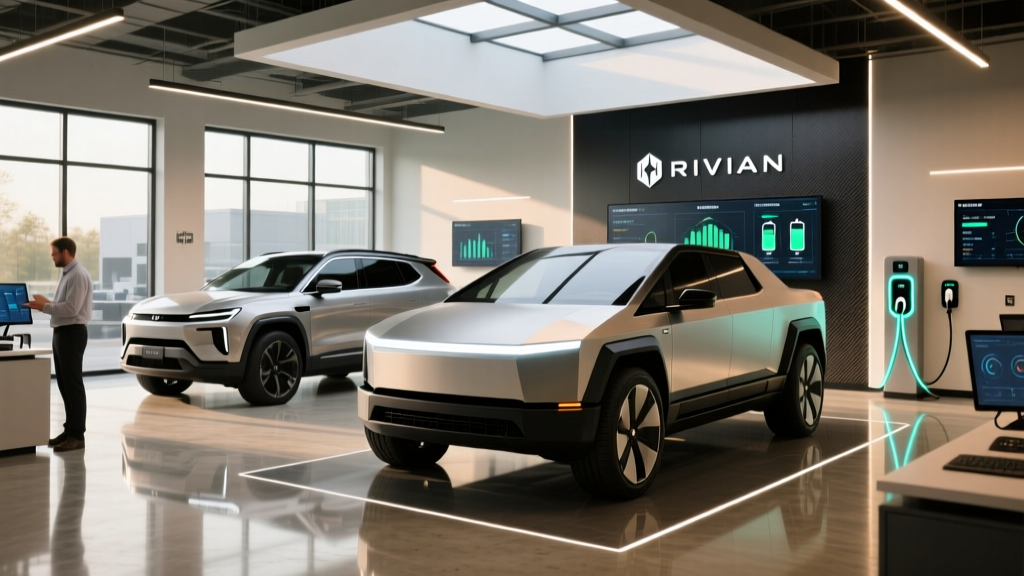
Rivian's decision to plant its regional headquarters in Atlanta isn't just a corporate real estate move — it's a signal. The Southeast is now one of the fastest-growing EV adoption corridors in the country, and Rivian is positioning itself to serve it directly. For shoppers in Georgia, the Carolinas, and Florida who've been watching the R1T pickup and R1S SUV from a distance, the Atlanta hub means faster service access, more demo drives, and a growing Supercharger-adjacent charging footprint via the Rivian Adventure Network.
But the real question for buyers isn't where Rivian's office is — it's whether the 2026 R1T and R1S deliver on range, charging speed, and value. Let's break down the numbers.
2026 Rivian R1T & R1S: Quick Spec Snapshot
Rivian offers both the R1T (truck) and R1S (three-row SUV) on the same Gen 2 platform. Here's how the key configurations stack up for the current model year:
| Spec | Dual-Motor (Standard) | Performance Dual-Motor | Tri-Motor |
|---|---|---|---|
| Battery (usable) | 92 kWh (LFP) | 109 kWh (NMC) | 141 kWh (NMC Max Pack) |
| EPA Range (R1T) | 270 mi | 352 mi | 420 mi |
| EPA Range (R1S) | 260 mi | 340 mi | 400 mi |
| Horsepower | 533 hp | 665 hp | 850 hp |
| 0-60 mph (R1T) | 4.5 sec | 3.4 sec | 2.9 sec |
| Drivetrain | AWD (dual-motor) | AWD (dual-motor) | AWD (tri-motor) |
| Max DC Fast Charge | 200 kW | 220 kW | 220 kW |
| 10-80% DCFC Time | ~30 min | ~28 min | ~42 min |
| Level 2 Home Rate | 11.5 kW (~25 mi/hr) | 11.5 kW (~25 mi/hr) | 11.5 kW (~25 mi/hr) |
| Towing Capacity | 11,000 lbs | 11,000 lbs | 11,000 lbs |
Source: Rivian R1T specs, fueleconomy.gov
Real-World Range: What the EPA Sticker Doesn't Tell You
EPA estimate: 270–420 mi (R1T), depending on pack and motor config.
Real-world highway (70-75 mph): Expect 220–350 mi. The boxy truck/SUV aero profile penalizes efficiency at speed.
Cold weather (below 32°F): Subtract 20-30%. A 352-mi Dual-Motor Large Pack may deliver 250–280 mi in a Georgia winter morning, and considerably less in mountain drives through North Carolina or Tennessee.
Towing: Halve it. Towing a 5,000-lb trailer at highway speed will drop effective range to roughly 140–180 mi regardless of pack size.
Rivian's LFP Standard pack is the value play — it's heavier, slightly less energy-dense, but far more durable over thousands of cycles. The NMC Large and Max packs give you the range most buyers actually want, though the Max Pack's 141 kWh comes with a weight penalty you'll feel in cornering and efficiency (roughly 2.0–2.2 kWh/mi on the highway vs. 1.8 for the Standard).
Efficiency on the EPA combined cycle lands around 73–79 MPGe depending on configuration, or roughly 42–48 kWh per 100 miles. That's thirstier than a Tesla Model Y or Hyundai Ioniq 5 — the trade-off for a 6,000+ lb adventure vehicle with genuine off-road and towing chops.
Charging Speed: DC Fast, Home, and the Adventure Network
Charging is where Rivian has made meaningful Gen 2 gains, though it still trails Hyundai/Kia's 800V architecture in peak speed.
| Level | Power | Miles Added per Hour | Notes |
|---|---|---|---|
| Level 1 (120V) | ~1.4 kW | ~3 mi/hr | Emergency/trickle only |
| Level 2 (240V, 48A) | 11.5 kW | ~25 mi/hr | Full charge overnight (~10 hrs for Large Pack) |
| DC Fast Charge | 200–220 kW peak | ~700+ mi/hr (at peak) | 10-80% in 28-42 min; tapers sharply above 80% |
A few practical notes from real-world charging:
- Preconditioning matters. Use the Rivian app to precondition the battery 15–20 minutes before arriving at a DC fast charger. Skip this in cold weather and your peak rate may be half of what's listed above.
- The charge curve tapers hard. You'll see 220 kW briefly in the 10–30% state-of-charge window on the Large Pack, then it steps down. The 10–80% time is the number that matters, not the peak kW headline.
- NACS native. All 2026 Rivians ship with the Tesla NACS port, giving direct access to the Tesla Supercharger network without an adapter — a significant advantage over CCS-equipped competitors in the Southeast, where Supercharger density is high.
- Rivian Adventure Network chargers are strategically placed near trails, parks, and overlanding routes — relevant if your use case involves the Blue Ridge or the Okefenokee.
Performance and Drivetrain: More Than a Lifestyle Truck
The Dual-Motor R1T's 4.5-second 0-60 time is genuinely quick for a body-on-frame-ish truck (it's actually a unibody skateboard platform). The Tri-Motor's 2.9 seconds is supercar territory, though the 7,000+ lb curb weight means you feel the physics in braking distances and tire wear.
All configurations are AWD with individual motor torque vectoring. The quad-motor configuration from early model years has been replaced by the more efficient Tri-Motor setup, which uses a rear axle with two motors and a single front motor.
Off-road, the air suspension gives 14.9 inches of ground clearance in Max mode, with approach/departure/breakover angles that rival a Jeep Gladiator. Water fording is rated at 3+ feet. This isn't a mall-crawler pretending to be rugged.
Pricing, Trims, and the Federal Tax Credit Reality
Here's where the rubber meets the road — and where the Atlanta HQ's presence in Georgia (a state without a meaningful EV rebate) makes the federal credit even more important.
| Configuration | Base MSRP | §30D Federal Credit | Effective Price (if eligible) |
|---|---|---|---|
| R1T Dual-Motor (Standard Pack, LFP) | $69,900 | Up to $7,500* | ~$62,400 |
| R1T Dual-Motor (Large Pack, NMC) | $75,900 | Up to $7,500* | ~$68,400 |
| R1T Tri-Motor (Max Pack, NMC) | $99,900 | $0 (over MSRP cap) | $99,900 |
| R1S Dual-Motor (Standard Pack) | $74,900 | Up to $7,500* | ~$67,400 |
| R1S Tri-Motor (Max Pack) | $104,900 | $0 (over MSRP cap) | $104,900 |
*Per IRS §30D rules, eligibility requires:
- MSRP cap: Vans/SUVs/pickups must be under $80,000. The Tri-Motor configs exceed this.
- Income cap: AGI ≤ $150K single / $300K joint.
- Battery sourcing: Critical minerals and battery component requirements phase in annually — verify current-year compliance on the IRS qualified vehicle list before purchasing.
- Point-of-sale transfer: You can apply the credit at purchase rather than waiting for tax filing, reducing your out-of-pocket immediately.
The Standard Pack LFP configuration is the credit-eligibility sweet spot — it's the most likely to clear sourcing requirements and stays well under the MSRP cap.
Cargo, Passenger Space, and Daily Livability
R1T (truck):
- Bed: 4'6" (54" long) — shorter than a traditional short-bed truck, but the Gear Tunnel (11 cu ft lockable pass-through behind the cab) is a Rivian exclusive that swallows golf bags, camping gear, or groceries.
- Frunk: 11 cu ft (front trunk, drainable — doubles as a cooler).
- Rear seat legroom: 38.4 inches — adequate for adults, not class-leading.
R1S (SUV):
- Cargo behind 3rd row: 10.6 cu ft
- Cargo behind 2nd row: 46.7 cu ft
- Cargo behind 1st row (max): 104.7 cu ft
- Third-row legroom: 30.3 inches — best for children on short trips
Both vehicles have the Rivian OS infotainment system on a 15.6" center display, with native route planning that accounts for charging stops, elevation, and weather. The Driver+ assistance suite is SAE Level 2 (hands-on-wheel, eyes-on-road) — it's competent highway assist, not autonomous driving. Expect lane centering, adaptive cruise, and automatic lane changes on divided highways, but you remain the driver at all times.
Warranty and Long-Term Ownership
- Battery: 8 years / 175,000 miles (≥70% capacity retention)
- Powertrain: 8 years / 175,000 miles
- Bumper-to-bumper: 5 years / 60,000 miles
- Roadside assistance: 5 years / unlimited miles
The 175,000-mile battery warranty is among the best in the segment (Tesla covers 8yr/150K on Model X). LFP packs in the Standard configuration are expected to outlast NMC in cycle life, though Rivian has not published specific degradation curves.
For Atlanta-area buyers, Rivian's growing service footprint in Georgia (including mobile service vans for software-related issues and minor hardware) reduces the "nearest service center is 200 miles away" concern that plagued early adopters in the Southeast.
Pros, Cons, and Who Should Buy
- Class-leading off-road capability with 14.9" ground clearance
- Gear Tunnel and frunk add genuinely useful storage
- Native NACS port = direct Supercharger access
- 11,000-lb towing (best in EV truck segment)
- LFP option for longevity-focused buyers
- Strong battery warranty (175K miles)
- Highway efficiency lags sleeker EVs — range drops at 75+ mph
- Tri-Motor trims ineligible for §30D credit (over $80K MSRP cap)
- 3rd row in R1S is tight for adults
- Rear bed is only 4'6" — shorter than most truck buyers expect
- Premium pricing vs. Chevy Silverado EV or Ford F-150 Lightning
- Service network still expanding in the Deep South
Buy the R1T if: You need a truck that tows, off-roads, and daily-drives without compromise — and you're willing to pay a premium over a Lightning or Silverado EV for build quality and adventure features.
Buy the R1S if: You want a three-row family SUV with genuine off-road capability and don't need the third row for full-size adults daily.
Skip if: Your priority is max efficiency, lowest cost per mile, or you regularly haul four adults in the back seat (look at the Kia EV9 or Tesla Model X instead).
Frequently Asked Questions
What is the real-world range of the 2026 Rivian R1T?
The EPA rates the R1T Dual-Motor Large Pack at 352 miles. In real-world highway driving at 70-75 mph, expect 280–310 miles. In cold weather (below freezing), reduce that by 20-30%. Towing cuts range roughly in half regardless of pack size.
How fast does the Rivian R1T charge at home and on the road?
At home on a Level 2 (240V, 48A) charger, you'll add about 25 miles of range per hour — a full Large Pack charge takes roughly 10 hours overnight. On DC fast chargers, the Large Pack peaks at 220 kW and charges 10-80% in about 28 minutes when preconditioned. The Max Pack takes closer to 42 minutes due to its larger capacity.
Does the Rivian R1T qualify for the federal EV tax credit?
The Dual-Motor Standard and Large Pack configurations (under $80,000 MSRP) can qualify for up to $7,500 under IRS §30D, subject to buyer income limits ($300K joint AGI), battery sourcing requirements, and point-of-sale transfer availability. The Tri-Motor Max Pack configurations exceed the $80,000 MSRP cap for trucks/SUVs and do not qualify. Always verify current eligibility on the IRS qualified vehicles list before purchasing.
Is the Rivian R1T worth buying over the Ford F-150 Lightning or Chevy Silverado EV?
The R1T wins on off-road capability, build quality, and adventure-specific features (Gear Tunnel, air suspension, water fording). The F-150 Lightning wins on bed length, rear-seat space, and price (starting ~$15K lower). The Silverado EV offers the longest range (400+ mi on 4WT) and a larger bed. Choose Rivian if off-road and premium experience matter; choose Ford or Chevy if utility and budget lead your decision.
What does the Rivian Atlanta HQ mean for Southeast buyers?
Rivian's Atlanta regional hub expands service capacity, demo-drive availability, and Adventure Network charging infrastructure across Georgia, the Carolinas, and Florida. It signals long-term commitment to the region — important for buyers who previously worried about service access outside major coastal markets.