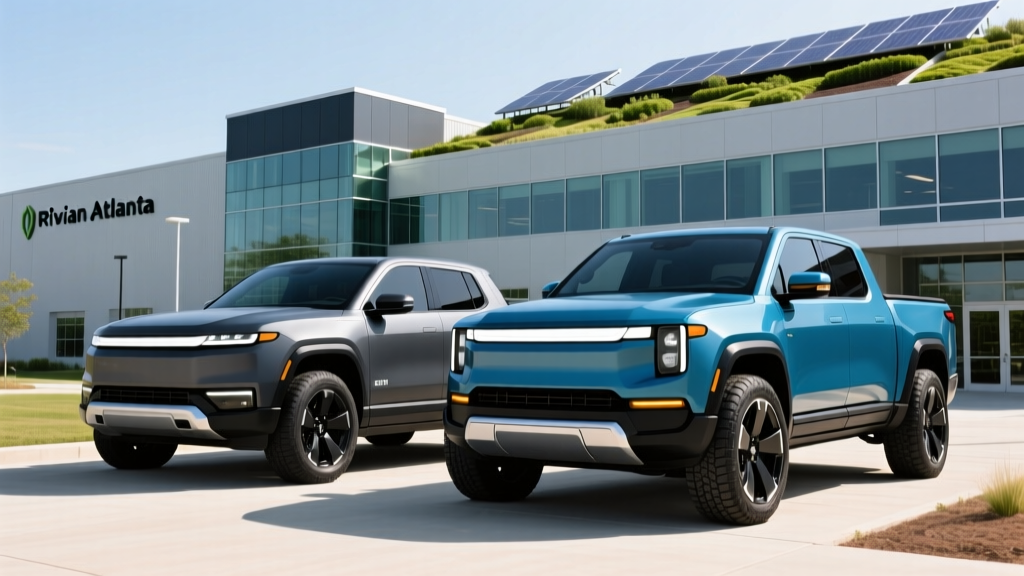
Rivian's decision to establish a major corporate presence in Atlanta, Georgia, is one of the most consequential moves in the American EV startup space. The Rivian Atlanta HQ plans — anchored by a multi-building campus in the city's tech corridor and closely tied to the company's broader Southeast manufacturing strategy — signal that Rivian is no longer a niche adventure-brand. It's scaling into a mainstream automaker with national service, delivery, and engineering ambitions.
But what does this corporate expansion actually mean for the vehicles you can buy today? The 2026 Rivian R1S (three-row SUV) and R1T (pickup truck) are the direct beneficiaries of Rivian's growing capital base, Georgia-backed incentives, and expanded R&D headcount. Below, we break down everything you need to know about the current-generation R1S and R1T — range, charging, pricing, tax credits, and ownership reality — through the lens of Rivian's Atlanta-driven growth story.
Rivian's Atlanta Footprint: Why It Matters for EV Buyers
Rivian's Atlanta operations serve multiple strategic functions. The campus houses software engineering teams, fleet operations management (critical for Rivian's Amazon EDV delivery van contract), and regional service/delivery coordination for the Southeast. While Rivian's primary vehicle assembly remains at its Normal, Illinois factory, the Atlanta presence reflects a company investing in long-term infrastructure rather than short-term hype.
For buyers, this matters in three concrete ways:
- Service network expansion: More Southeast service centers and mobile service technicians, reducing the "nearest service center is 400 miles away" problem that plagued early Rivian owners.
- Software development velocity: Atlanta-based engineering teams contribute to Rivian's over-the-air (OTA) update pipeline, which has been one of the brand's strongest ownership perks.
- Future production capacity: Georgia's EV manufacturing incentives and Rivian's Southeast footprint keep the door open for a second assembly plant — a prerequisite for the upcoming, more affordable R2 and R3 models.
2026 Rivian R1S & R1T: Core Specifications at a Glance
The 2026 model year brings incremental but meaningful updates to the second-generation R1 platform (introduced for MY2025). Both the R1S and R1T share the same skateboard architecture, battery options, and powertrain configurations. Here's the full spec breakdown:
| Specification | R1S Dual-Motor (Standard) | R1S Tri-Motor | R1T Dual-Motor (Standard) | R1T Tri-Motor |
|---|---|---|---|---|
| EPA Range (Max Pack) | 352 miles | 320 miles | 342 miles | 315 miles |
| Battery (Max Pack) | ~141 kWh usable, NMC | ~141 kWh usable, NMC | ~141 kWh usable, NMC | ~141 kWh usable, NMC |
| Battery (Standard Pack) | ~92 kWh usable, LFP | N/A | ~92 kWh usable, LFP | N/A |
| Horsepower | 533 hp | 850+ hp | 533 hp | 850+ hp |
| 0-60 mph | 4.5 sec | ~2.9 sec | 4.5 sec | ~3.0 sec |
| Drivetrain | Dual-Motor AWD | Tri-Motor AWD | Dual-Motor AWD | Tri-Motor AWD |
| Max DC Fast Charge | 220 kW | 220 kW | 220 kW | 220 kW |
| 10-80% DCFC Time | ~30 min | ~30 min | ~30 min | ~30 min |
| Level 2 Home Charging | 11.5 kW (~25 mi/hr) | 11.5 kW (~25 mi/hr) | 11.5 kW (~25 mi/hr) | 11.5 kW (~25 mi/hr) |
| MPGe (Combined) | 73 MPGe | 69 MPGe | 73 MPGe | 69 MPGe |
| Towing Capacity | 7,700 lbs | 7,700 lbs | 11,000 lbs | 11,000 lbs |
Source: fueleconomy.gov and Rivian official specifications. Figures reflect Max Pack configuration unless noted.
Real-World Range: What the EPA Sticker Doesn't Tell You
EPA Estimated: 352 miles
Real-World Highway (70-75 mph): ~280-300 miles
Real-World Cold Weather (below 32°F): ~230-260 miles
Real-World Towing (5,000 lb trailer): ~160-190 miles
The R1S and R1T are large, heavy, and boxy — all factors that work against highway efficiency. In mixed suburban driving at moderate speeds, you'll see numbers close to the EPA rating. But sustained highway travel at 75+ mph, especially in the R1T with its open bed creating aerodynamic drag, will pull range down by 15-20%.
Cold weather compounds this. Rivian's heat pump system (standard on second-gen models) mitigates cabin heating energy draw, but battery chemistry itself loses efficiency in freezing temperatures. Expect a 25-30% range reduction in sustained sub-freezing conditions — consistent with most NMC-based EVs in this class. The LFP Standard Pack battery is slightly more resilient to cold-weather degradation over time, though LFP's lower energy density means you start with fewer total miles.
If you regularly tow — a core R1T use case — plan your charging stops around a 170-mile effective range. This is the single biggest ownership adjustment for truck buyers coming from a diesel F-250 or Silverado.
Charging Speed and Infrastructure: The NACS Advantage
Second-generation Rivians ship with the NACS (North American Charging Standard) port natively, meaning direct access to Tesla's Supercharger network — the most reliable and geographically comprehensive DC fast-charging network in the U.S. This was a pivotal decision and one of Rivian's strongest competitive advantages over CCS-equipped rivals that still rely on adapters.
| Charging Level | Power (kW) | Speed (miles of range added per hour) | Use Case |
|---|---|---|---|
| Level 1 (120V household) | 1.4 kW | ~3-4 mi/hr | Emergency / overnight trickle |
| Level 2 (240V home, 48A) | 11.5 kW | ~25 mi/hr | Daily home charging (full overnight) |
| DC Fast Charge (peak) | 220 kW | ~700+ mi/hr (peak) | Road trips, 10-80% in ~30 min |
| DC Fast Charge (sustained avg.) | ~150 kW avg | ~480 mi/hr (avg) | Real-world average across session |
A critical note on the charge curve: Rivian's 220 kW peak rate applies only between roughly 10-40% State of Charge (SoC). Above 60%, the rate tapers significantly — by 80% SoC, you're typically seeing 50-70 kW. This is normal for NMC lithium-ion chemistry, which requires careful current management at higher SoC to protect cell longevity. Plan road-trip stops around the 10-80% window; charging from 80-100% can add 25+ minutes for relatively few miles.
For home charging, Rivian's Wall Charger delivers up to 11.5 kW on a 60A circuit (48A continuous). Most owners with a Standard Pack (~92 kWh) will achieve a full charge in 8-9 hours. Max Pack owners (~141 kWh) need 12-14 hours from near-empty — fine for overnight use, but worth understanding if you deplete the pack on a long trip and need a quick turnaround.
Pricing, Trims, and Federal Tax Credit Eligibility
Rivian positions the R1S and R1T as premium adventure vehicles, and pricing reflects that. However, the company has simplified its trim structure for 2026, reducing the confusing option matrix of earlier model years.
| Model / Configuration | Base MSRP | As-Tested (Typical) | §30D Federal Credit Eligibility |
|---|---|---|---|
| R1S Dual-Motor (Standard Pack) | $75,900 | $79,000-$83,000 | Eligible — up to $7,500* |
| R1S Dual-Motor (Max Pack) | $84,900 | $89,000-$95,000 | Eligible — up to $7,500* |
| R1S Tri-Motor (Max Pack) | $99,900 | $105,000+ | NOT eligible (exceeds $80K SUV cap) |
| R1T Dual-Motor (Standard Pack) | $69,900 | $73,000-$78,000 | Eligible — up to $7,500* |
| R1T Dual-Motor (Max Pack) | $78,900 | $83,000-$88,000 | Eligible — up to $7,500* |
| R1T Tri-Motor (Max Pack) | $94,900 | $100,000+ | NOT eligible (exceeds $80K truck cap) |
*Federal tax credit eligibility under IRS §30D is subject to multiple requirements:
- MSRP caps: $80,000 for SUVs and vans (R1S); $80,000 for pickup trucks (R1T). Tri-Motor trims exceed these limits.
- Buyer income caps: Modified AGI ≤ $300,000 (joint), $225,000 (head of household), $150,000 (single).
- Battery sourcing: Critical minerals and battery components must meet escalating domestic-content thresholds. Rivian has worked to qualify its supply chain, but verify current-year compliance at the point of sale.
- Point-of-sale transfer: As of 2024+, you can transfer the credit to the dealer at purchase, reducing your out-of-pocket cost directly — no need to wait for tax filing.
Always confirm eligibility with your tax professional and the dealer at the time of purchase. Rules can shift with regulatory guidance.
Cargo, Passenger Space, and Practicality
The R1S is a genuine three-row SUV, though the third row is best suited for children or occasional adult use on short trips. The R1T is a crew-cab pickup with a 4.5-foot bed (shorter than a traditional half-ton truck) but compensates with the innovative Gear Tunnel — a lockable, pass-through storage compartment behind the rear seats.
| Dimension | R1S (SUV) | R1T (Truck) |
|---|---|---|
| Front Legroom | 41.3 in | 41.3 in |
| Second-Row Legroom | 39.5 in | 39.5 in |
| Third-Row Legroom | 30.3 in | N/A |
| Cargo (behind 3rd row) | 10.7 cu ft | N/A |
| Cargo (behind 2nd row) | 46.7 cu ft | N/A |
| Cargo (max, seats folded) | 91.6 cu ft | N/A |
| Bed Volume | N/A | ~32 cu ft (bed) + Gear Tunnel |
| Frunk | 11.0 cu ft | 11.0 cu ft |
The R1T's Gear Tunnel (11.7 cu ft of enclosed storage) is a genuinely unique feature — ideal for skis, camping gear, or groceries you don't want sliding around an open bed. Both vehicles include a powered frunk (front trunk) large enough for a carry-on bag or charging cables.
Tech, Driver Assistance, and Software
Rivian's in-house software stack is a differentiator. The 15.6-inch center display runs a custom OS with native navigation, camp/trail maps, and detailed energy-consumption analytics. The digital driver display is clean and configurable. Wireless Apple CarPlay and Android Auto are standard, though Rivian's native nav is generally superior for route planning with charging stops.
Driver assistance falls under the "Rivian Driver+" branding, which includes:
- Adaptive cruise control with stop-and-go
- Lane-centering assist on divided highways
- Automatic emergency braking, blind-spot monitoring, rear cross-traffic alert
- Highway assist (combined lane-centering + adaptive cruise)
Rivian Driver+ is a Level 2 driver-assistance system per SAE International standards. The driver must remain fully engaged, hands on or near the wheel, and eyes on the road at all times. This is not self-driving or autonomous operation. It is comparable to Tesla Autopilot, Ford BlueCruise, or GM Super Cruise in capability, though it currently lacks the hands-free highway mapping of BlueCruise/Super Cruise.
Over-the-air updates continue to refine the system. Rivian's software team — including Atlanta-based engineers — has been steadily improving lane-centering accuracy and adaptive cruise behavior in construction zones and merging traffic.
Warranty Coverage
| Coverage Area | Term |
|---|---|
| Limited Vehicle Warranty | 5 years / 60,000 miles |
| Battery & Drive Units | 8 years / 175,000 miles |
| Battery Capacity Retention | ≥70% of original capacity over 8 yr / 175,000 mi |
| Roadside Assistance | 5 years / 60,000 miles |
Rivian's 8-year/175,000-mile battery and drive unit warranty is competitive with Tesla and exceeds most legacy automakers. The 70% capacity retention threshold is industry-standard. Real-world degradation data on second-gen Rivian packs is still accumulating (these vehicles launched for MY2025), but first-generation owner reports suggest ~5-7% degradation over 100,000 miles — well within the warranty buffer.
Pros, Cons, and the Verdict
- Best-in-class adventure capability (ground clearance, wading, off-road modes)
- Native NACS port = seamless Supercharger access
- Excellent OTA software updates and feature additions
- Genuine three-row seating (R1S) and innovative Gear Tunnel (R1T)
- Strong towing capacity (11,000 lbs R1T)
- Competitive battery warranty (8 yr / 175K mi)
- Expanding service network via Atlanta/Southeast investment
- Premium pricing — even base trims push $70-76K
- Tri-Motor trims exceed §30D tax credit MSRP caps
- Real-world highway range falls 15-20% below EPA
- Towing cuts effective range nearly in half
- Third row (R1S) is tight for adults on long trips
- R1T bed is shorter than traditional half-ton pickups
- Driver+ lacks hands-free highway capability (vs. BlueCruise/Super Cruise)
- Choose the R1S if: You need a three-row family SUV with genuine off-road capability, plan road trips on the Supercharger network, and want EV running costs without sacrificing adventure readiness. The Dual-Motor Max Pack at ~$85K (before credit) is the sweet spot.
- Choose the R1T if: You want an electric pickup for weekend towing, outdoor gear hauling, and daily driving — and you value the Gear Tunnel and frunk over maximum bed length. The Dual-Motor Max Pack is the best value.
- Look elsewhere if: Budget is under $65K, you need hands-free highway driving (consider Ford with BlueCruise or GM with Super Cruise), or you regularly tow heavy loads over long distances where range collapse makes trip planning impractical.
Frequently Asked Questions
What is the real-world range of the 2026 Rivian R1S and R1T?
The EPA rates the R1S Dual-Motor Max Pack at 352 miles and the R1T at 342 miles. In real-world highway driving at 70-75 mph, expect 280-300 miles (R1S) and 270-290 miles (R1T). Cold weather (below 32°F) can reduce this further to 230-260 miles. Towing a 5,000-lb trailer drops effective range to approximately 160-190 miles.
How fast does the Rivian R1S/R1T charge at home and on the road?
On a DC fast charger, both vehicles peak at 220 kW and can charge from 10-80% in approximately 30 minutes. At home on a Level 2 charger (240V, 48A), they accept 11.5 kW — adding about 25 miles of range per hour. A full Max Pack charge from near-empty takes 12-14 hours overnight.
How much does a 2026 Rivian cost after the federal tax credit?
The R1T Dual-Motor Standard Pack starts at $69,900. With the full $7,500 §30D federal tax credit (if you meet income and sourcing requirements), the effective price drops to ~$62,400. The R1S Dual-Motor Standard Pack starts at $75,900, or ~$68,400 after credit. Tri-Motor trims exceed the $80,000 MSRP cap and do not qualify for the federal credit.
Does the Rivian R1S or R1T qualify for the federal EV tax credit?
Dual-Motor configurations with an MSRP at or below $80,000 qualify, provided the buyer meets income caps ($300K joint / $150K single) and the vehicle's battery meets current-year critical mineral and component sourcing requirements per IRS §30D guidelines. Tri-Motor trims exceed the MSRP cap and are ineligible. Always verify at the point of sale.
Is the Rivian R1S/R1T worth buying over the Tesla Model X, Ford F-150 Lightning, or Chevy Silverado EV?
It depends on your priorities. The R1S offers better off-road capability and build quality than the Model X, with native Supercharger access. The R1T is more refined and software-forward than the F-150 Lightning, though the Lightning is significantly cheaper at base trims. The Silverado EV offers more bed length and a lower starting price but less premium interior execution. If adventure capability, software quality, and NACS charging are top priorities, Rivian earns its premium.
How does Rivian's Atlanta HQ investment affect current owners and buyers?
The Atlanta campus primarily expands Rivian's software engineering, fleet operations, and Southeast regional service capabilities. For buyers, this translates to better OTA update velocity, more Southeast service options, and a signal of the company's long-term viability — important for a startup automaker. It also keeps Georgia in contention for a future R2/R3 production facility, which would dramatically increase Rivian's volume and affordability.