Rivian in Atlanta: Why the R1S and R1T Fit the Metro ATL Lifestyle
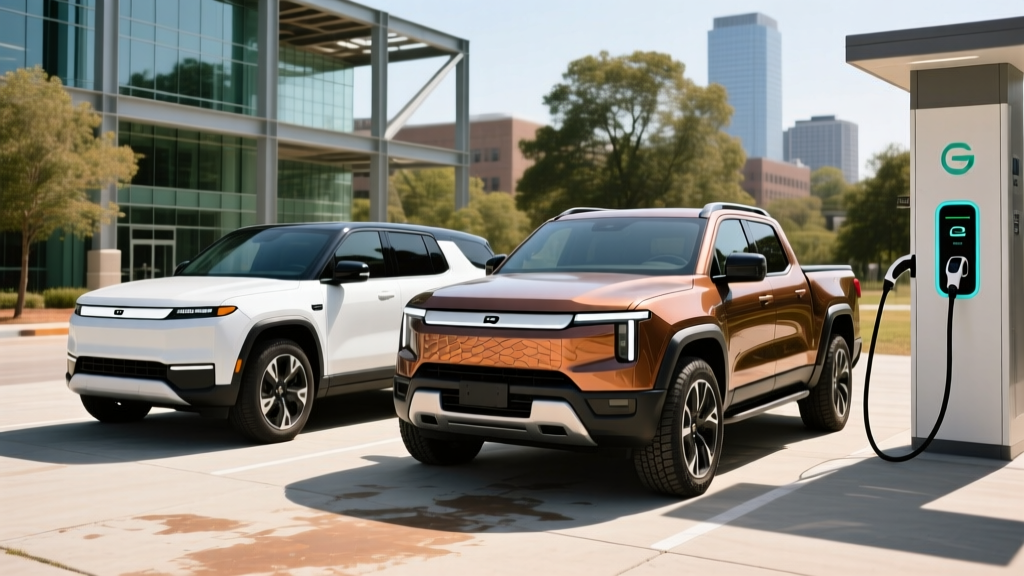
Atlanta is one of the strongest EV markets in the Southeast, and Rivian's R1S SUV and R1T pickup have become common sights from Buckhead to Decatur. With Georgia's growing public charging infrastructure, a long commuting radius, and weekend trips to the Blue Ridge or the coast, the use case for a long-range, dual- or quad-motor electric adventure vehicle lines up neatly with how Atlantans actually drive. This review breaks down the 2026 Rivian lineup with the exact numbers buyers need — EPA range, real-world efficiency on I-75 and I-85, DC fast-charge curves, home Level 2 reality in older intown neighborhoods, and federal tax-credit eligibility under the latest IRS §30D rules.
2026 Rivian Lineup at a Glance: R1S vs R1T Specs
Rivian offers two core vehicles, both on the updated Gen 2 platform with tri- and quad-motor options, plus a Standard, Large, and Max battery pack. Below is a consolidated spec table for the most popular configurations sold in the Atlanta market.
| Spec | R1S Dual-Motor Large | R1S Tri-Motor Max | R1T Dual-Motor Large | R1T Quad-Motor Max |
|---|---|---|---|---|
| EPA Range | ~330 mi | ~410 mi | ~328 mi | ~420 mi |
| Battery (usable, kWh) | ~106 kWh (NMC) | ~141 kWh (NMC) | ~106 kWh (NMC) | ~141 kWh (NMC) |
| Horsepower | 533 hp | 850 hp | 533 hp | 1,025 hp |
| 0-60 mph | 4.5 s | 2.9 s | 4.5 s | 2.5 s |
| Drivetrain | AWD | AWD (tri) | AWD | AWD (quad) |
| Max DC Fast Charge | ~220 kW | ~220 kW | ~220 kW | ~220 kW |
| 10-80% DC Time | ~21 min | ~30 min | ~21 min | ~30 min |
| Level 2 Home Rate | 11.5 kW (~25 mi/hr) | 11.5 kW (~25 mi/hr) | 11.5 kW (~25 mi/hr) | 11.5 kW (~25 mi/hr) |
| Towing Capacity | 7,700 lb | 7,700 lb | 11,000 lb | 11,000 lb |
| Base MSRP | $79,900 | $104,900 | $74,800 | $99,900 |
Source: Rivian spec sheets and fueleconomy.gov. Figures reflect 2026 model-year estimates; final EPA certifications may vary by wheel/tire option.
Real-World Range: What Atlanta Drivers Actually See
Rivian's NMC packs use active liquid thermal management, which helps in Georgia's humid summers but still draws energy for cabin and battery conditioning. Owners commuting from Marietta to Midtown (~20 miles each way) with mostly city driving and regen-heavy traffic will often beat EPA; highway-heavy commuters from Peachtree City or Johns Creek typically land 10–15% below it. Efficiency on the dual-motor R1S averages around 47 MPGe combined (about 2.1 kWh/mile), per EPA data.
Charging in Metro Atlanta: DC Fast, Home Level 2, and Network Reality
Atlanta's DC fast-charging map has matured considerably, with Electrify America, EVgo, Tesla Superchargers (now NACS-open to Rivian via adapter), and Georgia Power's public chargers covering the perimeter and major corridors. Rivian's native NACS port on 2025+ models means direct access to Tesla Superchargers — a major practical shift for Atlanta owners who previously relied on CCS adapters.
| Level | Power | Miles Added per Hour | Notes |
|---|---|---|---|
| Level 1 (120V) | ~1.4 kW | ~3 mi/hr | Emergency / trickle only |
| Level 2 (240V, 48A) | 11.5 kW | ~25 mi/hr | Full overnight charge in 10–14 hrs |
| DC Fast (peak) | ~220 kW | ~650 mi/hr (peak) | 10-80% in ~21 min (Large), ~30 min (Max) |
Charge-curve reality check: Peak 220 kW is sustained only between roughly 10–35% SoC. The curve tapers to ~150 kW by 50% and ~80 kW by 70%. Plan road-trip stops (e.g., Atlanta to Charleston) around 15–20 minute intervals at 10–70% rather than expecting peak rates to 80%.
Home Level 2 Installation in Atlanta
Most intown Atlanta homes (Virginia-Highland, Inman Park, Grant Park) have 100–150A panels that may need a 200A upgrade before adding a 48A hardwired charger — budget $1,500–$3,500 for the panel work alone. Newer construction in Buckhead, Sandy Springs, and Alpharetta usually handles a 60A circuit without upgrade. Expect $800–$1,800 total for a straightforward install with permit through a licensed electrician; Georgia Power offers a time-of-use rate (Plug-in Electric) that can cut overnight charging cost to roughly $0.07/kWh — about $7.50 for a full Large-pack charge.
Performance, Tech, and Daily Livability
Even the "base" Dual-Motor R1S delivers 533 hp and a 4.5-second 0-60, with torque-vectoring AWD that handles Piedmont Park rain and North Georgia mountain roads confidently. The Quad-Motor R1T is a supercar-in-a-truck at 1,025 hp and 2.5 seconds — though most Atlanta buyers opt for Dual- or Tri-Motor for cost and efficiency.
Inside, the 15.6-inch center display runs Rivian OS with native navigation that factors in charger routing, elevation (relevant on I-575 north), and battery preconditioning. Driver assistance is SAE Level 2 under the "Driver+" system — hands-on-wheel supervision required, with highway assist and lane-centering. It is not self-driving and should not be treated as such.
Cargo and Passenger Space
- R1S: 3-row, up to 7 passengers. ~105 cu ft max cargo (2nd/3rd rows folded). ~38 in third-row legroom — usable for kids, tight for adults on long trips.
- R1T: 5-passenger crew cab. ~54 cu ft bed + 11 cu ft front trunk (frunk) + Gear Tunnel (~17 cu ft) between cab and bed — a signature feature for camping/hardware storage.
Pricing, Trims, and Federal Tax-Credit Eligibility
Rivian pricing has climbed with the Gen 2 refresh, and federal §30D credit eligibility is the most nuanced part of the purchase decision. Under current IRS rules, the $7,500 credit requires the buyer to meet income caps ($150k single / $300k joint MAGI), the vehicle to be under MSRP caps ($80,000 for SUVs/pickups like R1S and R1T), and battery critical-mineral and component sourcing thresholds to be satisfied. Most Rivian configurations exceed the $80,000 SUV/pickup cap when well-equipped, which disqualifies them from §30D.
| Trim | Base MSRP | Typical As-Tested | §30D Eligible? | Effective Price |
|---|---|---|---|---|
| R1T Dual-Motor Standard | $69,900 | $74,500 | Potentially (if under cap + sourcing) | ~$67,000 |
| R1S Dual-Motor Large | $79,900 | $86,000 | Usually no (as-tested MSRP exceeds cap) | $86,000 |
| R1T Tri-Motor Max | $99,900 | $105,000 | No | $105,000 |
| R1S Quad-Motor Max | $104,900 | $112,000 | No | $112,000 |
Always verify before purchase: IRS §30D sourcing requirements change annually, and the point-of-sale transfer option (effective 2024+) lets the dealer apply the credit at closing if eligible. Confirm the specific VIN's eligibility on the IRS clean-vehicle list and with a tax professional — never assume $7,500 off the sticker. See IRS.gov §30D guidance.
Warranty, Reliability, and Atlanta Service Access
Rivian covers the battery and drivetrain for 8 years / 175,000 miles (whichever comes first) with a minimum 70% capacity retention threshold — one of the more generous battery warranties among premium EVs. The limited vehicle warranty is 5 years / 60,000 miles. Rivian operates a service center in the Atlanta metro (Doraville area) plus mobile service vans that cover most of the perimeter and northern suburbs; rural Georgia and out-of-state trips rely on mobile or partner shops. Parts availability has improved since 2023 but body-shop turnaround after a collision can still run longer than legacy OEMs.
Pros and Cons: The Honest Atlanta Owner's View
- Class-leading range on Max pack (~410–420 mi EPA) — Atlanta to Jacksonville on one charge is realistic
- NACS native port gives direct Supercharger access without adapter on 2025+ builds
- Gear Tunnel (R1T) and frunk give unmatched utility vs ICE trucks
- Tri- and Quad-Motor performance is absurd in a vehicle this size
- 8-yr/175,000-mi battery warranty provides long-term peace of mind
- Georgia Power TOU rate makes home charging exceptionally cheap
- Most well-equipped trims exceed §30D MSRP cap — federal credit unlikely
- Real-world highway range drops ~15% in summer, ~20–25% in winter
- Service footprint in Georgia is still single-location for major repairs
- Insurance premiums run 15–25% higher than comparable ICE SUVs/trucks
- Third row in R1S is best for kids, not adults on long hauls
- Charging curve tapers aggressively past 50% SoC — plan stops accordingly
Who Should Buy a Rivian in Atlanta — And Who Shouldn't
Buy it if: you need a 3-row electric SUV or a full-size electric truck for family + weekend adventure use, you can charge at home (ideally with a Georgia Power TOU plan), and your budget is $80k–$110k. The R1S is the strongest electric 3-row option for ATL families who tow a small boat or camper; the R1T is the default electric pickup for contractors and outdoor users who want bed + frunk + Gear Tunnel utility.
Consider alternatives if: you strictly need a sub-$60k EV (look at the Hyundai Ioniq 5 or Tesla Model Y), you lack home charging and rely solely on public infrastructure, or you want the lowest-depreciation premium EV (Tesla still wins on resale data). For pure commuting without the adventure use case, a smaller EV will cost less to run.
FAQ: Rivian Ownership in Atlanta, GA
What is the real-world range of a Rivian on Atlanta highways?
Expect ~270–290 miles from the Large pack and ~340 miles from the Max pack at 70–75 mph on I-75/I-85 in summer. Winter trips north of the city drop these figures by roughly 20%.
How fast does the Rivian charge at home and on DC fast chargers?
Level 2 at 11.5 kW adds ~25 miles per hour, fully recharging the Large pack in about 10 hours. DC fast charging peaks at ~220 kW, with 10–80% taking ~21 minutes (Large) or ~30 minutes (Max), tapering significantly above 50% SoC.
Does the 2026 Rivian qualify for the $7,500 federal EV tax credit?
Only the base R1T Dual-Motor Standard, kept under the $80,000 SUV/pickup MSRP cap and meeting §30D battery-sourcing rules, is potentially eligible. Most well-equipped R1S and R1T builds exceed the cap. Verify per-VIN with the IRS and a tax professional.
Is Rivian worth it vs Tesla Model X or Ford F-150 Lightning in Atlanta?
For 3-row SUV use, the R1S offers more adventure utility (Gear Tunnel on R1T, better ground clearance, air suspension) than Model X, though Model X wins on Supercharger network depth and efficiency. Against the F-150 Lightning, the R1T is more expensive but faster, more refined, and has the unique Gear Tunnel. Choose Rivian for build quality and off-pavement capability; choose Lightning for value and dealer-service density.
Where is the nearest Rivian service center to Atlanta?
Rivian's primary Atlanta-area service hub is in Doraville, with mobile service vans covering most of the metro. Body work may require partner collision centers and can take longer than legacy OEM repairs.
How does Georgia's EV registration fee affect Rivian ownership cost?
Georgia imposes an annual EV registration surcharge (currently ~$213) in place of gas tax. Factor this into 5-year TCO — it roughly offsets the fuel-cost advantage of electricity vs gas at low annual mileage.