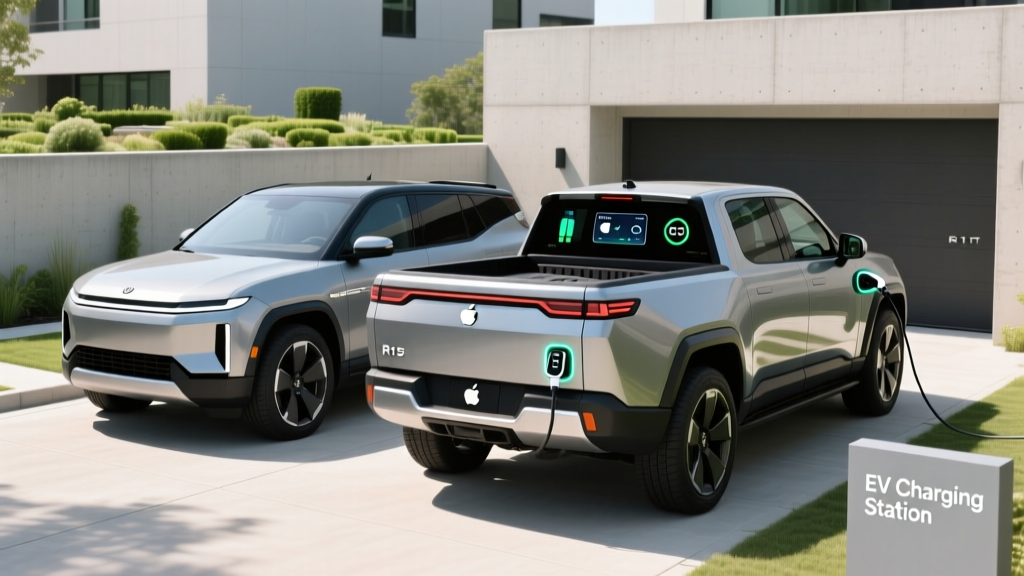
If you've searched for Rivian Apple Car Key functionality, you've likely discovered that Rivian doesn't support Apple Wallet car keys the way BMW, Hyundai, and Genesis do. Instead, Rivian relies on its own NFC key cards, Bluetooth-enabled key fobs, and a phone-as-key system via the Rivian app. That distinction matters for iPhone users shopping the 2026 R1S SUV and R1T pickup — so does everything else about these updated electric adventure vehicles. This review covers the full ownership picture: real-world range, charging speeds, pricing after federal tax credits, and whether Rivian's digital key ecosystem works well enough to make you forget about Apple Car Key.
2026 Rivian R1S and R1T: What's New and Who They're For
Rivian's second-generation R1S (three-row SUV) and R1T (crew-cab pickup) received significant updates starting with the 2025 model year that carry into 2026: a new electrical architecture with zonal controllers, upgraded driver-assistance hardware, improved thermal management for the battery pack, and a revamped interior with higher-quality materials. Both vehicles ride on Rivian's skateboard platform and are built in Normal, Illinois.
These are positioned as premium adventure-family vehicles — think off-road capability meets daily school-drop and road-trip comfort. The R1S seats up to seven; the R1T seats five with a 4.5-foot bed and the signature Gear Tunnel for enclosed cargo. Neither is cheap, but both aim to justify their price with genuine off-road chops, strong towing ratings, and tech-forward ownership.
Digital Key Reality: Rivian App, NFC Cards, and the Apple Car Key Question
Let's address the keyword directly. Rivian does not currently integrate with Apple Car Key (the Apple Wallet-based digital car key standard supported by the Car Connectivity Consortium). If you tap your iPhone or Apple Watch on the door handle expecting it to unlock, nothing happens. Here's what Rivian actually offers:
- Phone-as-Key (Bluetooth): The Rivian iOS/Android app pairs with the vehicle via Bluetooth Low Energy (BLE). When your phone is within ~6 feet, the vehicle unlocks. Walk away, and it locks. This is the primary daily-driver method for most owners.
- NFC Key Cards: Two credit-card-sized NFC cards ship with each vehicle. Tap on the driver-side B-pillar to unlock, tap again inside on the center console to start. These are your backup if your phone dies.
- Key Fob (optional accessory): A traditional BLE fob is available for those who prefer a physical button-press experience.
In practice, the phone-as-key system works reliably for most owners, though some report occasional BLE handshake delays in extreme cold or when the phone is buried deep in a bag. It's not as seamless as Apple Car Key's ultra-wideband precision unlocking, but it's functional. Rivian has not announced any timeline for Apple Car Key or CCC Digital Key support.
EPA Range, Battery Specs, and Real-World Expectations
Rivian offers three battery pack sizes for 2026, using a mix of cell chemistries depending on pack and configuration. The Standard battery uses LFP (lithium iron phosphate) chemistry — heavier but more durable over thousands of cycles and tolerant of regular 100% charging. The Large and Max packs use NMC (nickel manganese cobalt) for higher energy density.
| Pack | Chemistry | Usable Capacity | EPA Range (R1S) | EPA Range (R1T) |
|---|---|---|---|---|
| Standard | LFP | ~92 kWh | 270 mi | 270 mi |
| Large | NMC | ~109 kWh | 330 mi | 328 mi |
| Max | NMC | ~141 kWh | 410 mi | 420 mi |
Real-World Range Reality Check: EPA estimates assume a mix of city and moderate-speed driving. In our experience and owner reports, expect the following adjustments:
- Highway (70-75 mph): Subtract 12-18% from EPA. A Max-pack R1T at 420 mi EPA delivers roughly 340-360 mi on a flat interstate.
- Cold weather (below 32°F): Subtract 20-30% depending on cabin heat usage and whether you precondition. The LFP Standard pack is more affected by cold than NMC.
- Towing: Expect 50-60% of EPA range when towing near max capacity (7,700 lb for R1S, 11,000 lb for R1T). Plan charging stops accordingly.
Source: fueleconomy.gov for official EPA figures.
Charging Speeds: DC Fast, Level 2, and Home Setup
Rivian's 2026 architecture supports NACS (North American Charging Standard) natively — no adapter needed at Tesla Superchargers. This was a major shift from the CCS1 port on early R1 vehicles, and it dramatically expands the usable fast-charging network for Rivian owners.
| Level | Power | Speed / Time | Notes |
|---|---|---|---|
| Level 1 (120V) | ~1.4 kW | ~3-4 mi/hr | Emergency trickle only |
| Level 2 (240V, 48A) | 11.5 kW | ~25-30 mi/hr | Full charge in 10-14 hrs (Max pack) |
| DC Fast (Standard/Large) | Peak 200 kW | 10-80% in ~28 min | Tapers above 80% |
| DC Fast (Max pack) | Peak 220 kW | 10-80% in ~30 min | Larger battery = longer total time |
Charging curve reality: Rivian's peak kW rate is sustained between roughly 10-50% SoC on the Large and Max packs. After 60%, the curve tapers progressively. If you're road-tripping, plan stops around 10-80% rather than trying to fill to 100% at a DC charger — the last 20% can take as long as the first 70%.
At home, Rivian sells the Wall Charger (48A, hardwired, NACS connector) for ~$550. A full Level 2 installation typically costs $500-$1,800 depending on your electrical panel's capacity and the run distance from panel to garage. If your home has a 200A panel with spare capacity, you're likely looking at the lower end. Older homes with 100A service may need a panel upgrade ($1,500-$3,500).
Performance, Efficiency, and Capability
The 2026 R1S and R1T come in three powertrain configurations:
| Config | Horsepower | Torque | 0-60 mph | Drivetrain |
|---|---|---|---|---|
| Dual-Motor AWD | 533 hp | 610 lb-ft | 4.5 sec | AWD (2 motors) |
| Performance Dual-Motor | 665 hp | 829 lb-ft | 3.4 sec | AWD (2 motors) |
| Quad-Motor AWD | 1,025 hp | 1,198 lb-ft | 2.5 sec | AWD (4 motors, torque vectoring) |
Efficiency varies by configuration and pack. The Dual-Motor R1S with the Large pack returns an EPA-rated 69 MPGe combined (roughly 36 kWh/100 mi). The Quad-Motor drops to about 59 MPGe due to the additional motor weight and higher-performance tuning. For context, that's comparable to a Tesla Model X but thirstier than a smaller SUV like the Hyundai Ioniq 5.
Towing: The R1S tows up to 7,700 lb; the R1T up to 11,000 lb (properly equipped). Both use Rivian's integrated trailer brake controller and tow-assist cameras. Just remember: towing at max capacity effectively halves your range.
Cargo, Passenger Space, and Interior Practicality
The R1S offers three rows of seating for up to seven passengers:
- Cargo behind 3rd row: 10.6 cu ft
- Cargo behind 2nd row (3rd row folded): 46.7 cu ft
- Max cargo (all rear seats folded): 88.2 cu ft
- Front trunk (frunk): 11.0 cu ft — large enough for groceries or a carry-on
- 3rd-row legroom: 30.4 inches — tight for adults on long trips, fine for kids
The R1T crew cab seats five with generous rear legroom (38.6 inches) and features the innovative Gear Tunnel — a 11.0 cu ft pass-through compartment behind the rear seats accessible from both sides of the bed. The bed itself is 4.5 feet long (extending to ~6 feet with the tailgate down) and includes an integrated air compressor, 120V outlet, and L-track tie-downs.
Pricing, Trim Levels, and Federal Tax Credit Eligibility
| Model / Trim | Base MSRP | As-Tested (typical) | §30D Credit Eligible? |
|---|---|---|---|
| R1S Dual-Motor (Standard) | $74,900 | $78,000-$82,000 | Partial — see below |
| R1S Dual-Motor (Large) | $82,900 | $88,000-$95,000 | Likely ineligible (MSRP cap) |
| R1T Dual-Motor (Standard) | $69,900 | $73,000-$78,000 | Partial — see below |
| R1T Dual-Motor (Large) | $77,900 | $84,000-$90,000 | Likely ineligible (MSRP cap) |
| R1T Quad-Motor (Max) | $99,900 | $105,000+ | Ineligible (MSRP cap) |
Federal tax credit (§30D) details: Under current IRS rules, the credit is up to $7,500 but comes with strict requirements:
- MSRP cap: SUVs (R1S) capped at $80,000; trucks (R1T) capped at $80,000. Many R1 configurations exceed this once options are added.
- Buyer income cap: AGI must not exceed $150,000 (single), $225,000 (head of household), or $300,000 (joint).
- Battery sourcing: Critical minerals and battery components must meet phased-in domestic/free-trade sourcing thresholds. Rivian's supply chain has been evolving; confirm current-year compliance with your dealer before purchase.
- Point-of-sale transfer: Eligible buyers can transfer the credit to the dealer at purchase for an immediate price reduction rather than waiting for tax filing.
Consult a tax professional before relying on credit eligibility. Rules are subject to legislative change.
Tech, Driver Assistance, and Safety
The 2026 R1S and R1T feature a 15.6-inch center touchscreen running Rivian's proprietary infotainment OS — not Android Automotive or Apple CarPlay. This is a notable drawback for buyers who expect smartphone mirroring. Rivian's native interface is clean and well-designed, but the lack of Apple CarPlay and Android Auto is a dealbreaker for some.
Driver assistance (Rivian Driver+): This is a SAE Level 2 system — meaning it provides combined steering and speed assistance on highways, but you must remain fully attentive with hands on or near the wheel at all times. It is not self-driving. The 2026 hardware suite includes 11 cameras, 5 radar units, and enhanced processing for smoother lane-keeping and adaptive cruise. Automatic emergency braking, blind-spot monitoring, and rear cross-traffic alert are standard.
Safety ratings: The R1T earned an IIHS Top Safety Pick+ designation in prior testing, and both vehicles include 8 airbags standard. NHTSA 5-star ratings carry over from the updated platform.
Warranty Coverage
- Basic vehicle: 5 years / 60,000 miles
- Battery & powertrain: 8 years / 120,000 miles (with at least 70% capacity retention)
- Roadside assistance: 5 years / 60,000 miles
Rivian's battery warranty is competitive with industry norms (Tesla offers 8yr/120k-150k mi depending on model). The 70% retention threshold is standard — if your battery degrades below 70% of original capacity within the warranty window, Rivian will repair or replace it.
Pros, Cons, and the Verdict
Pros
- Max pack delivers 410-420 mi EPA — among the longest-range EVs available
- Native NACS port = full Tesla Supercharger access without adapter
- Genuine off-road capability (air suspension, up to 14.9" ground clearance)
- R1T Gear Tunnel is uniquely practical for adventure gear
- Quad-Motor performance is supercar-rivaling (2.5 sec 0-60)
- Strong build quality improvements in 2025-2026 models
Cons
- No Apple Car Key, no Apple CarPlay, no Android Auto
- Most trims exceed $80,000 MSRP cap for federal tax credit
- Towing cuts range by 40-50% — painful on long hauls
- Service center network still expanding; wait times in some regions
- 3rd row in R1S is cramped for adults
- Price premium vs. competitors like the Hyundai Ioniq 9 or Chevy Silverado EV
Is the Rivian R1S/R1T Worth It vs. the Competition?
If your priority is adventure capability plus family hauling and you have home charging, the R1S and R1T remain category leaders. The R1T has no direct electric pickup rival that matches its combination of size, range, and off-road chops (the Ford F-150 Lightning is larger but less trail-capable; the Tesla Cybertruck is polarizing and still ramping). The R1S competes with the Kia EV9 (cheaper, less range, less off-road ability) and the Tesla Model X (more Superchargers, less adventure-oriented).
If Apple Car Key or Apple CarPlay is a non-negotiable feature for you, Rivian will disappoint. You'll need to rely on the Rivian app and accept their walled-garden infotainment approach. For many owners, the tradeoff is worth it — but go in with eyes open.
Frequently Asked Questions
Does Rivian support Apple Car Key in 2026?
No. Rivian uses its own Bluetooth phone-as-key system, NFC key cards, and an optional BLE key fob. Apple Car Key (the Wallet-based digital key) is not supported, and Rivian has not announced plans to add it.
Can I use my iPhone to unlock a Rivian?
Yes, through the Rivian iOS app using Bluetooth. Your phone acts as the key when it's within proximity of the vehicle. It's functional but not as seamless as ultra-wideband-based Apple Car Key implementations.
What is the real-world range of the Rivian R1T Max pack?
The EPA rates it at 420 miles. Expect roughly 340-360 miles at highway speeds (70-75 mph), and 280-310 miles in cold weather (below freezing) without preconditioning. Towing drops range to roughly 210-250 miles.
Does the Rivian R1T qualify for the $7,500 federal tax credit?
Only the base Dual-Motor Standard pack R1T at $69,900 MSRP has a chance of qualifying, and only if the buyer meets income caps ($300,000 joint / $150,000 single) and the battery meets current-year critical-mineral and component sourcing rules per IRS §30D. Most configured R1T and R1S vehicles exceed the $80,000 MSRP cap and are ineligible.
How fast does the Rivian charge at home?
On a Level 2 home charger (240V, 48A), the Rivian charges at up to 11.5 kW, adding roughly 25-30 miles of range per hour. A full charge of the Max pack (141 kWh) takes approximately 12-14 hours from near-empty.
Does Rivian have Apple CarPlay?
No. The 2026 R1S and R1T use Rivian's proprietary infotainment system. Neither Apple CarPlay nor Android Auto is available, wired or wireless.