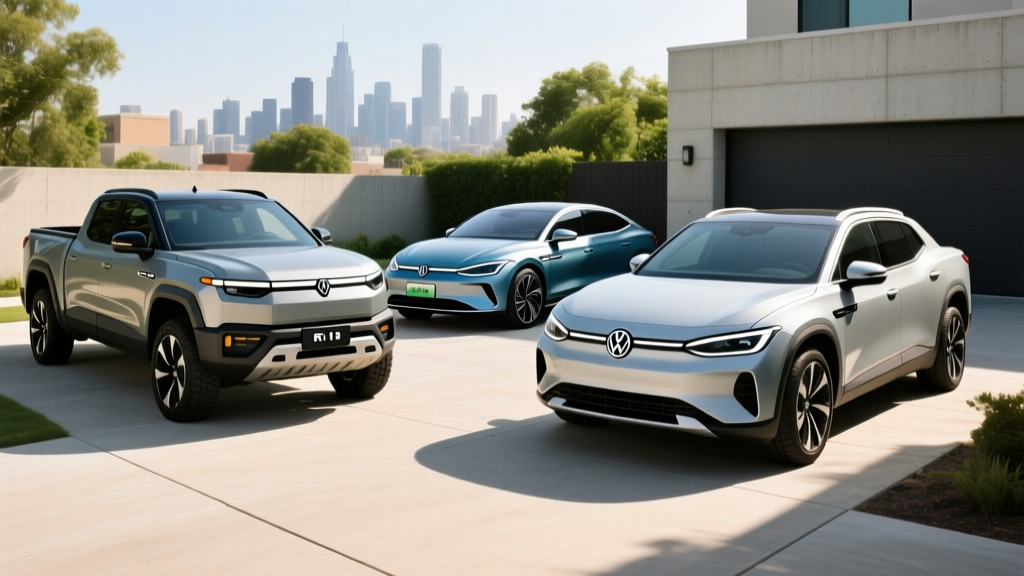
If you've been cross-shopping the electric SUV and truck market, you've likely landed on a search for Rivian and VW — two brands that occupy very different corners of the EV landscape but increasingly compete for the same buyers. Rivian targets the adventure-ready premium segment with its R1S SUV and R1T truck, while Volkswagen courts practical families with the ID.4 crossover and the ID.7 sedan. In 2026, both automakers have refreshed their lineups, adjusted pricing, and navigated the shifting federal tax credit landscape.
This guide puts the key models head-to-head with exact EPA range figures, real-world charging data, battery specs, and total cost of ownership so you can decide which brand — or which specific model — earns your garage space.
Quick Verdict: Rivian vs Volkswagen EVs in 2026
Choose Rivian if: You need serious towing capacity (up to 7,700 lbs on the R1T), want premium adventure features like the gear tunnel, and can budget $75,000+ before incentives. The R1S and R1T offer best-in-class performance and build quality for outdoor-oriented families.
Choose Volkswagen if: You want a practical, comfortable daily driver in the $40,000–$55,000 range, value straightforward infotainment, and prioritize federal tax credit eligibility. The ID.4 remains one of the most accessible long-range electric crossovers on the market.
Rivian R1S and R1T: 2026 Specs at a Glance
Rivian's second-generation R1S (three-row SUV) and R1T (crew-cab pickup) received significant powertrain and electrical-architecture updates for the 2025 model year that carry into 2026. The shift to an 800V architecture, new in-house drive units, and a Max battery pack option dramatically improved charging speed and efficiency.
| Spec | R1S Dual-Motor (Standard) | R1S Dual-Motor (Max Pack) | R1T Dual-Motor (Standard) | R1T Dual-Motor (Max Pack) |
|---|---|---|---|---|
| EPA Range | 270 mi | 410 mi | 270 mi | 420 mi |
| Battery (usable) | 92 kWh (NMC) | 141 kWh (NMC) | 92 kWh (NMC) | 141 kWh (NMC) |
| Horsepower | 533 hp | 533 hp | 533 hp | 533 hp |
| 0–60 mph | 4.5 sec | 4.7 sec | 4.5 sec | 4.7 sec |
| Peak DC Charge | 200 kW | 220 kW | 200 kW | 220 kW |
| 10–80% DC Time | ~30 min | ~42 min | ~30 min | ~42 min |
| Level 2 Rate | 11.5 kW (~30 mi/hr) | 11.5 kW (~30 mi/hr) | 11.5 kW (~30 mi/hr) | 11.5 kW (~30 mi/hr) |
| Drivetrain | AWD (dual-motor) | AWD (dual-motor) | AWD (dual-motor) | AWD (dual-motor) |
| Towing Capacity | 7,700 lbs (R1T) | 7,700 lbs (R1T) | 7,700 lbs | 7,700 lbs |
| Base MSRP | $75,900 | $85,900 | $69,900 | $79,900 |
Sources: Rivian R1S specs, fueleconomy.gov
Real-World Range Reality Check: The EPA's 410-mile rating on the R1S Max Pack is impressive on paper, but expect roughly 320–350 miles on a sustained 75 mph highway run in mild weather. In freezing temperatures (below 30°F), plan for 260–290 miles of usable range before you need to find a charger. Towing a 5,000-lb trailer with the R1T cuts range roughly in half — to around 180–200 miles. The Standard pack's 270-mile EPA figure translates to about 210–230 miles highway in practice.
Volkswagen ID.4 and ID.7: 2026 Specs at a Glance
Volkswagen's MEB-platform vehicles prioritize comfort and accessibility over raw performance. The 2026 ID.4 crossover receives an updated infotainment system (software 4.0) with improved responsiveness, while the ID.7 sedan continues as VW's flagship electric family hauler with class-leading rear-seat room.
| Spec | ID.4 Standard Range | ID.4 Pro S (AWD) | ID.7 Pro S | ID.7 Pro S AWD |
|---|---|---|---|---|
| EPA Range | 206 mi | 263 mi | 342 mi | 310 mi |
| Battery (usable) | 62 kWh (NMC) | 82 kWh (NMC) | 82 kWh (NMC) | 82 kWh (NMC) |
| Horsepower | 201 hp | 335 hp | 282 hp | 335 hp |
| 0–60 mph | 7.7 sec | 5.4 sec | 6.5 sec | 5.3 sec |
| Peak DC Charge | 135 kW | 175 kW | 175 kW | 175 kW |
| 10–80% DC Time | ~30 min | ~28 min | ~28 min | ~28 min |
| Level 2 Rate | 11 kW (~28 mi/hr) | 11 kW (~28 mi/hr) | 11 kW (~30 mi/hr) | 11 kW (~30 mi/hr) |
| Drivetrain | RWD | AWD | RWD | AWD |
| MPGe (combined) | 104 MPGe | 98 MPGe | 115 MPGe | 104 MPGe |
| Base MSRP | $39,995 | $49,495 | $52,495 | $56,495 |
Sources: Volkswagen ID.4, fueleconomy.gov
Real-World Range Reality Check: The ID.4 Pro S AWD's 263-mile EPA rating holds up reasonably well in mixed city/highway driving — expect 230–245 miles in temperate conditions. On a sustained 70 mph highway cruise, plan for 210–225 miles. The ID.7 Pro S, with its more aerodynamic sedan profile, delivers closer to its 342-mile EPA sticker in real-world use: roughly 300–315 miles highway. Cold weather (sub-30°F) reduces all MEB-platform ranges by 20–30%.
Charging Speed Deep Dive: Rivian vs VW
Charging speed is where Rivian's 800V architecture shows a clear advantage. Higher voltage means the battery can accept more power without excessive current, which translates to faster sessions and less heat generation.
| Charging Level | Rivian R1S/R1T (Max) | Rivian R1S/R1T (Standard) | VW ID.4 Pro S | VW ID.7 Pro S |
|---|---|---|---|---|
| Level 1 (120V / 12A) | ~3 mi/hr | ~3 mi/hr | ~3 mi/hr | ~3 mi/hr |
| Level 2 (240V / 48A) | 11.5 kW / ~30 mi/hr | 11.5 kW / ~30 mi/hr | 11 kW / ~28 mi/hr | 11 kW / ~30 mi/hr |
| DC Fast Charge (peak) | 220 kW | 200 kW | 175 kW | 175 kW |
| 10–80% DC Time | ~42 min (Max) | ~30 min (Std) | ~28 min | ~28 min |
| Connector | NACS (native) | NACS (native) | CCS (NACS adapter avail.) | CCS (NACS adapter avail.) |
Charge curve reality: Rivian's 220 kW peak on the Max Pack is impressive but only sustained between roughly 15–40% state of charge (SoC). Above 60%, the rate tapers significantly — from about 150 kW down to 50 kW near 80%. This is why the 10–80% time stretches to 42 minutes despite the higher peak. The VW models sustain a flatter curve relative to their peak, which is why a smaller 82 kWh battery still hits 10–80% in roughly 28 minutes.
Rivian's native NACS connector grants direct access to the Tesla Supercharger network — currently the most reliable DC fast-charging infrastructure in the US. VW's CCS-equipped vehicles require an adapter (provided by VW) for Supercharger access, adding a minor friction point at the plug.
Pricing, Tax Credits, and Total Cost
The price gap between Rivian and Volkswagen is substantial — and federal tax credit eligibility makes it even wider.
| Model / Trim | Base MSRP | Federal §30D Credit | Effective Price | Notes |
|---|---|---|---|---|
| VW ID.4 Standard Range | $39,995 | Up to $7,500 | ~$32,495 | Eligible (under $80K SUV cap, US-assembled) |
| VW ID.4 Pro S AWD | $49,495 | Up to $7,500 | ~$41,995 | Eligible (under $80K SUV cap) |
| VW ID.7 Pro S | $52,495 | Up to $7,500 | ~$44,995 | Eligible (under $55K sedan cap) |
| Rivian R1T Dual-Motor Std | $69,900 | Up to $7,500 | ~$62,400 | Eligible (under $80K truck cap) |
| Rivian R1S Dual-Motor Std | $75,900 | Up to $7,500 | ~$68,400 | Eligible (under $80K SUV cap) |
| Rivian R1S Max Pack | $85,900 | $0 | $85,900 | Exceeds $80K SUV MSRP cap — ineligible |
Critical §30D caveats: Federal tax credit eligibility under IRS §30D depends on multiple factors beyond MSRP:
- Income caps: Modified AGI must not exceed $150,000 (single), $225,000 (head of household), or $300,000 (joint).
- MSRP caps: $80,000 for SUVs/pickups/vans; $55,000 for sedans. This is why the R1S Max Pack at $85,900 is ineligible.
- Battery sourcing: The vehicle must meet critical minerals and battery component requirements that phase in annually. Confirm current-year compliance at fueleconomy.gov.
- Point-of-sale transfer: As of 2024+, you can transfer the credit to the dealer at purchase, reducing your out-of-pocket cost immediately rather than waiting for tax filing.
Always verify eligibility with a tax professional before purchase — rules change annually, and battery sourcing compliance can shift mid-year.
Cargo, Passenger Space, and Daily Practicality
This is where the Rivian-vs-VW comparison splits sharply by use case.
| Dimension | Rivian R1S | Rivian R1T | VW ID.4 | VW ID.7 |
|---|---|---|---|---|
| Seating | 7-passenger (3 rows) | 5-passenger | 5-passenger | 5-passenger |
| Cargo (behind 2nd row) | 46.7 cu ft | N/A (bed: 4.5 ft) | 30.3 cu ft | 18.4 cu ft (trunk) |
| Cargo (max, seats folded) | 104.7 cu ft | Bed + gear tunnel (11.7 cu ft) | 64.2 cu ft | ~55 cu ft (seats folded) |
| Rear Legroom (2nd row) | 38.6 in | 38.4 in | 37.6 in | 40.1 in |
| Frunk | 11.0 cu ft | 11.0 cu ft | None | None |
| Ground Clearance | Up to 14.9 in (adjustable) | Up to 14.9 in (adjustable) | 6.7 in | 5.7 in |
The R1T's gear tunnel — a 11.7 cu ft pass-through compartment behind the cab — is a genuinely unique feature no competitor offers. It's ideal for skis, camping gear, or groceries you want secured and out of the cabin. The R1S's three-row layout makes it one of very few EVs that can carry seven people, though the third row is best suited for children on longer trips.
The ID.7 sedan surprises with 40.1 inches of rear legroom — more than the R1S and competitive with full-size luxury sedans. For families that don't need SUV ride height, the ID.7 offers superior passenger comfort at a lower price.
Tech, Driver Assists, and Software
Both brands have invested heavily in software, but their approaches differ meaningfully.
Rivian runs a custom Linux-based infotainment system on a 15.6-inch landscape display. The interface is widely praised for responsiveness and logical menus. Key features include:
- Over-the-air updates adding new features quarterly
- Built-in navigation with real-time charger availability (including Superchargers via NACS)
- Driver+ (Level 2 ADAS): adaptive cruise, lane centering, automatic lane change on highway — requires hands-on-wheel supervision at all times
- Camp mode, pet mode, and gear-guard security camera
- Phone-as-key with UWB (ultra-wideband) proximity
SAE Automation Level: Rivian's Driver+ and VW's Travel Assist are both SAE Level 2 systems. The driver must remain fully engaged, monitor the road, and keep hands on or near the steering wheel. These are not self-driving systems and cannot navigate without human oversight.
Volkswagen overhauled its infotainment for the ID.4 and ID.7 with software version 4.0, addressing longstanding complaints about laggy touch-capacitive sliders and confusing menus. The 12.9-inch display (ID.7) is brighter and more responsive than prior generations. Key features include:
- Wireless Apple CarPlay and Android Auto
- Travel Assist (Level 2 ADAS): adaptive cruise with lane centering, works down to 0 mph in traffic
- Park Assist Plus with memory parking (learns your driveway/garage routine)
- Augmented-reality head-up display (ID.7 Pro S and above)
- OTA updates, though less frequent than Rivian's cadence
Neither brand offers anything approaching Tesla's FSD Supervised or GM's Super Cruise in terms of hands-off highway capability. If hands-free driving assist is a top priority, neither Rivian nor VW currently competes in that tier.
Warranty and Long-Term Ownership
| Warranty | Rivian | Volkswagen |
|---|---|---|
| Bumper-to-Bumper | 5 yr / 60,000 mi | 4 yr / 50,000 mi |
| Battery & Powertrain | 8 yr / 175,000 mi | 8 yr / 100,000 mi |
| Battery Retention Threshold | 70% capacity | 70% capacity |
| Roadside Assistance | 5 yr / 60,000 mi | 4 yr / 50,000 mi |
Rivian's 8-year/175,000-mile battery warranty is among the best in the industry — significantly more mileage coverage than VW's 100,000-mile limit. Both guarantee 70% capacity retention, which is the industry-standard threshold. In practical terms, modern NMC batteries in thermally managed packs (both brands use active liquid cooling) typically degrade 8–12% over the first 100,000 miles based on Recurrent Auto data, well within warranty coverage.
Who Should Buy What?
Best for Adventure / Towing: Rivian R1T. 7,700-lb towing, adjustable air suspension with 14.9" ground clearance, gear tunnel, and built-in camp kitchen option. Nothing from VW competes here.
Best for Budget-Conscious Families: VW ID.4 Pro. Starting at ~$42,000 after the federal credit, it offers 263 miles of range, comfortable seating for five, and access to the growing Supercharger network via adapter.
Best for Three-Row Seating: Rivian R1S. One of the only mainstream three-row EVs available. The Kia EV9 is the closest competitor, but the R1S offers more power and off-road capability.
Best for Highway Commuters: VW ID.7 Pro S. 342 miles EPA, excellent rear-seat comfort, AR head-up display, and 115 MPGe combined make it a superb daily driver under $53K.
Pros and Cons: Rivian vs VW
Rivian R1S / R1T — Pros
- Class-leading performance (533 hp, sub-5-sec 0–60)
- Native NACS — seamless Supercharger access
- Adventure features (gear tunnel, air suspension, wading mode)
- 8 yr / 175,000 mi battery warranty
- Excellent build quality and materials
Rivian R1S / R1T — Cons
- High base price ($69,900–$85,900); Max Pack exceeds tax credit MSRP cap
- Real-world highway range falls significantly below EPA on Max Pack
- Limited service center network — mobile service handles minor issues, but body/collision work can take weeks
- Third row in R1S is tight for adults
- Insurance premiums run 20–35% higher than comparable VW models
VW ID.4 / ID.7 — Pros
- Accessible pricing ($39,995–$56,495); most trims qualify for full §30D credit
- Comfortable ride quality and quiet cabin
- ID.7 offers 342 mi EPA range and excellent rear-seat room
- Improved infotainment (SW 4.0) addresses prior complaints
- Large dealer network for service
VW ID.4 / ID.7 — Cons
- CCS connector requires adapter for Supercharger access
- Moderate performance — ID.4 Standard hits 0–60 in 7.7 sec
- No frunk on either model
- DC fast charging peaks at 175 kW — slower than rivals like Hyundai Ioniq 5 (240 kW)
- Lower battery warranty mileage (100,000 mi vs Rivian's 175,000 mi)
Frequently Asked Questions
What is the real-world range of Rivian and VW electric vehicles?
Real-world range varies significantly by model and conditions. The Rivian R1S Max Pack (EPA 410 mi) delivers approximately 320–350 miles on highway drives in mild weather and 260–290 miles in freezing cold. The Standard pack (EPA 270 mi) nets about 210–230 miles highway. The VW ID.4 Pro S AWD (EPA 263 mi) returns roughly 210–245 miles depending on speed and temperature, while the ID.7 Pro S (EPA 342 mi) achieves 300–315 miles highway — its aerodynamic sedan shape helps it stay closer to its sticker number.
How fast do Rivian and VW EVs charge at home and on the road?
At home on a Level 2 (240V) charger, Rivian adds about 30 miles of range per hour at 11.5 kW, while VW adds roughly 28–30 mi/hr at 11 kW. A full overnight charge (8–10 hours) is sufficient for any daily commute on either brand. On DC fast chargers, Rivian peaks at 200–220 kW (depending on pack size) and VW at 175 kW. Expect 10–80% sessions of 28–42 minutes depending on the specific model and battery size.
Do Rivian and VW EVs qualify for the $7,500 federal tax credit?
Most trims do — but with important exceptions. The VW ID.4 (all trims under $50K) and ID.7 (under $55K sedan cap) qualify, as do the Rivian R1T (under $80K truck cap) and R1S Standard/Large packs (under $80K SUV cap). The R1S Max Pack at $85,900 exceeds the $80,000 SUV MSRP cap and is ineligible. All buyers must also meet IRS income limits ($150K single / $300K joint) and the vehicle must satisfy battery-sourcing requirements. Verify at irs.gov and consult a tax professional.
Is Rivian worth the premium over Volkswagen?
It depends entirely on your use case. If you need towing, off-road capability, three-row seating, or adventure-specific features, Rivian offers capabilities VW simply doesn't match. If you want a comfortable, efficient daily driver at the lowest possible cost after incentives, the ID.4 and ID.7 are compelling choices that save $25,000–$40,000 at purchase. The two brands serve fundamentally different needs.
Can I charge a VW at Tesla Superchargers?
Yes, but you'll need VW's CCS-to-NACS adapter (provided with newer models or available for purchase). Rivian vehicles have a native NACS port and plug directly into Superchargers without an adapter. In both cases, you'll need to activate the session through the respective network's app or payment system.
Which brand has better long-term battery reliability?
Both use liquid-cooled NMC battery packs with active thermal management, which is the proven approach for longevity. Rivian's 8-year/175,000-mile battery warranty provides more mileage coverage than VW's 8-year/100,000-mile warranty. Real-world degradation data from fleet monitoring services suggests both brands track within the 8–12% degradation range over 100,000 miles — well within the 70% retention guarantee.