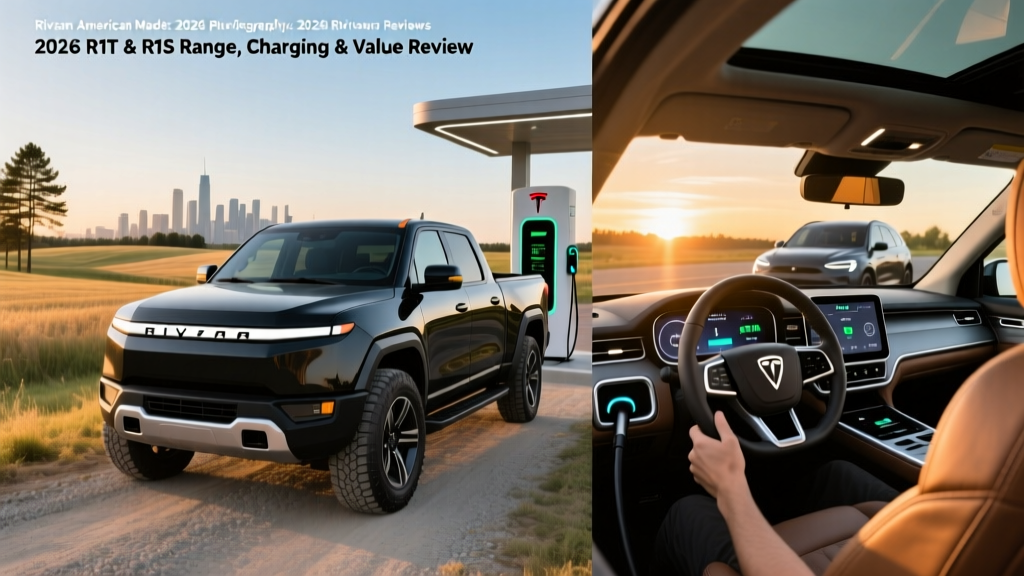
Rivian has carved out a distinct niche in the electric vehicle market: adventure-ready trucks and SUVs designed, engineered, and built in the United States. For buyers specifically searching for a Rivian American made electric vehicle, the answer is straightforward — every R1T pickup and R1S SUV rolls off the assembly line at Rivian's manufacturing plant in Normal, Illinois. But domestic manufacturing is only part of the purchase equation. What matters more to your wallet and your daily driving is real-world range, charging speed, total cost after incentives, and how these vehicles stack up against competitors like the Ford F-150 Lightning, Tesla Cybertruck, and Chevrolet Silverado EV.
This review covers the current 2026 Rivian lineup — the R1T (crew-cab pickup) and the R1S (three-row SUV) — with exact numbers on battery capacity, EPA range, DC fast-charging performance, pricing by trim, and federal tax credit eligibility under IRS §30D rules.
2026 Rivian Lineup at a Glance: R1T and R1S Specs
For the 2026 model year, Rivian offers the R1T and R1S on its second-generation platform with updated battery packs, improved motors, and a NACS (North American Charging Standard) charge port — meaning native Tesla Supercharger access without an adapter. Here are the core specifications across the most popular configurations.
| Specification | R1T (Dual-Motor, Standard) | R1S (Dual-Motor, Standard) |
|---|---|---|
| EPA Range | 270 miles | 258 miles |
| Battery (Usable) | 92 kWh (NMC) | 92 kWh (NMC) |
| Max DC Fast Charge | 200 kW (peak) | 200 kW (peak) |
| 10–80% DC Charge Time | ~30 minutes | ~30 minutes |
| Level 2 Home Charge Rate | 11.5 kW (~25 mi/hr) | 11.5 kW (~23 mi/hr) |
| Drivetrain | Dual-Motor AWD | Dual-Motor AWD |
| Horsepower | 533 hp | 533 hp |
| 0–60 mph | 4.5 seconds | 4.8 seconds |
| MPGe (Combined) | 73 MPGe | 69 MPGe |
| Efficiency | 46 kWh/100 mi | 49 kWh/100 mi |
| Towing Capacity | 11,000 lbs | 7,700 lbs |
| Base MSRP | $69,900 | $74,900 |
| Battery/Powertrain Warranty | 8 yr / 100,000 mi | 8 yr / 100,000 mi |
Source: fueleconomy.gov and Rivian official specifications.
Battery Chemistry, Capacity, and the Max Pack Option
Rivian uses NMC (nickel manganese cobalt) lithium-ion cells across its battery lineup. NMC chemistry offers higher energy density than LFP (lithium iron phosphate), which matters for a truck platform that needs to balance range, payload, and ground clearance. The trade-off: NMC cells degrade slightly faster over time than LFP and perform best when daily charging is limited to 80–90% state of charge rather than sitting at 100%.
The Standard battery pack provides approximately 92 kWh of usable capacity. For buyers who need maximum range, Rivian offers a Max Pack option (approximately 141 kWh usable) that pushes the R1T EPA range to roughly 352 miles and the R1S to approximately 330 miles. The Max Pack adds significant cost — typically $10,000 or more depending on trim — and adds weight that slightly reduces efficiency and payload.
The EPA estimates are measured under controlled conditions. In real-world highway driving at 70+ mph, expect the R1T Standard to deliver approximately 230–245 miles before needing a charge. In cold weather (below 32°F), range can drop 20–30%, bringing effective highway range down to roughly 190–210 miles. The R1S, being heavier and less aerodynamic, sees slightly larger reductions. If your road trips regularly exceed 250 miles between charging stops, the Max Pack is worth the premium.
Charging Speed: DC Fast Charging and Home Level 2
Charging speed is where Rivian's second-generation platform shows meaningful improvement. The NACS charge port on 2026 models provides native access to Tesla's Supercharger network — currently the most reliable DC fast-charging infrastructure in the U.S.
| Charging Level | Power (kW) | Miles Added per Hour | Notes |
|---|---|---|---|
| Level 1 (120V household) | 1.4 kW | ~3–4 mi/hr | Emergency/trickle only |
| Level 2 (240V, 48A home charger) | 11.5 kW | ~25 mi/hr (R1T) | Full charge in ~8 hours |
| DC Fast Charge (peak) | 200 kW | ~140 mi in 20 min | Peak rate, tapers above 80% |
| DC Fast Charge (10–80%) | Avg ~150 kW | — | ~30 minutes total |
Charging curve reality: The 200 kW peak rate is achieved between approximately 10–40% state of charge. Above 60%, the charge rate tapers progressively — by 80%, you're pulling roughly 80–100 kW. This is normal for NMC chemistry and thermal management, but it means the last 20% of a charge session takes nearly as long as the first 60%. Plan road-trip charging stops around the 10–80% window for the fastest turnaround.
For home charging, Rivian's Wall Charger delivers up to 11.5 kW on a 240V/48A circuit. A full overnight charge from 20% to 100% takes roughly 7–8 hours. Most owners will set a daily charge limit of 80–90% to preserve long-term battery health, which a typical overnight session handles easily. Installation costs for a Level 2 home charger typically run $800–$2,500 depending on whether your electrical panel needs an upgrade — a 200-amp panel is recommended.
Performance, Drivetrain, and Towing
The Dual-Motor AWD configuration is the volume seller, delivering 533 horsepower and a 0–60 mph time of 4.5 seconds in the R1T. That's genuinely quick for a 7,000-pound truck. For buyers who want more, Rivian offers a Tri-Motor configuration (approximately 850 hp, 0–60 in roughly 3.0 seconds) and a Quad-Motor option (over 1,000 hp) on higher trims — though these configurations command a significant price premium and reduce efficiency.
The R1T's 11,000-pound towing capacity is competitive with the Ford F-150 Lightning (10,000 lbs) and well ahead of the Tesla Cybertruck AWD (11,000 lbs for the Cyberbeast). However, towing at capacity reduces range dramatically — expect roughly 50–60% of the EPA range when towing near the maximum, so a 270-mile EPA truck becomes a 140–160-mile truck under heavy load.
Rivian's air suspension system provides adjustable ride height with up to 14.9 inches of ground clearance in the R1T, making it genuinely capable off-road. The gear tunnel (a unique R1T feature — a pass-through storage compartment behind the cab) adds 11 cubic feet of lockable, weather-sealed storage that no competitor offers.
Pricing, Trim Levels, and Federal Tax Credit Eligibility
Rivian's pricing positions the R1T and R1S as premium adventure vehicles. Here's the current trim structure for 2026:
| Trim | Configuration | MSRP | Est. After §30D Credit |
|---|---|---|---|
| Adventure (Standard Battery) | Dual-Motor AWD | $69,900 | $62,400* |
| Adventure (Max Pack) | Dual-Motor AWD | $79,900 | $72,400* |
| Ascend (Standard Battery) | Dual-Motor AWD | $75,900 | $68,400* |
| Ascend (Tri-Motor) | Tri-Motor AWD | $89,900 | $82,400* |
*Tax credit estimates assume full eligibility. See rules below.
- MSRP Cap: Vans, SUVs, and pickups qualify up to $80,000 MSRP. The R1T qualifies at Standard and most Max Pack trims; the R1S qualifies under the SUV cap. Tri-Motor and Quad-Motor configurations may exceed the cap — verify the specific VIN's MSRP.
- Buyer Income Cap: Modified AGI must not exceed $150,000 (single), $225,000 (head of household), or $300,000 (joint filers).
- Battery Sourcing: The vehicle must meet critical mineral and battery component sourcing requirements that tighten annually. Rivian's Illinois manufacturing and North American supply chain position it favorably, but eligibility can change — always verify at irs.gov or through the point-of-sale transfer process at the dealer.
- Point-of-Sale Transfer: Eligible buyers can transfer the credit to the dealer at purchase, reducing the upfront price rather than waiting for a tax refund.
Interior, Cargo, and Technology
The R1T and R1S share a common platform and interior architecture. The cabin is modern and minimalist, with a 15.6-inch central touchscreen running Rivian's proprietary infotainment system and a 12.3-inch digital instrument cluster. There's no Apple CarPlay or Android Auto — Rivian uses its own native software, which includes navigation, media, and vehicle settings. This is a polarizing choice: some owners appreciate the clean integration, while others miss the familiarity of phone-mirroring apps.
Cargo and passenger dimensions (R1T):
- Bed length: 54 inches (4.5 feet)
- Bed volume: ~34 cu ft
- Gear tunnel: 11 cu ft (lockable, weather-sealed)
- Front trunk (frunk): 11 cu ft
- Rear-seat legroom: 37.3 inches
- Front-seat headroom: 41.1 inches
Cargo dimensions (R1S):
- Cargo behind 3rd row: 10.4 cu ft
- Cargo behind 2nd row: 46.7 cu ft
- Max cargo (all rows folded): 104.7 cu ft
- Third-row legroom: 30.2 inches (tight for adults on long trips)
Driver assistance: Rivian's driver-assist suite includes adaptive cruise control, lane-keeping assist, automatic emergency braking, and highway assist (a Level 2 SAE system that combines steering and speed control on divided highways). This is not self-driving — the driver must remain engaged and keep hands on the wheel. Rivian's system is competent but trails GM's Super Cruise and Ford's BlueCruise in hands-free highway capability. Rivian has indicated future over-the-air updates to expand assisted-driving features, but as of 2026, hands-on supervision is required.
Rivian vs. the Competition: Is It Worth Buying?
The Rivian R1T competes directly with the Ford F-150 Lightning, Tesla Cybertruck, and Chevrolet Silverado EV. The R1S faces the Tesla Model X, Cadillac Escalade IQ, and large electric SUVs from legacy automakers. Here's how the R1T stacks up on the metrics that matter most:
| Metric | Rivian R1T (Dual-Motor) | Ford F-150 Lightning (Ext. Range) | Tesla Cybertruck (AWD) |
|---|---|---|---|
| EPA Range | 270 mi (Std) / 352 mi (Max) | 320 mi | 340 mi |
| Base MSRP | $69,900 | $59,995 | $79,990 |
| Max DC Charge | 200 kW | 150 kW | 250 kW |
| 0–60 mph | 4.5 sec | 3.8 sec | 4.1 sec |
| Towing | 11,000 lbs | 10,000 lbs | 11,000 lbs |
| NACS Native | Yes (2026+) | Adapter required | Yes |
| Built In | Normal, IL | Dearborn, MI | Austin, TX |
- You want a truck that is genuinely off-road capable with adjustable air suspension and 14.9 inches of ground clearance.
- The gear tunnel and frunk storage solutions matter for your adventure gear.
- You value a premium, well-finished interior over bare-bones utility.
- Native NACS/Supercharger access without an adapter is a priority.
- You want a vehicle manufactured in the USA with a transparent North American supply chain.
- Budget is the top priority — the F-150 Lightning starts roughly $10,000 lower.
- You need the longest possible range without a Max Pack premium — the Cybertruck AWD offers 340 miles standard.
- You want hands-free highway driving — GM's Super Cruise on the Silverado EV is more advanced.
- You need a full-size truck bed (6.5+ feet) — the R1T's 4.5-foot bed is shorter than most full-size trucks.
Pros and Cons
- Genuine off-road capability with air suspension
- Unique gear tunnel and generous frunk storage
- Native NACS port for Tesla Supercharger access
- Premium interior quality and materials
- Strong towing capacity (11,000 lbs)
- American-made in Normal, Illinois
- Competitive 8-yr/100,000-mi battery warranty
- Premium pricing — starts near $70K before options
- Short 4.5-foot bed limits utility for long cargo
- No Apple CarPlay or Android Auto
- Driver assist trails Super Cruise/BlueCruise in capability
- Efficiency drops significantly under heavy towing
- Max Pack adds substantial cost for range
- R1S third row is tight for adults
Who Is the Rivian R1T / R1S Best For?
The Rivian platform is best suited for buyers who use their truck or SUV as a dual-purpose vehicle: daily commuting and weekend adventure. If you tow a boat or camper on weekends, hit trails, and want a premium cabin for the workweek commute, the R1T is arguably the most versatile electric truck available. The R1S works well for families who need three rows and cargo space but should test-fit adults in the third row before committing.
For pure fleet or work-truck buyers who prioritize lowest cost and longest bed, the F-150 Lightning or Silverado EV may be better fits. For tech-focused buyers who want the most advanced driver-assist system, GM's Super Cruise-equipped vehicles currently lead. But for the adventure-lifestyle buyer who wants a vehicle that is American-made, off-road capable, and built with premium materials, Rivian's 2026 lineup is difficult to beat.
Frequently Asked Questions
Are Rivian vehicles really made in America?
Yes. All Rivian R1T and R1S vehicles are manufactured at the company's factory in Normal, Illinois. Rivian sources many components from North American suppliers, and the company qualifies as a domestic manufacturer under federal incentive rules. The Illinois plant has been operational since 2021 and continues to expand capacity.
What is the real-world range of the Rivian R1T?
The EPA rates the R1T Dual-Motor with the Standard battery at 270 miles. In real-world highway driving at 70 mph, expect approximately 230–245 miles. In cold weather (below freezing), range can drop to roughly 190–210 miles. The Max Pack option (352 miles EPA) provides a more comfortable buffer for road trips and cold climates.
How fast does the Rivian charge at home and on the road?
At home on a Level 2 charger (240V, 48A), the R1T charges at 11.5 kW, adding roughly 25 miles of range per hour — a full overnight charge takes about 8 hours. On DC fast chargers, the R1T peaks at 200 kW and charges from 10–80% in approximately 30 minutes. The NACS port provides native access to Tesla Superchargers.
Does the Rivian R1T qualify for the $7,500 federal EV tax credit?
It can, but eligibility depends on multiple factors. Under IRS §30D rules, the buyer must meet income caps ($150K single / $300K joint), the vehicle MSRP must be under $80,000 (for trucks/SUVs), and the battery must meet critical mineral and component sourcing requirements. Most R1T Standard Battery trims fall under the MSRP cap. Always verify current eligibility at irs.gov and consult a tax professional, as sourcing rules tighten annually.
Is the Rivian R1T worth buying over the Ford F-150 Lightning?
It depends on your priorities. The F-150 Lightning starts roughly $10,000 lower, has a longer standard bed, and offers strong value. The R1T offers superior off-road capability, a more premium interior, the unique gear tunnel, native NACS charging, and a more adventure-focused design. If budget is the primary driver, the Lightning wins. If capability, design, and premium feel matter more, the R1T is the stronger choice.
What is the Rivian battery warranty?
Rivian provides an 8-year / 100,000-mile warranty on the battery pack and powertrain, consistent with industry standards for electric vehicles. The warranty covers defects and excessive capacity degradation. As with all NMC batteries, limiting routine charging to 80–90% and avoiding prolonged storage at 100% or below 10% will help maximize long-term battery health.