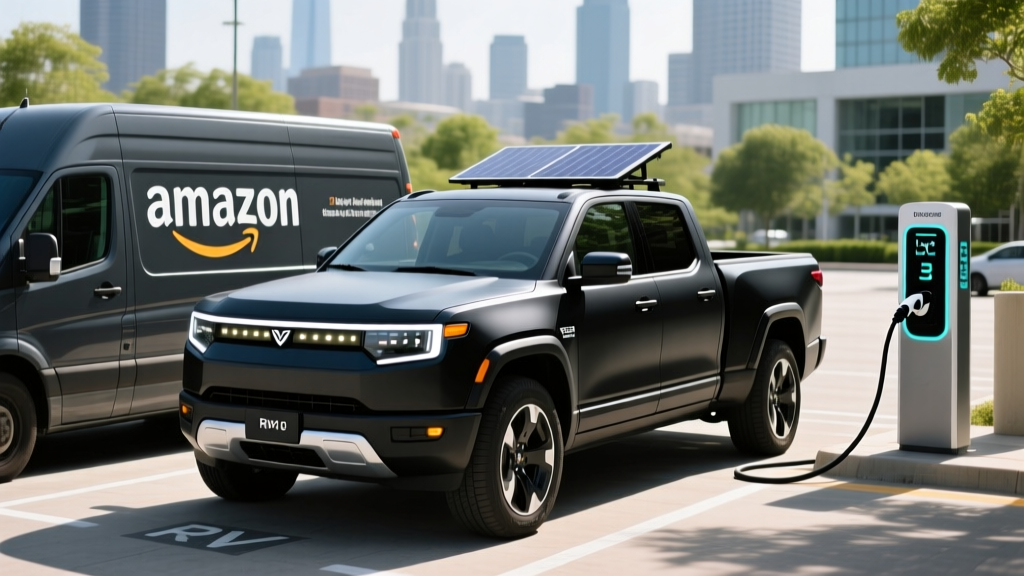
When you see a Rivian Electric Delivery Van (EDV) rolling through your neighborhood with an Amazon smile on the grille, you're looking at the physical manifestation of one of the most consequential corporate bets in EV history. But for prospective Rivian buyers — whether you're eyeing an R1S, R1T, or the upcoming R2 — the question isn't just idle curiosity: how much of Rivian does Amazon own, and what does that ownership stake mean for the company's stability, its technology pipeline, and your purchase decision?
This guide breaks down the Amazon-Rivian ownership structure as of 2026, then pivots to a full technical profile of the Rivian EDV — the vehicle that put Rivian's manufacturing muscle on the map — along with practical context for retail Rivian buyers navigating range, charging, tax credits, and real-world ownership.
Amazon's Rivian Stake: The Numbers Behind the Partnership
Amazon's relationship with Rivian began in September 2019, when the e-commerce giant announced an order for 100,000 electric delivery vans — the largest EV fleet order in history at the time. Alongside that order, Amazon led a $700 million funding round and accumulated a significant equity position.
As of early 2026, Amazon holds approximately 17% of Rivian's outstanding shares, down from a peak of roughly 22% at Rivian's November 2021 IPO. Amazon has periodically trimmed its position through scheduled sales, but it remains Rivian's largest single shareholder and its most important commercial customer.
- Amazon's estimated stake: ~17% of outstanding common stock
- Original order: 100,000 EDVs, with delivery milestones through 2030
- Revenue dependency: Amazon-related revenue accounts for a substantial portion of Rivian's total, though retail (R1S/R1T/R2) is growing
- Warrant implications: Amazon holds warrants tied to EDV delivery milestones that could adjust ownership if exercised
- Exclusivity: An early exclusivity clause preventing Rivian from selling EDVs to other fleets expired in late 2023, opening a new commercial revenue stream
For retail buyers, the takeaway is twofold. Amazon's stake gives Rivian a reliable revenue anchor and has forced the company to scale manufacturing faster than most EV startups manage. But it also means Rivian's financial health remains partially tethered to one customer's fleet decisions — a risk worth monitoring if you're committing to a brand for the long haul.
Rivian EDV: Full Specs and Technical Profile
The Rivian EDV (Electric Delivery Van) isn't sold to consumers, but its engineering underpins the same skateboard platform and manufacturing ecosystem that produces the R1S and R1T. Here's the complete spec breakdown for the most common variant, the EDV-700 (the mid-size van in Amazon's fleet).
| Spec | Value |
|---|---|
| EPA Estimated Range | ~150 miles (fully loaded) |
| Battery Capacity | ~105 kWh usable (NMC lithium-ion) |
| Drivetrain | Single-motor front-wheel drive |
| Horsepower | ~275 hp |
| 0-60 mph | N/A (governed for commercial use) |
| Max DC Fast Charge | ~115 kW peak |
| 10-80% DC Charge | ~45 minutes |
| Level 2 Charge Rate | ~11.5 kW (depot charging) |
| Cargo Volume | ~660 cu ft (EDV-700) |
| Efficiency | ~1.8-2.2 kWh/mile (route-dependent) |
| Base Price | Fleet-only; not consumer-priced |
Rivian also builds the EDV-500 (smaller cargo area, ~500 cu ft) and the EDV-900 (larger, ~850 cu ft), each with correspondingly adjusted battery sizes and range figures.
Real-World Range: What the EPA Number Doesn't Tell You
EPA estimated: ~150 miles (fully loaded). In real-world Amazon delivery routes, drivers report achieving 120-140 miles on dense urban stop-and-go routes with frequent regenerative braking opportunities, and as low as 100-115 miles on suburban/rural routes with higher sustained speeds. Cold-weather operation in northern U.S. climates can reduce range by 20-30%, bringing effective range to 105-120 miles without preconditioning. The EDV's large frontal area and boxy aerodynamics amplify highway-speed and cold-weather losses compared to a sedan or crossover.
For context, Amazon has designed its delivery routes around this reality. Most EDV routes are planned to stay well under 100 miles per shift, returning to the depot with 20-30% State of Charge (SoC) remaining. This is a deliberate engineering and operational choice: the van doesn't need 300 miles of range because its job is predictable and local.
Charging Speed: Depot-Centric Design
The EDV is optimized for overnight depot charging, not public fast-charging networks. Here's the full charging picture:
| Level | Power | Miles Added/Hour | Use Case |
|---|---|---|---|
| Level 1 (120V) | ~1.4 kW | ~0.7 mi/hr | Not practical for fleet |
| Level 2 (240V) | ~11.5 kW | ~6-7 mi/hr | Overnight depot charge (~10-12 hrs for full) |
| DC Fast Charge | ~115 kW peak | ~70-80 mi/hr (peak) | Mid-shift top-up; 10-80% in ~45 min |
A critical nuance: the EDV's charge curve tapers significantly above 80% SoC. Fleet operators typically charge to 80-85% overnight to avoid the slow taper and preserve long-term battery health. The ~115 kW peak DC rate is modest compared to Rivian's consumer vehicles (the R1T and R1S can peak at over 200 kW on the latest battery packs), but it's adequate for a van that returns to the same depot every night.
Amazon has invested heavily in depot charging infrastructure, installing tens of thousands of Level 2 chargers across its U.S. fulfillment network. Many depots also feature DC fast chargers for mid-shift top-ups on longer routes or double-shift operations.
What This Means for Retail Rivian Buyers: R1S and R1T Context
You can't buy an EDV, but the Amazon partnership directly shapes the Rivian you can buy. Here's how the EDV program benefits retail R1S and R1T owners:
- Manufacturing scale: The EDV contract gave Rivian the revenue certainty to build out its Normal, Illinois factory and invest in a second plant in Stanton, Georgia (coming online for R2 production). Without Amazon, Rivian might not have survived the capital-intensive production ramp that killed competitors like Lordstown Motors.
- Battery supply chain: EDV volumes secured battery cell supply agreements that benefit the R1 platform. Rivian has negotiated long-term NMC and LFP cell contracts partly on the back of fleet volume commitments.
- Software maturity: Running thousands of EDVs daily generates massive real-world data on battery management, thermal systems, and over-the-air update reliability — all of which flows back into the consumer vehicles.
- Service network: Rivian's mobile service and repair infrastructure was built partly to support Amazon's fleet uptime requirements, meaning R1 owners benefit from a more robust service footprint than a typical EV startup could afford.
Consumer Rivian Pricing, Tax Credits, and Ownership Costs
While the EDV is fleet-only, here's a snapshot of the consumer Rivian lineup as of 2026, with federal tax credit context:
| Model | Base MSRP | EPA Range | §30D Credit Eligible? |
|---|---|---|---|
| R1T Dual-Motor (Standard) | ~$69,900 | ~270 mi | Partial — varies by battery sourcing |
| R1S Dual-Motor (Standard) | ~$74,900 | ~260 mi | Partial — varies by battery sourcing |
| R1T/R1S Max Pack | ~$89,000+ | ~350+ mi | MSRP cap may disqualify SUV; truck eligible |
| R2 (upcoming, late 2026) | ~$45,000 (announced) | ~300+ mi (est.) | Expected eligible |
- Maximum credit: Up to $7,500 for new EVs ($4,000 for used EVs under §25E)
- MSRP caps: $80,000 for SUVs/pickups/vans; $55,000 for sedans
- Buyer income caps: $300,000 joint / $225,000 head of household / $150,000 single (modified AGI)
- Battery sourcing: Credit splits into $3,750 for critical minerals + $3,750 for battery component assembly — both with escalating domestic-content thresholds per IRS §30D guidelines
- Point-of-sale transfer: Eligible buyers can transfer the credit to the dealer at purchase, reducing the out-of-pocket price immediately
Rivian's R1T qualifies as a pickup (higher MSRP cap), while the R1S qualifies as an SUV. Max Pack trims may push above the $80,000 SUV cap. Always verify current eligibility at fueleconomy.gov and consult a tax professional — sourcing rules change frequently.
EDV Tech, Driver Assists, and Warranty
The EDV comes loaded with purpose-built technology that reflects Amazon's operational requirements:
- Integrated route optimization: The van's infotainment system is deeply integrated with Amazon's delivery app, providing turn-by-turn routing optimized for package drop sequence.
- Driver assist (SAE Level 2): The EDV features automatic emergency braking, lane-keeping assist, and blind-spot monitoring. This is not autonomous driving — the driver must remain fully engaged at all times, consistent with NHTSA guidelines on Level 2 systems.
- Thermal management: Active liquid cooling and heating for the battery pack, critical for maintaining range in extreme temperatures and supporting consistent DC fast-charge speeds.
- Over-the-air updates: Like all Rivians, the EDV receives OTA software updates for performance, efficiency, and feature improvements.
Warranty: Rivian provides an 8-year / 175,000-mile battery and powertrain warranty for the EDV (higher mileage threshold than consumer vehicles due to fleet use). The consumer R1S and R1T carry an 8-year / 175,000-mile battery warranty with a 70% capacity retention threshold, and an 8-year / 125,000-mile powertrain warranty.
Pros and Cons: Rivian's Amazon Relationship for Buyers
Pros
- Amazon's stake provides financial stability and revenue predictability
- Fleet volume accelerated manufacturing scale and supply chain maturity
- Depot-charging data improves battery management across all Rivian vehicles
- Service infrastructure built for fleet uptime benefits retail owners
- Post-exclusivity: Rivian can now sell EDVs to other commercial fleets, diversifying revenue
Cons
- Heavy revenue dependency on a single customer creates concentration risk
- Amazon's periodic share sales can suppress Rivian's stock price
- EDV engineering focus may divert resources from consumer vehicle innovation
- Amazon's leverage could influence Rivian's strategic decisions (pricing, partnerships)
- Fleet vehicles depreciate differently — used EDVs entering the secondary market could complicate resale values
Who Is Rivian Best Suited For?
Setting aside the EDV (which is fleet-only), here's who should consider Rivian's consumer lineup:
- Adventure-oriented families: The R1S seats up to seven with a ~260-mile EPA range, genuine off-road capability, and a frunk for gear. Ideal for ski trips, camping, and national park road trips.
- Truck buyers who tow: The R1T offers up to ~11,000 lbs towing capacity with the Max Pack, plus the Gear Tunnel for secure storage. A strong alternative to the Ford F-150 Lightning for buyers who want a more premium interior.
- Tech-forward commuters: Rivian's software stack, OTA updates, and integrated navigation with charger routing make daily driving seamless.
- Buyers who value company stability: Amazon's ownership stake provides a financial backstop that most EV startups can't match, reducing the "will they be around in 5 years?" risk.
Who should look elsewhere: Budget-conscious buyers (Rivian starts near $70K), sedan seekers (no Rivian sedan exists), or those who want the widest public charging network access (Tesla's Supercharger network remains the most reliable, though Rivian owners have growing access via NACS adapters and the expanding non-Tesla Supercharger rollout).
Frequently Asked Questions
How much of Rivian does Amazon own in 2026?
Amazon holds approximately 17% of Rivian's outstanding common stock as of early 2026. This is down from roughly 22% at Rivian's 2021 IPO, as Amazon has periodically sold shares. Amazon remains Rivian's largest single shareholder and most important commercial customer.
Can I buy a Rivian EDV delivery van?
No. The EDV is a fleet-only vehicle built primarily for Amazon, though following the expiration of an exclusivity clause in late 2023, Rivian has begun offering EDVs to other commercial fleets. Individual consumers cannot purchase an EDV. The consumer lineup consists of the R1S (SUV), R1T (pickup), and the upcoming R2 (compact SUV).
What is the real-world range of Rivian's consumer vehicles?
The R1T Dual-Motor achieves an EPA-estimated ~270 miles; expect 230-250 miles in mixed highway driving and 190-210 miles in cold weather (below 30°F). The R1S is similar at ~260 miles EPA. The Max Pack variants push to ~350+ miles EPA but at a significant price premium. Always precondition the battery before DC fast charging and before cold-weather driving to maximize range.
Does Rivian qualify for the federal EV tax credit?
Eligibility varies by model, trim, and your personal tax situation. The R1T (as a pickup) and R1S (as an SUV) both fall under the $80,000 MSRP cap for their vehicle classes. However, the $7,500 credit splits into two halves tied to battery critical-mineral sourcing and component assembly requirements, which change annually. Max Pack trims on the R1S may exceed the $80,000 SUV cap. Check current eligibility at fueleconomy.gov and verify with a tax professional.
How fast do Rivian consumer vehicles charge?
The latest R1T and R1S with the Max Pack can peak at over 200 kW on DC fast chargers, achieving a 10-80% charge in approximately 25-30 minutes. Standard pack models peak around 190 kW. Level 2 home charging operates at up to 11.5 kW, adding roughly 25-28 miles of range per hour — adequate for overnight replenishment of daily driving.
Is Rivian a safe long-term bet given its Amazon dependency?
Amazon's stake provides meaningful financial stability, and Rivian's expanding retail lineup (especially the more affordable R2) is reducing its dependency on fleet revenue. The risk of Amazon concentration is real but declining. For buyers, Rivian's 8-year battery warranty and growing service network provide reasonable long-term ownership security, though as with any younger automaker, there is more uncertainty than with legacy brands.