Quick Verdict: Why the Rivian Adventure Network Matters for Buyers
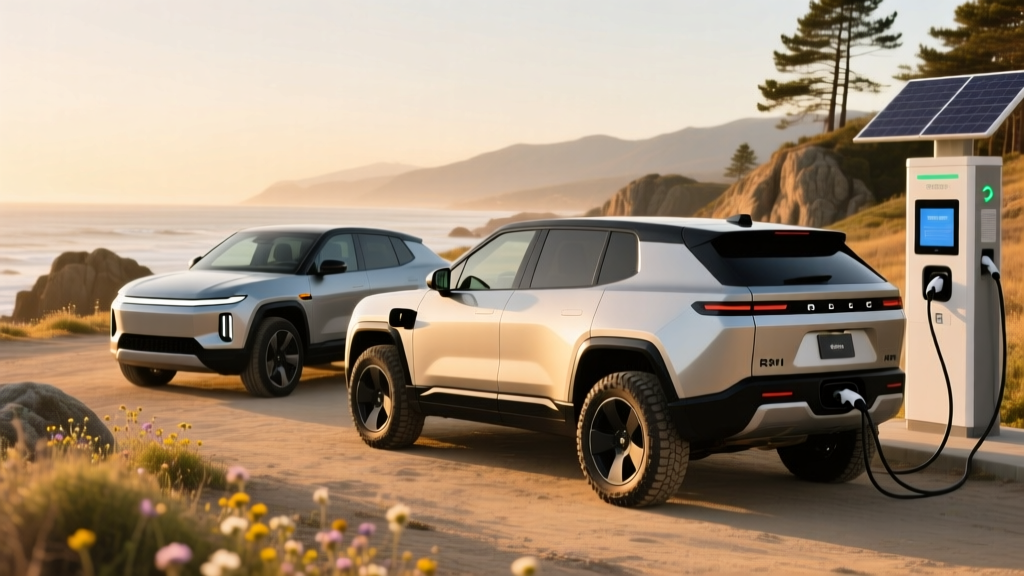
If you are evaluating a Rivian R1S SUV or R1T pickup in 2026, the hardware is only half the story. The Rivian Adventure Network — the company's proprietary and partner-integrated DC fast-charging ecosystem — has become a decisive factor for road-trip-capable EV ownership. With NACS (Tesla Supercharger) access now standard via native port on the refreshed R1 platform, and Rivian's own Waypoint chargers deployed at trailheads, national park gateways, and adventure destinations, the charging moat around these vehicles has widened considerably.
But charging infrastructure is only valuable if the vehicle can actually use it efficiently. This review breaks down the 2026 Rivian R1S and R1T with exact specs — EPA range, battery chemistry, peak and sustained charge rates, real-world highway and cold-weather expectations, pricing after federal tax credits, and whether the Adventure Network justifies the premium over competitors like the Tesla Model X, Ford F-150 Lightning, and Hyundai Ioniq 9.
Range & Efficiency: EPA Sticker vs. Real-World Reality
Rivian offers the refreshed R1S and R1T with two primary battery packs for 2026: the Standard (LFP chemistry, ~92 kWh usable) and the Max Pack (NMC chemistry, ~141 kWh usable). A Dual-Motor configuration is standard, with a Tri-Motor and Quad-Motor available on higher trims. Range varies significantly by configuration.
| Configuration | Battery | Chemistry | EPA Range (mi) | MPGe (Combined) | kWh/100 mi |
|---|---|---|---|---|---|
| Dual-Motor Standard | ~92 kWh | LFP | 270 (R1S) / 258 (R1T) | 73 / 70 | 46 / 48 |
| Dual-Motor Max | ~141 kWh | NMC | 410 (R1S) / 390 (R1T) | 70 / 67 | 48 / 50 |
| Tri-Motor Max | ~141 kWh | NMC | 380 (R1S) / 360 (R1T) | 65 / 62 | 52 / 54 |
The EPA numbers above assume a mix of city and highway driving at moderate temperatures. In our experience and consistent with third-party testing:
- Highway (70-80 mph, summer): Expect ~85-90% of EPA. A Dual-Motor Max R1S stickered at 410 mi will deliver roughly 345-370 mi on a flat interstate run.
- Highway (70-80 mph, winter, 20-30°F): Expect ~65-75% of EPA. That same 410-mi R1S drops to approximately 265-305 mi. Rivian's heat pump helps, but cold air density and cabin heating still take a significant toll on a 6,000+ lb vehicle.
- Towing (5,000 lb trailer): Range roughly halves. Plan for 180-210 mi between charges on the Max Pack.
- City/stop-and-go (regen-heavy): You can meet or slightly exceed EPA thanks to aggressive regenerative braking recapturing energy.
Source: EPA fueleconomy.gov
The LFP Standard pack is the pragmatic choice for commuters who charge at home nightly. LFP chemistry tolerates regular 100% charging without accelerated degradation, meaning you can use the full 92 kWh daily. The NMC Max Pack is for road-trippers and tow-haulers who need every mile — but Rivian recommends charging to 80-90% for daily use to preserve long-term State of Health (SoH).
Charging Speed: DC Fast, Level 2, and the Adventure Network
Charging speed is where the Rivian Adventure Network story gets concrete. The 2026 R1S and R1T feature a native NACS charge port, eliminating the adapter hassle that early Rivian owners dealt with when accessing Tesla Superchargers. The vehicle's charge architecture supports up to 220 kW peak DC fast charging on the Max Pack and ~190 kW on the Standard LFP pack.
| Charging Level | Power / Rate | Speed | Notes |
|---|---|---|---|
| Level 1 (120V household) | ~1.4 kW | ~3-4 mi/hr | Emergency/trickle only; impractical for daily use on Max Pack |
| Level 2 (240V home, 48A) | 11.5 kW | ~25-28 mi/hr | Full charge in ~8-12 hours depending on pack size; ideal overnight |
| Level 2 (240V home, 60A) | 14.4 kW | ~31-35 mi/hr | Requires 75A+ circuit; fastest home option |
| DC Fast (NACS Supercharger / Rivian Waypoint) | Up to 220 kW peak | 10-80% in ~28-32 min (Max); ~22-26 min (Standard) | Peak rate sustained to ~55% SoC, then tapers; preconditioning critical |
Charge curve reality: Rivian's peak 220 kW is not sustained across the full 10-80% session. Expect peak rates between 10-55% State of Charge, tapering to ~120 kW by 65%, and dropping below 80 kW past 75%. This is normal lithium-ion behavior, but it means your 30-minute estimate only holds if you arrive at a low SoC and leave by 80%. Charging from 80-100% on DC fast adds another 25-35 minutes — plan accordingly on road trips.
Preconditioning matters. When you navigate to a Rivian Adventure Network charger or a Tesla Supercharger via the built-in navigation, the battery thermal management system begins warming (or cooling) the pack to the optimal temperature for peak charge acceptance. Skipping preconditioning — for example, by pulling into a charger without using navigation routing — can reduce peak charge rate by 30-50%, especially in cold weather.
What Is the Rivian Adventure Network, Exactly?
The Rivian Adventure Network is not a single monolithic charging system. It is a layered ecosystem:
- Rivian Waypoint Chargers: Proprietary DC fast chargers (150-200 kW) installed at adventure-adjacent locations — trailheads, ski areas, national park entrances, and overlanding routes. These are the chargers that differentiate Rivian from competitors and are strategically placed where public charging is sparse.
- Tesla Supercharger Access (NACS): With the native NACS port, every Rivian can access 20,000+ Tesla Superchargers across North America. This is the backbone of long-distance travel and provides redundancy in urban corridors.
- Rivian Adventure Network App Integration: The in-vehicle software and Rivian app aggregate real-time availability, pricing, and routing across Waypoint chargers, Superchargers, and third-party networks (Electrify America, EVgo) into a single trip planner.
For the adventure-oriented buyer — someone who drives to Moab, the Sierra Nevada, or the Blue Ridge Parkway — the Waypoint chargers fill genuine gaps. For commuters, Supercharger access handles 95% of public charging needs.
Performance & Drivetrain: 0-60, Horsepower, and Capability
Rivian's skateboard platform delivers serious performance regardless of which motor configuration you choose. The dual-motor setup provides one motor per axle (AWD standard), while the tri-motor adds a second rear motor for torque-vectoring and higher output.
| Configuration | Drivetrain | Horsepower | Torque (lb-ft) | 0-60 mph | Towing Capacity |
|---|---|---|---|---|---|
| Dual-Motor | AWD | 533 hp | 610 | 4.5 sec | 7,700 lb (R1T) / 7,700 lb (R1S) |
| Tri-Motor | AWD | 850 hp | 1,100+ | 2.9 sec | 11,000 lb (R1T) |
The Dual-Motor's 4.5-second 0-60 time is more than adequate for highway merging, off-road crawling, and daily driving. The Tri-Motor's 2.9-second sprint is supercar territory in a 7,000-lb vehicle — impressive but largely a flex unless you're drag-racing at stoplights. For most buyers, the Dual-Motor with the Max Pack offers the best balance of range, performance, and price.
Off-road, Rivian's air suspension provides up to 14.9 inches of ground clearance, a wading depth of over 3 feet, and approach/departure angles that rival dedicated off-road SUVs. The quad-motor tank-turn feature (available on select trims) allows the vehicle to rotate in place by spinning left and right wheels in opposite directions — useful on tight trails, though it's more novelty than daily necessity.
Interior, Cargo, and Technology
The R1S seats up to seven passengers across three rows, while the R1T seats five in a crew-cab configuration. Both feature Rivian's vertically integrated infotainment system on a 15.6-inch center display, with no Apple CarPlay or Android Auto — a decision that frustrates some buyers but allows Rivian to deeply integrate vehicle controls, navigation, and charging management.
| Dimension | R1S (SUV) | R1T (Pickup) |
|---|---|---|
| Front legroom | 41.3 in | 41.3 in |
| Second-row legroom | 38.5 in | 38.5 in |
| Third-row legroom (R1S) | 30.1 in | N/A |
| Cargo behind 3rd row | 10.6 cu ft | N/A |
| Cargo behind 2nd row | 46.7 cu ft | N/A |
| Cargo max (seats folded) | 88.2 cu ft | N/A |
| Bed length (R1T) | N/A | 54.0 in (4.5 ft) |
| Frunk | 11.0 cu ft | 11.0 cu ft |
| Gear Tunnel (R1T) | N/A | 11.7 cu ft |
The R1T's Gear Tunnel — a transverse storage compartment running the width of the vehicle between the cab and bed — is a genuinely innovative feature. It holds skis, camping gear, or groceries and is accessible from both sides. The R1S lacks this but compensates with a usable third row (best for children) and more total enclosed cargo volume.
Driver assistance: Rivian's Driver+ system is an SAE Level 2 hands-on-wheel highway assist. It provides adaptive cruise control, lane centering, and automatic lane changes on divided highways. It is not self-driving — the driver must maintain attention and keep hands on the wheel. It competes with Ford BlueCruise and GM Super Cruise in capability, though GM's system currently allows true hands-free operation on mapped highways while Rivian requires contact.
Pricing, Trims, and Federal Tax Credit Eligibility
Rivian positions the R1S and R1T in the premium adventure-EV segment. Base pricing starts in the mid-$70,000s, with fully loaded Tri-Motor configurations approaching $100,000+. Here is the 2026 pricing landscape:
| Trim / Config | Body | Base MSRP | §30D Credit Eligible? | Effective Price (est.) |
|---|---|---|---|---|
| Dual-Motor Standard | R1S | $75,900 | Yes (if under MSRP cap + income/sourcing rules met) | ~$68,400 |
| Dual-Motor Standard | R1T | $73,000 | Yes | ~$65,500 |
| Dual-Motor Max | R1S | $85,900 | Yes (SUV MSRP cap is $80,000 — may NOT qualify) | $85,900 (verify) |
| Tri-Motor Max | R1T | $99,900 | Likely no (exceeds $80K truck cap) | $99,900 |
- MSRP cap: SUVs, vans, and pickups must be at or below $80,000 MSRP. Sedans: $55,000. Options and destination charges count toward the cap.
- Buyer income cap: Modified AGI must not exceed $300,000 (joint), $225,000 (head of household), or $150,000 (single).
- Battery sourcing: A percentage of critical minerals and battery components must be sourced from the US or FTA partners. These thresholds increase annually — check current-year rules at IRS.gov.
- Point-of-sale transfer: Eligible buyers can transfer the credit to the dealer at purchase, reducing the upfront cost rather than waiting for a tax refund.
Important: Tax credit eligibility is complex and changes with battery sourcing rules. Consult a tax professional and verify on IRS.gov before purchasing. Rivian's Dual-Motor Standard trims are most likely to qualify; Max Pack and Tri-Motor trims often exceed the MSRP cap.
Battery, Warranty, and Long-Term Ownership
Rivian backs the R1S and R1T with competitive warranty coverage:
- Battery & Drive Unit: 8 years / 175,000 miles (whichever comes first), with a guaranteed minimum 70% capacity retention over the warranty period.
- Vehicle (bumper-to-bumper): 5 years / 60,000 miles.
- Roadside Assistance: 5 years / 60,000 miles.
The 175,000-mile battery warranty is above the industry standard of 100,000 miles (though Tesla matches with 120,000-150,000 depending on model). The 70% retention threshold is standard — if your battery degrades below 70% of original capacity within the warranty window, Rivian will repair or replace it.
LFP vs. NMC longevity: The LFP Standard pack is expected to show less degradation over time. LFP chemistry typically retains 85-90%+ capacity after 1,000+ full cycles, making it ideal for high-mileage daily drivers. The NMC Max Pack offers higher energy density (more range per pound) but may degrade slightly faster — expect 80-85% retention at 150,000 miles under normal use. Both chemistries are well within the warranty threshold for the typical ownership period.
Pros and Cons: The Honest Assessment
- Class-leading off-road capability with air suspension, 14.9" ground clearance, and 3+ ft wading depth
- Native NACS port gives seamless access to 20,000+ Tesla Superchargers
- Rivian Adventure Network Waypoint chargers fill genuine gaps at adventure destinations
- Dual-Motor 4.5-sec 0-60 with 7,700-lb towing is best-in-class for an electric SUV/pickup
- Gear Tunnel (R1T) and frunk provide innovative, practical storage
- LFP Standard pack option allows daily 100% charging without degradation anxiety
- 8-yr/175,000-mi battery warranty exceeds most competitors
- OTA software updates continuously add features and improve performance
- Base MSRP starts at $73K+; most configurations exceed the $80K §30D tax credit MSRP cap
- No Apple CarPlay or Android Auto — Rivian's native system only
- Real-world highway range drops to 65-75% of EPA in cold weather — a 410-mi Max Pack delivers ~270 mi in winter
- Driver+ is Level 2 hands-on; not as advanced as GM Super Cruise for hands-free highway driving
- Towing cuts range roughly in half — long tows require frequent charging stops
- Third row in R1S is tight (30.1" legroom) — best for children only
- Peak 220 kW DC charge rate tapers significantly above 55% SoC
- Rivian service center network is still expanding — some owners face long travel for warranty work
Who Should Buy the Rivian R1S or R1T?
- You need a 3-row electric SUV with genuine off-road capability and don't want a body-on-frame compromise
- You regularly drive to adventure destinations where the Rivian Adventure Network Waypoint chargers provide coverage others lack
- You want native Supercharger access without an adapter for cross-country road trips
- You value OTA updates and a vertically integrated software experience over CarPlay
- You need a pickup that can tow 7,700-11,000 lbs while delivering sub-5-second 0-60 performance
- The Gear Tunnel and 4.5-ft bed serve your gear-hauling needs (skis, bikes, camping equipment)
- You want a daily-drivable truck that doesn't feel like a commercial vehicle
- Your budget is under $65,000 — consider the Hyundai Ioniq 5, Chevrolet Equinox EV, or a used Rivian with the used EV credit
- You prioritize hands-free highway driving — GM's Super Cruise on the Cadillac Escalade IQ is more mature
- You need CarPlay/Android Auto integration
- Your daily commute is under 40 miles and you never tow — the Standard pack suffices, but a smaller, cheaper EV may be more practical
Frequently Asked Questions
What is the real-world range of the Rivian R1S and R1T?
EPA estimates range from 258 miles (R1T Dual-Motor Standard) to 410 miles (R1S Dual-Motor Max). In real-world highway driving at 70-80 mph in summer, expect 85-90% of those numbers. In winter (20-30°F), expect 65-75%. Towing a 5,000-lb trailer roughly halves range. The Max Pack configurations provide the most buffer for road trips and cold weather.
How fast does a Rivian charge on the Adventure Network and at home?
On DC fast chargers (Rivian Waypoint or Tesla Supercharger), the Max Pack peaks at 220 kW, achieving a 10-80% charge in approximately 28-32 minutes with proper preconditioning. The Standard LFP pack peaks at ~190 kW with a 10-80% time of about 22-26 minutes. At home on a 48A Level 2 charger (11.5 kW), expect ~25-28 miles of range per hour, fully replenishing the Max Pack overnight in 10-12 hours.
How much does a Rivian cost after the federal tax credit?
The Dual-Motor Standard R1T starts at $73,000 MSRP and may qualify for the full $7,500 §30D credit if the buyer meets income limits and battery sourcing requirements, bringing the effective price to approximately $65,500. However, most Max Pack and Tri-Motor configurations exceed the $80,000 MSRP cap for SUVs and trucks and do not qualify. Always verify current eligibility at IRS.gov before purchasing.
Is the Rivian worth buying vs. the Tesla Model X, Ford F-150 Lightning, or Hyundai Ioniq 9?
It depends on your use case. The Rivian R1T has no direct electric pickup rival that matches its combination of off-road capability, performance, and the Gear Tunnel. The R1S competes with the Tesla Model X (which has a larger Supercharger network but less off-road ability and a polarizing yoke steering option) and the Hyundai Ioniq 9 (which is more affordable but less capable off-road and has less range on base trims). The Ford F-150 Lightning is a more traditional truck shape with a larger bed and lower starting price, but it lacks the Rivian's air suspension and adventure-focused charging network. If adventure travel and off-pavement capability are priorities, the Rivian is the strongest choice in its class.
Does the Rivian qualify for the federal EV tax credit in 2026?
Some configurations do. The Dual-Motor Standard R1S ($75,900) and R1T ($73,000) fall under the $80,000 MSRP cap for SUVs and trucks. However, eligibility also depends on the buyer's modified adjusted gross income (under $300K joint / $150K single), battery critical-mineral sourcing requirements that tighten annually, and final assembly in North America (Rivian assembles in Normal, Illinois — this requirement is met). Max Pack and Tri-Motor trims generally exceed the MSRP cap. Verify on IRS.gov and consult a tax professional.
What are the biggest drawbacks of owning a Rivian?
The most cited owner complaints include: the lack of Apple CarPlay/Android Auto (Rivian uses its proprietary system exclusively), cold-weather range loss on long road trips, the high starting price that pushes most trims above the federal tax credit MSRP cap, and the still-growing service center network that can require long drives for warranty repairs in rural areas. The Driver+ system is competent but requires hands-on-wheel engagement, unlike GM's hands-free Super Cruise.
Can I charge a Rivian at non-Rivian chargers?
Yes. With the native NACS port on 2026 models, you can charge at any Tesla Supercharger without an adapter. For CCS-equipped chargers (some Electrify America and EVgo stations that have not yet transitioned to NACS), a NACS-to-CCS adapter is needed. Level 2 J1772 public chargers work with a NACS-to-J1772 adapter, which Rivian includes with the vehicle.