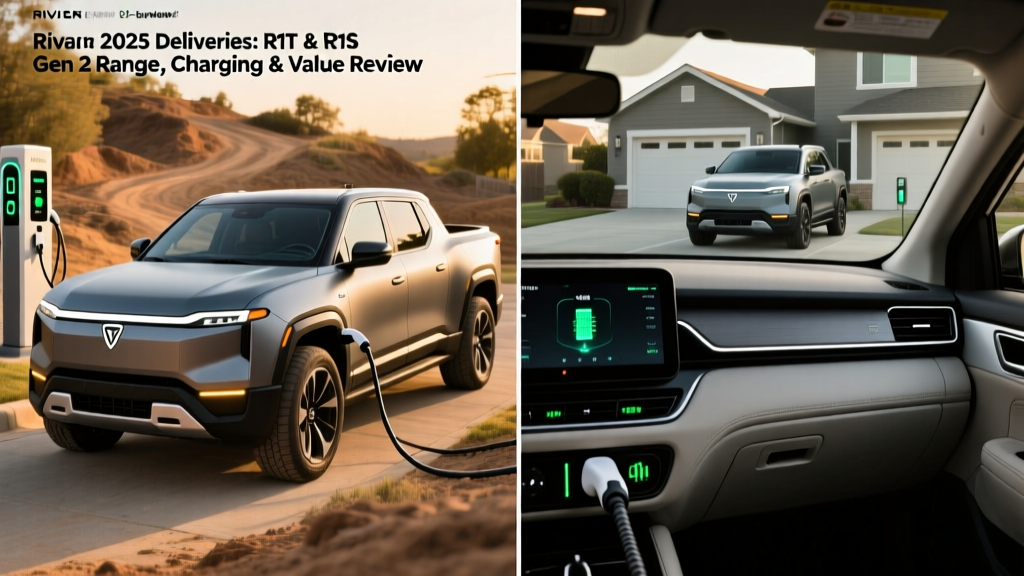
Rivian's Gen 2 R1T pickup and R1S SUV began reaching driveways in mid-2024, and Rivian 2025 deliveries are now accelerating as production capacity at the Normal, Illinois plant scales. The updated platform brings a new electrical architecture, faster DC charging, a tri-motor option, and meaningful weight savings. But with base prices still north of $70,000 and a shifting federal tax credit landscape, buyers need hard numbers before committing.
This review covers the 2025 Rivian R1T and R1S lineup with exact EPA range figures, real-world efficiency data, charging speeds, pricing by trim, and current IRS §30D eligibility — everything you need to evaluate whether a Gen 2 Rivian belongs in your garage.
2025 Rivian R1T & R1S: Spec Overview
| Spec | R1T (Dual-Motor, Standard) | R1S (Dual-Motor, Standard) |
|---|---|---|
| EPA Range | 270 miles | 261 miles |
| Battery (usable) | ~92 kWh (NMC) | ~92 kWh (NMC) |
| Max DC Fast Charge | 200 kW (peak) | 200 kW (peak) |
| 10–80% DC Time | ~30 minutes | ~30 minutes |
| Level 2 Home Charging | 11.5 kW (~25 mi/hr) | 11.5 kW (~25 mi/hr) |
| 0–60 mph | 4.5 sec | 4.6 sec |
| Horsepower | 533 hp | 533 hp |
| Drivetrain | AWD (dual-motor) | AWD (dual-motor) |
| MPGe (combined) | 73 MPGe | 71 MPGe |
| Efficiency | 46 kWh/100 mi | 48 kWh/100 mi |
| Base MSRP | $69,900 | $74,900 |
| Battery/Powertrain Warranty | 8 yr / 175,000 mi | 8 yr / 175,000 mi |
Source: fueleconomy.gov, Rivian official specifications. Specs vary by battery pack and motor configuration.
Range: EPA Sticker vs. Real-World Expectations
EPA Estimate: 270 miles
Real-World Highway (70 mph, moderate temps): ~230–245 miles
Cold Weather (below 32°F, highway): ~190–210 miles
Mixed Commute (city + suburban): ~255–270 miles
Regenerative braking recovers more energy in stop-and-go driving. Highway efficiency suffers from the R1T's boxy aerodynamics and ~7,000 lb curb weight.
The R1T and R1S are available in three battery configurations for 2025: Standard (~92 kWh usable), Large (~109 kWh usable), and Max (~141 kWh usable). All use NMC (nickel manganese cobalt) chemistry, which offers higher energy density than LFP but is more sensitive to sustained 100% state-of-charge storage.
The Max Pack R1T pushes the EPA range to 420 miles — one of the longest ranges of any production EV. However, the Max Pack adds significant cost and approximately 400 lbs of weight, which reduces efficiency and payload capacity. For most buyers, the Large Pack (EPA 352 miles, R1T) provides the best balance of range and value.
If you live in a cold climate or regularly drive highway speeds above 75 mph, plan for 15–25% range reduction from the EPA sticker. The R1T's heat pump (standard on Gen 2) mitigates some cold-weather loss compared to Gen 1 vehicles, but the physics of a heavy, aerodynamically blunt truck can't be fully overcome.
Charging Speed: DC Fast and Home Level 2
| Charging Level | Power / Rate | Miles Added per Hour | Notes |
|---|---|---|---|
| Level 1 (120V) | ~1.4 kW | ~3–4 mi/hr | Emergency/trickle only |
| Level 2 (240V, 48A) | 11.5 kW | ~25 mi/hr | Full charge in ~9–12 hrs depending on pack |
| DC Fast Charge | 200 kW peak | ~140 mi in 20 min (Large Pack) | Tapers significantly above 80% SoC |
Gen 2 Rivians charge at up to 200 kW peak on DC fast chargers — an improvement over Gen 1's ~190 kW. On a 350 kW Electrify America or Tesla Supercharger stall (with NACS adapter), you'll see peak speeds sustained from roughly 10–40% SoC, after which the charge curve tapers. The 10–80% charge takes approximately 30 minutes for the Standard and Large packs.
Charging curve reality: Above 80% SoC, charging drops below 50 kW to protect the NMC cells. If you need to charge past 80% on a road trip, budget an extra 20–30 minutes. For daily driving, Rivian recommends setting a charge limit of 80–85% to maximize long-term battery health.
At home, the onboard 11.5 kW charger means a Level 2 wall connector on a 60-amp circuit (48A continuous) adds about 25 miles of range per hour. A full overnight charge from 20% to 80% on the Large Pack takes roughly 7 hours. Rivian includes a portable charger with each vehicle that handles both 120V and 240V outlets, though dedicated Rivian Wall Connector installation is recommended for daily use. Expect $500–$1,500 for professional Level 2 installation depending on your electrical panel capacity and run length.
Performance and Drivetrain
The 2025 R1T and R1S offer three motor configurations:
- Dual-Motor AWD: 533 hp, 610 lb-ft torque, 0–60 in ~4.5 seconds
- Performance Dual-Motor: 665 hp, 829 lb-ft, 0–60 in ~3.4 seconds
- Tri-Motor AWD: 850+ hp, 1,100+ lb-ft, 0–60 in ~2.9 seconds (R1T only)
Even the base dual-motor configuration delivers sports-car acceleration in a 7,000-lb truck. The Gen 2 platform uses a new silicon carbide inverter and improved thermal management, allowing sustained performance without the power derating that affected some Gen 1 models during repeated hard launches.
The R1T's towing capacity is 11,000 lbs (properly equipped), and the R1S tows up to 7,700 lbs. However, towing cuts range dramatically — expect a 40–50% reduction when pulling a heavy trailer at highway speeds. Rivian's tow mode adjusts regen and throttle mapping, but no EV pickup currently offers competitive range while towing compared to diesel alternatives.
Pricing, Trims, and Federal Tax Credit Eligibility
| Configuration | Base MSRP | Est. Federal Credit | Effective Price |
|---|---|---|---|
| Dual-Motor / Standard Pack | $69,900 | Up to $7,500* | ~$62,400 |
| Dual-Motor / Large Pack | $75,900 | Up to $7,500* | ~$68,400 |
| Performance Dual / Large | $84,900 | Up to $7,500* | ~$77,400 |
| Tri-Motor / Max Pack | $99,900+ | Up to $7,500* | ~$92,400+ |
*Federal tax credit eligibility is subject to IRS §30D rules. See details below.
The 2025 Rivian R1T starts at $69,900 (Dual-Motor, Standard battery) before destination. The R1S starts at $74,900. Most buyers opt for the Large Pack, which adds $6,000 but provides a meaningful range increase. Fully loaded Tri-Motor configurations push past $100,000.
Does the 2025 Rivian Qualify for the $7,500 Federal Tax Credit?
- MSRP Cap: Trucks/SUVs must be ≤$80,000. R1T Dual-Motor and Large Pack trims qualify; Performance Dual-Motor and Tri-Motor trims exceed the cap. ✅/❌ varies by trim.
- Buyer Income Cap: AGI ≤$300,000 (joint), $225,000 (head of household), $150,000 (single). ✅ if within limits.
- Battery Sourcing: Critical minerals and battery component requirements phase in annually. Rivian sources cells from Samsung SDI; check IRS.gov §30D guidance for current-year sourcing compliance. ⚠️ Verify before purchase.
- Point-of-Sale Transfer: The credit can be transferred to the dealer at purchase, reducing your out-of-pocket cost immediately (effective 2024+). ✅ available.
- Assembly: Must be assembled in North America. Rivian builds in Normal, Illinois. ✅
Interior, Cargo, and Practicality
The R1T seats five with generous legroom (41.3 inches front, 38.2 inches rear). Its party trick is the gear tunnel — a 11.7 cu ft pass-through storage compartment between the cab and bed, accessible from both sides. The 54-inch bed (4.5 feet) is shorter than a traditional half-ton truck, limiting its appeal for contractors hauling sheet goods, but it handles bikes, kayaks, and camping gear well. Total payload is approximately 1,760 lbs.
The R1S seats up to seven (with the optional third row), though the third row is best suited for children. Cargo space behind the third row is limited at ~10.5 cu ft, expanding to 57.5 cu ft with the third row folded and 104.7 cu ft with both rear rows down. The R1S also features a front trunk (frunk) with 11.1 cu ft of lockable storage.
Build quality on Gen 2 vehicles has improved notably — panel gaps are tighter, interior materials feel more premium, and the redesigned center console adds practical storage. The 15.6-inch center touchscreen runs Rivian's proprietary OS, which is responsive and well-organized but lacks Apple CarPlay and Android Auto. Wireless phone mirroring is not available; Rivian insists its native software provides deeper vehicle integration.
Tech, Driver Assistance, and Standout Features
Every 2025 Rivian includes the Rivian Driver+ suite — a Level 2 driver-assistance system featuring adaptive cruise control, lane centering, automatic lane changes (with confirmation), and hands-free highway driving on compatible mapped roads. Per SAE automation standards, this is a Level 2 system requiring continuous driver supervision. It is not self-driving.
This is a Level 2 driver-assist system, not autonomous driving. You must keep your hands on the wheel (or demonstrate attentiveness via the driver monitoring camera) and remain fully responsible for vehicle control at all times. The system may disengage unexpectedly in construction zones, poor lane markings, or adverse weather.
Standout tech features include:
- Camp Kitchen: Available slide-out kitchen system that integrates with the gear tunnel (R1T)
- Vehicle-to-Load (V2L): Power devices up to 1.5 kW from the bed outlet — useful for camping or job-site tools
- Over-the-air updates: Continuous feature additions and performance improvements
- Rivian Adventure Network: Proprietary Level 2 chargers at trailheads and outdoor destinations
- Quad-motor tank turns: (Tri-motor only) Low-speed pivot maneuvers for off-road situations
Notable drawbacks include the lack of Apple CarPlay/Android Auto, limited third-row practicality in the R1S, and a ride quality that can feel firm over sharp bumps despite the available air suspension.
Warranty and Long-Term Ownership
Rivian provides an 8-year / 175,000-mile battery and drive unit warranty — among the most generous in the EV truck segment. The battery is warranted to retain at least 70% of its original capacity during that period. The limited vehicle warranty covers 5 years / 60,000 miles.
NMC battery degradation data for Rivian's Gen 2 pack is still accumulating, but Gen 1 owners report approximately 5–8% degradation after 50,000 miles, which is consistent with industry norms for liquid-cooled NMC packs. Following the 80% daily charge limit recommendation and avoiding frequent DC fast charging will maximize long-term state of health.
Insurance costs for the R1T and R1S run 15–25% higher than comparable ICE trucks, reflecting the vehicle's purchase price, repair complexity, and limited collision-repair network. Get quotes before purchasing.
Who Should Buy a 2025 Rivian?
Choose the R1T if:
- You need an adventure-capable electric truck with genuine off-road ability and 11,000-lb towing
- You value the gear tunnel and integrated accessory ecosystem
- Your daily commute is under 200 miles round-trip, or you can charge at home
- You need three-row seating for family duty and want EV running costs
- You want a luxury electric SUV that can handle light off-road trails and ski trips
- You prioritize frunk + enclosed cargo space over an open bed
- You need a full-size truck bed for commercial work (consider the Ford F-150 Lightning or Chevy Silverado EV)
- Your budget is under $60,000 (consider waiting for the Rivian R2, expected 2026)
- You require Apple CarPlay/Android Auto integration
Pros and Cons
- Class-leading acceleration and off-road capability
- 420-mile Max Pack range (R1T)
- Innovative gear tunnel and V2L
- 8-yr/175,000-mi battery warranty
- Continuous OTA improvements
- North American assembly (Illinois)
- High starting price ($69,900+)
- No Apple CarPlay / Android Auto
- Short truck bed limits commercial use
- Towing cuts range by 40–50%
- Insurance premiums above average
- Service center network still expanding
Frequently Asked Questions
What is the real-world range of the 2025 Rivian R1T?
The EPA rates the R1T Dual-Motor Standard at 270 miles. In real-world highway driving at 70 mph in moderate temperatures, expect approximately 230–245 miles. Cold weather (below freezing) reduces this to roughly 190–210 miles on the highway. The Large Pack extends real-world highway range to ~300 miles, and the Max Pack can deliver ~350+ real-world highway miles.
How fast does the 2025 Rivian charge at home and on DC fast chargers?
On a DC fast charger, the Gen 2 Rivian peaks at 200 kW, achieving a 10–80% charge in approximately 30 minutes. At home on a Level 2 (240V, 48A) charger, the 11.5 kW onboard charger adds roughly 25 miles of range per hour, meaning a full overnight charge is realistic for most daily driving needs.
Does the 2025 Rivian qualify for the $7,500 federal EV tax credit?
It depends on the trim and your income. The R1T Dual-Motor Standard ($69,900) and Large ($75,900) fall under the $80,000 MSRP cap for trucks. Performance and Tri-Motor trims exceed it. Buyer AGI must be ≤$300,000 (joint) / $150,000 (single). Battery sourcing requirements also apply and change annually — verify on IRS.gov before purchasing.
Is the Rivian R1T worth buying over the Ford F-150 Lightning or Tesla Cybertruck?
The R1T excels in off-road capability, acceleration, and adventure-oriented design. The F-150 Lightning offers a larger bed, more traditional truck utility, and a lower starting price. The Cybertruck undercuts on price (base ~$60,990) but has polarizing styling and limited proven reliability data. If you prioritize adventure features and premium build, the R1T is compelling. If you need a work truck or have a tighter budget, the Lightning may be more practical.
What are the biggest drawbacks of the 2025 Rivian?
The main drawbacks are the high starting price, lack of smartphone mirroring (no CarPlay/Android Auto), short bed length for commercial use, significant range loss while towing, and an expanding-but-still-limited service center network. Insurance costs also run higher than average for the segment.
How long will the Rivian battery last?
Rivian warranties the NMC battery pack for 8 years or 175,000 miles, guaranteeing at least 70% capacity retention. Based on Gen 1 owner data and industry NMC degradation curves, expect 85–92% capacity retention at 100,000 miles with normal use (80% daily charge limit, limited DC fast charging). Full battery replacement cost, if needed out of warranty, is estimated at $15,000–$25,000 depending on pack size.