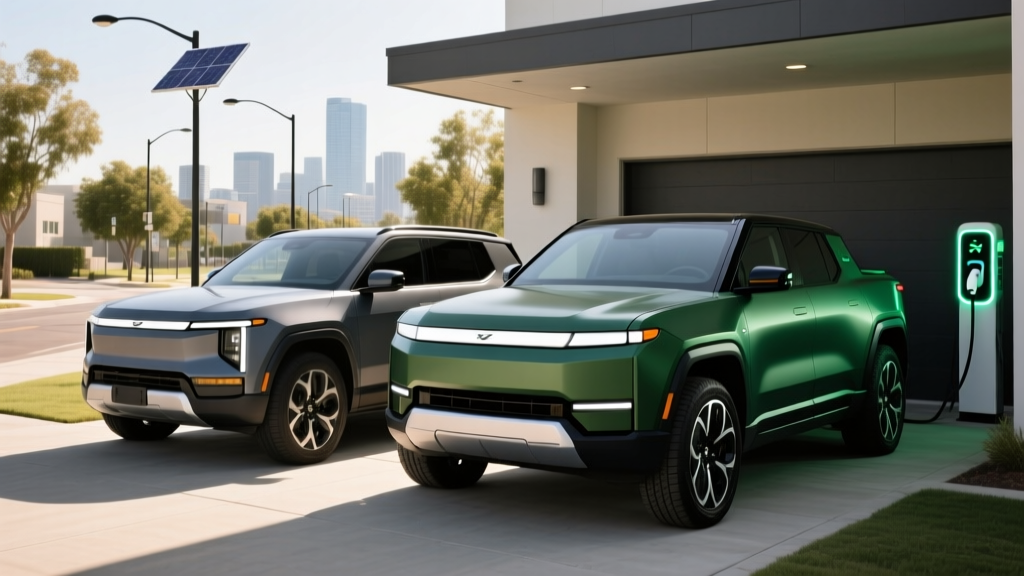
Rivian's over-the-air (OTA) software updates are among the most consequential in the EV industry — not just for infotainment tweaks, but for genuine vehicle-dynamic improvements, battery management refinements, and driver-assist capability expansions. The Rivian 2025.46 update, rolled out to R1S and R1T vehicles (both first-generation and the refreshed Gen 2 platform) in late 2025, is no exception. Now that several months of real-world owner data have accumulated into early 2026, we can assess what this update actually changed, whether it moved the needle on range and charging, and how the R1 platform stacks up against competitors like the Tesla Model X, Ford F-150 Lightning, and Chevrolet Silverado EV.
This review profiles the Rivian R1S and R1T as they stand post-2025.46, with exact specs, real-world range data, charging performance, pricing, and tax-credit eligibility — everything you need to evaluate whether a Rivian is the right electric adventure vehicle for you.
Rivian R1S and R1T: Post-Update Spec Snapshot
The 2025.46 update primarily targeted battery thermal management algorithms, regenerative braking tuning, and the Rivian Autonomy Platform (driver-assist stack). It did not alter the physical battery pack or motor hardware. Here is the current specification sheet for the most popular configurations as of early 2026:
| Spec | R1S Dual-Motor (Max Pack) | R1T Dual-Motor (Max Pack) | R1T Quad-Motor (Large Pack) |
|---|---|---|---|
| Battery Capacity (usable) | 149 kWh (NMC) | 149 kWh (NMC) | 128 kWh (NMC) |
| EPA Range | 410 miles | 415 miles | 328 miles |
| Horsepower | 533 hp | 533 hp | 835 hp |
| 0–60 mph | 4.5 sec | 4.5 sec | 3.0 sec |
| Drivetrain | AWD (dual-motor) | AWD (dual-motor) | AWD (quad-motor) |
| Max DC Fast Charge | 220 kW (peak) | 220 kW (peak) | 220 kW (peak) |
| 10–80% DCFC Time | ~42 min | ~42 min | ~34 min |
| Level 2 Home Charge Rate | 11.5 kW (~25 mi/hr) | 11.5 kW (~25 mi/hr) | 11.5 kW (~25 mi/hr) |
| Efficiency (MPGe) | 69 MPGe combined | 73 MPGe combined | 70 MPGe combined |
| Towing Capacity | 7,700 lbs | 11,000 lbs | 11,000 lbs |
| Base MSRP | $89,800 | $79,900 | $99,900 |
Sources: EPA fueleconomy.gov, Rivian R1T specs, Rivian R1S specs.
What the Rivian 2025.46 Update Actually Changed
Rivian's release notes for 2025.46 were characteristically detailed. The three headline changes and their real-world implications:
1. Battery Thermal Preconditioning Improvements
The update refined the battery preconditioning algorithm — the process by which the pack heats or cools itself to an optimal temperature window before arriving at a DC fast charger. Post-update, owners report that preconditioning initiates slightly earlier on navigation-routed trips to chargers, resulting in the pack arriving closer to the ideal ~35–40°C window. The practical result: slightly faster initial charge ramp-up at the charger, shaving an estimated 2–3 minutes off a 10–80% session in cold weather (below 40°F). In moderate temperatures, the difference is negligible.
2. Regen and Efficiency Tuning
Rivian recalibrated the regenerative braking profile, smoothing the transition between regen and friction braking at low speeds. Efficiency gains are minor — owners tracking kWh/mi on forums report roughly a 1–2% improvement in mixed driving. On the Max Pack's 149 kWh battery, that translates to approximately 4–8 additional real-world miles per full charge. Not transformative, but a welcome incremental gain.
3. Driver+ Assist Enhancements
The Driver+ system (Rivian's SAE Level 2 hands-on-wheel highway assist) received improved lane-centering behavior on curves and better handling of lane merges. This remains a Level 2 system — you must keep your hands on the wheel and eyes on the road at all times. It is not autonomous driving. The update also improved the system's confidence in construction-zone lane reconfigurations, a historically weak area for most Level 2 systems.
Real-World Range: What the EPA Sticker Doesn't Tell You
R1T Dual-Motor Max Pack: EPA 415 mi → Expect ~350–370 mi in mixed real-world driving; ~300–320 mi sustained highway at 75 mph; ~260–290 mi in cold weather (below 30°F) with cabin heat.
R1S Dual-Motor Max Pack: EPA 410 mi → Expect ~340–365 mi mixed; ~290–310 mi highway; ~255–285 mi cold-weather.
R1T Quad-Motor Large Pack: EPA 328 mi → Expect ~275–295 mi mixed; ~240–260 mi highway; ~210–230 mi cold-weather.
The R1 platform is a large, heavy, boxy vehicle — the R1T crew cab weighs over 7,000 lbs. Aerodynamic drag and mass are the enemies of efficiency, and the Rivian's real-world highway range consistently falls 15–25% below the EPA estimate depending on speed, temperature, and terrain. This is typical for the electric truck/SUV segment and is not unique to Rivian. The Ford F-150 Lightning Extended Range (EPA 320 mi) shows similar real-world behavior.
The 2025.46 regen tuning has nudged mixed-driving efficiency slightly upward, but highway range remains governed primarily by speed and air density. If your typical drive involves sustained 75–80 mph interstate travel in winter, plan your charging stops around 250–280 miles of usable range on the Max Pack.
Charging Speed: DC Fast Charging and Home Level 2
Charging speed is where Rivian's NMC large packs reveal a trade-off: enormous range comes with longer charge sessions. The Max Pack's 149 kWh battery is one of the largest in any production EV, and even at 220 kW peak, filling it takes time.
| Charging Level | Power / Rate | Miles Added per Hour | Notes |
|---|---|---|---|
| Level 1 (120V household) | ~1.4 kW | ~3 mi/hr | Emergency/top-up only; impractical for daily use on Max Pack |
| Level 2 (240V, 48A home charger) | 11.5 kW | ~25 mi/hr | Full Max Pack charge in ~13 hours; overnight is sufficient for most owners |
| DC Fast Charge (CCS/NACS) | 220 kW peak | ~140 mi in first 15 min | Peak only sustained briefly; taper begins ~60% SoC; 10–80% in ~34–42 min depending on pack |
Charging-curve reality check: The 220 kW peak is achieved only in a narrow SoC window (roughly 15–35% on the Large Pack, slightly wider on the Max Pack). Above 60%, the charge rate tapers significantly — expect ~80–100 kW in the 60–80% band, and ~40 kW above 85%. This is standard NMC behavior, but it means that "10–80%" time is the meaningful metric, not peak kW. The 2025.46 preconditioning update marginally improves the ramp to peak in cold weather, but the overall curve shape remains unchanged.
Rivian vehicles now ship with the NACS (Tesla-style) charge port on Gen 2 models, and first-generation vehicles can use Tesla Superchargers via the included NACS adapter. The Rivian Adventure Network (RAN) continues to expand at destination-oriented locations, though public CCS networks like Electrify America and EVgo remain the backbone for road-trip charging.
Pricing, Tax Credits, and Ownership Cost
Rivian positions the R1S and R1T as premium adventure vehicles, and the pricing reflects that. Here is where things stand for 2025–2026 model-year pricing:
| Model / Configuration | Base MSRP | As-Tested (Typical Config) | §30D Federal Credit Eligible? |
|---|---|---|---|
| R1T Dual-Motor (Standard Pack) | $69,900 | $76,500 | Yes — up to $7,500 (subject to income & sourcing rules) |
| R1T Dual-Motor (Max Pack) | $79,900 | $88,000 | Yes — up to $7,500 (truck MSRP cap is $80,000; base qualifies) |
| R1S Dual-Motor (Max Pack) | $89,800 | $97,500 | No — SUV MSRP cap is $80,000; exceeds limit |
| R1T Quad-Motor (Large Pack) | $99,900 | $107,000 | No — exceeds $80,000 truck MSRP cap |
Key §30D rules to understand (per IRS.gov, current for 2026):
- MSRP caps: $80,000 for trucks/SUVs/vans; $55,000 for sedans. The R1S is classified as an SUV (cap: $80,000), so most R1S configs exceed the limit. The R1T is classified as a truck (cap: $80,000), so base Dual-Motor configs qualify.
- Income caps: Modified AGI must not exceed $300,000 (married filing jointly), $225,000 (head of household), or $150,000 (single).
- Battery sourcing: The $7,500 credit splits into $3,750 for critical-minerals sourcing and $3,750 for battery-component manufacturing. Rivian has been working to qualify both halves, but sourcing requirements tighten annually. Verify current eligibility on the IRS clean vehicle credit page before purchase.
- Point-of-sale transfer: Eligible buyers can transfer the credit to the dealer at purchase, reducing the upfront price rather than waiting for a tax refund.
The Rivian R1S's classification as an SUV (rather than a truck) is a meaningful disadvantage for tax-credit purposes. The R1T, classified as a truck, has a higher MSRP cap and more configurations qualify.
Cargo, Passenger Space, and Utility
The R1T's crew-cab layout with a 4.5-foot bed (extendable via the Gear Tunnel) offers practical utility for a midsize truck. The R1S provides three rows of seating for up to seven passengers.
| Dimension | R1T (Crew Cab) | R1S (3-Row SUV) |
|---|---|---|
| Front Legroom | 41.3 in | 41.3 in |
| Rear Legroom | 38.4 in | 38.4 in (2nd row) |
| Bed Length / Cargo Behind 3rd Row | 54.2 in (bed); +63 cu ft Gear Tunnel | 10.6 cu ft (behind 3rd row) |
| Max Cargo Volume | Bed + Gear Tunnel + Frunk (~100+ cu ft total) | 104.7 cu ft (2nd/3rd rows folded) |
| Frunk | 11.0 cu ft | 11.0 cu ft |
The R1T's Gear Tunnel — a pass-through storage compartment behind the rear seats — is a signature Rivian feature. It's ideal for skis, camping gear, or the optional Camp Kitchen accessory. The R1S sacrifices the Gear Tunnel for its third-row seat but gains the versatility of passenger hauling.
Standout Tech and Notable Drawbacks
What Rivian does well:
- Rivian OS and UX: The 15.6-inch center display is responsive, well-organized, and receives regular OTA updates (like 2025.46) that add genuine functionality. The digital instrument cluster and optional head-up display round out the interface.
- Adventure-oriented features: Built-in air compressor, integrated camp kitchen option, Gear Guard cable lock for bed cargo, and wading mode for water crossings (up to ~36 inches).
- Over-the-air evolution: Rivian's update cadence is among the best in the industry. The 2025.46 update is one of several per year that meaningfully improve the vehicle.
- Quad-motor torque vectoring: On Quad-Motor trims, independent motors at each wheel enable precise torque distribution — useful off-road and in low-traction conditions.
Honest drawbacks:
- Charging speed vs. battery size: The Max Pack's 149 kWh battery means 10–80% DCFC sessions take ~42 minutes — noticeably longer than lighter EVs with smaller packs that achieve similar range.
- Efficiency: At 69–73 MPGe combined, the R1 platform is less efficient than the Tesla Model X (102 MPGe). You'll spend more per mile on electricity, especially on road trips.
- Service center access: Rivian's service network is growing but remains sparse outside major metros. Mobile service vans handle many repairs, but bodywork and major issues may require a trip to a service center.
- No hands-free driving: Unlike GM's Super Cruise or Ford's BlueCruise, Rivian's Driver+ requires hands on the wheel. There is no eyes-off or hands-off mode currently available or announced.
- Weight: At 7,000+ lbs, tire wear is accelerated, and the vehicle's mass is noticeable in emergency maneuvers despite the low center of gravity.
Pros and Cons at a Glance
✅ Pros
- Class-leading Max Pack range (410–415 mi EPA)
- Excellent build quality and materials
- Frequent, meaningful OTA updates (2025.46 included)
- Unique adventure features (Gear Tunnel, air compressor, wading)
- Quad-motor torque vectoring for off-road capability
- 11,000-lb towing capacity (R1T)
❌ Cons
- Max Pack DCFC sessions are long (~42 min 10–80%)
- Below-average efficiency (69–73 MPGe)
- R1S mostly ineligible for §30D tax credit (MSRP cap)
- Driver+ requires hands-on; no hands-free highway mode
- Service network still limited in many regions
- High starting price ($69,900+)
Who Should Buy a Rivian R1S or R1T?
- You need a midsize truck for towing, hauling, or off-road adventures
- You want 400+ miles of EPA range and can accommodate longer charge stops
- You value OTA software evolution and unique adventure features
- Your budget supports a $70K–$110K vehicle
- You need three-row seating for a family (up to 7 passengers)
- You want electric SUV range without the Tesla ecosystem
- You accept the tax-credit ineligibility and premium pricing
- Fastest possible DC charging is your top priority (consider Hyundai Ioniq 5 or Porsche Macan EV)
- You need hands-free highway driving (GM Super Cruise or Ford BlueCruise)
- Budget is below $65K (consider used EV market or wait for Rivian's R2 platform)
Battery Warranty and Long-Term Ownership
Rivian covers the battery and powertrain with an 8-year / 175,000-mile warranty, whichever comes first. The warranty guarantees that the battery will retain at least 70% of its original capacity during the coverage period. This is competitive with the industry standard (most OEMs offer 8 years / 100,000 miles), and Rivian's 175,000-mile threshold is above average.
The R1 platform uses Samsung SDI NMC (nickel-manganese-cobalt) cells in both the Large and Max packs. NMC chemistry offers higher energy density than LFP (lithium iron phosphate), which is why Rivian can pack 149 kWh into the Max Pack. The trade-off is that NMC cells are more sensitive to sustained high-SoC storage and extreme heat. Best practices for longevity:
- Set daily charge limit to 80–90% (Rivian's app allows this)
- Avoid leaving the vehicle at 100% SoC for extended periods
- Use DC fast charging for road trips, but rely on Level 2 home charging for daily needs
Frequently Asked Questions
What is the real-world range of the Rivian R1T after the 2025.46 update?
For the Dual-Motor Max Pack (EPA 415 mi), expect approximately 350–370 miles in mixed driving, 300–320 miles on sustained highway trips at 75 mph, and 260–290 miles in cold weather below 30°F. The 2025.46 regen tuning added roughly 1–2% efficiency, but real-world range is dominated by speed, temperature, and terrain.
How fast does the Rivian charge at home and on DC fast chargers?
At home on a Level 2 (240V, 48A) charger, the Rivian accepts up to 11.5 kW, adding roughly 25 miles of range per hour. A full Max Pack charge takes about 13 hours. On DC fast chargers, peak rate is 220 kW, but the charge curve tapers significantly above 60% SoC. Expect 10–80% in approximately 34 minutes (Large Pack) or 42 minutes (Max Pack).
Does the Rivian R1T qualify for the $7,500 federal EV tax credit?
The R1T Dual-Motor Standard Pack (base MSRP $69,900) qualifies for up to $7,500 under IRS §30D, provided the buyer meets income caps ($300K joint / $150K single) and the vehicle meets battery critical-mineral and component sourcing requirements. The R1T Max Pack and Quad-Motor exceed the $80,000 truck MSRP cap and do not qualify. The R1S (classified as an SUV with an $80,000 cap) is ineligible in most configurations. Always verify current eligibility at IRS.gov before purchasing.
Is the Rivian R1T worth buying vs. the Ford F-150 Lightning or Tesla Cybertruck?
The R1T offers superior range (Max Pack 415 mi vs. Lightning's 320 mi Extended Range), better off-road capability (especially Quad-Motor), and a more refined interior. The F-150 Lightning is less expensive and has a more established dealer/service network. The Cybertruck offers comparable performance but with polarizing styling and a less mature software platform. If range, adventure features, and build quality are your priorities, the R1T is the strongest choice. If budget and service convenience matter more, the Lightning is worth considering.
What are the biggest pros and cons of owning a Rivian?
Pros: exceptional range on Max Pack, high-quality interior, frequent OTA updates that add real features, unique adventure utility (Gear Tunnel, camp kitchen, air compressor), strong off-road capability. Cons: long DC fast-charge sessions on Max Pack, below-average efficiency (MPGe), limited service centers outside major metros, high price point, no hands-free driving mode.
Did the 2025.46 update fix any known issues?
The 2025.46 update primarily refined battery preconditioning timing, smoothed regenerative braking transitions, and improved Driver+ lane-centering on curves and in construction zones. It did not address hardware-level concerns like tire wear or charging-curve taper, which are inherent to the vehicle's mass and battery chemistry.