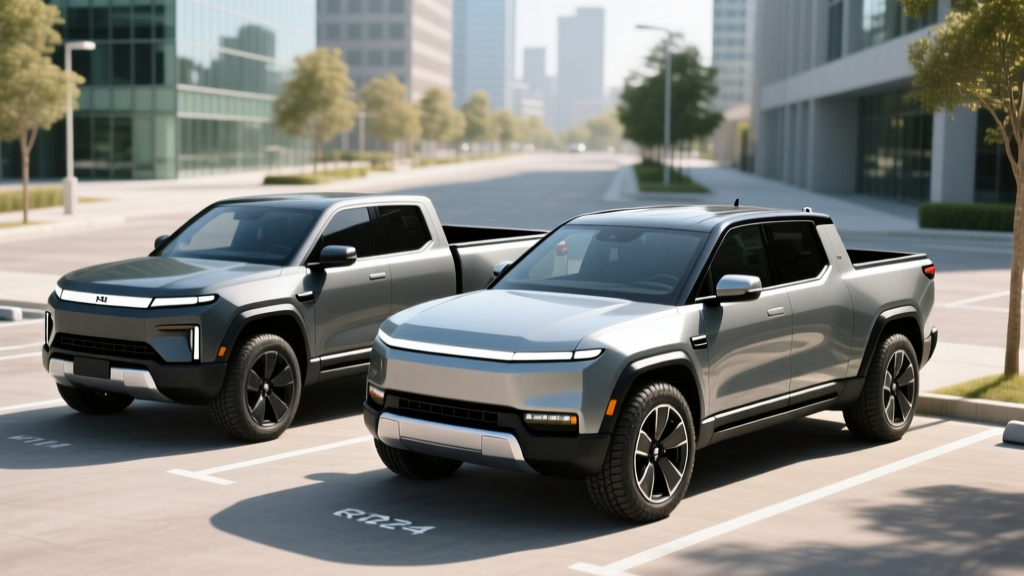
Rivian's 2024 model year marks a pivotal shift for the American EV startup. The R1T pickup and R1S three-row SUV now ride on a heavily revised Gen 2 platform with new in-house drive units, a more energy-dense battery pack, and a zonal electrical architecture that shed roughly 300 pounds and added meaningful range. For buyers researching the Rivian 2024 lineup, the headline numbers are compelling — but the real story lies in how these trucks and SUVs perform once you leave the spec sheet behind.
This review covers both the R1T and R1S across all available battery configurations, with exact EPA data, charging curves, ownership costs, and the tax-credit nuances that affect your out-of-pocket price.
Quick Verdict: Who the 2024 Rivian Is For
Choose the R1T if: You need a capable pickup with legitimate off-road chops, a 499 cu-ft gear tunnel, and towing up to 11,000 lbs — and you want it electric.
Choose the R1S if: You need three rows of seating for up to seven passengers, family road-trip range, and a more refined on-road ride than the R1T.
Look elsewhere if: Your budget is under $65,000, you need access to the full Tesla Supercharger network without an adapter (though NACS adoption is expanding), or you primarily drive in extreme cold where range loss hits large-battery EVs hardest.
Range, Battery, and Efficiency
Rivian offers the 2024 R1T and R1S with two primary battery configurations: the Standard pack and the Max pack. A Large pack (approximately 128.9 kWh usable, NMC chemistry) carried over from earlier model years remains available on some configurations.
| Spec | Standard Pack | Max Pack |
|---|---|---|
| Battery Capacity (usable) | ~92.5 kWh (NMC) | ~141.5 kWh (NMC) |
| EPA Range — R1T Dual-Motor | 270 miles | 420 miles |
| EPA Range — R1S Dual-Motor | 258 miles | 410 miles |
| EPA Range — R1T Performance Dual-Motor | 258 miles | 392 miles |
| Efficiency (R1T Dual-Motor Std) | 73 MPGe combined / 46 kWh/100 mi | |
Real-World Range Reality Check
The EPA numbers above assume mixed driving. In real-world highway testing at 70-75 mph in moderate temperatures (65-75°F), expect the R1T Dual-Motor Standard to deliver roughly 230-245 miles before needing a charge. The Max pack R1T typically returns 350-380 highway miles.
In cold weather (below 32°F), plan for a 20-30% reduction depending on cabin heat usage and whether you precondition. A Max-pack R1T that delivers 370 highway miles in July may only manage 260-290 miles on a frigid January interstate. Rivian's heat pump (standard on Gen 2 models) helps mitigate this compared to resistive heating, but physics is physics — large battery packs lose more absolute range to cold than smaller ones.
All 2024 Rivian packs use NMC (nickel manganese cobalt) chemistry. Unlike LFP batteries found in some base-model Teslas and Fords, NMC offers higher energy density — critical for achieving 400+ mile range in a heavy truck — but it's less tolerant of repeated 100% charges. Rivian recommends daily charging to 85-90% and reserving 100% for road trips.
Charging Speed: DC Fast, Level 2, and the Charge Curve
Charging speed is where the Gen 2 platform shows its biggest improvement over the 2022-2023 models. The new electrical architecture and revised thermal management allow higher sustained charge rates.
| Charging Method | Standard Pack | Max Pack |
|---|---|---|
| Max DC Fast-Charge Rate | 200 kW peak | 220 kW peak |
| 10-80% DC Fast-Charge Time | ~27 minutes | ~41 minutes |
| Sustained Rate (10-50%) | ~170-190 kW | ~190-210 kW |
| Level 2 (Home, 11.5 kW / 48A) | ~20 mi/hr | ~25 mi/hr |
| Level 2 Full Charge (0-100%) | ~9 hours | ~13 hours |
| Level 1 (120V, 12A) | ~3 mi/hr | ~3 mi/hr |
Understanding the charge curve: Like all EVs, the Rivian doesn't hold peak kW for the entire session. The Standard pack may hit 200 kW briefly around 15-25% State of Charge (SoC), then taper progressively. Above 80%, charging slows dramatically — going from 80% to 100% on DC fast charge can take nearly as long as 10-80%. For road trips, plan to charge to 80% and go; the time penalty for that last 20% isn't worth it unless you absolutely need the range.
At home, the 2024 Rivian accepts up to 11.5 kW on Level 2 (48 amps on a 60-amp circuit). This is a meaningful upgrade from earlier models capped at 11.5 kW / 48A, and it means a Standard pack fully replenishes overnight. A Max pack takes longer — roughly 13 hours from empty — but since most owners arrive home with 40-60% remaining, a full overnight cycle easily tops it off.
Connector note: The 2024 Rivian uses the NACS (Tesla-style) charge port on vehicles built after mid-2024, or J1772/CCS on earlier 2024 builds. Rivian owners now have access to Tesla Superchargers (with adapter or native NACS port), dramatically expanding the public fast-charging network. Verify your specific build's connector before purchasing adapters.
Performance and Drivetrain
The Gen 2 Rivian uses Rivian's in-house dual-motor drive unit, replacing the Bosch-sourced units in earlier models. The result is more power, better efficiency, and fewer parts.
| Configuration | Horsepower | Torque (lb-ft) | 0-60 mph | Drivetrain |
|---|---|---|---|---|
| R1T Dual-Motor | 533 hp | 610 | 4.5 sec | AWD |
| R1T Performance Dual-Motor | 665 hp | 829 | 3.4 sec | AWD |
| R1T Quad-Motor (if avail.) | 1,025 hp | 1,198 | 2.5 sec | AWD (torque-vectoring) |
| R1S Dual-Motor | 533 hp | 610 | 4.6 sec | AWD |
The dual-motor setup provides genuine all-wheel-drive capability with independent torque control front and rear. The Performance Dual-Motor's 3.4-second 0-60 time makes the R1T one of the quickest pickups ever sold, rivaling sports cars from a decade ago. The Quad-Motor, when available, adds individual wheel torque vectoring for extreme off-road articulation and supercar acceleration — but at a significant price and range penalty.
Towing capacity maxes out at 11,000 lbs for the R1T (properly equipped), though expect range to drop by roughly 40-50% when towing near max weight at highway speeds. The R1S is rated for 7,700 lbs.
Pricing, Trims, and Federal Tax Credit Eligibility
| Model / Trim | Base MSRP | As-Tested (Typical) | §30D Credit Eligible? |
|---|---|---|---|
| R1T Dual-Motor Standard | $69,900 | $74,000-$78,000 | Yes (if under MSRP cap) |
| R1T Performance Dual-Motor | $79,900 | $85,000-$94,000 | Partial / No (MSRP cap) |
| R1S Dual-Motor Standard | $74,900 | $79,000-$84,000 | Yes (if under MSRP cap) |
| R1S Performance Dual-Motor | $84,900 | $90,000-$99,000 | No (exceeds MSRP cap) |
Federal tax credit (§30D) specifics: The R1T qualifies as a "pickup truck" under IRS rules, which sets the MSRP cap at $80,000. The R1S, classified as an SUV, has an MSRP cap of $80,000 as well. This means the Dual-Motor Standard configurations of both vehicles can qualify for up to $7,500 in federal credits — but only if the final MSRP (before destination but including factory-installed options) stays under the cap.
Critical caveats per IRS §30D rules:
- Buyer income caps apply: Modified AGI cannot exceed $300,000 (joint), $225,000 (head of household), or $150,000 (single).
- Battery sourcing requirements: The $7,500 credit splits into two halves — $3,750 for critical minerals sourcing and $3,750 for battery component manufacturing. Rivian's sourcing has improved but verify current-year compliance on the IRS qualified vehicles list before purchase.
- Point-of-sale transfer: As of 2024, you can transfer the credit to the dealer at purchase, reducing your out-of-pocket cost immediately rather than waiting for tax filing.
Always confirm eligibility with a tax professional and check the latest fueleconomy.gov credit listings before committing to a build.
Interior, Cargo, and Technology
The 2024 Rivian interior received meaningful upgrades over the 2022-2023 models: improved materials, redesigned center console, better second-row seat comfort, and a revised software stack running on the new zonal architecture.
Cargo and Passenger Space
| Dimension | R1T (Pickup) | R1S (SUV) |
|---|---|---|
| Front Legroom | 41.3 in | 41.3 in |
| Second-Row Legroom | 38.2 in | 38.2 in |
| Third-Row Legroom (R1S) | N/A | 30.4 in |
| Bed / Rear Cargo Volume | 54.0 cu ft (bed) + 11.0 cu ft (frunk) + 499 cu ft (gear tunnel, R1T only) | 104.7 cu ft (behind 1st row) + 11.0 cu ft (frunk) |
| Towing Capacity | 11,000 lbs | 7,700 lbs |
The R1T's signature gear tunnel — a 499 cu-ft pass-through compartment behind the rear seats — remains one of the most clever storage solutions in any pickup. It's ideal for skis, camping gear, or groceries and is accessible from both sides of the truck.
Tech and Driver Assistance
The 2024 Rivian runs a proprietary infotainment system on a 15.6-inch center display with an integrated 12.3-inch driver cluster. Wireless Apple CarPlay and Android Auto are not supported — Rivian uses its own mapping, media, and navigation stack. This is a dealbreaker for some and a non-issue for others, depending on your ecosystem loyalty.
Rivian Driver+ (ADAS): This is a SAE Level 2 driver-assistance system combining adaptive cruise control, lane-centering, and automatic lane changes on divided highways. It is not self-driving — you must keep your hands on the wheel and eyes on the road. The system uses a cabin-monitoring camera to verify driver attention. In practice, Driver+ is competent for highway cruising but less aggressive than Ford's BlueCruise or GM's Super Cruise in hands-free zones. Rivian does not currently offer a hands-free driving mode.
ADAS Limitation Notice: Rivian Driver+ is a Level 2 system. It does not drive the vehicle autonomously. You are legally and operationally responsible for the vehicle at all times. Do not use a phone, read, or disengage from driving while Driver+ is active.
Warranty and Long-Term Ownership
| Coverage | Term |
|---|---|
| Bumper-to-Bumper | 5 years / 60,000 miles |
| Battery & Drive Units | 8 years / 175,000 miles |
| Battery Capacity Retention | ≥70% over 8 yr / 175,000 mi |
| Roadside Assistance | 5 years / 60,000 miles |
Rivian's battery warranty is competitive, guaranteeing at least 70% capacity retention over 8 years or 175,000 miles — whichever comes first. Based on early data from 2022-2023 models, NMC pack degradation has tracked in line with industry norms: roughly 5-8% loss over the first 30,000 miles, after which the curve flattens. The 175,000-mile battery term is generous compared to the more common 100,000-mile coverage from legacy automakers.
One ownership reality to budget for: insurance premiums on the R1T and R1S tend to run 20-40% higher than comparable gas pickups due to repair costs, parts availability, and the vehicle's MSRP. Get a quote before ordering.
Pros, Cons, and Competition
Pros
- Class-leading range with Max pack (420 mi EPA)
- Best-in-class gear tunnel storage (R1T)
- Sub-4.5 second 0-60 in Dual-Motor; 2.5s in Quad
- Genuine off-road capability with air suspension and 14.9" ground clearance
- 11,000-lb towing (R1T) with integrated trailer brake controller
- 8-yr / 175,000-mi battery warranty
- Over-the-air updates continually add features
- Now compatible with Tesla Supercharger network (NACS adapter or native port)
Cons
- Base price starts near $70,000; well-equipped builds exceed $90,000
- No Apple CarPlay or Android Auto
- Max pack charges slower overall (larger battery = longer sessions)
- Third-row space in R1S is tight for adults (30.4" legroom)
- Service center network still limited outside major metros
- Insurance premiums higher than gas equivalents
- Towing slashes range by ~40-50%
- Driver+ is competent but not class-leading among Level 2 systems
Rivian vs. Key Competitors
The R1T's closest rival is the Ford F-150 Lightning, which starts roughly $15,000 lower, offers a Mega Power Frunk, and has a wider dealer/service network — but trails in range (max ~320 mi EPA), performance, and off-road capability. The Chevrolet Silverado EV (4WT and RST) offers up to 440 miles of range but is larger, heavier, and less agile off-road. The Tesla Cybertruck undercuts on price in base AWD form and offers Supercharger-native access, but its polarizing design, limited service infrastructure, and build-quality inconsistency are real considerations.
The R1S competes with the Tesla Model X (more Supercharger access, falcon-wing doors, but aging platform) and the Kia EV9 (significantly cheaper at ~$55,000, but less range and no off-road pretension).
Frequently Asked Questions
What is the real-world range of the 2024 Rivian R1T?
The EPA rates the R1T Dual-Motor Standard at 270 miles and the Max pack at 420 miles. In real-world highway driving at 70-75 mph, expect roughly 230-245 miles from the Standard and 350-380 miles from the Max. Cold weather (below freezing) reduces these figures by 20-30%. City and moderate-speed driving will be closer to or slightly above EPA estimates thanks to regenerative braking.
How fast does the 2024 Rivian charge at home and on the road?
On a DC fast charger, the Standard pack peaks at 200 kW and charges 10-80% in roughly 27 minutes. The Max pack peaks at 220 kW but takes ~41 minutes for 10-80% due to its larger capacity. At home on Level 2 (11.5 kW / 48A), expect about 20 miles of range per hour for the Standard and 25 mi/hr for the Max — a full overnight charge tops off either pack for most daily use cases.
How much does the 2024 Rivian cost after the federal tax credit?
The R1T Dual-Motor Standard starts at $69,900 MSRP. If you meet all IRS §30D requirements — income caps, MSRP under $80,000 for trucks, and battery-sourcing rules — you may qualify for up to $7,500 in federal credits, bringing the effective starting price to roughly $62,400. Point-of-sale transfer lets you apply this at purchase. Higher trims and Max-pack configurations typically exceed the MSRP cap and are ineligible.
Does the 2024 Rivian qualify for the federal EV tax credit?
The base Dual-Motor Standard configurations of both the R1T and R1S can qualify, provided the final MSRP stays under $80,000 and the buyer meets income requirements ($300k joint / $150k single). Battery-sourcing compliance is split into two $3,750 halves; verify the specific build on the IRS qualified vehicles list before purchasing. Higher trims with options that push MSRP above $80,000 lose eligibility. Always consult a tax professional.
Is the Rivian R1T worth buying over the Ford F-150 Lightning?
If your priorities are maximum range, off-road capability, performance, and clever storage (gear tunnel), the R1T is the stronger vehicle. If budget, dealer proximity, and a massive front trunk matter more, the F-150 Lightning is the practical choice. The R1T costs $15,000-$25,000 more at comparable spec but delivers meaningfully better range (420 vs. 320 mi max), towing (11,000 vs. 10,000 lbs), and 0-60 times.
Can the Rivian use Tesla Superchargers?
Yes. Rivians built with a native NACS port (mid-2024 onward) can use Tesla Superchargers directly. Earlier 2024 models with CCS/J1772 ports can access Superchargers using a Rivian-approved NACS adapter. This significantly expands the available fast-charging network, particularly in rural areas where Electrify America and other CCS networks have thinner coverage.
How long will the Rivian battery last?
Rivian warranties the battery for 8 years / 175,000 miles with a 70% capacity retention guarantee. Based on early fleet data, NMC packs in Rivians show roughly 5-8% degradation in the first 30,000 miles, then a gradual flattening curve. With proper care (avoiding repeated 100% charges, using preconditioning for fast charging, limiting DC fast-charge frequency), most owners can expect 85-90% capacity at 100,000 miles.
Sources: fueleconomy.gov (EPA range and efficiency data), IRS §30D Clean Vehicle Credits, Rivian official specifications. Tax credit rules are subject to change; verify current eligibility before purchase.