Quick Verdict: What Riding in a Tesla Model Y Actually Feels Like
If you've been curious about riding in a Tesla but haven't taken the plunge, the 2026 Model Y remains the default entry point for millions of buyers. It's the best-selling EV in the United States for good reason: a practical crossover shape, access to the Supercharger network, and a starting price that undercuts most electric rivals after incentives. But the Juniper-refreshed Model Y isn't perfect — build quality has improved yet still trails legacy luxury brands, the ride can feel firm over broken pavement, and the all-screen interior demands a learning curve.
Below, we dissect the 2026 Tesla Model Y Long Range AWD — the volume trim most buyers actually purchase — with exact EPA figures, real-world range data, charging curves, and tax-credit-adjusted pricing so you can decide whether this EV fits your life.
2026 Tesla Model Y Core Specifications
| Spec | Long Range AWD | Performance |
|---|---|---|
| EPA Range | 320 miles | 293 miles |
| Battery (usable) | ~78 kWh, NMC | ~78 kWh, NMC |
| Drivetrain | Dual-motor AWD | Dual-motor AWD |
| Horsepower | 384 hp | 456 hp |
| 0–60 mph | 4.8 seconds | 3.5 seconds |
| MPGe (combined) | 111 MPGe | 103 MPGe |
| Efficiency | 27 kWh/100 mi | 29 kWh/100 mi |
| Max DC Fast Charge | 250 kW (peak) | 250 kW (peak) |
| 10–80% DC Time | ~25 minutes | ~25 minutes |
| Level 2 (11.5 kW) | ~44 mi/hr | ~44 mi/hr |
| Cargo (rear seats up) | 30.2 cu ft | 30.2 cu ft |
| Cargo (rear seats down) | 72.1 cu ft | 72.1 cu ft |
| Rear Legroom | 41.6 in | 41.6 in |
| Base MSRP | $44,990 | $49,990 |
| Battery Warranty | 8 yr / 120,000 mi | 8 yr / 120,000 mi |
Real-World Range: Beyond the EPA Sticker
Real-World Expectation: ~260–280 miles at sustained 75 mph highway driving; ~230–250 miles in sub-30°F winter conditions with cabin heat; up to 310 miles in mild-weather city/regen-heavy driving.
The EPA's 320-mile figure for the 2026 Model Y Long Range is achievable under ideal conditions — moderate temperatures, mixed city/highway driving, and a light right foot. In our experience and consistent with independent testing data cataloged by fueleconomy.gov, highway-heavy road trips at 75+ mph pull efficiency down to roughly 3.5–3.8 mi/kWh, translating to 260–280 miles before you'll want to stop and charge.
Cold weather compounds this. Lithium-ion NMC chemistry loses efficiency in freezing temperatures, and running the cabin heater (even with Tesla's standard heat pump) can drop usable range to 230–250 miles in deep winter. If you live in the upper Midwest or Northeast, plan your winter road trips around 70% of the EPA sticker to stay safe. Conversely, spring and fall city driving with regenerative braking can push you close to the 320-mile mark.
One nuance many new Tesla owners miss: the battery management system reserves a small top and bottom buffer (roughly 2–3 kWh combined) to protect the NMC pack from degradation. The 78 kWh usable figure already accounts for this, so what you see on the range display at 100% is genuinely what's available to drive.
Charging Speed: Supercharger Network and Home Setup
| Charging Level | Power (kW) | Speed | Notes |
|---|---|---|---|
| Level 1 (120V outlet) | ~1.4 kW | ~5 mi/hr | Emergency/trickle only |
| Level 2 (240V, 48A) | 11.5 kW | ~44 mi/hr | Full overnight charge in ~8 hrs |
| DC Fast (V3 Supercharger) | 250 kW peak | 10–80% in ~25 min | Peak only below 50% SoC |
| DC Fast (V4 Supercharger) | Up to 350 kW* | 10–80% in ~20 min* | *Model Y limited by onboard architecture to ~250 kW |
Tesla's DC fast-charging advantage isn't just peak kW — it's the reliability and density of the Supercharger network. On a V3 Supercharger (250 kW capable), the Model Y Long Range peaks near 250 kW at low states of charge (around 10–20%), but the charge curve tapers progressively. You'll see roughly 170–180 kW through the 40–60% range, dropping to under 100 kW past 70%, and crawling below 50 kW after 85%. This is standard lithium-ion behavior, not a Tesla-specific flaw, but it means the advertised 250 kW figure applies only to a narrow window.
For home charging, Tesla's Wall Connector on a 60-amp circuit delivers up to 11.5 kW (48 amps continuous), adding about 44 miles of range per hour. A full charge from 10% to 100% takes roughly 8 hours — easily accomplished overnight. Installation costs typically run $500–$1,500 for the electrician's labor and materials on top of the $475 Wall Connector hardware, assuming your electrical panel has capacity. Older homes with 100-amp service may need a panel upgrade ($1,500–$3,000+), so get a quote from a licensed electrician before committing.
For daily driving, Tesla recommends charging NMC batteries to 80% for longevity, reserving 100% for road trips. This effectively gives you about 256 EPA-equivalent miles of daily usable range — plenty for most commutes.
Performance and Driving Dynamics
The 2026 Model Y Long Range AWD posts a 4.8-second 0–60 mph time from its dual-motor setup producing 384 combined horsepower. That's genuinely quick for a family crossover — it merges onto highways and passes with authority. The Performance trim drops that to 3.5 seconds with 456 hp, which enters sports-car territory.
Ride quality was a common complaint on pre-refresh Model Ys, and the Juniper update brought meaningful improvements: revised damper tuning, acoustic glass, and additional sound deadening make the 2026 cabin noticeably quieter at highway speed. The suspension still leans firm compared to a Hyundai Ioniq 5 or Ford Mustang Mach-E, particularly over expansion joints and potholes, but it's no longer harsh.
Steering is precise if somewhat numb, and the low center of gravity (battery pack under the floor) keeps body roll well-controlled through corners. One-pedal driving via regenerative braking is intuitive once you adjust — Tesla's "Hold" mode lets you come to a complete stop without touching the brake pedal in most traffic scenarios.
Interior, Technology, and Driver Assistance
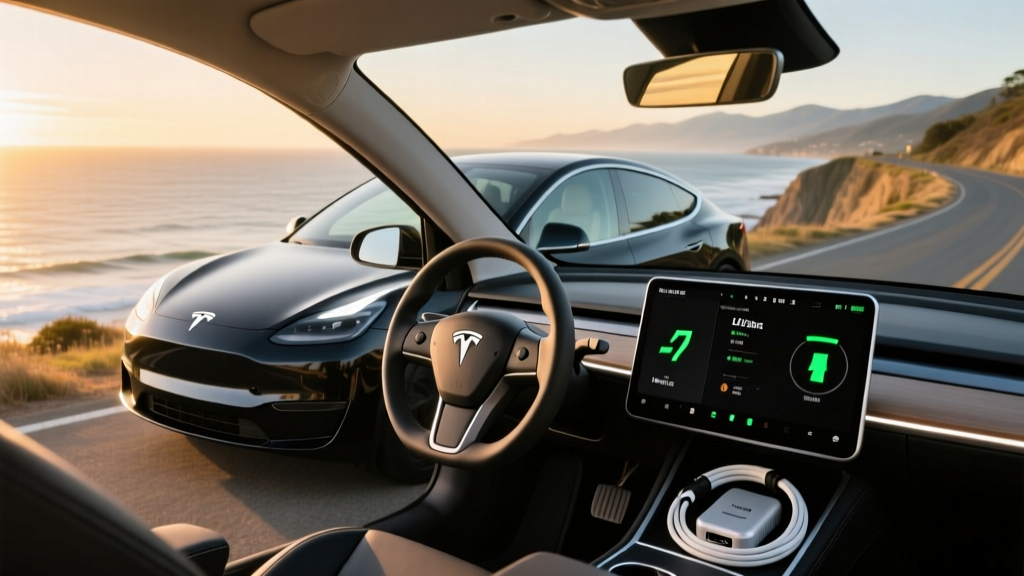
The Juniper refresh simplified the interior further. The 15.4-inch center touchscreen handles virtually every function — climate, navigation, media, vehicle settings — with no physical buttons beyond the steering-wheel controls and a secondary 8-inch rear touchscreen for passengers. Build quality has genuinely improved: tighter panel gaps, ventilated front seats (now standard on Long Range), ambient lighting, and higher-quality materials throughout.
Autopilot and FSD (Supervised): Every Model Y ships with basic Autopilot (adaptive cruise + lane centering). Tesla's Full Self-Driving (Supervised) package remains a $8,000 add-on (or $99/month subscription) and adds automatic lane changes, traffic-light recognition, and city-street navigation. However, this is SAE Level 2 driver assistance — you must keep your hands on the wheel and eyes on the road at all times. It is not autonomous driving. The system handles many scenarios competently but still requires intervention for construction zones, faded lane markings, and complex unprotected turns.
Cargo space is generous: 30.2 cubic feet behind the second row (enough for a week's groceries or two large suitcases) and 72.1 cubic feet with the 60/40 split rear seats folded flat. The front trunk (frunk) adds another 4.1 cubic feet for charging cables or a small bag.
Pricing, Trims, and Federal Tax Credit Eligibility
| Trim | MSRP | Est. After §30D Credit | Notes |
|---|---|---|---|
| Long Range AWD | $44,990 | $37,490* | Destination fee additional |
| Performance | $49,990 | $42,490* | Under $55K MSRP cap for SUVs |
*Assumes full $7,500 federal tax credit eligibility. Point-of-sale transfer available at participating dealers, reducing the purchase price directly.
The federal EV tax credit under IRS §30D can reduce your effective cost by up to $7,500, but eligibility is not automatic. You must meet all of the following requirements:
- Income caps: Modified AGI ≤ $150,000 (single), $225,000 (head of household), or $300,000 (joint filers)
- MSRP cap: Vehicle base price must be ≤ $80,000 for SUVs (both Model Y trims qualify)
- Battery sourcing: A percentage of critical minerals and battery components must be sourced from the US or free-trade-agreement countries — Tesla's shifting supply chain means eligibility can change month to month
- Assembly: Vehicle must undergo final assembly in North America (Fremont, CA and Austin, TX plants qualify)
Critical-mineral and battery-component sourcing thresholds tighten annually under the Inflation Reduction Act. Always verify current eligibility on the fueleconomy.gov credit lookup tool before purchasing, and consult a tax professional for your specific situation. If eligible, the point-of-sale transfer option lets you apply the $7,500 directly to your down payment at delivery rather than waiting for tax filing.
Tesla Model Y vs. Key Competitors
The Model Y's closest rivals include the Hyundai Ioniq 5 (EPA 305 mi, starting ~$42,000), Ford Mustang Mach-E (EPA 320 mi, starting ~$43,000), and the upcoming Chevrolet Equinox EV. Here's how the Model Y stacks up in the categories that matter most:
- Charging network access: Tesla wins. The Supercharger network remains the most reliable and widespread DC fast-charging ecosystem in the US. Competitors relying on Electrify America or third-party CCS networks still face more downtime and slower speeds in practice.
- Efficiency: Tesla wins narrowly. At 27 kWh/100 mi, the Model Y extracts more miles per kWh than the Ioniq 5 (~29 kWh/100 mi) or Mach-E (~31 kWh/100 mi).
- Ride comfort: Competitors win. The Ioniq 5 and Mach-E offer more compliant suspensions and quieter cabins over rough roads.
- Interior ergonomics: Subjective, but competitors win for buyers who prefer physical buttons and traditional gauge clusters.
- Cargo and space: Roughly even. The Model Y's 72.1 cu ft maximum cargo is competitive with the segment.
Pros and Cons
Pros
- Best-in-class Supercharger network access
- Leading efficiency (27 kWh/100 mi)
- Strong 320-mile EPA range
- Over-the-air updates add features post-purchase
- Generous cargo and passenger space
- Qualifies for $7,500 federal tax credit (verify sourcing)
- Improved Juniper ride quality and cabin quietness
Cons
- Firm ride on rough pavement
- All-screen interface has a steep learning curve
- No physical buttons for climate or volume
- FSD (Supervised) is expensive and still Level 2
- NMC battery requires 80% daily charge limit for longevity
- Insurance premiums tend to run higher than segment average
- Rear visibility is limited; relies heavily on cameras
Who the 2026 Model Y Suits Best
Ideal for: Tech-comfortable commuters and small families who road-trip regularly and value charging-network reliability above all else. If you drive 30–60 miles daily and can install a Level 2 charger at home, the Model Y Long Range is one of the most efficient and lowest-hassle EVs you can own. The 320-mile range and 25-minute DC fast-charge sessions make cross-country travel practical.
Look elsewhere if: You prioritize ride comfort over tech, want physical climate controls, need more than two rows of seating (consider the Model X or Kia EV9), or live in a region with extreme cold where LFP-chemistry alternatives with better cold tolerance might suit you better. If your daily commute is under 20 miles and you rarely road-trip, a less expensive EV or PHEV could save you thousands.
Frequently Asked Questions
What is the real-world range of the 2026 Tesla Model Y?
Expect 260–280 miles on highway road trips at 75 mph, and 230–250 miles in freezing winter conditions. The EPA rates it at 320 miles, which is achievable in mild weather with mixed city driving and regenerative braking.
How fast does the Model Y charge at home and on the road?
On a home Level 2 charger (11.5 kW), you'll add about 44 miles per hour, fully charging overnight in ~8 hours. On a V3 Supercharger, 10–80% takes approximately 25 minutes, though peak 250 kW speeds only apply at low states of charge.
Does the 2026 Tesla Model Y qualify for the federal EV tax credit?
Yes, both the Long Range ($44,990) and Performance ($49,990) trims fall under the $80,000 SUV MSRP cap and are assembled in the US. However, you must also meet IRS income limits ($150K single / $300K joint) and the battery must meet critical-mineral and component sourcing thresholds, which change periodically. Always verify on fueleconomy.gov before purchasing.
How much does the Model Y cost after the tax credit?
With the full $7,500 §30D credit applied, the Long Range AWD drops from $44,990 to approximately $37,490, and the Performance drops from $49,990 to approximately $42,490 — before destination fees, state incentives, or optional add-ons like FSD.
Is the Tesla Model Y worth buying vs. the Hyundai Ioniq 5 or Ford Mach-E?
If charging-network reliability and efficiency are your top priorities, the Model Y is the strongest choice. If you prefer a softer ride, physical buttons, or a more conventional interior layout, test-drive the Ioniq 5 and Mach-E before committing. All three are compelling — the right answer depends on your daily driving habits and comfort preferences.
What's the battery warranty on the 2026 Model Y?
Tesla covers the battery and drive unit for 8 years or 120,000 miles (whichever comes first) with a minimum 70% capacity retention guarantee. In practice, NMC Tesla packs have shown degradation of roughly 10–12% over 100,000 miles based on fleet data, which is well within the warranty threshold.
Is Tesla's Full Self-Driving actually self-driving?
No. FSD (Supervised) is an SAE Level 2 driver-assistance system. It can handle many highway and city driving scenarios but requires continuous driver supervision — hands on the wheel, eyes on the road. It is not a Level 4 autonomous system like Waymo's robotaxis.