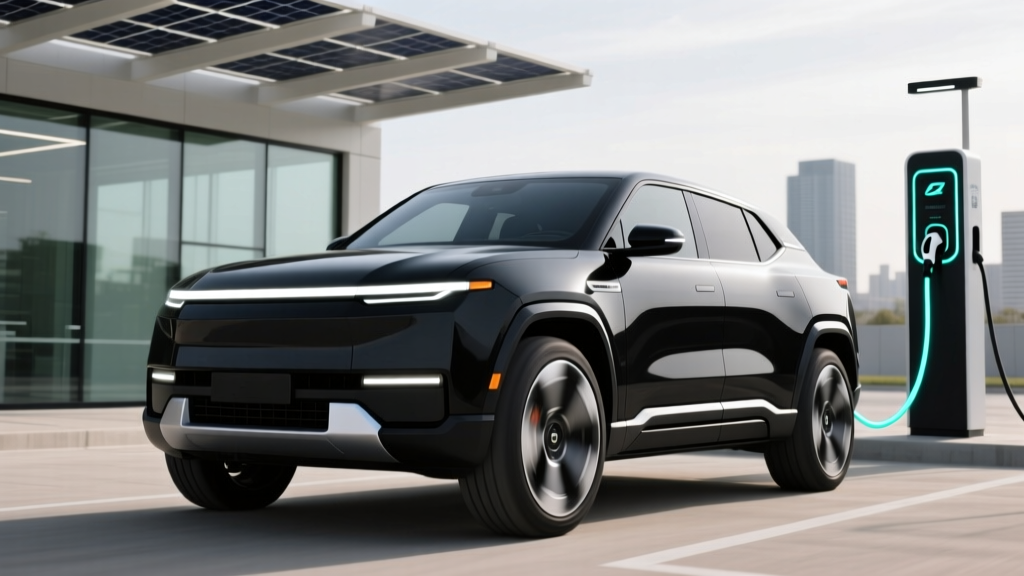
The Rivian R2 is the automaker's long-awaited compact SUV aimed squarely at the mainstream EV buyer. First unveiled in March 2024 and slated for production in early 2026 at Rivian's Normal, Illinois plant (with a second line at the new Georgia facility later), the R2 promises to deliver much of the R1S's capability at a far more accessible price point. If you've been searching for how to reserve the Rivian R2, what it actually offers on paper, and whether preliminary specs justify the $1,000 deposit, this profile breaks down every confirmed and estimated figure available as of mid-2026.
Important note: The Rivian R2 began limited production in the first half of 2026. Some specifications below are based on Rivian's official announcements and pre-production disclosures. Final EPA certification figures, trim-level pricing, and IRS §30D tax credit eligibility will be confirmed closer to customer deliveries. We will update this article as official data is released.
Preliminary Rivian R2 Specifications at a Glance
| Attribute | Rivian R2 (Estimated / Announced) |
|---|---|
| Body Style | 5-passenger compact SUV (2-row) |
| EPA Range (est.) | 330+ miles (Large Pack AWD) |
| Battery Capacity (est.) | ~85–95 kWh usable (Large Pack) |
| Battery Chemistry | NMC (Standard & Large); LFP planned for base Standard pack |
| Drivetrain | Dual-motor AWD / Single-motor RWD (base) |
| Horsepower | ~450–600 hp (depending on configuration) |
| 0–60 mph (est.) | ~3.5 seconds (Performance Dual-Motor) |
| Max DC Fast Charge | ~225 kW peak (NACS connector) |
| 10–80% DC Charge Time | ~25–30 minutes (est.) |
| Level 2 Home Charge | 11.5 kW (~30–33 miles/hr added) |
| Base MSRP (target) | ~$45,000 (Standard RWD) |
| Battery Warranty | 8 years / 175,000 miles (Rivian standard) |
| Reservation Deposit | $1,000 (fully refundable) |
Range and Efficiency: What to Expect in the Real World
Rivian has targeted an EPA-estimated range of 330+ miles for the R2 with the Large Battery Pack and dual-motor AWD. This places the R2 competitively against the Tesla Model Y Long Range (currently rated at 320 miles EPA) and the Hyundai Ioniq 5 (305 miles with the extended-range RWD configuration). A Standard Pack variant is expected to deliver roughly 270 miles EPA, though Rivian has not published a final number.
The 330-mile EPA sticker is a useful baseline, but real-world results depend heavily on driving conditions:
- Highway driving at 75 mph: Expect approximately 270–290 miles before needing to charge — typical of most EVs where high sustained speeds cut efficiency by 12–18%.
- Cold weather (below 32°F): Range can drop 20–30%, meaning a cold-weather highway trip could yield 220–250 miles. The R2 is expected to include a heat pump (standard on the R1S/R1T), which helps mitigate cabin-heating losses.
- City / mixed driving in moderate temps: You'll likely match or slightly exceed the EPA figure thanks to regenerative braking and lower average speeds.
Rivian's R1 platform has historically delivered honest EPA numbers — the R1S and R1T real-world results track closely with their stickers under normal conditions. We expect the same calibration for the R2.
Efficiency is projected at roughly 3.0–3.3 miles per kWh (about 30–33 kWh/100 miles), which translates to an estimated 110–120 MPGe combined. This is respectable for a compact SUV with AWD and off-road capability, though the Hyundai Ioniq 5 and Tesla Model Y still hold a slight efficiency edge due to lighter curb weights and more aerodynamic profiles.
Charging Speed: NACS Native on the Tesla Supercharger Network
One of the R2's biggest advantages is that it launches with a native NACS (North American Charging Standard) port — the same connector used by Tesla. That means R2 owners will have access to the Tesla Supercharger network (over 25,000 stalls in North America) without an adapter, a significant practical advantage over CCS-equipped competitors still relying on adapter solutions or third-party networks with spotty reliability.
| Charging Level | Power | Speed / Time |
|---|---|---|
| Level 1 (120V household) | ~1.4 kW | ~3–4 miles per hour |
| Level 2 (240V home / public) | 11.5 kW | ~30–33 miles per hour; full charge in ~8–9 hours |
| DC Fast Charge (peak) | ~225 kW | 10–80% in ~25–30 minutes (est.) |
A few things to understand about the DC fast-charging spec:
- Peak vs. sustained rate: The 225 kW figure is a peak — the charge curve will taper as the battery fills. Expect the 10–80% session to average closer to 150–170 kW, which is normal for lithium-ion packs. Charging from 80–100% slows dramatically to protect battery health.
- Preconditioning: The R2's thermal management system is expected to precondition the battery when a DC fast-charger is set as your navigation destination. This warms the pack to its optimal charging temperature, enabling faster charge acceptance — especially important in cold weather.
- Supercharger V4 stalls: Tesla's newer V4 Superchargers can deliver up to 350 kW. The R2 won't use that full capacity, but it will benefit from the newer stalls' improved cable management and reliability.
For home charging, an 11.5 kW Level 2 setup on a 60-amp circuit adds roughly 30–33 miles of range per hour — enough to fully replenish the Large Pack overnight. Installation typically costs $800–$2,000 depending on your electrical panel, run length, and local permit requirements (a licensed electrician should evaluate your panel capacity before purchase).
Performance and Powertrain Options
The R2 will be offered in multiple configurations, echoing Rivian's approach with the R1S and R1T but on a more cost-optimized platform:
- Single-Motor RWD (base): Expected around 300–350 hp. This will be the most affordable trim and likely paired with the Standard battery pack. 0–60 mph should land in the 5.5–6.5 second range.
- Dual-Motor AWD: The volume seller, with approximately 450–500 hp. This is the configuration Rivian has cited for the 330+ mile range target with the Large Pack. 0–60 mph estimated at roughly 4.0 seconds.
- Performance Dual-Motor AWD: A higher-output variant with up to 600 hp, aimed at buyers who want sports-SUV acceleration. 0–60 mph in approximately 3.5 seconds.
Rivian's dual-motor system uses independent front and rear motors for precise torque vectoring. The R2 will retain a version of Rivian's quad-motor architecture capability is not confirmed for the R2 — that remains exclusive to the R1 platform. However, the dual-motor AWD system still delivers strong off-road competence with selectable drive modes, adjustable ride height (via available air suspension), and Rivian's tank-turn-inspired software features for low-speed maneuvering.
Towing capacity is expected at approximately 3,300–4,400 pounds depending on configuration — adequate for a small camper, utility trailer, or pair of dirt bikes, but notably less than the R1T's 11,000-pound rating.
Interior, Cargo, and Practicality
The R2 is a true 5-passenger compact SUV, smaller than the 3-row R1S but larger than subcompact competitors like the Volvo EX30. Rivian has confirmed the following practical details:
- Cargo volume: Approximately 30–33 cubic feet behind the second row, expanding to roughly 65–70 cubic feet with the rear seats folded. A front trunk (frunk) adds an estimated 10–12 cubic feet of sealed, drainable storage — a signature Rivian feature.
- Seating: 5 passengers across two rows. Rear legroom is expected at approximately 38–40 inches, competitive with the Model Y and Ioniq 5.
- Infotainment: A large central touchscreen (likely 15+ inches) running Rivian's proprietary software, wireless Apple CarPlay and Android Auto, and over-the-air updates. The R2 will also feature Rivian's integrated camp kitchen and gear tunnel accessories are not expected — those are R1S/R1T-specific — but the brand's adventure-oriented accessory ecosystem (crossbars, bike mounts, pet accessories) will carry over.
- Glass roof: A large panoramic glass roof is standard, consistent with Rivian's design language.
Driver-assistance technology will include Rivian's Driver+ system — a Level 2 (SAE) hands-on-wheel ADAS suite with adaptive cruise control, lane centering, and automatic emergency braking. Rivian has not confirmed a hands-free highway driving feature for the R2 at launch, though its hardware suite (multiple cameras, radar) suggests future capability via OTA updates. As with all Level 2 systems, the driver must remain attentive and keep hands on the wheel at all times.
Pricing, Trims, and the Federal EV Tax Credit
Rivian has stated a target starting MSRP of approximately $45,000 for the base single-motor RWD configuration with the Standard battery pack. Higher trims with dual-motor AWD, the Large Pack, and the Performance package will push pricing higher:
| Configuration (Estimated) | Target MSRP | Potential §30D Credit | Effective Price (if eligible) |
|---|---|---|---|
| Standard RWD (base) | ~$45,000 | Up to $7,500 | ~$37,500 |
| Large Pack Dual-Motor AWD | ~$52,000–$55,000 | Up to $7,500 | ~$44,500–$47,500 |
| Performance Dual-Motor AWD | ~$58,000–$62,000 | Up to $7,500 | ~$50,500–$54,500 |
Federal tax credit eligibility (§30D) is not guaranteed. As of 2026, the IRS enforces multiple requirements that buyers must verify before assuming the full $7,500 credit:
- MSRP cap: SUVs must have an MSRP at or below $80,000. All R2 trims should clear this threshold.
- Buyer income cap: Modified adjusted gross income (MAGI) must not exceed $150,000 (single), $225,000 (head of household), or $300,000 (joint filers).
- Battery sourcing requirements: A percentage of critical minerals and battery components must be sourced from the U.S. or free-trade-agreement countries. These thresholds tighten annually. Rivian has been working to secure compliant supply chains, but final eligibility for each trim depends on the battery pack's specific sourcing at time of delivery.
- Point-of-sale transfer: Under current rules, you can transfer the credit to the dealer at purchase, reducing your out-of-pocket cost immediately rather than waiting to claim it on your tax return.
Always verify current eligibility on IRS.gov and consult a tax professional before relying on the credit in your purchase budget. State and local incentives may stack on top — check fueleconomy.gov for your specific ZIP code.
Warranty Coverage
Rivian's current warranty structure (carried over from the R1S and R1T) is expected to apply to the R2:
- Battery & drive unit: 8 years / 175,000 miles (with a minimum capacity retention threshold, typically 70% over the warranty period)
- Bumper-to-bumper: 5 years / 60,000 miles
- Corrosion perforation: 8 years / unlimited miles
The 175,000-mile battery warranty is among the most generous in the segment, exceeding the federal minimum of 8 years / 100,000 miles. Rivian has stated it will use both NMC and (for the base Standard pack) LFP chemistry. LFP cells typically offer longer cycle life and can tolerate routine 100% charging, while NMC packs provide higher energy density — a trade-off worth understanding if you plan to charge to full daily.
How to Reserve the Rivian R2
Rivian is accepting reservations for the R2 through its website with a $1,000 fully refundable deposit. Here's how the process works:
- Place your deposit: Visit rivian.com/r2, select your preferred configuration (drivetrain, battery pack, color), and pay the $1,000 deposit via credit card.
- Join the queue: Reservations are fulfilled in order of deposit date. Earlier reservations get earlier delivery windows. Rivian has indicated that initial production will prioritize certain configurations, so your exact delivery timeline depends on your build selection.
- Finalize your order: As your delivery window approaches, Rivian will invite you to lock in your final configuration, select delivery location, and complete financing or purchase paperwork.
- Deposit is refundable: If you change your mind at any point before final order lock-in, you can cancel and receive a full refund of your $1,000.
As of mid-2026, Rivian has reported over 100,000 R2 reservations since the vehicle's March 2024 unveiling. Delivery timelines for new reservations placed today may extend into late 2026 or 2027, depending on production ramp-up at the Normal, Illinois facility.
R2 vs. Key Competitors: Is It Worth the Wait?
The R2 enters a crowded compact electric SUV segment. Here's how its preliminary specs compare to established rivals:
| Attribute | Rivian R2 (Dual-Motor AWD, est.) | Tesla Model Y Long Range | Hyundai Ioniq 5 (AWD) |
|---|---|---|---|
| EPA Range | ~330 mi | 320 mi | 290 mi |
| Battery (usable) | ~90 kWh | ~78 kWh | 77.4 kWh |
| 0–60 mph | ~4.0 sec | 4.8 sec | 5.0 sec |
| Max DC Charge | ~225 kW | 250 kW | 240 kW |
| Native Connector | NACS | NACS | CCS (NACS adapter avail.) |
| Starting MSRP | ~$52,000 (AWD) | ~$48,000 | ~$47,000 |
| Cargo (rear seats up) | ~31 cu ft | 30 cu ft | 27 cu ft |
| Frunk | Yes (~11 cu ft) | Small (~4 cu ft) | Yes (~2 cu ft) |
- Choose the R2 if: You want an adventure-capable electric SUV with a genuine frunk, strong off-road chops, native Supercharger access, and a brand identity centered on outdoor lifestyle. You're willing to wait for production ramp and accept that some specs may shift before delivery.
- Choose the Model Y if: You need immediate availability, the lowest price in the segment, and the most mature Supercharger network access. The Model Y's interior materials and ride quality remain weaker points.
- Choose the Ioniq 5 if: You prioritize the fastest DC charging speeds (10–80% in ~18 minutes on 350 kW stalls), a more distinctive design, and Hyundai's strong warranty. CCS adapter reliance for Supercharger access is a drawback until the NACS-native 2025+ models fully proliferate.
Pros, Cons, and the Bottom Line
- 330+ mile estimated range is segment-competitive
- Native NACS / Supercharger access from day one
- Generous frunk + cargo versatility for adventure use
- Strong performance across dual-motor configurations
- 8-year / 175,000-mile battery warranty
- Refundable $1,000 reservation — low risk to hold your place
- Expected §30D eligibility on most trims (pending sourcing confirmation)
- Production ramp delays are a real risk — Rivian's R1 launch experienced significant wait times
- Base $45K trim may be limited in availability; AWD trims push past $50K
- Final EPA and tax-credit figures not yet certified
- No 3-row option — families needing 7 seats must look to the R1S or competitors
- DC fast-charge speed (~225 kW) trails the Ioniq 5's 800V architecture
- Rivian's service center network is still expanding — coverage in rural areas may be thin
The Rivian R2 shapes up as one of the most compelling compact electric SUVs entering the market in 2026. Its combination of range, native Supercharger access, adventure-friendly design, and a starting price near $45,000 positions it to challenge the Tesla Model Y's dominance — if Rivian can execute on production at scale. A $1,000 refundable reservation is a low-cost way to secure your place in line while final specs and pricing solidify.
Frequently Asked Questions
What is the real-world range of the Rivian R2?
The R2's estimated EPA range is 330+ miles with the Large Pack and dual-motor AWD. In real-world highway driving at 75 mph, expect roughly 270–290 miles. In cold weather (below freezing), that can drop to 220–250 miles. City and mixed driving in moderate temperatures should match or slightly exceed the EPA sticker.
How fast does the Rivian R2 charge?
Rivian targets a peak DC fast-charge rate of approximately 225 kW, with a 10–80% session taking an estimated 25–30 minutes. At home on a Level 2 charger (11.5 kW / 240V), the R2 adds about 30–33 miles of range per hour, enabling a full overnight charge.
How much does the Rivian R2 cost after tax credits?
The base single-motor RWD R2 targets approximately $45,000 MSRP, potentially dropping to around $37,500 if you qualify for the full $7,500 federal §30D credit. The more popular dual-motor AWD with the Large Pack is expected around $52,000–$55,000, or roughly $44,500–$47,500 after the credit. Eligibility depends on your income, the vehicle's battery sourcing, and MSRP caps — verify on IRS.gov.
Is the Rivian R2 worth buying vs. the Tesla Model Y or Hyundai Ioniq 5?
The R2 is worth considering if you value adventure-oriented design, a large frunk, off-road capability, and Rivian's brand ethos. The Model Y wins on immediate availability and lowest price; the Ioniq 5 wins on fastest DC charging. If you can wait for production and the R2's specs hold at delivery, it's a strong contender in the segment.
Does the Rivian R2 qualify for the federal EV tax credit?
Based on current §30D rules, the R2's expected MSRP (well under the $80,000 SUV cap) makes it structurally eligible. However, final credit amounts ($3,750 or $7,500) depend on battery critical-mineral and component sourcing requirements that tighten each year, as well as your personal income. Confirm eligibility on IRS.gov closer to your delivery date.
Can I reserve the Rivian R2 right now?
Yes. Rivian is accepting R2 reservations at rivian.com with a $1,000 fully refundable deposit. Reservations are fulfilled in queue order, and new reservations placed in 2026 may see delivery in late 2026 or 2027 depending on configuration and production ramp.