Why Tesla Repair Costs Defy Expectations (and Where They Don't)
If you've searched "repairing a Tesla" expecting horror stories across the board, the reality is more nuanced. Teslas have far fewer moving parts than internal-combustion vehicles—no oil changes, no timing belts, no transmission fluid flushes, no spark plugs. Routine maintenance is almost laughably minimal. But when something does go wrong, especially body damage or out-of-warranty drivetrain issues, the invoices can be eye-opening.
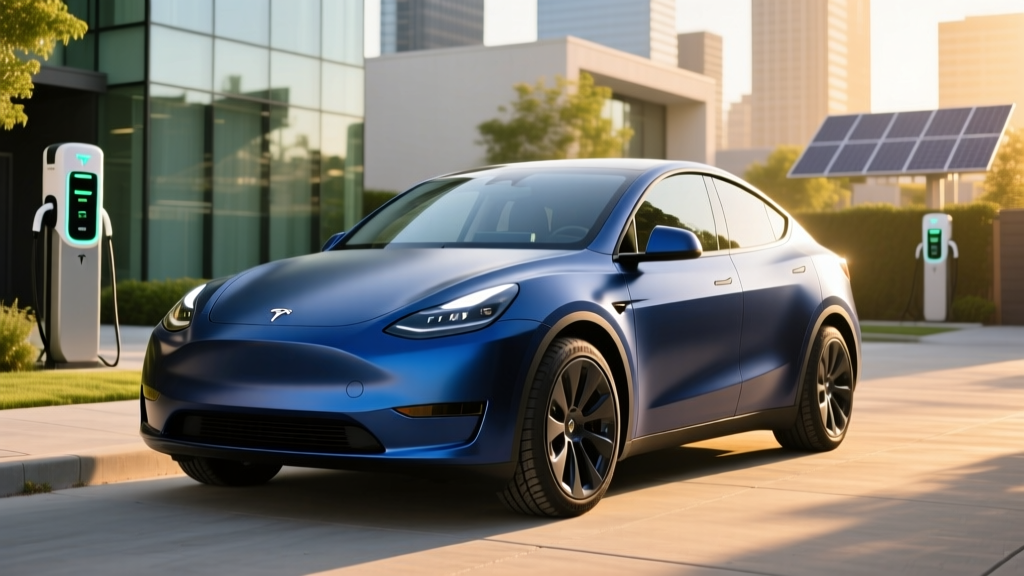
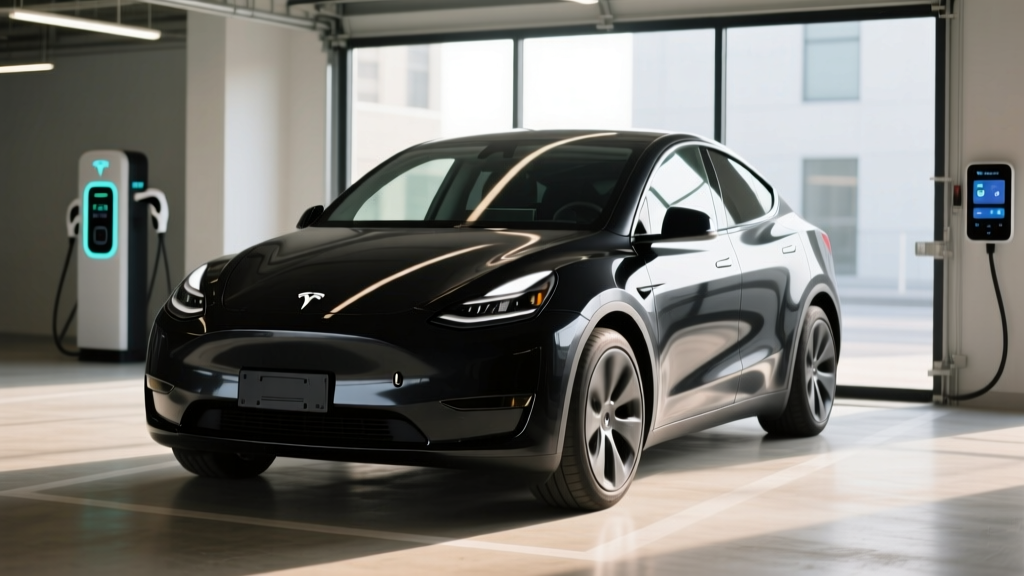
This guide breaks down what Tesla ownership actually costs in repairs and maintenance across the current 2025-2026 lineup (Model 3, Model Y, Model S, Model X, and Cybertruck), what the warranty covers, where independent shops fit in, and how the Total Cost of Ownership compares to gas equivalents. We'll use the 2026 Model Y Long Range AWD as our anchor vehicle for specs, since it's Tesla's highest-volume seller and the one most buyers cross-shop.
2026 Tesla Model Y Long Range: The Spec Sheet That Matters
Before we get into repair economics, here's what you're actually buying. The 2026 Model Y Long Range AWD received a refresh (internally called "Juniper") with updated styling, improved sound insulation, a rear touchscreen, and revised suspension tuning.
| Spec | Value |
|---|---|
| EPA Range | 320 miles |
| Battery Capacity | ~78 kWh usable (NMC chemistry) |
| Max DC Fast Charge | 250 kW peak (V3 Supercharger) |
| 10-80% DC Charge Time | ~27 minutes |
| Level 2 Home Charge Rate | 11.5 kW (~44 miles/hr) |
| 0-60 mph | 4.8 seconds |
| Horsepower | 384 hp (dual motor) |
| Drivetrain | AWD (dual motor) |
| Efficiency | 122 MPGe combined / 28 kWh/100mi |
| Cargo Volume | 76 cu ft (rear seats folded) |
| Rear Legroom | 41.6 inches |
| Base MSRP | $48,990 (includes destination) |
| Battery Warranty | 8 years / 120,000 miles |
What Routine Maintenance Actually Costs on a Tesla
Tesla does not have a manufacturer-recommended scheduled maintenance program like traditional automakers. There are no 5,000-mile oil changes, no coolant flushes at 30,000 miles (the battery thermal management coolant is largely sealed), and no transmission service. Here's what you will spend money on:
- Cabin air filter (HEPA): $35-$50 for the part, replace every 2-3 years. Many owners DIY this in 15 minutes.
- Tire rotation: Every 6,250 miles. Tesla Service Centers charge ~$30-$50; any tire shop can do it for similar pricing.
- Tire replacement: EVs eat tires 20-30% faster than gas cars due to instant torque and heavier curb weight. Expect $800-$1,400 for a set of four OEM-spec tires every 25,000-35,000 miles.
- Brake fluid check: Tesla recommends testing every 2 years; replacement if contaminated. ~$80-$120 at a service center.
- Brake pads: Thanks to regenerative braking, pads often last 100,000+ miles. Replacement (when needed): $300-$500 per axle.
- Wiper blades: $30-$60, owner-replaceable.
- 12V lithium auxiliary battery: The 2025+ models use a lithium 12V pack (replacing the old lead-acid). Expected lifespan: 4-6 years. Replacement cost: ~$250-$350.
- Wheel alignment: Recommended annually or after hitting potholes. $150-$250 at a Tesla-approved shop.
Total estimated annual maintenance cost for a Model Y: $300-$500/year over the first five years, dominated by tire wear. Compare that to $900-$1,200/year for a comparable gas-powered SUV like the Toyota RAV4 or Honda CR-V when you factor in oil changes, transmission fluid, and air filters.
The Expensive Repairs: Body Work, Batteries, and Drive Units
Routine maintenance is cheap. The costs that scare prospective Tesla buyers fall into three categories: collision repair, high-voltage battery replacement, and drive unit failures.
Collision and Body Repair
This is where Tesla ownership diverges sharply from Toyota or Honda. Tesla uses a direct-repair model with a network of approved body shops. Common complaints from owners include:
- Wait times: Parts availability can stretch repairs to 3-6 weeks for moderate collision damage, especially for body panels unique to Tesla (frunk assemblies, glass roofs, aluminum castings).
- Cost: A minor fender-bender that might cost $1,500-$2,500 on a Camry can run $3,000-$6,000 on a Model Y due to aluminum body panels, integrated sensors, and camera recalibration requirements.
- Totaled threshold: Because Tesla parts are expensive and labor rates at approved shops run $150-$220/hour, insurance companies total Teslas at lower damage thresholds than conventional vehicles. This is a known factor driving higher Tesla insurance premiums.
- Glass roof replacement: $1,200-$2,000 if cracked (not covered by warranty unless defect-related).
Insurance data from the Highway Loss Data Institute (HLDI) consistently shows Tesla collision claim severity running 20-40% higher than the industry average for vehicles in their class.
High-Voltage Battery Replacement
The biggest fear for any EV buyer. Let's put numbers to it:
- Under warranty: Tesla's battery warranty covers 8 years / 120,000 miles (100,000 miles on the base RWD Model 3/Y) with a minimum 70% capacity retention threshold. If your battery degrades below 70% within that window, Tesla replaces or refurbishes it at no cost.
- Out of warranty: A full battery pack replacement for a Model 3 or Model Y runs $12,000-$16,000 at a Tesla Service Center (parts + labor). Model S/X packs are more expensive at $15,000-$22,000 due to larger capacity.
- Real-world failure rates: Data aggregated from owner forums and fleet studies suggests fewer than 2-3% of Tesla battery packs require full replacement within the warranty period. Most degradation follows a curve: roughly 5-8% loss in the first 50,000 miles, then a slow linear decline.
- Module-level repair: Some independent EV shops can replace individual battery modules rather than the full pack for $3,000-$6,000, but this voids any remaining Tesla warranty.
For context, a transmission replacement on a gas vehicle runs $4,000-$8,000, and an engine rebuild can exceed $7,000. The battery replacement is more expensive, but it's also far less likely to be needed during typical ownership.
Drive Unit (Motor) Failures
Tesla's permanent-magnet synchronous and induction motors are far simpler than internal combustion engines, but they aren't immune to failure. Drive unit replacements under warranty are covered (8 years / 120,000 miles). Out of warranty, expect $5,000-$8,000 per drive unit. The dual-motor AWD models have two, though simultaneous failure of both is extremely rare. Early Model S/X vehicles had higher drive unit failure rates; the 2021+ refresh models have shown improved reliability.
Tesla's Warranty: What's Covered and What's Not
| Component | Coverage |
|---|---|
| Basic Vehicle (bumper-to-bumper) | 4 years / 50,000 miles |
| Battery & Drive Unit (Model 3/Y LR & Perf) | 8 years / 120,000 miles |
| Battery & Drive Unit (Model 3/Y RWD) | 8 years / 100,000 miles |
| Battery & Drive Unit (Model S/X) | 8 years / 150,000 miles |
| Minimum Battery Capacity Retention | 70% during warranty period |
| Roadside Assistance | 4 years / 50,000 miles |
Key exclusions: cosmetic corrosion, tire wear, damage from accidents or misuse, and the 12V battery (covered under the 4-year basic warranty, not the 8-year HV warranty). Tesla's warranty is competitive with Hyundai/Kia (10yr/100,000mi battery) but slightly shorter on mileage. See Tesla's official warranty page for full terms.
The Independent Shop Question: Can Non-Tesla Mechanics Fix These Cars?
Historically, Tesla tightly controlled parts distribution and diagnostic software, making independent repair nearly impossible. That's changing slowly:
- Right to Repair: Tesla provides a limited set of service manuals and wiring diagrams through their Right to Repair portal, though it's less comprehensive than what legacy automakers offer.
- Parts availability: Tesla has begun selling some collision and suspension parts to independent shops, but high-voltage components and proprietary electronics remain restricted.
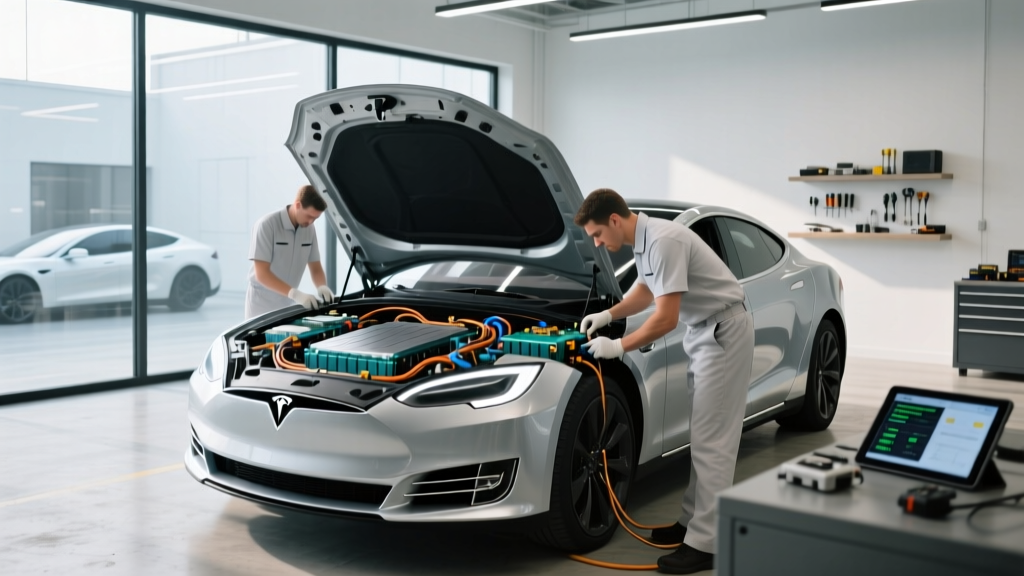
- Third-party EV shops: A growing network of independent EV specialists (e.g., Electrified Garage, EVoutlet) can handle suspension work, 12V battery replacement, tire service, and even some module-level battery repair. Pricing is typically 30-50% less than Tesla Service Centers for non-warranty work.
- Software limitations: Many repairs require Tesla's diagnostic software to recalibrate cameras, reset fault codes, or pair new components. This limits what a traditional mechanic can do without Tesla authorization.
Bottom line: for tires, brakes, suspension, and 12V systems, independent shops are increasingly viable. For anything involving the high-voltage system, drive units, or ADAS calibration, you're largely tethered to Tesla's service network.
Tesla vs. Competitors: Repair Cost Context
How does repairing a Tesla stack up against key competitors? Here's a 5-year estimated maintenance and repair cost comparison for popular electric SUVs:
| Vehicle | Est. 5-Year Cost | Key Factors |
|---|---|---|
| Tesla Model Y LR AWD | $1,800 - $2,800 | Low routine cost, higher tire and collision cost |
| Hyundai Ioniq 5 (AWD) | $2,000 - $3,000 | Stronger dealer network, 10yr battery warranty |
| Ford Mustang Mach-E (AWD) | $2,200 - $3,400 | Ford dealer service access, slightly higher routine costs |
| Toyota RAV4 (gas AWD) | $3,800 - $5,200 | Oil changes, transmission, more wear items |
Data synthesized from RepairPal, Consumer Reports reliability surveys, and owner-reported maintenance logs. The Tesla advantage is primarily in powertrain simplicity; the disadvantage is collision severity and parts lead times.
Insurance: The Hidden Repair Cost Multiplier
Because repairing a Tesla after a collision is expensive, insurance premiums reflect that reality. Average annual premiums for a 2026 Model Y range from $2,200-$3,400/year depending on state, driver profile, and coverage level—roughly 20-35% higher than a comparably priced gas SUV. Tesla offers its own insurance product in many states that uses real-time driving data (via the Tesla app) to price premiums, which can be 10-20% cheaper for safe drivers. Always quote multiple providers before purchasing.
Tax Credits and the True Purchase Price
Understanding repair economics requires knowing what you actually paid for the vehicle. As of 2026, the federal EV tax credit under IRS §30D remains available but with strict eligibility requirements:
- MSRP cap: SUVs must be under $80,000; sedans under $55,000.
- Buyer income cap: $150,000 single / $300,000 married filing jointly (modified AGI).
- Battery sourcing: Critical minerals and battery components must meet phased-in domestic/free-trade sourcing thresholds. These requirements tighten annually.
- Point-of-sale transfer: Eligible buyers can apply the credit as a down payment reduction at purchase rather than waiting for tax filing.
The 2026 Model Y Long Range AWD at $48,990 falls under the SUV MSRP cap. However, battery sourcing compliance varies by build date and supply chain shifts. Always verify current eligibility on the fueleconomy.gov tax credit page before purchasing. Do not assume the full $7,500 credit applies—partial credits ($3,750) are possible if only one of the two sourcing thresholds is met.
Pros: Repairing a Tesla
- No oil changes, transmission service, or emissions maintenance ever
- Regenerative braking extends pad life to 100,000+ miles
- 8-year/120,000-mile battery and drive unit warranty
- OTA software updates can resolve some issues without a shop visit
- Growing independent EV shop network for non-HV work
- Lower total 5-year maintenance cost than gas equivalents
Cons: Repairing a Tesla
- Collision repair is 20-40% more expensive than comparable gas vehicles
- Parts lead times can stretch body repairs to weeks
- Out-of-warranty battery replacement: $12,000-$16,000+
- Software lock-in limits independent mechanic access
- Insurance premiums run 20-35% higher due to repair severity
- Tesla Service Center availability varies by region (rural owners may drive hours)
Who Should (and Shouldn't) Buy a Tesla Based on Repair Economics
Best for: Urban and suburban commuters with access to home charging, drivers who plan to keep the vehicle within the warranty window (8 years), and those in metro areas with nearby Tesla Service Centers or approved body shops. The low routine-maintenance cost shines for high-mileage commuters who would otherwise spend heavily on gas-car upkeep.
Think twice if: You live in a rural area far from Tesla service infrastructure, you plan to keep the vehicle well past 120,000 miles (out-of-warranty risk), or you have a history of at-fault collisions that would compound the insurance premium penalty. In those cases, a Hyundai Ioniq 5 or Kia EV6—with their broader dealer networks and 10-year battery warranties—may offer more repair peace of mind.
Frequently Asked Questions
What is the most common Tesla repair?
Tire replacement is the single most frequent and costly routine expense. EVs are heavier and produce instant torque, wearing tires 20-30% faster than gas cars. Budget $800-$1,400 every 25,000-35,000 miles for a quality set.
How much does it cost to replace a Tesla battery out of warranty?
A full high-voltage battery pack replacement for a Model 3 or Model Y costs $12,000-$16,000 at a Tesla Service Center. Model S/X packs run $15,000-$22,000. However, statistically fewer than 2-3% of packs require full replacement, and most degradation stays above the 70% warranty threshold within the 8-year window.
Does Tesla have a right to repair program?
Yes, but it's limited. Tesla provides some service documentation and sells certain parts to independent shops through their Right to Repair portal. However, high-voltage components, drive units, and software-dependent calibrations remain largely restricted to Tesla-authorized service.
Are Teslas more expensive to insure than gas cars?
Yes, typically 20-35% more expensive for comparable vehicle prices. The primary driver is higher collision repair severity—aluminum body panels, integrated sensor arrays, and parts pricing all contribute. Tesla's own insurance product can reduce premiums for safe drivers in participating states.
Can I take my Tesla to any mechanic?
For tire rotations, brake pad replacement, suspension work, and 12V battery service, many independent shops can handle it. For anything involving the high-voltage battery, drive units, camera/sensor recalibration, or software-dependent systems, you'll need a Tesla Service Center or Tesla-approved shop.
How does Tesla's reliability compare to other EV brands?
Tesla's powertrain reliability is strong, but build quality (panel gaps, paint, interior trim) has historically lagged behind Hyundai/Kia and BMW. Consumer Reports and J.D. Power surveys place Tesla mid-pack overall, with powertrain scores pulling up what body hardware and interior quality pull down. The 2025-2026 Juniper refresh has shown measurable improvement in fit and finish.