If you live in Renton, Washington and are shopping for a Tesla, you're likely considering the Model Y — the brand's best-selling crossover and the most practical entry point into the Tesla ecosystem. With the Fremont factory now producing the 2026 refresh (codenamed "Juniper"), Renton-area buyers are seeing updated inventory at the nearby Bellevue and Tukwila service centers. This guide breaks down exactly what the 2026 Model Y offers in range, charging speed, real-world Pacific Northwest ownership, and whether it still qualifies for the federal EV tax credit.
2026 Tesla Model Y: Quick Spec Overview
| Specification | Long Range AWD | Performance |
|---|---|---|
| EPA Range | 308 miles | 277 miles |
| Real-World Range (highway/cold) | ~250–275 mi | ~225–245 mi |
| Battery Capacity | 78.1 kWh usable (NMC) | 78.1 kWh usable (NMC) |
| Drivetrain | Dual Motor AWD | Dual Motor AWD |
| Horsepower | 384 hp | 510 hp |
| 0–60 mph | 4.8 seconds | 3.5 seconds |
| Max DC Fast Charge | 250 kW (peak) | 250 kW (peak) |
| 10–80% DC Charge Time | ~22 minutes | ~22 minutes |
| Level 2 Home Charge Rate | 11.5 kW (~44 mi/hr) | 11.5 kW (~44 mi/hr) |
| Efficiency (MPGe) | 111 MPGe combined | 102 MPGe combined |
| Efficiency (kWh/100 mi) | 30 kWh/100 mi | 33 kWh/100 mi |
| Cargo Volume (rear seats up) | 30.2 cu ft | 30.2 cu ft |
| Cargo Volume (rear seats folded) | 72.1 cu ft | 72.1 cu ft |
| Rear Legroom | 41.6 inches | 41.6 inches |
| Base MSRP | $44,990 | $51,490 |
| Battery Warranty | 8 yr / 120,000 mi | 8 yr / 120,000 mi |
Source: EPA fueleconomy.gov, Tesla.com specifications (2026 model year). Pricing excludes destination fee.
Real-World Range: What Renton Drivers Actually Get
Real-World Highway (70 mph, dry): ~260–275 miles
Real-World Highway (PNW winter, 35–45°F): ~235–255 miles
City/Commuter (Renton–Seattle, stop-and-go): ~280–300 miles
The EPA's 308-mile figure for the 2026 Model Y Long Range AWD assumes a blended drive cycle. In practice, Renton commuters heading north on I-405 to Seattle or south toward Tacoma will see numbers closer to 280 miles in mild weather thanks to regenerative braking in traffic. Highway driving at sustained 70+ mph drops that to roughly 260–275 miles.
Pacific Northwest winters are the real variable. Unlike colder Midwest states, Renton typically sees 35–50°F in winter, which means moderate range loss — roughly 15–20% compared to summer. The 2026 Model Y's heat pump (standard on all trims) mitigates cabin heating losses significantly compared to older resistive-heater EVs. Still, a January road trip from Renton to Spokane (280 miles) will require at least one Supercharger stop in Ellensburg to maintain a comfortable buffer.
The Performance trim's 277-mile EPA rating reflects its stickier tires, more aggressive motor tuning, and slightly higher rolling resistance. Expect ~225–245 real-world miles in typical PNW mixed driving.
Charging Speed: DC Fast, Supercharger, and Home Level 2
Understanding charging requires distinguishing between kW (power — how fast energy flows) and kWh (energy — how much the battery holds). The Model Y's 78.1 kWh battery is the "tank size"; the 250 kW peak charge rate is the "pump speed."
| Charging Level | Power (kW) | Miles Added per Hour | Typical Use Case |
|---|---|---|---|
| Level 1 (120V household outlet) | ~1.4 kW | ~5 mi/hr | Emergency/top-off only |
| Level 2 (240V home wall connector) | 11.5 kW | ~44 mi/hr | Daily overnight charging |
| DC Fast (Tesla Supercharger V3/V4) | Up to 250 kW peak | ~1,000+ mi/hr (peak) | Road trips, rapid top-ups |
| DC Fast (3rd-party CCS via adapter) | Up to 150–175 kW | ~600–700 mi/hr (peak) | Non-Tesla networks |
DC Fast Charging: The Real Charge Curve
The Model Y peaks at 250 kW on Tesla V3 and V4 Superchargers, but that peak only holds between roughly 10–30% state of charge (SoC). Above 50%, the rate tapers to ~120 kW; above 80%, it drops further to ~40–60 kW. This is why Tesla quotes "10–80% in ~22 minutes" — the full 0–100% charge takes closer to 45–50 minutes.
Renton-area owners have strong Supercharger access: the Tukwila Supercharger (Southcenter area) and the Bellevue Supercharger are both V3 stations with 250 kW capability. The newer V4 stations appearing along I-90 toward Snoqualmie offer similar speeds with improved cable management.
Home Level 2 Charging in Renton
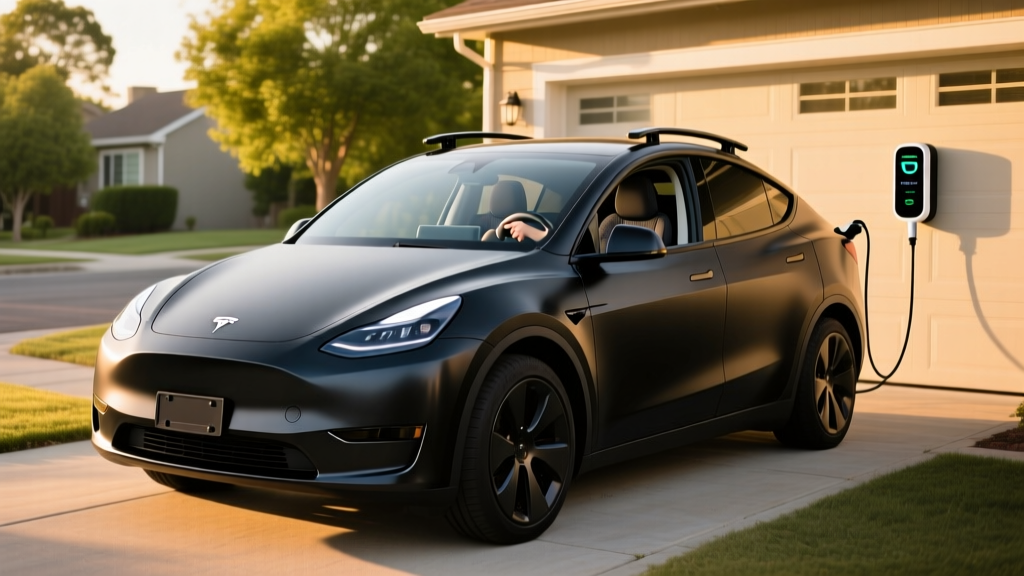
For daily use, a Tesla Wall Connector on a 60-amp circuit delivers 11.5 kW, adding roughly 44 miles of range per hour. A full overnight charge (10 hours) replenishes the entire 78.1 kWh battery. Most Renton homes with 200-amp electrical panels can accommodate this without a panel upgrade, but older homes (pre-1990s) in areas like Highlands or Kennydale may need an electrical assessment. Budget $500–$1,500 for a licensed electrician to install a 240V/60A circuit — and always get a permit through the City of Renton building department.
Performance, Ride, and Daily Driving
The Long Range AWD's dual-motor setup produces 384 horsepower and a 4.8-second 0–60 time — quick enough for confident I-405 merges and on-ramp acceleration. The Performance trim's 510 hp and 3.5-second sprint is genuinely sports-car territory, though the stiffer suspension trade-off is noticeable on Renton's rougher arterial roads like Sunset Boulevard or parts of Rainier Avenue.
Ride quality on the 2026 Juniper refresh is noticeably improved over the pre-2025 Model Y. Tesla has retuned the suspension bushings and added acoustic glass, reducing highway wind noise. The steering remains quick but somewhat numb — a Tesla hallmark that some drivers love and others find artificial.
Ground clearance is 6.6 inches, adequate for Renton's occasional snow days but not for serious unpaved roads. The AWD system provides confident traction in wet PNW conditions, and Tesla's traction control software is among the best in the industry for managing low-grip starts.
Pricing, Trims, and Federal Tax Credit Eligibility
| Trim | Base MSRP | Destination Fee | Est. Federal Credit (§30D) | Effective Price (if eligible) |
|---|---|---|---|---|
| Long Range AWD | $44,990 | $1,390 | Up to $7,500 | ~$38,880 |
| Performance | $51,490 | $1,390 | Up to $7,500 | ~$45,380 |
Source: IRS §30D Clean Vehicle Credit. Eligibility depends on buyer income, vehicle MSRP, and battery component/critical mineral sourcing. Verify current rules before purchase.
§30D Tax Credit Rules for 2026
The federal Clean Vehicle Credit under IRS §30D offers up to $7,500 for qualifying new EVs, but eligibility is not automatic. Key requirements for 2026:
- MSRP Cap: SUVs/crossovers must have an MSRP at or below $80,000 (the Model Y qualifies easily)
- Buyer Income Cap: Modified AGI must not exceed $150,000 (single), $225,000 (head of household), or $300,000 (joint filers)
- Battery Sourcing: A percentage of critical minerals and battery components must be sourced from the U.S. or free-trade-agreement countries — Tesla's U.S.-built battery packs generally meet current thresholds, but the exact $3,750 + $3,750 split depends on the specific build batch
- Point-of-Sale Transfer: As of 2024, buyers can transfer the credit to the dealer at purchase, reducing the out-of-pocket price immediately rather than waiting for tax filing
- Final Assembly: Must occur in North America (Fremont, CA qualifies)
Critical caveat for Renton buyers: Tax credit rules have shifted multiple times since 2023. Always verify current eligibility on IRS.gov or consult a tax professional before finalizing your purchase. The point-of-sale transfer option simplifies the process but requires the dealer to be registered with the IRS Energy Credits Online portal.
Tech, Interior, and Driver Assistance
The 2026 Model Y's cabin reflects the Juniper redesign: a 15.4-inch center touchscreen, ventilated front seats (finally standard), ambient lighting, and a rear-seat entertainment screen. The minimalist interior is polarizing — there are no physical stalks for turn signals (now on the steering wheel rim) and no traditional instrument cluster. Everything routes through the central display.
Autopilot and FSD (Supervised)
Both Autopilot and Full Self-Driving (Supervised) require continuous driver engagement. These are NOT self-driving systems. The driver must keep hands on the wheel and eyes on the road at all times. True driverless operation (Level 4) is limited to geofenced robotaxi services like Waymo.
Standard Autopilot includes traffic-aware cruise control and lane centering — adequate for I-405 commutes. The optional FSD (Supervised) package ($8,000 one-time or $99/month in 2026) adds automated lane changes, traffic light and stop sign recognition, and city street navigation assistance. It works well on Renton's gridded streets but can hesitate in complex construction zones or poorly marked lanes near the SR-167 interchange.
Notable Tech Drawbacks
The turn-signal buttons on the steering wheel rim (replacing the traditional stalk) remain controversial — many owners report a multi-week adaptation period. The lack of Apple CarPlay and Android Auto is a dealbreaker for some buyers who prefer phone-based navigation. Tesla's native navigation is strong, but it doesn't integrate with your phone's ecosystem. And while the glass roof is expansive, it admits significant heat on sunny summer days — a sunshade accessory is recommended.
Pros and Cons at a Glance
Pros
- 308-mile EPA range covers most PNW road trips without charging
- Extensive Supercharger network — reliable, fast, well-maintained
- Strong efficiency (30 kWh/100 mi) keeps charging costs low
- 72.1 cu ft cargo space rivals midsize SUVs like the Subaru Outback
- Over-the-air updates continuously add features
- Heat pump standard — excellent for PNW winters
- Qualifies for up to $7,500 federal tax credit (if eligible)
Cons
- No Apple CarPlay or Android Auto
- Steering-wheel turn-signal buttons require adaptation
- Ride quality firm on rougher Renton surface streets
- FSD (Supervised) is expensive and still Level 2 — not autonomous
- Glass roof admits heat; sunshade recommended
- Insurance premiums 15–25% higher than comparable gas crossovers
- CCS adapter needed for non-Tesla DC fast chargers
Model Y vs. Key Competitors: Is It Still the Best Buy?
The 2026 Model Y faces legitimate competition it didn't have three years ago:
- Hyundai Ioniq 5: 310-mile range, 800V architecture (10–80% in ~18 min at 350 kW chargers), more comfortable ride, CarPlay/Android Auto. Lacks Tesla's Supercharger network.
- Ford Mustang Mach-E: 320-mile extended-range option, more traditional interior controls, BlueCruise hands-free on mapped highways. DC charging peaks at ~150 kW — slower than Tesla.
- Kia EV6: Shares the Ioniq 5's 800V platform, sportier styling, slightly less cargo space. Also lacks native Supercharger access.
Who Should Buy the 2026 Model Y
- Choose the Model Y if: You value the Supercharger network for road trips, want OTA updates, prefer the minimalist tech-forward cabin, and primarily charge at home in Renton with occasional I-90/I-5 corridor travel.
- Consider competitors if: You need CarPlay/Android Auto, prefer a softer ride, want the fastest possible DC charging (Hyundai/Kia 800V), or need hands-free highway driving (Ford BlueCruise).
Ownership Costs: What Renton Drivers Actually Pay
Washington State has no state income tax, which simplifies the federal-only tax credit calculation. However, Washington does impose a motor vehicle sales tax (6.5% statewide, plus local additions — Renton's combined rate is approximately 10.35%). On a $44,990 Long Range AWD, expect ~$4,650 in sales tax before any credit.
Charging cost estimate: At Puget Sound Energy's residential rate (~$0.12/kWh in 2026), fully charging the 78.1 kWh battery at home costs roughly $9.37 — equivalent to about $1.20/gallon gasoline. Over 12,000 annual miles, home charging runs approximately $430/year versus ~$1,500 for a 28-MPG gas crossover at $3.50/gallon.
Insurance: Model Y insurance in King County averages $1,800–$2,400/year depending on driving record and coverage — roughly 20% above a comparable gas SUV. Get quotes before committing.
Warranty coverage: Tesla provides a 4-year/50,000-mile basic vehicle warranty and an 8-year/120,000-mile battery and drive unit warranty with a minimum 70% capacity retention threshold. This is competitive with Hyundai's 10-year/100,000-mile battery warranty, though Tesla's basic warranty is shorter.
Frequently Asked Questions
What is the real-world range of the 2026 Tesla Model Y in Renton, WA?
Expect 260–275 miles on highway trips in mild weather, 280–300 miles in city commuting, and 235–255 miles during PNW winters (35–45°F). The EPA sticker reads 308 miles for the Long Range AWD trim.
How fast does the Model Y charge at home and on the road?
At home on a 240V Wall Connector (11.5 kW), you'll add ~44 miles of range per hour — a full charge takes about 7–8 hours. On a Tesla V3/V4 Supercharger, peak rate is 250 kW with a 10–80% charge in approximately 22 minutes.
Does the 2026 Model Y qualify for the $7,500 federal EV tax credit?
The Model Y generally qualifies for up to $7,500 under IRS §30D, provided the buyer meets income caps ($150K single / $300K joint), the MSRP is under $80,000 (it is), and battery sourcing requirements are met. The credit can be transferred at point of sale. Always verify current rules at IRS.gov before purchase.
Is the Model Y worth buying over the Hyundai Ioniq 5 or Ford Mach-E?
The Model Y wins on Supercharger network access, cargo space, and efficiency. The Ioniq 5 wins on DC charging speed (800V), ride comfort, and CarPlay support. The Mach-E wins on hands-free highway driving (BlueCruise) and traditional controls. Your priority determines the winner.
Do I need a CCS adapter for my Model Y?
The 2026 Model Y comes with the NACS (Tesla) connector natively. Tesla includes or sells a CCS adapter for accessing non-Tesla DC fast chargers (Electrify America, EVgo, etc.). As more networks adopt NACS connectors through 2026, the adapter becomes less critical but remains useful for older stations.
Can I install a Level 2 charger in my Renton home?
Most Renton homes with a 200-amp electrical panel can support a Tesla Wall Connector on a 60-amp circuit. Expect $500–$1,500 for professional installation by a licensed electrician. Older homes may need a panel assessment. Always pull a permit with the City of Renton for electrical work.
For the latest EPA data, visit fueleconomy.gov. For safety ratings, check NHTSA.gov. Tax credit rules are subject to change — consult IRS.gov or a qualified tax professional.