Why Renting a Tesla for a Day Is the Smartest Pre-Purchase Move
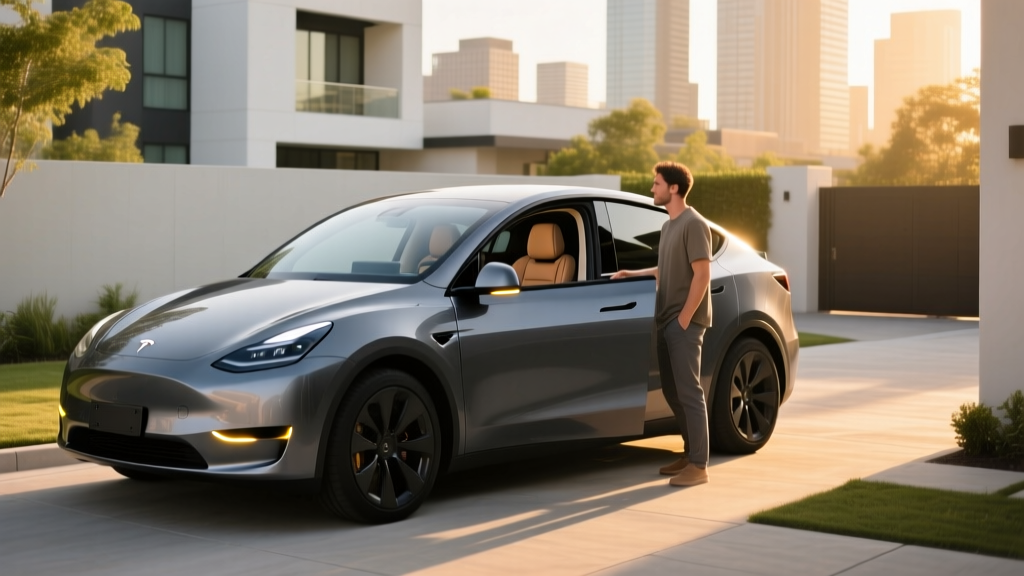
If you've been researching electric vehicles and keep landing on Tesla, you've probably asked yourself: should I rent a Tesla for a day before buying? The answer is a qualified yes — but only if you use that rental day strategically. A 24-hour rental in a 2026 Tesla Model Y Long Range AWD reveals what spec sheets and dealership test drives cannot: how the vehicle performs on your actual commute, how home or public charging fits your routine, and whether the minimalist interior suits your daily life.
This review breaks down the 2026 Model Y Long Range with the exact data you need — EPA range, real-world efficiency, DC fast-charging curves, tax credit eligibility, and ownership economics — so that whether you're renting to try before you buy or deciding outright, you know precisely what you're getting.
2026 Tesla Model Y Long Range: Core Specifications
| Specification | 2026 Model Y Long Range AWD |
|---|---|
| EPA Range | 320 miles |
| Battery (Usable) | ~75 kWh, NMC (Nickel Manganese Cobalt) |
| Max DC Fast Charge | 250 kW peak |
| 10–80% DC Charge Time | ~27 minutes |
| Level 2 Home Charge Rate | 11.5 kW (~44 mi/hr) |
| 0–60 mph | 4.8 seconds |
| Horsepower | 384 hp (dual motor) |
| Drivetrain | Dual Motor AWD |
| Efficiency | 122 MPGe combined / 28 kWh/100 mi |
| Cargo Volume | 30.2 cu ft (rear seats up), 72.1 cu ft (folded) |
| Rear Legroom | 40.5 inches |
| Towing Capacity | 3,500 lbs |
| Base MSRP | $47,990 (incl. destination) |
| Battery Warranty | 8 years / 120,000 miles (min 70% retention) |
Real-World Range: What the EPA Sticker Doesn't Tell You
EPA Estimated Range: 320 miles
Real-World Expectation: Plan for 255–280 miles on a highway road trip at 70–80 mph. In cold weather (below 32°F), expect 20–30% range reduction, dropping effective range to roughly 220–250 miles. City driving with regenerative braking recovers closer to the EPA figure or slightly above.
The Model Y Long Range's 320-mile EPA rating is competitive in the midsize electric SUV segment, but renters and buyers alike should understand how real-world conditions reshape that number. Tesla's thermal management system is among the best in the industry — the heat pump is standard and highly effective — but physics still governs lithium-ion cells. On a 75°F day at 65 mph with light climate use, you'll see roughly 290–300 miles before needing to charge. Push speeds to 80 mph on an interstate, and consumption climbs noticeably.
According to fueleconomy.gov, the Model Y Long Range AWD achieves 122 MPGe combined. During a rental day, pay attention to the energy consumption readout (measured in Wh/mi) on the touchscreen. A reading of 250–280 Wh/mi is typical for mixed driving; above 300 Wh/mi indicates aggressive acceleration, high speeds, or cold conditions eating into your range.
Charging Speed: DC Fast Charging and Home Setup
Understanding the difference between kW (power — the rate of charging) and kWh (energy — the battery's total capacity) is essential. The Model Y Long Range has a ~75 kWh battery and can accept up to 250 kW of charging power at a DC fast charger.
| Charging Level | Power | Speed (Approx.) | Use Case |
|---|---|---|---|
| Level 1 (120V outlet) | ~1.4 kW | ~5 miles per hour | Emergency / overnight trickle |
| Level 2 (240V home) | 11.5 kW | ~44 miles per hour | Daily home charging |
| DC Fast (Supercharger) | Up to 250 kW peak | 10–80% in ~27 min | Road trips |
The charging curve matters. The 250 kW peak rate applies only at low states of charge (roughly 10–30%). As the battery fills, the rate tapers to protect cell health. Expect sustained rates of ~150 kW through 50%, dropping to ~60 kW by 80%, and slower still above 90%. This is why the 10–80% metric is the industry standard — charging past 80% on DC adds significant time.
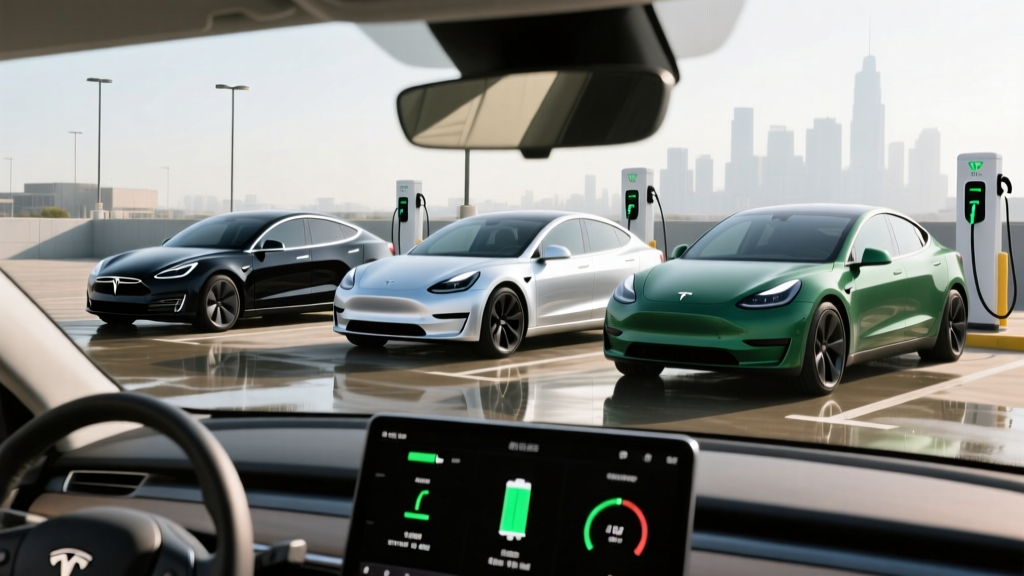
For your rental day: use a Tesla Supercharger (now open to other EVs via the NACS standard, but still the most reliable network for Tesla owners). Plug in, precondition the battery by navigating to the charger in the car's nav system, and expect a meaningful charge in 20–25 minutes.
At home, an 11.5 kW Level 2 wall connector on a 60-amp circuit adds roughly 44 miles of range per hour of charging. A full overnight charge (8 hours) restores the entire battery. Installation costs typically range from $800–$2,500 depending on panel capacity and conduit run — factor this into your purchase decision. Consult a licensed electrician to assess whether your panel supports a 60-amp dedicated circuit or requires an upgrade.
Performance and Driving Dynamics
The dual-motor AWD powertrain produces 384 horsepower and launches the Model Y Long Range to 60 mph in 4.8 seconds — quick by any measure and particularly responsive in stoplight-to-stoplight city driving. The low center of gravity from the floor-mounted battery pack keeps body roll well-controlled through corners, though the ride quality trends firm, especially on the standard 19-inch wheels with all-season tires.
One-pedal driving via regenerative braking is a hallmark Tesla experience. Lift off the accelerator and the car decelerates assertively, often eliminating the need for the friction brake pedal in normal driving. New EV drivers typically adapt within an hour — during your rental day, give yourself a brief adjustment period in a low-traffic area.
Driver assistance clarity: Tesla's Autopilot comes standard and includes Traffic-Aware Cruise Control and Autosteer (lane centering). Full Self-Driving (Supervised) is an optional add-on that enables automated lane changes, on-ramp-to-off-ramp highway driving, and city-street navigation. However, FSD Supervised is an SAE Level 2 system — the driver must remain fully engaged, hands on the wheel, eyes on the road at all times. This is not autonomous driving. Only Level 4 services like Waymo operate without a human driver.
Pricing, Trims, and Federal Tax Credit Eligibility
| Trim | MSRP (incl. destination) | Est. Price After §30D Credit* |
|---|---|---|
| Model Y Long Range AWD | $47,990 | ~$40,490 |
| Model Y Performance AWD | $52,990 | ~$45,490 |
*Federal tax credit estimates assume buyer eligibility. See details below.
The IRS §30D clean vehicle credit offers up to $7,500 for qualifying new EVs, but eligibility hinges on several rules that change and tighten over time:
- MSRP Cap: SUVs must be priced at or below $80,000. Both Model Y trims qualify.
- Buyer Income Limits: Modified adjusted gross income must not exceed $300,000 (joint filers), $225,000 (head of household), or $150,000 (single). Check your prior-year or current-year MAGI.
- Battery Sourcing: Critical minerals and battery components must meet escalating domestic-sourcing thresholds. As of 2026, these requirements are stringent, and the credit amount can split into $3,750 for minerals and $3,750 for components. Verify current Model Y sourcing compliance on the IRS eligible vehicle list before relying on the full $7,500.
- Point-of-Sale Transfer: Eligible buyers can transfer the credit to the dealer at purchase, reducing the purchase price directly rather than waiting for a tax refund.
The Model Y is assembled at Giga Texas, but battery cell and mineral sourcing compliance is the variable that determines whether the full credit applies. Always confirm eligibility at the point of purchase and consult a tax professional for your specific situation.
Interior, Tech, and Cargo Practicality
The Model Y interior is defined by radical minimalism. There is no instrument cluster — all information routes through the 15.4-inch center touchscreen. Climate controls, mirror adjustments, glovebox release, and even windshield wiper settings live on this screen. Some drivers find this clean and intuitive after a day of acclimation; others find it distracting. This is precisely the kind of preference a rental day reveals.
Cargo space is a genuine strength: 30.2 cubic feet behind the second row and 72.1 cubic feet with the rear seats folded. The rear trunk is deep and wide, and the front trunk (frunk) adds useful sealed storage for charging cables or groceries. Rear legroom at 40.5 inches is comfortable for adults on longer trips.
The infotainment system is fast, supports over-the-air updates, and includes navigation, streaming media, and a surprisingly capable web browser. However, there is no Apple CarPlay or Android Auto — a dealbreaker for some buyers accustomed to phone projection. Bluetooth audio streaming works, but you're locked into Tesla's native interface for navigation and media.
Pros, Cons, and Key Competitors
Pros
- Supercharger network access — the most reliable DC fast-charging ecosystem in North America
- Class-leading cargo volume and practical SUV packaging
- Over-the-air updates continuously add features post-purchase
- Strong efficiency (28 kWh/100 mi) keeps charging costs low
- Quick acceleration and standard dual-motor AWD
Cons
- No Apple CarPlay or Android Auto
- Screen-dependent controls can be distracting while driving
- Firm ride quality on rough pavement
- FSD (Supervised) remains Level 2 despite the "self-driving" branding
- Battery sourcing compliance may reduce available tax credit
Key competitors to cross-shop: The Hyundai Ioniq 5 (EPA 305 mi, 800V architecture for faster peak charging, CarPlay standard), the Ford Mustang Mach-E Extended Range (EPA 320 mi, more traditional interior), and the Chevrolet Equinox EV (lower starting price, strong value). Each trades the Supercharger ecosystem for different strengths in comfort, interface, or price.
How to Use a Rental Day to Make Your Decision
If you're going to rent a Tesla for a day, maximize the investment:
- Drive your real commute. Don't just cruise the neighborhood. Hit your actual route at rush hour. Note energy consumption in stop-and-go versus highway segments.
- Test a DC fast charge. Find a Supercharger along your route. Precondition, plug in, and time the 10–80% session. Experience the taper firsthand.
- Evaluate the interface under real conditions. Adjust mirrors, change climate settings, and navigate to a new destination while driving (safely). Decide if the touchscreen-heavy approach works for you.
- Assess passenger and cargo fit. Load your typical cargo — strollers, groceries, luggage — and seat any family members who'll ride along regularly.
- Check home charging feasibility. Park near a 120V or 240V outlet if possible. Even a brief Level 1 session shows you how the Mobile Connector works and how your garage setup might function.
Frequently Asked Questions
What is the real-world range of the 2026 Model Y Long Range?
The EPA rates it at 320 miles. In real-world highway driving at 70–80 mph, expect 255–280 miles. In freezing temperatures, range can drop to 220–250 miles due to increased battery resistance and cabin heating demands.
How fast does the Model Y charge at home and on the road?
On a 240V Level 2 home charger at 11.5 kW, you'll add roughly 44 miles per hour — a full charge overnight. At a 250 kW Supercharger, the 10–80% session takes approximately 27 minutes, though the rate tapers significantly above 80%.
How much does the Model Y cost after federal tax credits?
The Long Range AWD starts at $47,990. If you qualify for the full §30D credit of $7,500, the effective price drops to roughly $40,490. However, eligibility depends on your income, the vehicle's battery sourcing compliance, and MSRP caps. Confirm details on the IRS clean vehicle credit page and with a tax professional.
Is the Model Y worth buying over the Hyundai Ioniq 5 or Ford Mach-E?
Choose the Model Y if Supercharger network reliability, over-the-air updates, and maximum cargo space are your priorities. Choose the Ioniq 5 if you want faster peak charging capability (800V architecture), Apple CarPlay, and a more conventional interior. Choose the Mach-E if you prefer a traditional driving feel and BlueCruise hands-free highway driving.
Does the 2026 Model Y qualify for the $7,500 federal EV tax credit?
It can, but the full amount depends on battery component and critical-mineral sourcing thresholds that tighten annually. The Model Y's MSRP is under the $80,000 SUV cap, and it's assembled in the US. Verify the current sourcing compliance status on the IRS eligible vehicle list before finalizing your purchase, as partial credit ($3,750) may apply if only one of the two sourcing requirements is met.
Does renting a Tesla count as a test drive for purchase decisions?
A rental is often more informative than a 20-minute dealership loop. You experience real charging logistics, daily-route efficiency, and interface fatigue (or comfort) over hours rather than minutes. Many EV buyers report that a day-long rental either confirmed their purchase or saved them from a mismatch.
What is the battery warranty on the Model Y?
Tesla covers the battery and drive unit for 8 years or 120,000 miles, whichever comes first, with a minimum 70% capacity retention guarantee. If the battery degrades below 70% of its original capacity within that window, Tesla will repair or replace it at no cost.