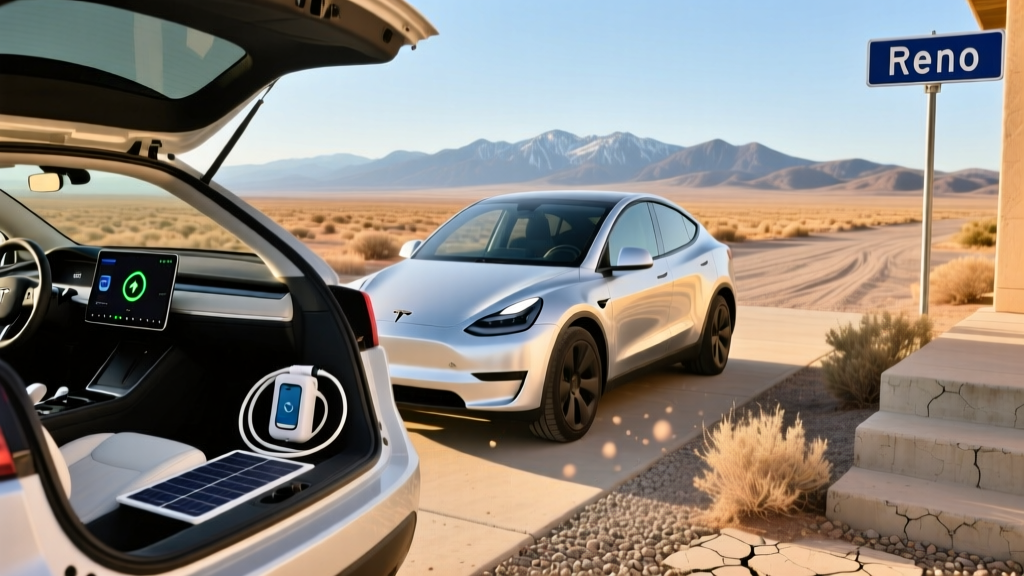
Reno, Nevada, is a unique place to own an electric vehicle. High-desert winters, sprawling highway commutes to Lake Tahoe or Carson City, and a growing public charging footprint make the Tesla Model Y the most visible EV on Sierra streets. If you've been searching for a Reno Tesla and wondering whether a Model Y makes sense for your specific climate, commute, and budget, this guide covers the real numbers that matter — not the marketing.
Tesla's Fremont factory is just a few hours west, meaning Northern Nevada benefits from strong regional service infrastructure, frequent Supercharger access along I-80 and US-395, and a community of experienced owners. But Reno's 4,500-foot elevation, sub-freezing winter mornings, and long mountain-grade drives introduce variables that spec sheets don't capture. Here's what you need to know before you buy.
2026 Tesla Model Y: Quick Specs at a Glance
| Spec | Long Range AWD | Performance |
|---|---|---|
| EPA Range | 320 miles | 295 miles |
| Battery (usable) | ~75 kWh, NMC | ~75 kWh, NMC |
| Drivetrain | Dual-Motor AWD | Dual-Motor AWD |
| Horsepower | 384 hp | 510 hp |
| 0–60 mph | 4.8 sec | 3.5 sec |
| Peak DC Charge Rate | 250 kW | 250 kW |
| 10–80% DCFC Time | ~25 min | ~25 min |
| Level 2 Home Rate | 11.5 kW (~44 mi/hr) | 11.5 kW (~44 mi/hr) |
| Efficiency | 122 MPGe / 28 kWh/100mi | 111 MPGe / 30 kWh/100mi |
| Cargo (rear seats up) | 30.2 cu ft | 30.2 cu ft |
| Cargo (rear seats folded) | 72.1 cu ft | 72.1 cu ft |
| Rear Legroom | 41.6 in | 41.6 in |
| Base MSRP | $47,990 | $54,990 |
| Battery Warranty | 8 yr / 120,000 mi | 8 yr / 120,000 mi |
Source: EPA fueleconomy.gov and Tesla specifications. Prices reflect 2026 model year before destination fees or options.
Real-World Range in Reno's High-Desert Climate
Real-World Expectation: ~260–290 mi on highway drives at 70+ mph; ~220–250 mi in winter (below 32°F) with cabin heat; ~280–310 mi in mild city driving with regen.
Tahoe Run Reality Check: Reno to South Lake Tahoe (~58 mi one-way) involves a 2,000+ ft elevation climb. Expect to use roughly 80–100 miles of range round-trip depending on temperature, speed, and regenerative braking on the descent.
The EPA's 320-mile estimate assumes a mix of city and highway driving at moderate temperatures. Reno's reality is different. Winter lows regularly dip into the teens, and battery chemistry — in this case, nickel-manganese-cobalt (NMC) — loses efficiency in cold weather. Expect 15–25% range reduction on freezing mornings, especially if you're preconditioning the cabin from a cold-soaked battery.
The good news: Tesla's heat pump (standard on all 2026 Model Y trims) is one of the most efficient in the industry. It pulls heat from the battery and drivetrain rather than relying solely on resistive heating, cutting winter energy consumption compared to older EVs without thermal management. Preconditioning while plugged in at home — scheduling your departure time via the Tesla app — effectively eliminates cold-start range loss for your daily commute.
For the I-80 corridor toward Sacramento or Elko, sustained 75–80 mph highway speeds will consume more energy than the EPA test cycle. Plan for roughly 260–290 miles of practical range in summer, and budget a Supercharger stop in Winnemucca (170 mi east) or Truckee (32 mi west) for longer trips.
Charging Speed: DC Fast Charging and Home Setup
The Model Y's 250 kW peak DC fast-charge capability on V3 Superchargers is well-established, but peak kW is not sustained kW. Here's what the charge curve actually looks like:
| Charging Method | Power (kW) | Speed (mi/hr added) | Notes |
|---|---|---|---|
| Tesla V3 Supercharger (DCFC) | Peak 250 kW | ~1,000+ mi/hr at peak | 10–80% in ~25 min; tapers sharply above 60% |
| Tesla V2 Supercharger | 150 kW | ~500 mi/hr at peak | 10–80% in ~38 min |
| Home Level 2 (Wall Connector, 48A) | 11.5 kW | ~44 mi/hr | Full charge in ~7 hr; requires 60A circuit |
| Home Level 2 (NEMA 14-50, 32A) | 7.7 kW | ~30 mi/hr | Full charge in ~10 hr; requires 50A circuit |
| Level 1 (120V standard outlet) | ~1.4 kW | ~3–4 mi/hr | Emergency/trickle only |
For Reno homeowners, a Tesla Wall Connector on a 60-amp dedicated circuit is the gold standard. Expect a licensed electrician to charge between $800 and $2,000 for installation, depending on whether your electrical panel needs an upgrade (many older Reno homes have 100A panels that may require a $1,500–$3,000 upgrade to 200A). NV Energy offers a time-of-use rate plan that makes overnight charging significantly cheaper than peak-hour charging — a full 75 kWh charge at off-peak rates costs roughly $6–$9, compared to $15–$22 at a Supercharger.
Reno's Supercharger network is robust: multiple stations along I-80 (including Sparks, Verdi, and Fernley), plus urban chargers at shopping centers. For trips to the Bay Area, the Donner Pass corridor is well-covered. For rural Nevada excursions, plan ahead — stretches of US-50 east of Fallon have sparse DC fast-charging options.
Performance and Drivetrain: What AWD Means for Sierra Driving
Both Model Y trims use dual-motor all-wheel drive, which is essential for Reno's winter conditions. The Long Range delivers 384 hp and a 4.8-second 0–60 mph time — quick for any practical purpose, including merging onto US-395 or climbing Mt. Rose Highway. The Performance trim bumps output to 510 hp and drops the 0–60 to 3.5 seconds, with upgraded brakes, a lowered sport suspension, and 21-inch wheels (which trade roughly 15–20 miles of range for grip and aesthetics).
For snow and ice, Tesla's traction control system responds in milliseconds by modulating torque to each axle independently. There's no mechanical linkage between front and rear motors, which means fewer parts to maintain and faster response than a traditional AWD system. That said, winter tires (or at minimum all-weather tires with a Three-Peak Mountain Snowflake rating) are strongly recommended for frequent Tahoe or Mt. Rose passes. The stock Continental or Michelin all-season tires are adequate for plowed Reno streets but less confident on packed snow at elevation.
Pricing, Trims, and Federal Tax Credit Eligibility
| Trim | Base MSRP | Est. After §30D Credit* | Est. Monthly (72 mo, 6.5%) |
|---|---|---|---|
| Long Range AWD | $47,990 | $40,490 | ~$675 |
| Performance AWD | $54,990 | $47,490 | ~$790 |
*Federal §30D credit eligibility requires buyer income ≤ $150K (single) / $300K (joint), vehicle MSRP ≤ $80,000 (SUVs), and compliant battery sourcing. Credit can be transferred to the dealer at point of sale as of 2024+. Consult a tax professional and see IRS.gov §30D guidance for current-year rules. Nevada has no state EV rebate as of 2026.
The Model Y qualifies as an SUV under IRS classification, so the MSRP cap is $80,000 (not $55,000 as with sedans). Both trims fall well below that threshold. The critical variable is battery component and critical-mineral sourcing — Tesla has progressively shifted supply chains to comply, but always verify the specific VIN's eligibility at the point of sale, as mid-year sourcing changes can affect qualification.
Nevada does not currently offer a state-level purchase incentive, but NV Energy's EV rate plan and potential utility rebates for home charger installation can reduce ownership costs. Check with your local co-op or municipality for any emerging programs.
Technology, Interior, and Daily Livability
The 2026 Model Y interior remains minimalist by design: a 15.4-inch center touchscreen handles all controls, navigation, media, and vehicle settings. There is no instrument cluster — speed and range info display on the left edge of the main screen. The updated "Juniper" refresh (introduced for the 2025 model year) added ventilated front seats, ambient lighting, a rear-seat touchscreen, power-folding second row, and improved sound insulation.
Standout tech features:
- Autopilot (included): SAE Level 2 lane-centering and adaptive cruise control. Effective for I-80 highway cruising but requires hands-on-wheel supervision at all times.
- Full Self-Driving Supervised ($8,000 option): Adds automatic lane changes, navigate-on-autopilot, and traffic-light recognition. Still Level 2 — you must remain fully engaged.
- Over-the-air updates: Tesla pushes software improvements regularly; range, charging, and UI refinements have arrived post-purchase for existing owners.
- Sentry Mode / Dashcam: Uses the vehicle's external cameras for parking surveillance and incident recording — useful in crowded Reno lots.
- Frunk + cargo: 4.1 cu ft front trunk plus 30.2 cu ft rear cargo (72.1 cu ft with seats folded). Fits two carry-ons in the frunk; the rear cargo area handles a week's groceries or ski gear for two.
Notable drawbacks:
- No physical buttons for climate, wipers, or glovebox — everything routes through the touchscreen, which can frustrate new owners.
- Ride quality on 20-inch wheels can feel firm over Reno's rougher roads and expansion joints on older highways.
- No Apple CarPlay or Android Auto — Tesla's proprietary infotainment is capable but closed.
- Panel gaps and paint quality have improved post-Juniper but still draw occasional criticism compared to legacy luxury brands.
Pros and Cons for Reno Buyers
Pros
- Dual-motor AWD excels on snow and mountain grades
- Heat pump minimizes winter range loss vs. competitors
- Extensive Supercharger network along I-80 and US-395
- Low home-charging cost on NV Energy TOU rates (~$7/full charge)
- Strong cargo capacity for ski gear, camping, or Costco runs
- OTA updates continue to add features post-purchase
- 8-year/120,000-mile battery warranty with 70% capacity retention guarantee
Cons
- Real-world winter range drops to ~220–250 mi on cold highway drives
- Touchscreen-only controls require an adjustment period
- Home charger install may require a panel upgrade ($1,500–$3,000)
- Insurance premiums run 15–25% higher than comparable gas SUVs in NV
- Rural Nevada charging deserts exist east of Fallon and north of Winnemucca
- Performance 21-inch wheels sacrifice ~15–20 mi of range
Who the Reno Tesla Model Y Suits Best
Best for: Daily commuters driving 20–80 miles round-trip on US-395 or I-80, families needing cargo space for gear, weekend Tahoe skiers who want AWD confidence, and homeowners with garage access for Level 2 charging. The Model Y's efficiency, Supercharger access, and thermal management make it arguably the most practical EV for Northern Nevada's specific conditions.
Consider alternatives if: You regularly drive 300+ miles into rural Nevada (charging gaps exist), you need three-row seating for larger families (look at the Model X or Kia EV9), or you prefer physical buttons and Apple CarPlay (the Hyundai Ioniq 5 or Ford Mustang Mach-E may feel more intuitive).
Compared to the Ford Mustang Mach-E (EPA 320 mi, ~$45K) and Hyundai Ioniq 5 (EPA 305 mi, ~$47K), the Model Y's advantage in Reno is specifically the Supercharger network reliability and cold-weather heat pump efficiency. Both competitors offer competitive range and NACS adapter access to Superchargers starting in 2025, but Tesla's integrated ecosystem remains the path of least resistance for Nevada's charging landscape.
Frequently Asked Questions
What is the real-world range of the Tesla Model Y in Reno?
Expect 260–290 miles in mild conditions on highway drives, and 220–250 miles on freezing winter mornings with cabin heat. City driving with regenerative braking can approach 300+ miles in spring and fall. The EPA sticker says 320 miles, but high-desert winters and sustained 75+ mph speeds reduce that figure meaningfully.
How fast does the Model Y charge at home and on road trips?
On a Tesla Wall Connector (Level 2, 11.5 kW), you'll add roughly 44 miles of range per hour — a full overnight charge takes about 7 hours. On a V3 Supercharger (250 kW peak), a 10–80% session takes approximately 25 minutes. The charge rate tapers significantly above 60% state of charge to protect the battery.
How much does a Tesla Model Y cost after federal tax credits?
The Long Range AWD starts at $47,990 and drops to roughly $40,490 if you qualify for the full $7,500 §30D federal credit. Eligibility depends on your income (≤$150K single / ≤$300K joint), the vehicle's battery sourcing compliance, and MSRP caps. The credit can be applied at the point of sale, reducing your down payment directly. Always verify VIN-level eligibility with your tax advisor.
Does the Tesla Model Y qualify for the federal EV tax credit?
As of 2026, the Model Y qualifies for up to $7,500 under IRS §30D, provided the buyer meets income limits, the vehicle MSRP is under $80,000 (SUV threshold), and battery sourcing requirements are met. Because Tesla's supply chain has shifted over time, confirm eligibility on your specific vehicle at purchase. See the IRS Clean Vehicle Credits page for current rules.
Is the Model Y worth buying over competitors in Reno?
For Reno specifically, the Model Y's advantages are the integrated Supercharger network (critical for I-80 and rural trips), best-in-class heat pump efficiency for cold winters, and strong AWD performance on mountain grades. The Ford Mach-E and Hyundai Ioniq 5 are competitive on price and range, but their public charging experience in Northern Nevada relies more on Electrify America and third-party networks, which have historically lower uptime than Tesla's proprietary stations.
How does cold weather affect the Model Y battery long-term?
Cold weather temporarily reduces range but does not accelerate permanent battery degradation — Tesla's thermal management system keeps the battery within safe operating temperatures. The 8-year/120,000-mile warranty guarantees at least 70% capacity retention. Real-world data from high-mileage Teslas suggests NMC batteries retain 85–90% capacity at 100,000 miles under normal use. Avoid regularly charging to 100% for daily driving; Tesla recommends 80% daily and 100% only for road trips.
What does home charging installation cost in Reno?
A Tesla Wall Connector install on a 60-amp circuit typically runs $800–$2,000 for labor and materials if your panel has capacity. If your home needs a 200-amp panel upgrade (common in pre-1990 Reno homes), add $1,500–$3,000. Always get a quote from a licensed electrician and check whether NV Energy offers any charger-install rebates.