Quick Answer: Are Renault EVs Available in the US?
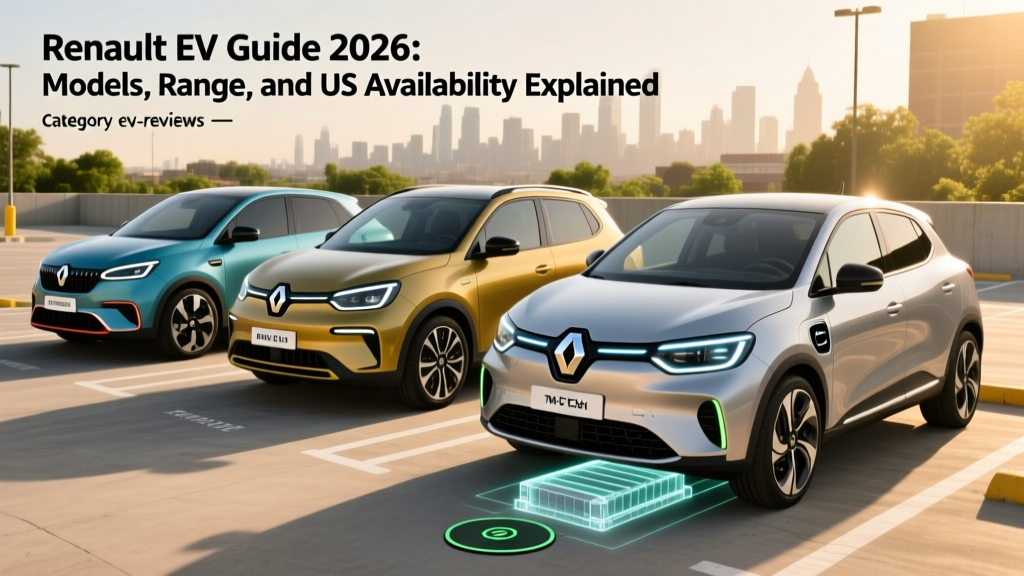
No. As of 2026, Renault does not sell or officially distribute electric vehicles in the United States. The Renault Group withdrew from the US passenger-car market decades ago, and its current EV lineup — including the popular Renault 5 E-Tech, Megane E-Tech, and Scenic E-Tech — is available only in Europe, select Asian markets, and other international regions. US-based EV shoppers interested in Renault's platform should look at corporate sibling Nissan's offerings (Nissan Ariya, Nissan Leaf) or European-market equivalents from Stellantis and Volkswagen Group that share similar compact-EV architectures. If you're considering importing a Renault EV, be aware that federal homologation (DOT/EPA compliance) and parts availability make this impractical for daily use.
Why Renault EVs Aren't Sold in America
Renault's absence from the US market isn't a recent decision — the brand exited the United States in the late 1980s after a brief partnership with American Motors Corporation (AMC). Since then, Renault has focused its passenger-vehicle operations on Europe, Africa, South America, and parts of Asia. The Renault-Nissan-Mitsubishi Alliance does operate in the US through Nissan, which sells the Leaf and Ariya electric vehicles, but Renault-branded vehicles have never returned.
Several structural factors keep Renault out of the US:
- Homologation costs: Meeting NHTSA crash standards, EPA emissions (and EV compliance) rules, and FMVSS lighting requirements requires significant re-engineering for a market where Renault has no dealer network.
- Dealer infrastructure: Building a US dealer network from scratch would cost billions, with no guarantee of market share against established brands.
- Alliance strategy: Nissan already serves as the Alliance's US-facing brand for EVs. Introducing Renault would create internal competition.
Renault's 2026 EV Lineup: Specs and Real-World Numbers
Even though you can't buy them stateside, Renault's current EV portfolio is worth understanding — especially if you're comparing European EV market dynamics, researching platform-sharing with Nissan, or planning an extended stay abroad. Here's a breakdown of Renault's three core EVs as sold in Europe for the 2025–2026 model years.
| Model | Battery (kWh usable) | Chemistry | WLTP Range | Est. Real-World Range | Max DC Charge (kW) | 10–80% Time | 0–100 km/h | HP | EU Starting Price |
|---|---|---|---|---|---|---|---|---|---|
| Renault 5 E-Tech | 40 / 52 | NMC | 300 / 400 km | ~220 / ~300 km | 80 kW (40 kWh) / 100 kW (52 kWh) | ~27 min | 8.0 / 7.2 sec | 120 / 150 | €25,900 |
| Megane E-Tech | 40 / 60 | NMC | 300 / 450 km | ~230 / ~340 km | 85 kW / 130 kW | ~30 / ~27 min | 10.0 / 7.4 sec | 130 / 220 | €38,900 |
| Scenic E-Tech | 60 / 87 | NMC | 430 / 625 km | ~330 / ~480 km | 130 kW / 150 kW | ~28 / ~32 min | 8.6 / 7.9 sec | 170 / 220 | €41,900 |
Important range note: WLTP (Worldwide Harmonised Light Vehicle Test Procedure) figures used in Europe are generally 10–20% more optimistic than US EPA estimates. A Scenic E-Tech rated at 625 km WLTP would likely achieve roughly 330–350 miles EPA if certified for the US market. In cold weather (below 32°F / 0°C), expect an additional 15–25% reduction from real-world range due to battery resistance and cabin heating demands.
Renault 5 E-Tech: The Retro Compact That Won't Cross the Atlantic
The Renault 5 E-Tech is Renault's most talked-about EV — a retro-styled compact hatchback built on the AmpR Small platform (co-developed with Nissan). With a starting EU price of €25,900 (~$27,500 USD before any incentives), it competes directly with the Dacia Spring, Citroën ë-C3, and upcoming VW ID.2 in Europe.
The 52 kWh battery variant delivers a WLTP-rated 400 km (~249 miles), though real-world highway driving at 120 km/h yields closer to 280–300 km (~175–185 miles). DC fast charging peaks at 100 kW on the larger battery, with the charge curve tapering significantly above 80% — a common NMC characteristic. Plan for 27 minutes from 10–80% at a compatible 100+ kW station, but expect 40+ minutes if the battery is cold and hasn't been preconditioned.
The 40 kWh LFP option (available in select trims) offers lower range but better cycle life and the ability to regularly charge to 100% without degradation concerns — a practical choice for city commuters with home charging.
US Alternatives: What to Buy Instead
If Renault's European EVs caught your eye, here's how comparable US-market vehicles stack up on price, range, and charging:
| Renault Model | US Equivalent | EPA Range | Battery (kWh) | Max DC kW | 10–80% | MSRP (USD) | Fed. Credit Eligible? |
|---|---|---|---|---|---|---|---|
| Renault 5 E-Tech (52 kWh) | Chevrolet Bolt EV | 259 mi | 65 (NMC) | 55 kW | ~45 min | $28,800 | Yes (up to $7,500) |
| Megane E-Tech (60 kWh) | Nissan Ariya (71 kWh) | 289 mi | 71 (NMC) | 130 kW | ~28 min | $39,590 | Partial (sourcing rules) |
| Scenic E-Tech (87 kWh) | Hyundai Ioniq 5 (77.4 kWh) | 318 mi | 77.4 (NMC) | 240 kW | ~18 min | $42,450 | Yes (up to $7,500) |
| Scenic E-Tech (87 kWh) | Tesla Model Y LR | 320 mi | 75 (NMC) | 250 kW | ~15 min | $44,990 | No (MSRP/income limits may apply) |
Tax credit caveat: The federal §30D EV tax credit offers up to $7,500, but eligibility depends on MSRP caps ($55,000 for SUVs, $50,000 for sedans/hatchbacks), buyer income limits ($150K single / $300K joint), and battery critical-mineral and component sourcing requirements that change annually. As of 2026, many vehicles qualify for a partial credit ($3,750) depending on battery sourcing. The credit can now be transferred to the dealer at point of sale as an instant discount. Always verify current eligibility at IRS.gov or fueleconomy.gov before purchasing.
Cost Comparison: EV vs Gas for the Renault-Sized Segment
Even without Renault in the US, the cost argument for compact EVs holds when compared to gas-powered equivalents like the Honda Civic, Toyota Corolla, or Mazda3. Here's a 5-year cost projection comparing a typical US-market compact EV (~$30K MSRP) against a comparable gas car (~$26K MSRP):
| Cost Category | Compact EV (e.g., Bolt) | Gas Compact (e.g., Civic) |
|---|---|---|
| Purchase Price (after credit) | $21,300 (w/ $7,500 credit) | $26,000 |
| Fuel / Electricity (5 yr) | $3,750 (home charging, $0.14/kWh avg) | $9,375 ($3.50/gal, 30 MPG) |
| Maintenance (5 yr) | $1,500 | $3,200 |
| Insurance (5 yr avg) | $7,500 | $6,250 |
| Depreciation (est.) | $9,000 | $8,500 |
| 5-Year Total | $43,050 | $53,325 |
Key assumptions: Electricity cost based on US residential average of ~$0.16/kWh (EIA data) with 70% home charging at off-peak rates and 30% public DC fast charging at ~$0.35/kWh. Gas prices based on a $3.50/gal national average (AAA). EV maintenance savings come from no oil changes, fewer brake replacements (regen braking), and simpler drivetrains. Insurance premiums for EVs run 15–25% higher on average due to repair costs and battery replacement exposure — get quotes before buying.
Real-World Ownership Considerations Before Going Electric
Whether you're eyeing a Bolt, Ariya, Ioniq 5, or any other compact EV as a Renault alternative, these practical factors determine whether EV ownership works for your situation:
Home Charging Access
Level 2 home charging (240V, 7–11 kW) is the backbone of convenient EV ownership. If you have a garage or dedicated parking spot with access to a 240V circuit, expect to pay $500–$2,000 for a quality Level 2 charger (Emporia, ChargePoint, Wallbox) plus $500–$2,500 for electrician installation depending on panel capacity and conduit runs. A 200-amp electrical panel is usually sufficient; older 100-amp panels may require a $1,500–$3,000 upgrade. Without home charging, you'll rely on public Level 2 and DC fast chargers, which adds time and cost.
Climate and Range Reality
If you live in a cold-weather region (sustained temps below 32°F), plan for 15–30% range loss in winter. A 300-mile EPA-rated EV may deliver only 210–255 miles in January in Minnesota. Heat pumps (standard on the Ioniq 5, optional on some trims of the Ariya) mitigate this by 5–10 percentage points. Preconditioning the battery while plugged in is essential for both range preservation and DC fast-charge speed.
Driving Patterns
EVs excel in stop-and-go city driving where regenerative braking recovers energy. Highway driving at 75+ mph is where EVs lose the most efficiency compared to their EPA stickers. If your commute is 90% highway, subtract 10–15% from the EPA range figure for realistic planning.
Myths vs Facts: Common EV Misconceptions
| Myth | Fact |
|---|---|
| "EV batteries need replacing every few years" | Modern NMC and LFP batteries are warrantied for 8 years/100,000 miles (federally mandated minimum). Real-world data from Tesla, Hyundai, and Nissan shows 85–92% capacity retention at 150,000 miles. Full replacement costs $8,000–$18,000 but is rarely needed within typical ownership periods. |
| "Charging takes too long" | Home Level 2 charging (overnight, 8 hours) adds 200–300 miles — more than most drivers use daily. DC fast charging at 150–250 kW stations delivers 10–80% in 15–30 minutes. The real bottleneck is charger availability, not speed. |
| "EVs are worse for the environment because of battery mining" | Lifecycle analyses (ICCT, Argonne National Lab) show EVs produce 50–70% fewer lifetime emissions than gas cars, even accounting for battery manufacturing. The grid is getting cleaner every year, improving EV environmental performance over time. |
| "The power grid can't handle mass EV adoption" | Most EV charging happens overnight when grid demand is lowest. Utilities are investing in managed-charging programs and grid upgrades. A study by Lawrence Berkeley National Lab found that even with 80% EV adoption, grid impacts are manageable with smart-charging policies. |
| "You can't take an EV on a road trip" | With DC fast-charger networks (Tesla Supercharger, Electrify America, EVgo) now covering major US highways at 25–70 mile intervals, road trips require 20–30 minute stops every 2–3 hours — similar to rest breaks on long drives. |
Decision Framework: Should You Buy an EV in 2026?
Choose an EV if:
- You have access to Level 2 home charging (garage, driveway, or workplace charger)
- Your daily driving is under 200 miles round-trip
- You qualify for the federal §30D credit or state incentives that reduce the effective price
- You want lower per-mile fuel costs ($0.04–0.06/mi on home electricity vs $0.12–0.15/mi on gas)
- You value instant torque, quiet operation, and reduced maintenance
Choose a Hybrid (HEV/PHEV) if:
- You lack reliable home charging access (apartment, street parking)
- You regularly drive 300+ miles in areas with sparse DC charging infrastructure
- You live in extreme cold climates and need consistent range without weather sensitivity
- You want EV-like city efficiency without range planning for road trips (PHEV: 25–40 mi electric + gas engine)
- Your budget is under $28,000 and you can't wait for more affordable EV options
Stick with Gas for Now if:
- You drive 40,000+ miles/year in rural areas with no charging infrastructure
- Your electrical panel can't support Level 2 charging and an upgrade isn't financially viable
- You tow heavy loads regularly (EV towing range drops 40–60%)
Frequently Asked Questions
Will Renault ever sell EVs in the United States?
There are no announced plans for Renault to re-enter the US passenger vehicle market. The Renault-Nissan-Mitsubishi Alliance uses Nissan as its US brand. Renault CEO Luca de Meo has focused the company's growth strategy on Europe and international markets. Unless the Alliance's US strategy changes fundamentally, Renault EVs will remain unavailable in America.
Can I import a Renault 5 E-Tech or Megane E-Tech to the US?
Technically, you can import a vehicle under the "Show or Display" exemption (limited to 2,500 miles/year) or after the vehicle reaches 25 years of age. For practical daily use, importing a current Renault EV is not feasible — it would need to pass NHTSA crash testing, EPA certification, and FMVSS lighting compliance at your expense, likely costing $50,000+ in modifications and testing. Parts availability and service would also be nonexistent.
Is the Nissan Ariya basically a Renault in disguise?
The Nissan Ariya shares the Alliance's CMF-EV platform with the Renault Megane E-Tech and Scenic E-Tech, but they are distinct vehicles with different body panels, interior designs, battery configurations, and software. The Ariya uses a 63 or 91 kWh battery (vs Renault's 60 or 87 kWh), different motor tuning, and Nissan's ProPILOT driver-assist system. Think of them as platform cousins, not twins.
What's the most affordable EV I can buy in the US in 2026?
The Chevrolet Bolt EV starts at $28,800 MSRP and qualifies for the full $7,500 federal tax credit (subject to income and sourcing requirements), bringing the effective price to around $21,300. The Nissan Leaf starts at $28,140 but qualifies for only a partial credit due to battery sourcing. Both offer 200+ miles of EPA range with Level 2 home charging capability.
How does European EV pricing compare to the US?
European EV prices include VAT (19–25% depending on country), making sticker prices appear higher. However, many European countries offer purchase incentives of €3,000–€7,000 and have lower electricity costs. When you normalize for taxes, incentives, and purchasing power, a Renault 5 E-Tech at €25,900 (~$27,500 before incentives) is roughly equivalent to a Chevy Bolt at $28,800 (before the $7,500 US credit). The US buyer arguably gets a better deal after incentives.