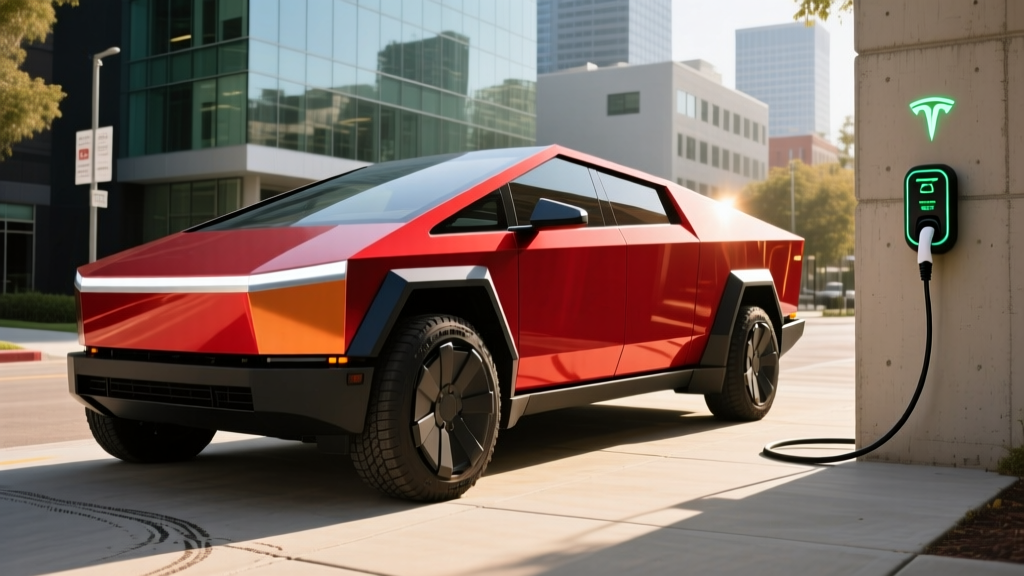
Search "red Cybertruck" on any EV forum and you'll find two camps: buyers who love the aesthetic but are tired of waiting, and skeptics who think Tesla's color-wrapping policy is more hype than hardware. The reality is somewhere in between. Tesla now offers a limited-run red color option (and color wraps) for the Cybertruck lineup, but the paint job doesn't change the underlying physics, chemistry, or charging architecture that defines this polarizing electric truck.
This review covers the 2026 Cybertruck in its available trims — including the red color variant — with exact numbers on range, charging curves, efficiency, pricing, and federal tax credit eligibility. We'll tell you what the EPA sticker says, what you'll actually see on a highway road trip in January, and whether the Cybertruck's stainless-steel exoskeleton makes sense for your driveway.
Range and Efficiency: EPA vs the Real World
The 2026 Cybertruck is offered in three main configurations, each with a different battery pack and range profile. Tesla uses NMC (nickel manganese cobalt) lithium-ion cells in the Cybertruck's structural battery pack — prioritizing energy density over the cycle-life advantages of LFP chemistry found in the standard-range Model 3.
| Trim | Battery (kWh usable) | EPA Range | MPGe (combined) | kWh/100 mi |
|---|---|---|---|---|
| AWD (Dual-Motor) | ~123 kWh | 340 mi | 72 MPGe | 47 |
| Cyberbeast (Tri-Motor) | ~123 kWh | 320 mi | 68 MPGe | 50 |
| RWD (announced, not yet available) | ~100 kWh (est.) | ~250 mi (est.) | TBD | TBD |
Efficiency of 47–50 kWh/100 miles is on the high side for an EV — comparable to the Ford F-150 Lightning Extended Range (~49 kWh/100 mi) but worse than the Rivian R1T Dual-Motor (~44 kWh/100 mi). That translates directly to higher electricity costs per mile and slower effective road-trip progress, since you're burning more energy to cover the same distance.
Charging Speed: 800V Architecture in Practice
The Cybertruck uses an 800-volt electrical architecture (nominally ~816V), which allows it to accept very high DC fast-charge power without excessive current. This is the same voltage class as the Hyundai Ioniq 5 and Porsche Taycan, and it matters for sustained charge rates.
| Charging Method | Max Power | Speed / Time |
|---|---|---|
| DC Fast Charge (NACS) | 250 kW peak | 10–80% in ~25–30 min |
| Level 2 Home (NACS / J1772 adapter) | 11.5 kW (48A) | ~30–33 mi/hr added |
| Level 1 (120V outlet) | ~1.4 kW | ~3–4 mi/hr added |
Charging curve reality: The Cybertruck peaks near 250 kW at low state of charge (~10–20%), but the curve tapers significantly above 50% SoC. You'll see ~180–200 kW through the mid-range, then a steep drop above 80%. This means the advertised 10–80% time of ~25–30 minutes is achievable at a V3 or V4 Tesla Supercharger, but charging from 80–100% adds another 20+ minutes. For road trips, plan to charge to 80% and go — the last 20% is rarely worth the wait.
At home on a 48-amp Level 2 circuit (requiring a 60-amp breaker), you'll add roughly 30–33 miles of range per hour. A full 0–100% charge takes about 12–13 hours. If your electrical panel supports a 60-amp EV circuit (many 200-amp residential panels do), this is the most cost-effective way to charge — typically $0.10–0.18/kWh depending on your utility, versus $0.30–0.45/kWh at public DC fast chargers.
Performance and Drivetrain
The Cybertruck's performance numbers remain startling for a vehicle with a 6,600+ lb curb weight. The tri-motor Cyberbeast uses three permanent-magnet synchronous reluctance motors (one front, two rear) with torque vectoring on the rear axle.
| Trim | Drivetrain | Horsepower | Torque (lb-ft) | 0–60 mph | Towing Capacity |
|---|---|---|---|---|---|
| AWD | Dual-Motor AWD | 600 hp | 740 | 3.9 sec | 11,000 lb |
| Cyberbeast | Tri-Motor AWD | 845 hp | 1,030 | 2.6 sec | 11,000 lb |
The 2.6-second 0–60 time in the Cyberbeast is legitimate and repeatable, though it requires the battery to be above ~50% SoC and preconditioned. Below 30% SoC, expect 0–60 times closer to 3.2–3.5 seconds as the battery management system limits peak discharge current to protect the cells.
Towing the full 11,000-pound rating will cut your range roughly in half — expect 150–180 miles from the AWD trim when pulling a heavy trailer. This is consistent with every electric truck on the market; the energy cost of moving 18,000+ combined pounds at highway speed is simply enormous.
Pricing, Trims, and Federal Tax Credit Eligibility
The Cybertruck's pricing has shifted since its late-2023 launch, with Tesla adjusting MSRPs in response to demand and competitive pressure. The red color option (or Tesla's official color wrap in red) adds approximately $2,500–$3,000 to the vehicle price.
| Trim | Base MSRP | As-Tested (w/ Red + common options) | §30D Federal Credit |
|---|---|---|---|
| AWD | $79,990 | ~$84,500 | See eligibility below |
| Cyberbeast | $99,990 | ~$104,500 | Not eligible (MSRP cap) |
| RWD (announced) | ~$60,990 (est.) | TBD | See eligibility below |
Federal tax credit (§30D) reality: The IRS caps the new clean vehicle credit at $7,500, but eligibility depends on three hurdles that eliminate many Cybertruck buyers:
- MSRP cap: Trucks must have an MSRP at or below $80,000. The AWD trim at $79,990 squeaks under — but adding the red color option or any significant package can push it over. The Cyberbeast at $99,990 is categorically ineligible.
- Buyer income cap: Modified AGI must not exceed $150,000 (single), $225,000 (head of household), or $300,000 (married filing jointly).
- Battery sourcing: A percentage of critical minerals and battery components must be sourced from the US or FTA partners. Tesla's supply chain has been evolving, and the qualifying credit amount can shift — currently the AWD Cybertruck qualifies for a partial or full credit depending on the production batch. Verify the specific VIN at fueleconomy.gov before purchasing.
The credit can now be transferred to the dealer at point of sale under 2024+ IRS rules, effectively reducing your purchase price at the dealership rather than waiting for a tax refund. Consult a tax professional for your specific situation — see IRS.gov §30D guidance for current rules.
Cargo, Interior Space, and Daily Practicality
The Cybertruck's dimensions are substantial but the usable interior space tells a more nuanced story than the exterior suggests.
- Bed length: 6 feet (with tailgate closed); extends to ~8 feet with the tailgate down and built-in ramp
- Bed width: ~4 feet between wheel wells
- Cargo volume (bed): ~67 cu ft (closed tonneau)
- Front trunk (frunk): ~7 cu ft — enough for a charging cable bag and a small cooler
- Front legroom: 41.3 inches
- Rear legroom: 38.2 inches — adequate for adults but tighter than an F-150 Lightning SuperCrew (43.5 in rear)
- Seating: 5 passengers (3-across rear bench, though the center position is narrow)
The stainless-steel exoskeleton and angular design create excellent outward visibility forward, but the rear window is small and high — the rearview camera is essentially mandatory for parking. The powered tonneau cover (standard) is a genuine advantage for secure, weather-sealed bed storage, but it limits vertical cargo height to about 26 inches with the cover closed.
Technology, Driver Assistance, and Drawbacks
The Cybertruck runs Tesla's latest infotainment platform on an 18.5-inch center touchscreen with a secondary 9.4-inch rear passenger screen. Key tech features include:
- Autopilot: Standard — adaptive cruise control, lane centering, automatic emergency braking (SAE Level 2 — driver must remain fully engaged)
- Full Self-Driving (Supervised): $8,000 option or $99/month subscription — adds automatic lane changes, traffic light/stop sign recognition, and supervised city-street navigation. Still SAE Level 2. Not autonomous.
- Steer-by-wire: No mechanical connection between the yoke and the wheels — enables the variable-ratio steering (less than one full turn lock-to-lock) but eliminates the option of a traditional round wheel
- 48-volt electrical architecture: Reduces wiring harness weight and enables higher-power accessories
- Bioweapon Defense Mode: HEPA air filtration system
- Powershare: 120V and 240V bed outlets (up to 11.5 kW output) for job-site tools or emergency home backup
Notable drawbacks:
- The yoke steering is polarizing and requires a genuine adaptation period — three-point turns and low-speed maneuvering feel unintuitive for the first several weeks
- Ride quality on rough pavement is firm; the air suspension helps but cannot fully mask the vehicle's mass
- Build quality has improved since early 2024 deliveries but panel-gap consistency still lags legacy automakers
- No Apple CarPlay or Android Auto — Tesla's native infotainment is the only option
- Rear-seat comfort is mediocre for long trips; the seat cushion is relatively flat and low
- Insurance premiums run 20–40% higher than comparable trucks due to repair costs for the stainless-steel body and structural battery
Warranty and Long-Term Battery Outlook
| Component | Coverage |
|---|---|
| Basic Vehicle | 4 years / 50,000 miles |
| Battery & Drive Unit | 8 years / 120,000 miles (minimum 70% capacity retention) |
| Restraint System | 5 years / 60,000 miles |
| Corrosion (body) | 12 years / unlimited miles (stainless steel does not rust traditionally) |
Tesla's 70% capacity retention threshold over 8 years is industry-standard. Based on data from Model S/X packs at similar energy densities, expect roughly 10–12% degradation over the first 100,000 miles under normal use — meaning a 340-mile EPA truck might deliver ~300 miles when new-equivalent at that mileage. The NMC chemistry in the Cybertruck is more energy-dense than LFP but slightly more sensitive to sustained high-SoC storage; Tesla recommends daily charging to 80–90% and only charging to 100% before long trips.
Full battery replacement out of warranty is estimated at $15,000–$22,000 based on current structural-pack complexity — a figure to factor into 10+ year ownership plans.
Who Should Buy the Red Cybertruck?
- You want maximum towing capacity (11,000 lb) in an electric truck
- Powershare (V2L/V2H) for job-site or emergency backup is a priority
- You have home Level 2 charging and mostly drive under 250 miles/day
- You value Supercharger network access for road trips (NACS native)
- The angular design and stainless-steel body appeal to you aesthetically
- Rear-seat passenger comfort on long trips is essential
- You want a traditional steering wheel (Rivian R1T, F-150 Lightning)
- Efficiency (kWh/100mi) matters more to you than raw power
- Your budget is under $75,000 — the RWD trim is still not available
- You need Apple CarPlay or a proven, mature service network
The red color option is purely cosmetic and doesn't affect any of the mechanical or electrical characteristics. If you're drawn to the look, the practical question remains the same as any Cybertruck purchase: does the combination of range, charging speed, utility, and daily comfort work for your specific driving patterns?
Frequently Asked Questions
What is the real-world range of the red Cybertruck?
The red color option has no effect on range. The AWD trim carries an EPA rating of 340 miles, but expect approximately 270–295 miles on highway trips in mild weather and 220–255 miles in cold conditions (below 30°F). The Cyberbeast's higher power output and slightly wider tires reduce its EPA figure to 320 miles, with real-world highway range closer to 255–280 miles.
How fast does the Cybertruck charge at home and on the road?
On a DC fast charger (Tesla Supercharger V3/V4), the Cybertruck peaks at 250 kW and charges from 10–80% in approximately 25–30 minutes. At home on a 48-amp Level 2 charger (11.5 kW), it adds about 30–33 miles of range per hour, requiring roughly 12–13 hours for a full charge from empty.
Does the Cybertruck qualify for the $7,500 federal EV tax credit?
It depends on the trim and your income. The AWD trim at $79,990 MSRP falls under the $80,000 truck cap, making it potentially eligible — but adding options (including the red color) can push the MSRP above the limit. The Cyberbeast at $99,990 is categorically ineligible. You must also meet income caps ($150K single / $300K married filing jointly) and the vehicle must meet battery-sourcing requirements. Verify eligibility by VIN at fueleconomy.gov and consult IRS guidance at irs.gov.
Is the Cybertruck worth buying over the F-150 Lightning or Rivian R1T?
The Cybertruck wins on towing capacity (11,000 lb vs 10,000 lb for the Lightning, 11,000 lb for the R1T Max) and Supercharger network convenience. The F-150 Lightning offers a more conventional driving experience, better rear-seat space, and a lower starting price for fleet/commercial buyers. The Rivian R1T delivers superior build quality, a more refined ride, and a quad-motor option — but at a premium. If the yoke steering and angular aesthetic appeal to you and your daily driving fits within the range envelope, the Cybertruck is a legitimate option. If traditional ergonomics and proven service infrastructure matter more, the Lightning or R1T may serve you better.
What are the biggest pros and cons?
- Class-leading 11,000-lb towing
- Native NACS / Supercharger access
- 800V architecture, 250 kW DC charging
- Powershare V2L/V2H up to 11.5 kW
- Stainless-steel body resists dents and corrosion
- Secure powered tonneau cover
- High energy consumption (47–50 kWh/100 mi)
- Yoke steering requires adaptation
- Cramped rear seat for a truck this size
- Build quality still inconsistent
- High insurance premiums
- Cyberbeast ineligible for §30D tax credit